Best HRMS and Payroll System for Manpower & Field Workforce
Running a manpower supply business or a security guard company is not like managing a typical office workforce.
In an office, employees usually come to one fixed location, work in a predictable schedule, and payroll stays almost the same month to month.
But in the manpower and security industry, nothing is fixed.
Employees work at multiple sites. Shifts change suddenly. Clients demand last-minute manpower.
Supervisors send attendance on WhatsApp. Guards are moved from Site A to Site B in the middle of the week. Overtime becomes a daily headache. And at the end of the month, payroll turns into a stressful puzzle.
If you’ve ever felt like your business is running on phone calls, Excel sheets, and luck—trust me, you’re not alone.
This is exactly why many companies are now searching for the best HRMS for manpower and security guard payroll.
Not because HRMS is a trend, but because it solves real operational pain.
Best HRMS and Payroll System for Manpower & Security Guard Companies
The best HRMS and payroll system helps manpower and security companies manage site-wise attendance, shift scheduling, overtime tracking, payroll automation, and payslip generation in one platform. It reduces manual work, improves accuracy, and prevents salary disputes.
In this guide, we’ll explore:
- why manpower and security companies struggle with payroll and compliance
- what features you should expect from modern HRMS software
- which HRMS features reduce workload instantly
- how site-based attendance and payroll automation work
- and how ZFour HRMS fits into this ecosystem naturally
This blog is written for a global audience, but also includes India-relevant compliance needs since India has one of the fastest-growing manpower and security workforce markets.
Why is payroll management difficult in manpower and security guard companies?
Payroll is difficult in manpower and security guard businesses because payroll depends on real work data, and real work data keeps changing.
Unlike corporate offices, manpower and security companies deal with:
- Multiple clients
- Multiple sites
- Multiple shifts
- High employee turnover
- Frequent absenteeism
- Overtime-heavy workforce
- Weekly off changes
- Attendance reporting from supervisors
In simple words, the problem isn’t that your HR team is weak.
The real problem is that the business model is dynamic, but the system you’re using is static.
When you manage such a moving workforce through manual methods, payroll errors are almost guaranteed.
Why do manpower agencies struggle with site-wise attendance tracking?
Because attendance in manpower agencies isn’t just “present or absent.”
It’s:
- Present at which site?
- Present in which shift?
- Present for how many hours?
- Was overtime approved?
- Did the guard leave early?
- Did the guard arrive late?
Most companies still track attendance like this:
- Supervisor calls HR
- Area officer sends attendance on WhatsApp
- Attendance is updated in Excel
- Payroll is manually calculated
This method works only when you have 10–15 employees.
But if you have 100, 300, or 1000 guards deployed across multiple locations, this system becomes messy.
And the moment you lose track of attendance, payroll becomes unreliable.
How does shift scheduling create payroll confusion in security guard companies?
Security guard companies are highly shift-driven.
Shifts may include:
- Day shift
- Night shift
- Rotational shift
- 12-hour shifts
- Split shifts
Now imagine this scenario:
A guard works:
- 15 days in day shift at Site A
- 10 days in night shift at Site B
- 5 days replacement duty at Site C
At the end of the month, the guard asks:
And HR starts checking Excel.
This is where trust issues begin.
The guard feels cheated, and HR feels frustrated.
But the real reason is that shift data is not recorded properly.
A proper HRMS should track:
- site selection
- shift allocation
- attendance logs
- overtime rules
- allowance rules
This creates payroll clarity for both employee and employer.
Why is overtime calculation one of the biggest challenges in manpower payroll?
Overtime is not just a number. It is a sensitive issue in manpower and security companies.
Most overtime disputes happen because:
- overtime is recorded manually
- overtime is approved verbally
- supervisors exaggerate overtime
- payroll team misses overtime entries
- overtime rules differ client-to-client
When overtime is not transparent, it creates:
- employee dissatisfaction
- salary disputes
- increased turnover
- loss of trust
This is why “overtime tracking software” and “payroll automation” are high-growing keywords globally.
How does advance salary management affect manpower companies?
Advance salary is extremely common in the manpower and security industry.
Many employees request advance due to:
- emergencies
- family needs
- travel cost
- medical situations
But here’s the problem:
Advance salary is easy to give.
Advance salary is hard to track.
Common issues include:
- employee forgets advance amount
- HR forgets to deduct it
- payroll team deducts wrong amount
- employee disputes deduction
- company loses money
A good HRMS should record:
- advance date
- advance amount
- EMI deduction schedule
- balance remaining
When advances are tracked properly, payroll becomes smoother and employee trust improves.
Why do manpower companies face high employee disputes during salary processing?
Salary disputes happen when employees cannot see or understand how salary is calculated.
If your company only shares a basic payslip with:
- gross salary
- net salary
then employees will always have questions.
Security guards and field employees need detailed clarity like:
- which site they worked at
- how many days counted
- how much overtime added
- which deductions applied
- whether PF/ESI was deducted
- whether advance salary was adjusted
If they don’t see it clearly, they assume something is wrong.
This is why modern HRMS platforms now include employee self-service portals and detailed payslips.
How does uniform and asset management become a hidden loss in security businesses?
Uniform management is one of the most underrated problems in manpower and security companies.
Many companies provide:
- uniforms
- shoes
- caps
- belts
- ID cards
- jackets
- raincoats
These items cost money.
But because there is no tracking system, companies lose uniforms due to:
- wrong size issued
- no record of distribution
- employee leaving without returning uniform
- duplicate issue without recovery
- EMI deductions not recorded
Over time, this becomes a major financial leakage.
That is why asset tracking is becoming a rising feature in HRMS platforms.
What is the best HRMS for manpower and security guard payroll?
The best HRMS for manpower and security guard payroll is one that is built for a moving workforce, not a fixed office.
A manpower HRMS should support:
- site-based attendance
- shift management
- supervisor attendance marking
- payroll automation
- overtime tracking
- uniform and asset tracking
- compliance and verification
- employee self-service access
- multi-branch and multi-location reporting
Many HRMS tools exist globally, but most are designed for office employees.
A platform like ZFour HRMS is specifically designed for manpower, security, and field workforce businesses, where location and shift-based attendance are real challenges.
How does a manpower HRMS system work step-by-step?
To understand HRMS better, let’s break it down in a real-world workflow.
A good HRMS system typically works like this:
Step 1: Business Structure Setup
The HRMS should allow you to set:
- Company
- Branch
- Sites
- Area officer / supervisor mapping
This is crucial because attendance and payroll depend on correct structure.
Step 2: Employee Enrollment
Employee details should include:
- Aadhaar / ID proof
- bank details
- PF/ESI details
- joining date
- designation
- assigned site
Step 3: Attendance Capture
Attendance can be captured through:
- employee mobile app login
- site selection drop-down
- supervisor attendance marking
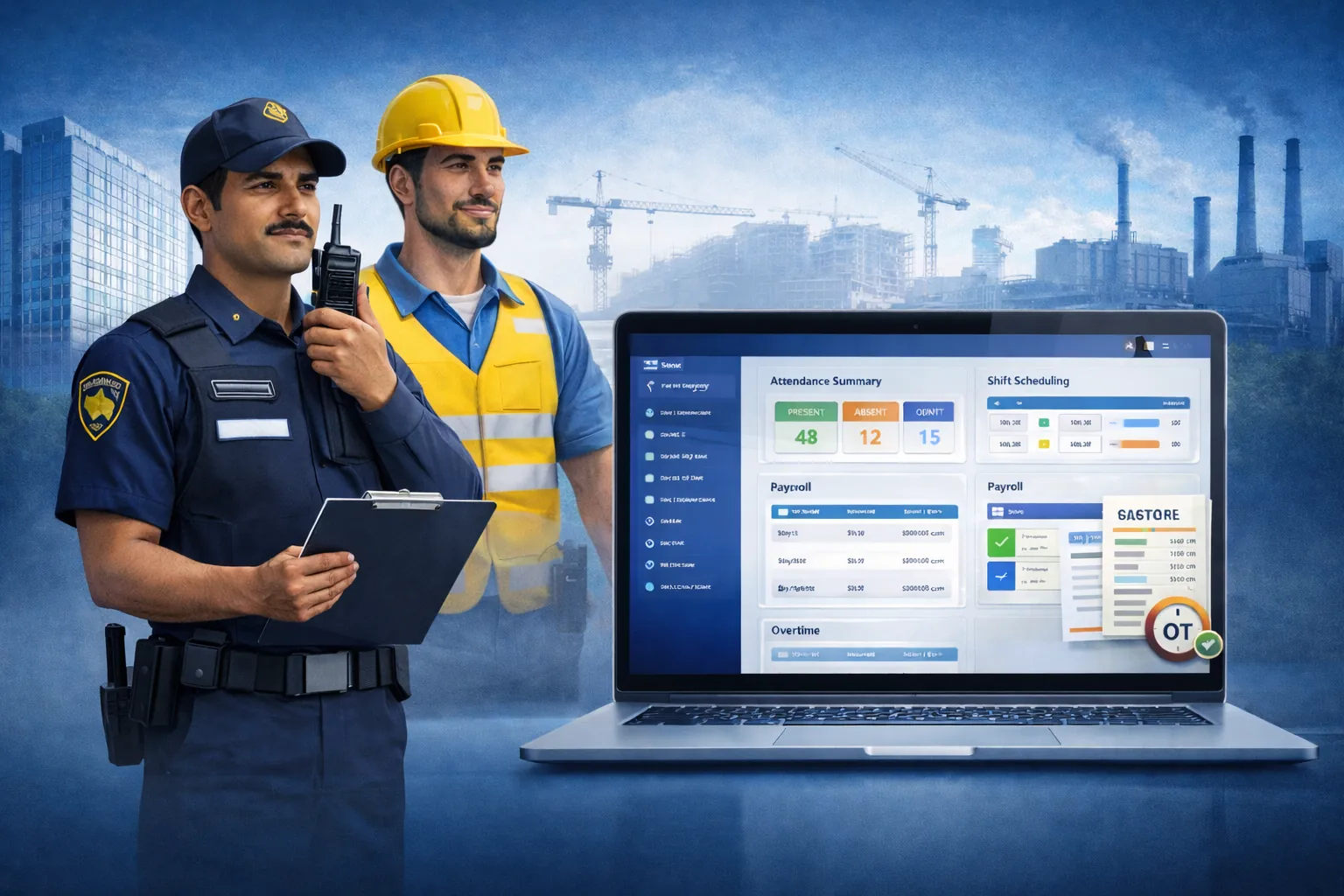
Step 4: Real-Time Dashboard View
Owner and HR should be able to view:
- who is present
- who is late
- who is absent
- who is overtime
Step 5: Payroll Generation
Payroll should be auto-generated based on attendance data.
Step 6: Payslip & Salary Explanation
Employees should receive detailed payslips and salary breakdown.
This workflow is exactly what ZFour HRMS aims to simplify.
Why is location-based attendance important for security guard companies?
Location-based attendance is important because manpower businesses depend on client satisfaction.
Clients pay you because manpower is physically present at their site.
So the question is:
If attendance is marked from anywhere, it creates a risk of fake attendance.
A modern HRMS provides site-based attendance where employees select their work location before marking attendance.
This creates:
- better accountability
- accurate payroll
- improved client trust
- reduced fraud
How does supervisor-based attendance improve field workforce tracking?
Not every worker uses a smartphone.
That is the ground reality.
Some guards may:
- not own smartphones
- not know how to use apps
- forget passwords
- face network issues
A manpower HRMS must allow supervisors or area officers to mark attendance for them.
This is an important feature because technology should support real people, not replace them.
ZFour HRMS includes this type of flexible attendance option, which makes it practical for manpower businesses.
What features should HRMS software include for manpower agencies?
Here is a table showing the most important features:
Must-Have Features in HRMS for Manpower & Security
Feature | Why It Matters | Benefit |
Site-wise attendance | Guards work at multiple sites | Accurate payroll + client reporting |
Shift scheduling | Shifts change frequently | Fewer payroll disputes |
Overtime tracking | Overtime is common in security | Transparent salary calculation |
Supervisor attendance marking | Not all employees use smartphones | Practical attendance collection |
Payroll automation | Payroll is complex in manpower | Saves HR workload |
Employee self-service | Reduces salary arguments | Improves trust |
Advance salary management | Common in field workforce | Prevents disputes |
Uniform/asset tracking | Uniform cost is high | Prevents losses |
Compliance & verification | Required in many countries | Audit-ready records |
Reports & dashboards | Owner needs visibility | Better decision-making |
How does payroll automation reduce HR workload?
Payroll automation is one of the biggest time-savers for manpower businesses.
Without automation, HR spends time on:
- manual attendance consolidation
- manual overtime calculation
- salary sheet preparation
- payslip formatting
- deduction tracking
Payroll automation reduces this workload by linking payroll directly with attendance and shift records.
This is why “payroll software” is one of the highest search volume HR-related keywords globally.
How can HRMS software improve employee trust in security companies?
Employee trust improves when employees can see their own records.
A good HRMS should allow employees to view:
- login/logout history
- site-wise duty record
- overtime hours
- leave and week-off
- salary slip details
When employees see their own data clearly, disputes reduce automatically.
This is a powerful psychological benefit, not just a technical feature.
Why is compliance management important in manpower and security industry?
Compliance is a global requirement, but it becomes more critical in manpower and security because:
- employee count is high
- employee turnover is high
- audits are common
- government compliance rules are strict
In India, manpower businesses often deal with:
- PF compliance (EPFO)
- ESI compliance (ESIC)
- wage compliance
- labour code documentation
Globally, manpower agencies must maintain proper worker documentation for legal and audit purposes.
Helpful compliance references include:
- EPFO (India)
- ESIC (India)
- International Labour Organization (ILO)
How does employee verification reduce risk in manpower companies?
Hiring the wrong person is one of the biggest risks in manpower and security.
A manpower company must ensure:
- ID verification
- address verification
- bank verification
- PF/ESI mapping
- documentation stored securely
A structured HRMS keeps all these records organized.
This reduces risk and supports audit readiness.
How does ZFour HRMS solve manpower and security payroll challenges?
Now, instead of listing “features” like a sales brochure, let’s connect ZFour with real problems manpower companies face.
Problem: Employees work across multiple sites
ZFour HRMS allows site-based structure so the system understands:
- which employee worked where
- which supervisor manages which site
Problem: Attendance mismatch
ZFour supports attendance marking with site selection and supervisor attendance.
Problem: Overtime disputes
ZFour captures attendance logs and generates salary records accordingly, reducing manual calculation.
Problem: Salary explanation takes too much time
ZFour provides detailed payslips with clarity on days worked, overtime, allowances, and deductions.
Problem: Uniform and asset losses
ZFour includes uniform/asset management to track what was issued, size, quantity, and whether the cost is paid, pending, or being deducted in EMI.
This helps companies avoid repeated uniform expenses and also ensures employees have clear records of what they received.
How do detailed payslips reduce salary disputes in manpower companies?
Salary disputes are common in manpower and security guard businesses, and most of the time the reason is simple: employees don’t understand how the salary was calculated.
A detailed payslip solves this issue because it provides transparency.
Instead of showing only gross and net salary, a modern HRMS should show:
- Site-wise working details
- Total days worked
- Overtime hours
- Shift details
- Allowances (if any)
- Deductions
- PF/ESI contribution
- Advance salary adjustment
When employees can see the full breakdown, the conversation changes from arguments to clarity.
ZFour HRMS generates detailed payslips so employees and HR both have the same data, which reduces unnecessary disputes.
Why do manpower businesses need reports and dashboards instead of Excel?
Excel is useful, but it has limitations when your workforce is spread across multiple sites.
Excel does not provide real-time visibility.
This is why manpower companies often face problems like:
- Not knowing who is absent until the client complains
- Not knowing overtime until payroll is already processed
- No visibility on site-wise attendance performance
- Difficulty in tracking branch-wise workforce
A dashboard-based HRMS makes this easier.
A proper system should give quick visibility like:
- Total employees deployed today
- Site-wise attendance
- Late check-ins
- Early check-outs
- Overtime employees
- Absentee list
- Supervisor-wise attendance summary
This kind of visibility gives business owners real control.
ZFour HRMS provides dashboard and reports that help management make decisions without depending fully on phone calls or manual follow-ups.
How does client billing create problems for manpower and security companies?
In manpower and security businesses, payroll is only half the story.
The other half is client billing.
Most manpower agencies generate invoices based on:
- number of guards deployed
- number of shifts completed
- number of man-days worked
- overtime or extra replacement duties
- site-wise billing rates
Now here’s the real problem:
If attendance data is not accurate, client billing becomes inaccurate.
For example:
- A guard was absent for 2 days but billing was still done for full month
- A replacement guard worked overtime but overtime billing was missed
- Site A required 3 guards but only 2 were present for 5 days
These small gaps create big billing disputes.
Clients start questioning:
“Why are you charging for manpower that was not deployed?”
And when billing disputes increase, contract renewals become difficult.
A good HRMS should help manpower companies generate:
- site-wise deployment reports
- shift-wise attendance logs
- replacement duty records
- overtime summary sheets
- client invoice-ready attendance sheets
This creates transparency not only for payroll, but also for client relationship management.
In many cases, HRMS becomes a business growth tool because it strengthens client trust and makes billing professional.
Why is reliever and replacement duty tracking important in security guard operations?
Replacement duty is a daily reality in manpower and security businesses.
Every week, guards take leave, fall sick, or suddenly go absent.
This creates an urgent need for relievers.
But the biggest issue is that reliever duty is rarely tracked properly.
A typical scenario looks like this:
- Guard absent at Site A
- Supervisor arranges a reliever from Site B
- Reliever works extra hours or night shift
- HR never gets the full detail
- Payroll is calculated incorrectly
At the end of the month, reliever complains:
“Sir, I worked 4 extra nights but salary is missing.”
This creates confusion and frustration for both HR and employees.
A manpower-focused HRMS should support temporary site assignment such as:
- replacement duty entry
- reliever shift tagging
- overtime auto-calculation
- allowance rules based on replacement site
When reliever duties are tracked properly, companies reduce salary disputes and improve service delivery at client sites.
This is especially critical for security guard companies, because client satisfaction depends heavily on consistent manpower presence.
How does leave and weekly-off management become complex in manpower companies?
Leave management is easy in office businesses.
But in manpower and security companies, leave is a serious operational issue.
Because when one guard takes leave, someone must replace them.
Manpower agencies deal with:
- rotational week-offs
- replacement duties
- emergency leaves
- planned leaves during festivals
- sudden absenteeism
The challenge is not approving leave.
The real challenge is ensuring that the client site remains fully staffed.
If leave is tracked manually, companies face problems like:
- wrong salary deduction
- incorrect attendance count
- mismatch in week-off calculation
- client complaints due to shortage of guards
A modern HRMS should provide:
- leave request system
- weekly-off scheduling
- leave approval workflow
- replacement duty mapping
- auto leave deduction in payroll
This reduces the burden on HR teams and ensures that manpower operations remain smooth even during high absenteeism seasons.
How does geo-fencing and GPS attendance reduce fake reporting in manpower businesses?
Fake attendance is one of the biggest hidden problems in manpower and security businesses.
Since employees work across multiple sites, there is always a risk of:
- attendance marked from wrong location
- supervisor marking attendance without physical presence
- guards leaving early after marking attendance
This creates client dissatisfaction and damages the company’s reputation.
That is why modern HRMS platforms now offer:
- GPS-based attendance
- geo-fencing attendance
- location verification at check-in
Geo-fencing means attendance can only be marked when the employee is physically inside the client site radius.
This feature is extremely useful because it creates proof that:
- guard was present at the right site
- guard checked in on time
- attendance is genuine and location verified
In the manpower industry, this is not only useful for payroll accuracy but also for client trust.
When clients demand proof of manpower deployment, geo-fencing reports become strong evidence.
What are the real mobile app challenges faced by security guards and field workforce?
Many HRMS companies assume every employee is comfortable using a mobile app.
But the ground reality in manpower and security businesses is different.
Security guards and field employees may face issues like:
- weak internet connection at sites
- low-end smartphones
- battery drain during long shifts
- difficulty using English-based apps
- forgetting passwords or login issues
This is why a manpower HRMS must be practical and flexible.
It should allow multiple attendance methods such as:
- employee self check-in (app based)
- supervisor attendance marking
- offline attendance sync (when network returns)
- site-based attendance dropdown selection
A good HRMS is not one that looks fancy.
A good HRMS is one that works smoothly for real manpower operations, even when workers are not tech-savvy.
This flexibility reduces attendance gaps and improves payroll reliability.
ZFour HRMS supports supervisor-based attendance options, making it more suitable for manpower and security companies.
Why is training and skill record tracking important in security guard companies?
Security and manpower agencies are not just deploying people.
They are deploying trained people.
Clients expect guards to know:
- basic discipline and duty protocols
- visitor handling
- emergency response
- fire safety procedures
- reporting procedures
- CCTV monitoring awareness
Many companies provide training, but they fail to track it systematically.
This creates problems such as:
- untrained guard deployed to sensitive site
- training certificates missing during audits
- client dissatisfaction due to poor guard performance
A manpower HRMS can help by maintaining:
- training records
- certification uploads
- training completion dates
- refresher training schedules
This makes the company more professional and audit-ready.
Training tracking also helps manpower agencies improve workforce quality and win better contracts.
How does employee exit, absconding, and final settlement affect manpower payroll?
Employee turnover is extremely high in manpower and security businesses.
Employees may resign suddenly or abscond without notice.
This creates multiple challenges:
- pending salary calculation
- advance recovery loss
- uniform or asset recovery issues
- PF/ESI closing problems
- incomplete documentation
In many cases, companies lose money because they cannot track what the employee owes.
A manpower HRMS should support:
- resignation tracking
- exit date marking
- final settlement payroll processing
- pending advance recovery
- uniform recovery deduction
- clearance checklist system
This ensures the company is protected financially and payroll remains clean.
In manpower operations, absconding is common, and HRMS plays a key role in reducing such financial leakage.
How does uniform and asset management connect with payroll recovery?
In manpower and security businesses, uniforms are not just clothing.
They are assets.
Uniform expenses include:
- shirts, trousers
- shoes
- belts and caps
- jackets
- raincoats
- ID cards
- torch or security equipment
If the company does not track uniform issuance, it leads to:
- multiple uniforms issued without record
- employees leaving without returning uniform
- duplicate issuing to the same employee
- no recovery of cost
A manpower HRMS should record:
- uniform issued date
- size and quantity
- item cost
- recovery method (free / EMI / deduction)
- pending uniform balance
This is important because uniform recovery is directly linked with payroll deductions.
If the system tracks it properly, salary disputes reduce and the company avoids unnecessary asset loss.
ZFour HRMS supports uniform and asset tracking, making it a valuable feature for manpower and security agencies.
How does contractor and vendor workforce management become a challenge?
Many manpower agencies operate through contractors or sub-vendors.
This creates a complex workforce structure such as:
- direct employees
- contractor employees
- temporary deployment staff
- client-based contractual staff
If HR records are not organized, payroll becomes confusing.
A manpower HRMS should allow:
- contractor-wise employee grouping
- contractor deployment reports
- contractor attendance monitoring
- contractor compliance document storage
This ensures the main company can control operations even when the workforce is managed through vendors.
What should you check before choosing HRMS for a security guard company?
Before selecting any HRMS platform, manpower and security companies should ask these practical questions:
- Can it manage multiple sites and multiple shifts?
- Can supervisors mark attendance for employees?
- Does it support overtime calculation?
- Can it generate detailed payslips?
- Can it manage advance salary recovery?
- Does it have asset/uniform tracking?
- Is it scalable for 500+ or 1000+ employees?
- Does it provide reports for client billing and workforce tracking?
If the answer is “yes,” then the HRMS is suitable for manpower operations.
ZFour HRMS is designed around these exact challenges, making it practical for security and manpower businesses.
If you want to manage site-wise attendance, payroll automation, overtime, employee records, and compliance in a structured way, ZFour HRMS can help you simplify daily operations.
Why ZFour HRMS Is a Practical Choice for Manpower & Security Companies
ZFour HRMS is designed with the realities of manpower and security operations in mind.
Instead of forcing businesses to adapt to software, it adapts to how field workforce businesses actually operate—where employees change sites, shifts rotate frequently, and supervisors play a key role in attendance reporting.
With features like site-wise attendance, payroll automation, uniform and asset tracking, employee self-service, and compliance-ready reporting, ZFour HRMS helps reduce the workload of HR teams while improving transparency for employees and business owners.