7 min read
India's labour reforms are one of the biggest structural changes in salary and compliance laws in recent years. While many employees have heard about the "50% basic pay rule," very few truly understand how it mechanically affects Provident Fund (PF), ESI contributions, gratuity payouts, and overall take-home salary — because most explanations stop at the rule itself, without showing the actual numbers.
This guide walks through concrete, worked examples — actual salary component tables and ₹ calculations across multiple salary levels — showing exactly how the 50% rule changes PF contributions, gratuity payouts, and take-home salary in practice.
If you're looking for the complete compliance framework — FTE gratuity rules, the 48-hour exit settlement rule, OSH Code safety requirements, and an employer self-audit checklist — see our India Labour Codes 2026 Compliance Guide instead. This article focuses specifically on the numbers and what they mean for both employees and employers.
Quick Answer: How Does the 50% Rule Actually Change Your Salary?
If your basic pay was previously structured below 50% of your CTC (a common practice to minimize statutory contributions), it must now be raised to meet the 50% threshold.
This doesn't change your total CTC — it redistributes the components. The practical effects are: higher PF contributions (both employee and employer share), a higher gratuity payout at the same tenure, and typically a modest reduction in monthly take-home pay, since more of your salary now flows through statutory deductions rather than fully-payable allowances.
Impact on Salary Structure Under India's Labour Codes 2026
One of the most significant changes under the new wage definition is the restructuring of salary components. Employers can no longer keep basic pay artificially low while increasing allowances (HRA, special allowance, and similar components) to reduce statutory contributions — a practice that was widespread specifically because PF, gratuity, and several other calculations are based on basic pay rather than total CTC.
If basic salary increases to meet the 50% rule:
PF contribution increases (both employee and employer share)
Gratuity amount increases, since it's calculated on last-drawn basic salary
Bonus calculation base may change, depending on how your organization structures bonus eligibility
Monthly in-hand salary may reduce slightly, since a larger share of CTC now flows through deductions
This change promotes transparency and standardization in salary structures across industries, closing a gap that previously allowed significant variation in how similarly-paid employees' statutory benefits were calculated.
What Is the 50% Basic Pay Rule, Precisely?
Under the new wage definition: if allowances exceed 50% of total compensation, the excess amount is added back to basic pay for the purposes of statutory calculation. This restructuring does not necessarily increase your total salary — it changes how salary components are structured, and consequently, how much of that salary is subject to PF, gratuity, and related calculations.
For the full statutory basis of this rule — the Code on Wages provisions, the complete Salary Component Treatment table, and Fixed-Term Employment changes — see our complete Labour Codes 2026 guide.
Salary Structure Example: Before & After
Let's walk through a concrete example at a ₹50,000 CTC level.
Before Labour Codes
Component | Amount (₹) | % of CTC |
|---|---|---|
Basic Pay | 15,000 | 30% |
HRA | 20,000 | 40% |
Special Allowance | 15,000 | 30% |
Total CTC | 50,000 | 100% |
Here, Basic Pay is only 30% of CTC — a structure common under the older framework, since it minimized the base on which PF and gratuity were calculated.
After 50% Rule Implementation
Component | Amount (₹) | % of CTC |
|---|---|---|
Basic Pay | 25,000 | 50% |
HRA | 15,000 | 30% |
Special Allowance | 10,000 | 20% |
Total CTC | 50,000 | 100% |
Now, Basic Pay is exactly 50% of CTC — the new statutory minimum. Total CTC remains unchanged at ₹50,000, but the composition has shifted significantly, which is what drives the changes to PF and gratuity below.
How This Plays Out at Different Salary Levels
The impact of this restructuring scales with salary. Here's how the same 30%-to-50% basic pay shift affects PF contributions across a few common salary brackets:
Total CTC (₹/month) | Old Basic (30%) | New Basic (50%) | Additional Monthly PF (Employee) |
|---|---|---|---|
30,000 | 9,000 | 15,000 | ₹720 |
50,000 | 15,000 | 25,000 | ₹1,200 |
75,000 | 22,500 | 37,500 | ₹1,800 |
100,000 | 30,000 | 50,000 | ₹2,400 |
Note: These figures illustrate the mechanical effect of the 30%-to-50% shift at standard PF rates. Your organization's specific old and new basic pay percentages may differ — use your actual salary structure for precise figures.
Impact on Provident Fund (PF)
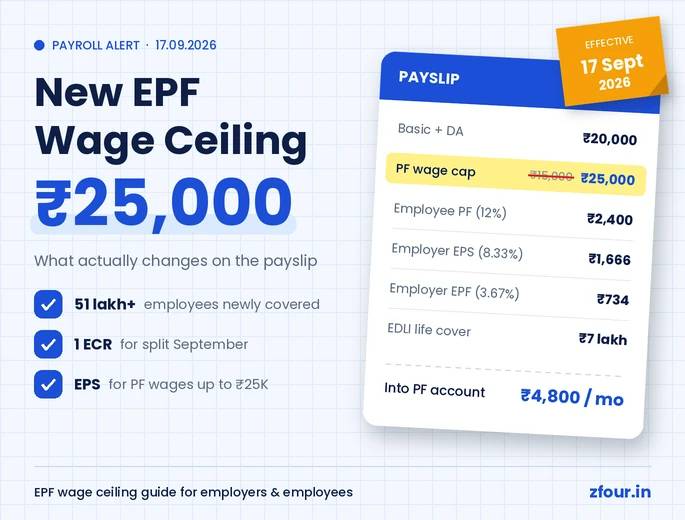
PF is calculated on Basic + Dearness Allowance (DA), which is precisely why raising basic pay under the 50% rule has a direct, proportional effect on PF contributions.
Current PF contribution rates (as per EPFO):
Employee contribution: 12% of Basic + DA
Employer contribution: 12% of Basic + DA
PF Comparison at the ₹50,000 CTC Example
Scenario | Basic Pay (₹) | Employee PF (12%) | Employer PF (12%) | Combined Monthly PF |
|---|---|---|---|---|
Before | 15,000 | 1,800 | 1,800 | 3,600 |
After | 25,000 | 3,000 | 3,000 | 6,000 |
What Changes, Practically
PF contribution increases for both employee and employer, since the calculation base itself is larger
Employer liability increases, which businesses need to account for in payroll budgeting, not just employee take-home
Employee take-home salary may reduce slightly each month, since more is being withheld for PF
Long-term retirement savings increase, since the additional PF contribution compounds over the employee's tenure
Impact on ESI
Employees earning up to ₹21,000 per month (gross) are eligible for ESI coverage.
Current contribution rates:
Employee: 0.75% of gross wages
Employer: 3.25% of gross wages
While these rates themselves remain unchanged under the Labour Codes, the new wage definition can affect ESI eligibility indirectly: if restructuring salary components changes an employee's gross wage calculation in a way that pushes them above or below the ₹21,000 threshold, their ESI eligibility status could shift. This is a detail worth checking specifically for employees near that threshold.
Impact on Gratuity
Gratuity is calculated using the formula:
(Last Drawn Salary × 15 × Years of Service) / 26
Since "last drawn salary" for gratuity purposes is based on basic pay (plus DA), and basic pay increases under the 50% rule, the gratuity payout at any given tenure increases correspondingly — even though the employee's total CTC hasn't changed at all.
Gratuity Comparison (5-Year Tenure Example)
Scenario | Last Drawn Salary (₹) | Years of Service | Gratuity (Approx ₹) |
|---|---|---|---|
Before | 15,000 | 5 | 43,269 |
After | 25,000 | 5 | 72,115 |
That's an increase of approximately ₹28,846 — nearly 67% more — for the exact same tenure, purely as a result of the salary restructuring. This is one of the more significant, and often overlooked, long-term benefits of the 50% rule for employees.
Gratuity Comparison Across Different Tenures
Years of Service | Gratuity at Old Basic (₹15,000) | Gratuity at New Basic (₹25,000) | Difference |
|---|---|---|---|
3 years | 25,962 | 43,269 | +17,307 |
5 years | 43,269 | 72,115 | +28,846 |
10 years | 86,538 | 144,231 | +57,693 |
The gap widens proportionally with tenure — meaning long-tenured employees benefit the most from this restructuring, even though it may feel like a modest monthly change on their payslip.
How Take-Home Salary Is Affected, Overall
Because PF contribution increases while total CTC stays fixed:
Monthly in-hand salary may reduce slightly (typically in the range of a few hundred to a few thousand rupees, depending on salary level and the magnitude of the basic pay adjustment)
Retirement corpus (PF balance) increases correspondingly over time
Gratuity payout increases, as shown above
Overall social security coverage improves, since a larger portion of compensation now flows through structured, protected channels rather than discretionary allowances
The reform is explicitly designed to prioritize long-term financial security over short-term monthly take-home — a trade-off employees should understand rather than simply notice as "my salary went down slightly."
What Employers & HR Teams Should Do
Implementing this restructuring correctly requires more than a one-time payroll adjustment.
Action Checklist
Review current salary structures against the 50% basic pay threshold for every employee, not just new hires
Ensure Basic + DA ≥ 50% of CTC across all salary bands, since the rule applies uniformly
Recalculate PF and gratuity liabilities for existing employees, factoring in the increased employer contribution
Update payroll software to reflect the new component structure and calculation logic
Communicate changes clearly to employees — proactively explaining why take-home may shift slightly avoids confusion and disputes later
Stay updated on state-level implementation notifications, since some compliance specifics are still being finalized at the state level
For organizations managing large or multi-location payroll operations, automated HRMS and payroll systems can meaningfully reduce the calculation errors and compliance risk that come with manually restructuring salary components across hundreds or thousands of employee records.
Why These Changes Matter, Beyond the Numbers
The new wage definition is aimed at:
Standardizing salary structures across industries, reducing the wide variation in how similarly-compensated employees' statutory benefits were previously calculated
Increasing social security benefits, since a larger, guaranteed portion of compensation now feeds into PF and gratuity
Preventing excessive allowance structuring, which was previously used specifically to minimize statutory contribution obligations
Strengthening retirement savings at a system level, not just for individual employees
While employees may initially notice a slight reduction in take-home salary, the long-term benefits — particularly PF accumulation and gratuity payouts, as the tables above illustrate — are meaningfully improved, especially for employees with longer tenure.
Final Thoughts
India's Labour Codes 2026 are reshaping salary structures across industries, and the 50% basic pay rule is the single change with the most direct, calculable impact on take-home salary, PF, and gratuity — as the worked examples above demonstrate at multiple salary levels and tenures.
For HR professionals and business owners, the practical priority is early restructuring, accurate payroll system updates, and transparent employee communication about why these changes are happening and what they genuinely mean long-term.
For the complete compliance framework beyond just the salary math — including FTE gratuity rules, the 48-hour exit settlement rule, OSH Code safety requirements, and an employer self-audit checklist — see our India Labour Codes 2026 Compliance Guide.
Want to see how ZFour HRMS handles these calculations automatically across your entire payroll?
Book a ZFour HRMS demo.

Farheen Ahmed
HR Tech Content Strategist at ZFour Technology Private Limited
Research-driven content on HRMS, payroll, attendance management, employee management, and modern HR technology for Indian businesses.