POSH Compliance India 2026: Governance & Transgender Inclusion
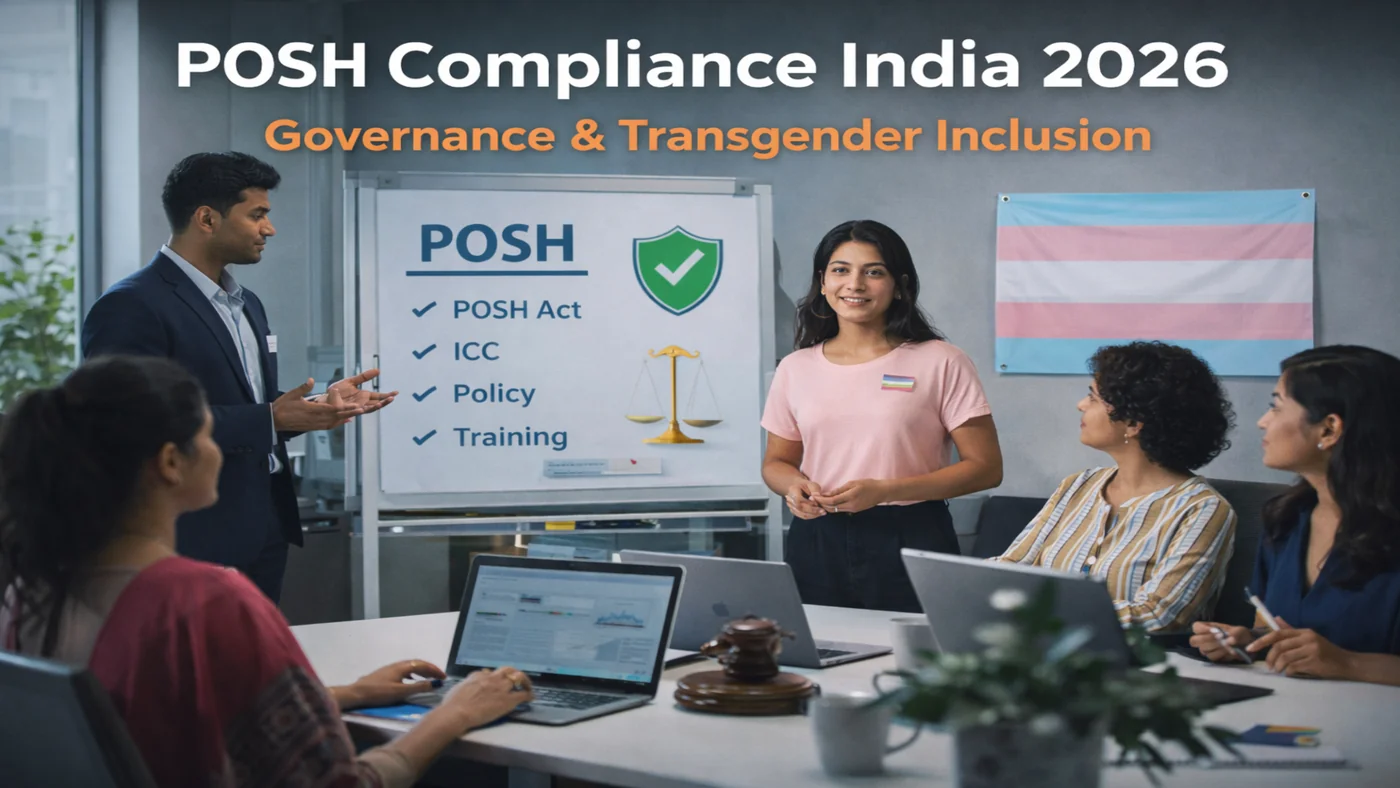
Workplace compliance in India is no longer limited to salaries, attendance, or payroll filings. By 2026, organizations will also be judged on how well they protect dignity, safety, and inclusion at work.
POSH compliance and transgender inclusion are no longer optional policies. They are now statutory governance responsibilities, backed by labour laws, inspections, and legal scrutiny.
This blog explains how POSH governance and transgender inclusion in 2026 actually work, where employers usually make mistakes, and how to stay compliant in a practical way.
Why POSH Compliance India 2026 Is Mandatory for Employers?
From January 2026, compliance under the POSH Act, 2013, is treated as a non-delegable duty of the employer.
Aspect | What Changed in 2026 |
Employer Responsibility | POSH is a non-delegable duty of the employer |
Outsourcing | POSH compliance cannot be outsourced |
Inquiry Validity | Procedural errors can invalidate inquiries |
Accountability | Senior management liability has increased |
Evaluation | POSH is assessed as a governance system, not a |
The “Employment Nexus” Rule Under POSH
In 2026, the definition of “workplace” has expanded significantly.
Harassment is no longer limited to office premises. POSH now applies wherever there is an employment connection.
Covered Area | POSH Applicability |
Office premises | Yes |
WhatsApp & internal chats | Yes |
Zoom / Teams meetings | Yes |
Work travel & offsites | Yes |
Client & third-party locations | Yes |
Rule: If the interaction is work-related, POSH applies.
POSH Inquiry Timelines Matter More Than Ever
The POSH law has always defined inquiry timelines, but enforcement in 2026 is much stricter.
Stage | Statutory Timeline | Risk if Missed |
Complaint filing | As prescribed | Case may be rejected |
Inquiry completion | 90 days | Inquiry can be invalidated |
Employer action | 60 days | Legal & governance exposure |
In 2026, timeline breaches = governance failure, not HR error.
Missing these timelines can:
- Invalidate the inquiry
- Weaken the organization’s legal position
- Create serious compliance exposure
POSH failures are now treated as governance failures, not HR errors.
Transgender Inclusion Under the 2026 Labour Codes
The Code on Wages and Social Security Code clearly prohibit discrimination based on gender identity.
These provisions align with the Transgender Persons (Protection of Rights) Act, 2019, which is actively enforced in 2026.
Employers are now legally expected to move beyond symbolic inclusion.
Gender-Neutral Pay Is Mandatory
“Equal Pay for Equal Work” applies regardless of whether an employee identifies as:
- Male
- Female
- Transgender
Employers must ensure:
- No pay difference based on gender identity
- Transparent salary structures
- Documented salary reviews
Pay inequality is a high-risk inspection trigger.
Digital Identity and Privacy for Transgender Employees
Transgender employees have the right to:
- Self-identify their gender
- Protect their personal information
- Avoid forced disclosure
Employers must ensure:
- Gender fields allow self-identification
- Sensitive data is access-restricted
- Privacy standards are strictly followed
Identity verification should be handled with care and confidentiality.
Complaints Officer: A Mandatory Requirement
Under the Transgender Persons Act, every establishment must appoint a Complaints Officer to handle gender-identity-related grievances.
This role is separate from:
- POSH Internal Committee
- General HR grievance teams
The Complaints Officer must:
- Handle cases confidentially
- Ensure direct routing of grievances
- Avoid unnecessary exposure or delays
Not appointing a Complaints Officer is a direct legal violation.
Inclusive Benefits and Payroll in 2026
Payroll and benefits systems can no longer be binary.
Inclusive governance now extends to:
- Leave policies
- Insurance coverage
- Social security benefits
Gender-Neutral Leave and Insurance
Many organizations now recognize:
- Gender-affirming care leave
- Inclusive health insurance
- Mental health support
While policies may differ, exclusion based on gender identity is not acceptable in 2026.
The “Parents-in-Law” Rule Under Social Security
The 2026 framework expands the definition of “family” for benefits.
Women and transgender employees can now include:
- Parents-in-law as dependents
This affects:
- Insurance coverage
- Payroll benefits
- Social security eligibility
Incorrect handling can lead to benefit disputes and audits.
The 2026 Workplace Dignity Scorecard (Inclusivity Audit)
To assess compliance gaps, many organizations use an Inclusivity Audit.
Sample Compliance Snapshot
- POSH Internal Committee is properly formed
- Transgender inclusion policy published
- Gender-neutral pay audit completed
- Grievance timelines monitored
Gaps in any of these areas increase legal risk.
Common Mistakes Employers Make
Most violations happen due to:
- Treating POSH as a yearly formality
- Missing inquiry timelines
- No transgender-specific grievance channel
- Binary payroll and benefits systems
- Poor documentation
These are process gaps, not intent gaps.
Why Inclusive Governance Is Critical in 2026
POSH and transgender inclusion are now:
- Audit-visible
- Legally enforceable
- Reputation-sensitive
A single procedural error can invalidate an inquiry or expose the organization to legal action.
Inclusive governance is no longer just an HR responsibility. It is a leadership responsibility.
Final Takeaway
In 2026, inclusion is not optional — it is compliance.
Employers must actively manage:
- POSH governance systems
- Inquiry timelines
- Gender-neutral pay
- Inclusive benefits
- Confidential grievance mechanisms
The law is clear, and enforcement is real.
Being unprepared is the biggest risk.