6 min read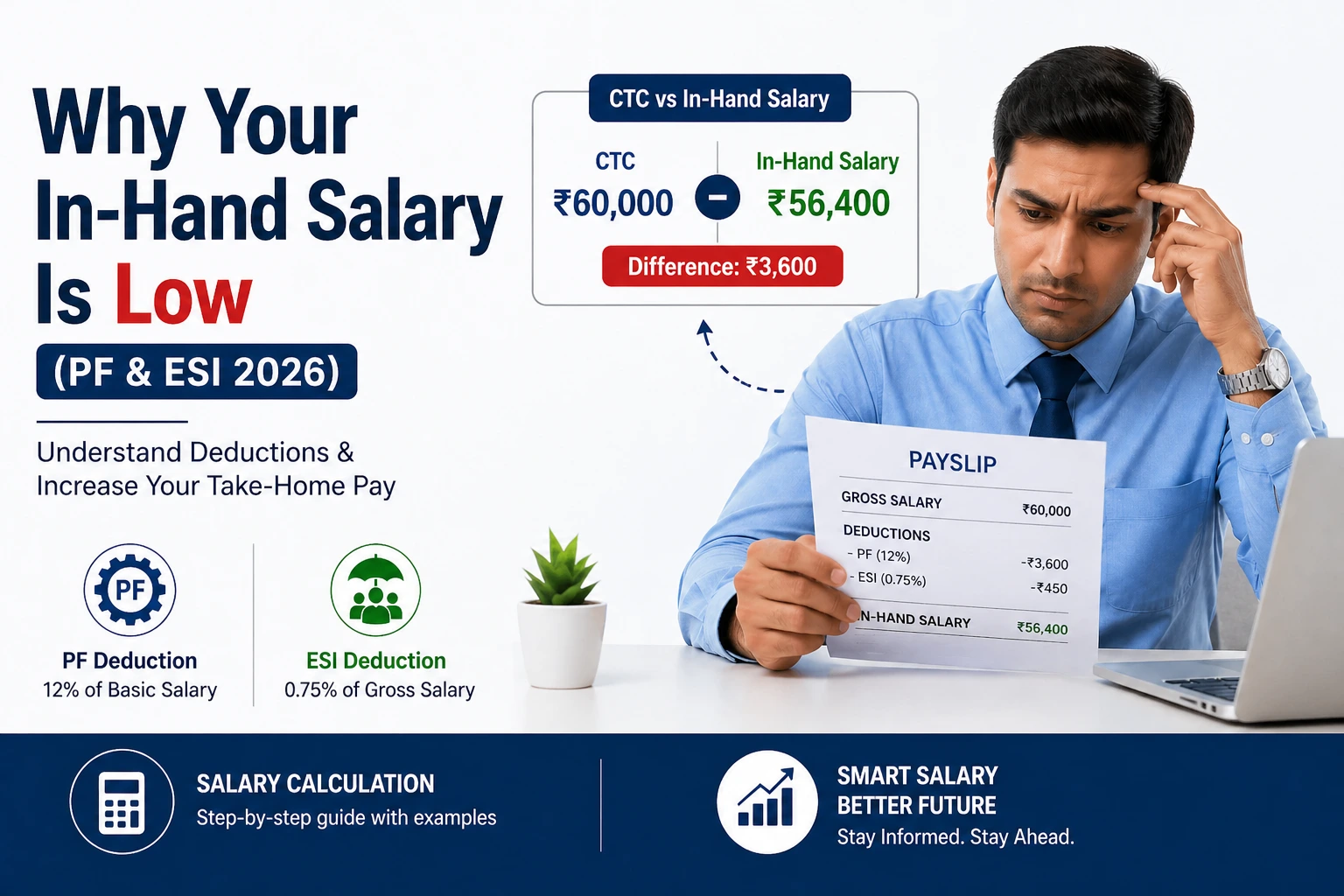
Quick Answer
Your in-hand salary is lower than your CTC because CTC includes components that may not be paid directly to you each month, such as employer PF contributions, gratuity provisions and certain benefits. Your gross salary is then reduced by applicable employee deductions such as PF, ESI and TDS. The difference between CTC and in-hand salary depends on your salary structure, applicable deductions, benefits and tax situation.
Key Takeaways
CTC is what your employer spends on you. Gross is CTC minus employer-side costs. In-hand is gross minus your own deductions. These are three different numbers, not one.
PF and ESI can reduce take-home pay when applicable, while TDS and other deductions may also affect the final amount credited to your bank account.
A higher basic-salary proportion can increase PF deductions today, while also increasing retirement savings. The effect on your take-home pay depends on your salary structure and applicable deductions.
If your payslip doesn't match these rules, it's worth a direct conversation with HR — not something to just assume is correct.
CTC vs. Gross vs. In-Hand: The Glossary Nobody Explains
Definition: These three numbers are often used interchangeably in casual conversation, but they mean very different things on your actual payslip.
CTC (Cost to Company): the total annual cost your employer bears for you — basic, HRA, allowances, employer PF contribution, gratuity provision, and any insurance or benefits. This is the number on your offer letter, and it's always the highest of the three.
Gross Salary: The salary earned before employee-side deductions such as PF, ESI, professional tax where applicable, and TDS. Gross salary generally excludes employer-side CTC components such as employer PF and gratuity provisions.
In-Hand (Net) Salary: gross salary minus your own PF contribution, ESI (if applicable), professional tax (if your state levies one), and TDS. This is what actually lands in your bank account.
Why it matters: most salary confusion comes from comparing the wrong two numbers — comparing your offer letter's CTC to your bank credit, instead of comparing gross to net. Once you separate these three, the "missing" money stops feeling mysterious.
Why Your In-Hand Salary Feels Lower Than Expected
1. PF Deduction: Employee PF contributions can reduce your monthly take-home pay while building retirement savings. The exact deduction depends on applicable PF wages and your employer's contribution policy.
2. ESI Contribution: ESI can reduce take-home pay for employees covered under the applicable ESI rules. The actual deduction depends on eligibility and the applicable salary structure.
3. Employer Contributions Counted in CTC, Not Paid as Monthly Take-Home: Employer PF contributions and gratuity provisions may form part of your CTC without being paid to you as monthly take-home salary. Gratuity is generally payable on eligible separation from employment, subject to applicable rules and conditions.
4. Salary Structure Design: The way your salary is divided between basic salary, HRA and allowances can affect your final in-hand salary. Two employees with the same CTC can therefore receive different take-home amounts depending on their salary structures.
Why PF Can Reduce Your In-Hand Salary
Employee PF is generally deducted from salary based on the applicable PF wage. This deduction reduces your monthly take-home pay but contributes toward your retirement savings. The exact PF calculation depends on your salary structure and employer's contribution practice. For detailed PF calculation rules and examples, see our PF and ESI on CTC calculation guide.
How ESI Affects Your Salary
ESI can also reduce take-home salary when an employee is covered under ESI. The employee contribution is deducted from eligible wages, reducing the amount credited to the employee's bank account. Whether ESI applies depends on the applicable wage threshold and employment circumstances. For detailed ESI eligibility and calculation rules, see our PF and ESI on CTC calculation guide.
Gross Salary vs. In-Hand Salary Example
Gross Salary | PF Deduction | ESI Deduction | In-Hand Before TDS |
|---|---|---|---|
₹40,000 | ₹2,400* | ₹0 | ₹37,600 |
PF treatment varies according to the applicable PF wage ceiling and employer policy. TDS is excluded from this illustration because it depends on individual tax circumstances.
How to Calculate Your Own In-Hand Salary
Step 1 — Identify your basic salary. Usually 40–50% of CTC, but check your offer letter — this varies by company.
Step 2 — Add HRA and allowances. This gives you gross salary.
Step 3 — Account for applicable PF deduction. Check your payslip and employer's PF policy to determine the actual employee contribution.
Step 4 — Account for ESI if applicable. Check whether you are covered under ESI and apply the deduction shown in your salary structure.
Step 5 — Deduct professional tax, if your state levies one. Not all states do — for example, Delhi currently has no Professional Tax, while Maharashtra and Karnataka do.
Step 6 — Deduct TDS, based on your declared tax regime and total annual income.
Result: gross minus all of the above = your in-hand salary.
Is Your Salary Being Calculated Correctly?
You may want to double-check your payslip if:
ESI is being deducted despite your gross salary being above ₹21,000/month.
PF looks inconsistent month to month without any change in your basic salary.
Your salary structure was never explained to you at hiring.
Your in-hand salary is significantly lower than the CTC-to-in-hand ratio your peers report for similar roles.
Common Salary Calculation Mistakes
Not clearly explaining the difference between CTC, gross salary and in-hand salary.
Using unclear salary structures where basic, HRA and allowances are not properly explained.
Not explaining applicable deductions before an employee accepts an offer.
Comparing CTC between employees without comparing their actual salary structures.
How to Increase Your In-Hand Salary Legally
1. Discuss salary structure at offer stage, not after joining. Basic-to-allowance ratio is often negotiable before you sign, rarely after.
2. Use tax-free reimbursements where eligible (subject to your company's policy and current tax rules).
3. Understand the PF trade-off. A lower basic reduces PF today but also reduces your retirement corpus — this is a trade-off, not a pure win.
4. Ask HR directly how your specific CTC breaks down before accepting an offer — a five-minute conversation avoids a lot of first-payslip confusion.
When Should You Raise This With HR?
Raise it directly if: ESI is deducted above the ₹21,000 gross threshold, your PF percentage doesn't match your basic salary, or your payslip components don't match what was in your offer letter.
It's probably fine if: your in-hand is lower than CTC by a predictable, explainable amount that matches PF + ESI (if applicable) + TDS — that gap is expected, not an error.
Conclusion
Most "why is my salary low" confusion comes down to three things: CTC, gross, and in-hand aren't the same number, PF and ESI follow specific rules rather than flat percentages of everything, and salary structure design (not just your CTC) determines what actually lands in your account.
Once you know which deductions should legally apply to your salary level, a payslip stops looking mysterious and starts looking like arithmetic.
Get It Right the First Time — For Your Whole Team
If you're on the HR or payroll side and want salary structures, PF, and ESI calculated correctly for every employee automatically — not manually re-checked every month — see how ZFour handles it end to end.
👉 Book a Free Demo Talk to an HR Expert
For the HR/employer-side calculation mechanics behind these numbers, see our PF and ESI on CTC calculation guide.

Farheen Ahmed
HR Tech Content Strategist at ZFour Technology Private Limited
Research-driven content on HRMS, payroll, attendance management, employee management, and modern HR technology for Indian businesses.