7 min read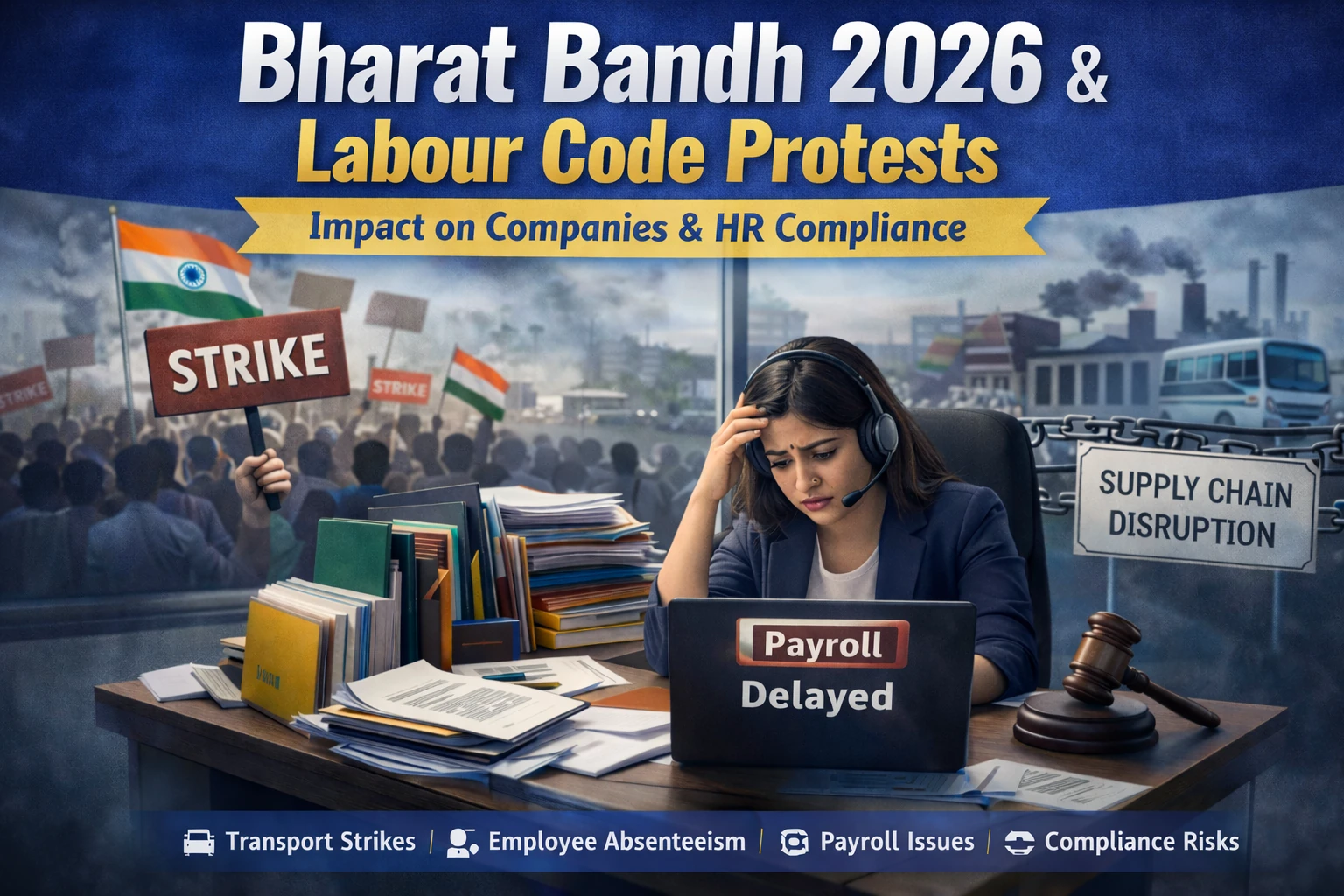
The Bharat Bandh held on 12 February 2026 was a nationwide general strike backed by central trade unions and other worker and farmer organisations. The unions opposed the four Labour Codes and raised additional concerns around worker and farmer policies. The reported impact varied by state and sector, with banking, transport, insurance, postal services, and some industrial activities affected in parts of the country.
For employers and HR teams, the event highlighted practical workforce-management questions around attendance, employee communication, shift changes, payroll records, and workplace policies.
Importantly, the four Labour Codes are no longer simply proposed reforms. The Government of India announced that the Code on Wages, 2019; Industrial Relations Code, 2020; Code on Social Security, 2020; and Occupational Safety, Health and Working Conditions Code, 2020 were made effective from 21 November 2025.
This article explains what the Bharat Bandh was about and what employers should consider when labour-related disruptions affect their workforce.
Important: A strike or bandh does not automatically create a legal violation for an employer. The appropriate treatment of attendance, leave, wages, deductions, and employee participation depends on the applicable law, employment policies, facts, and government directions. Employers should obtain professional legal advice where necessary.
What Was Bharat Bandh 2026?
On 12 February 2026, a joint platform of central trade unions organised a nationwide general strike. The unions called for repeal of the four Labour Codes and raised other policy demands.
News coverage of the strike confirmed participation from a coalition of ten central trade unions — including INTUC, AITUC, HMS, and CITU — with reported disruptions in banking, transport, and select industrial sectors varying significantly by state and region.
Key details
Topic | Details |
|---|---|
Event | Bharat Bandh / nationwide general strike |
Date | 12 February 2026 |
Main organisers | Central trade unions and supporting organisations |
Major issue | Opposition to the Four Labour Codes |
Other issues | Worker, farmer, and economic-policy concerns |
Business impact | Varied by sector and location |
HR impact | Possible attendance, shift, and communication challenges |
Employer focus | Accurate records, clear policies and lawful payroll treatment |
The reported scale of participation varied by source and represented union estimates in some cases, so employers should avoid treating headline participation figures as independently verified workforce counts.
Why Were Trade Unions Protesting the Labour Codes?
The government's position is that the four Labour Codes consolidate and modernize 29 existing central labour laws, with the objective of simplifying the regulatory framework while strengthening wages, safety, social security, and worker welfare.
Trade unions have raised objections to several aspects of the reforms and have demanded their repeal or changes. Reported concerns include issues relating to job security, collective bargaining, strike requirements, social security, and employer flexibility.
The four Labour Codes are
Code on Wages, 2019
Industrial Relations Code, 2020
Code on Social Security, 2020
Occupational Safety, Health, and Working Conditions Code, 2020
The Ministry of Labour & Employment provides the official texts, rules and implementation material on its Labour Codes page.
For a deeper explanation of the payroll and salary implications, see our India Labour Codes 2026: Impact on Salary, PF, ESI & Gratuity Explained.
How Can Bharat Bandh Affect Companies?
The impact of a bandh is not identical for every employer.
A company's exposure can depend on:
Location
Industry
Employee participation
Public transport availability
Supply-chain dependency
Shift patterns
Customer-facing operations
Government directions
Internal workplace policies
The February 2026 strike illustrates this variation: some sectors and locations experienced significant disruption, while others saw limited operational impact.
1. Employee Attendance Challenges
A bandh can create practical attendance issues when employees face:
Transport disruptions
Delayed public transport
Road closures
Local demonstrations
Difficulty reaching the workplace
Requests for remote work
Shift changes
HR teams should distinguish between absence, authorized leave, remote work, late arrival, and other approved arrangements rather than automatically treating every absence in the same way.
A digital attendance system can help maintain a clear record of check-in, check-out, approved leave, and attendance adjustments.
For a practical example, see How to Mark Attendance in ZFour HRMS: A Step-by-Step Guide.
2. Shift and Workforce Scheduling
Industries operating across multiple shifts may face additional challenges when transport or employee availability changes.
HR teams may need to manage:
Shift swaps
Delayed reporting
Emergency staffing
Remote-work arrangements
Overtime
Leave requests
Temporary schedule changes
Maintaining a clear record of approved changes helps HR and payroll teams reconcile attendance accurately later.
For businesses with distributed or field employees, Geo-Fencing in HRMS can also be relevant when location-based attendance is part of the organisation's workforce-management process.
3. Payroll and Wage Questions
Attendance changes can create payroll questions, especially when an employee:
Misses a scheduled shift
Works additional hours
Changes shifts
Takes approved leave
Works remotely
Is unable to report because of a disruption
Employers should not automatically deduct wages simply because a bandh occurred.
The correct treatment depends on the circumstances, applicable law, employment terms, company policy, and whether the absence was authorised.
Payroll teams should therefore maintain clear records of:
Attendance
Approved leave
Overtime
Shift changes
Wage adjustments
Employee communications
For broader guidance, see Payroll Compliance in India 2026: Complete Guide to PF, ESI, Wages & HR Rules.
4. Communication Becomes Important
One of the simplest ways to reduce confusion during a disruption is clear employee communication.
HR teams should communicate:
Whether the workplace is open
Whether remote work is permitted
How employees should report attendance
How leave should be requested
How shift changes will be handled
Who employees should contact
Whether any local restrictions apply
Policies should be communicated consistently rather than changing informally from employee to employee.
5. Record-Keeping Matters
During a labour-related disruption, accurate records can help HR explain what happened later.
Maintain appropriate records of:
Attendance
Leave approvals
Remote-work approvals
Shift changes
Overtime
Payroll adjustments
Employee communications
Relevant government notifications
An HRMS can centralise many of these records.
However, software does not replace legal compliance or HR judgement. The system should support the organisation's approved policies and applicable law.
What Should Employers Do During a Labour Disruption?
A practical employer checklist is:
Before a disruption
Review attendance policies
Review leave policies
Identify critical workforce dependencies
Establish communication channels
Confirm payroll procedures
Review business-continuity arrangements
During a disruption
Communicate clearly with employees
Record attendance accurately
Track approved leave and remote work
Monitor shift changes
Document important decisions
Avoid inconsistent treatment of employees
After the disruption
Reconcile attendance
Verify payroll inputs
Review overtime
Resolve attendance queries
Maintain relevant documentation
Update policies if gaps were identified
How Do Labour Codes Affect Employers in 2026?
The Labour Codes became effective from 21 November 2025, so employers should now focus on understanding the applicable requirements and implementation rules rather than treating the Codes as purely future reforms.
The Ministry of Labour & Employment has published the relevant Codes and rules, including the Code on Wages Rules, Industrial Relations Rules, Social Security Rules, and OSH & Working Conditions Rules.
Businesses should review areas such as:
Wage structures
Payroll calculations
Social-security obligations
Working conditions
Industrial relations
Employee records
Applicable reporting requirements
State-specific requirements where relevant
For a practical payroll-focused explanation, read India Labour Codes 2026: 50% Basic Salary Rule, PF, ESI & Gratuity Impact.
Important: Labour-law implementation can involve central and state rules, notifications, and industry-specific requirements. Employers should verify the rules applicable to their organisation before changing payroll or employment policies.
Why Accurate HR Records Matter
During periods of workforce disruption, HR teams need reliable information.
A centralised HRMS can help maintain records for:
Employee attendance
Leave
Shifts
Overtime
Payroll
Employee information
HR reports
This can make it easier to review what happened during a disruption and reconcile payroll afterwards.
It does not, however, mean that an HRMS automatically determines whether a wage deduction or leave treatment is legally permissible.
That decision should follow applicable law and the organisation's approved policies.
How ZFour HRMS Can Support Workforce Management
ZFour HRMS provides tools for managing several HR workflows that may become important during workforce disruptions, including:
Attendance
Leave management
Shift and roster management
Payroll
Overtime
Employee records
HR reports
GPS attendance
Biometric integration
Businesses can use these capabilities to maintain more organised workforce records and reduce dependence on disconnected spreadsheets.
For payroll and statutory workflows, see the ZFour HRMS Payroll Compliance solution.
For field teams, the ZFour HRMS GPS Attendance solution can help manage location-based attendance requirements.
Bharat Bandh 2026: Employer Checklist
Area | What HR Should Review |
|---|---|
Attendance | Record actual attendance and approved exceptions |
Leave | Document leave requests and approvals |
Remote work | Record approved work-from-home arrangements |
Shifts | Document schedule changes and swaps |
Overtime | Verify additional hours before payroll processing |
Payroll | Review attendance-linked adjustments |
Communication | Maintain clear employee instructions |
Compliance | Check applicable laws and government notifications |
Records | Retain relevant HR and payroll documentation |
Business continuity | Review critical workforce dependencies |
Final Thoughts
The Bharat Bandh on 12 February 2026 demonstrated how labour-related developments can affect businesses differently depending on their sector, location, workforce structure, and operating model.
For employers, the practical lesson is not simply to prepare for another bandh.
It is to maintain:
Clear HR policies
Accurate attendance records
Documented leave and shift changes
Reliable payroll inputs
Current labour-law information
Clear employee communication
Appropriate business-continuity processes
The Labour Codes are already in effect, so businesses should review their current HR and payroll processes against the applicable requirements and official rules.
A digital HRMS can support record-keeping and workforce management, but technology should complement, not replace legal review and sound HR policies.
Need Better HR and Payroll Management?
Explore ZFour HRMS to review attendance, payroll, leave, workforce management, and HR reporting capabilities.

Farheen Ahmed
HR Tech Content Strategist at ZFour Technology Private Limited
Research-driven content on HRMS, payroll, attendance management, employee management, and modern HR technology for Indian businesses.