10 min read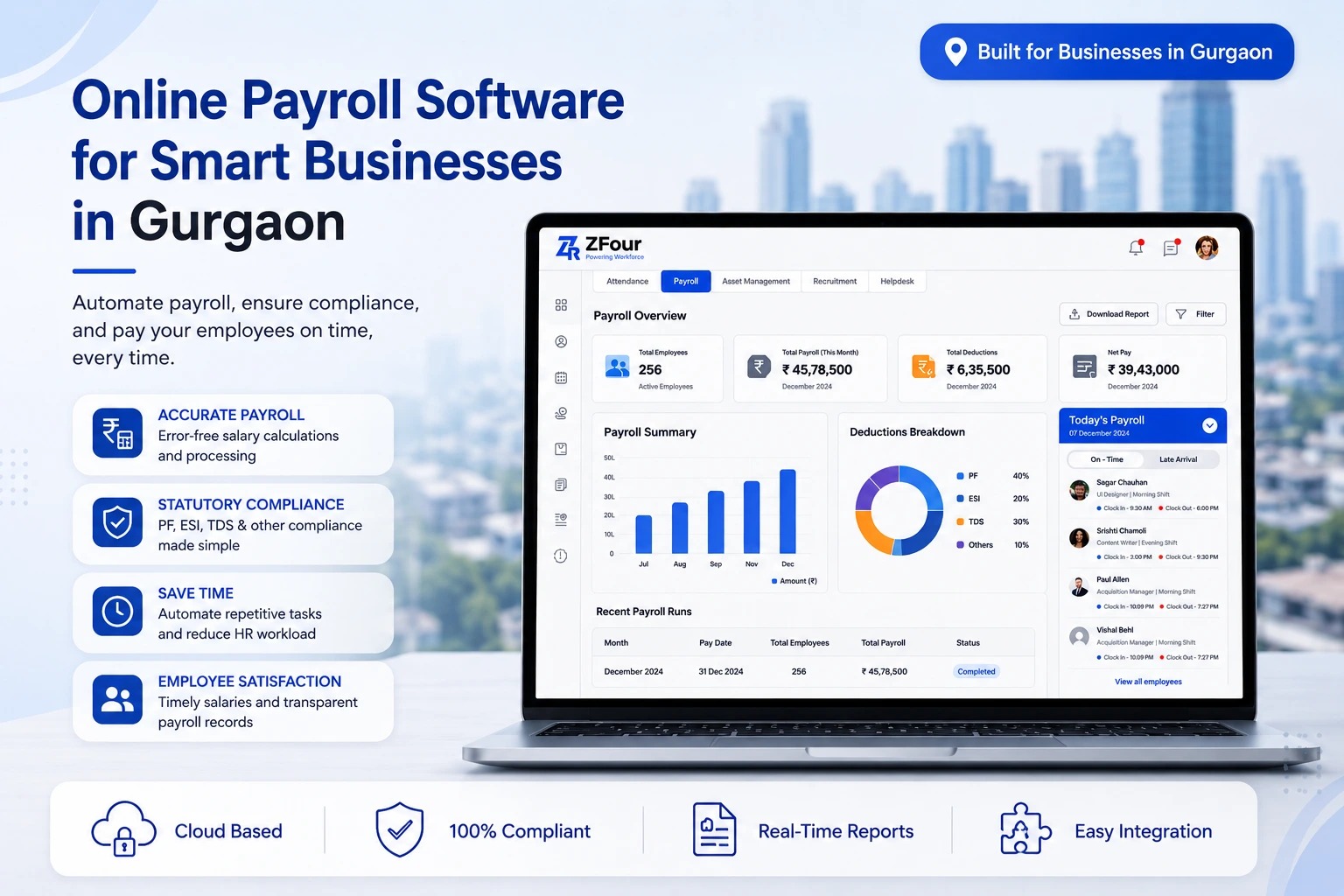
Quick Answer
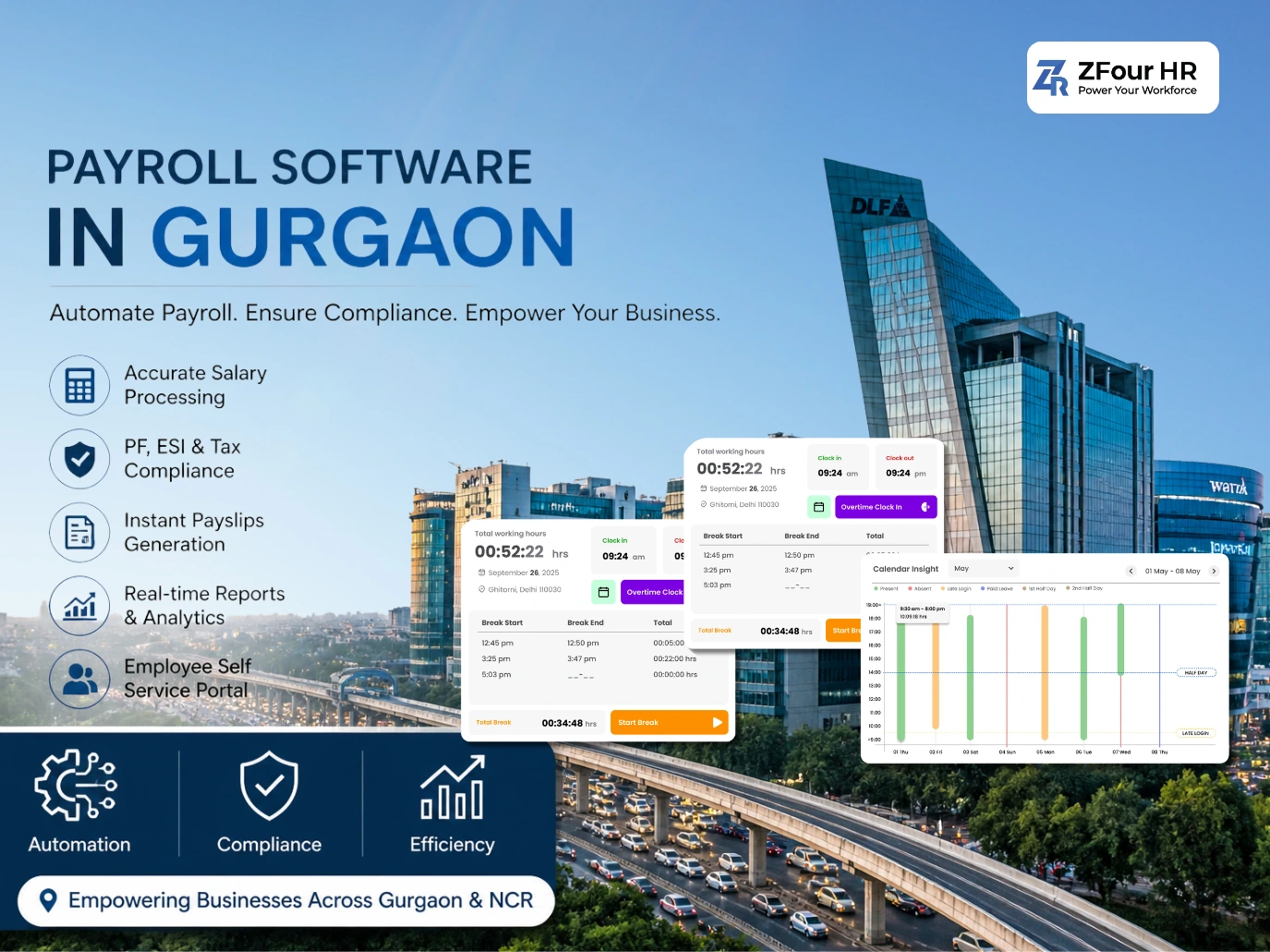
Cloud-based payroll software automates salary calculations, statutory tax deductions, and regulatory compliance reporting, while giving employees self-service access to payslips, tax documents, and leave balances through one centralized platform — replacing the spreadsheets and manual reconciliation that most growing Gurgaon businesses eventually outgrow.
Key Takeaways
Manual, spreadsheet-based payroll works fine at a handful of employees, then breaks down predictably as headcount and shift complexity grow
Centralized automation reduces calculation errors and closes the compliance gaps that manual processes tend to create over time
Gurgaon's dense concentration of IT parks, BPOs, and Fortune 500 offices creates payroll pressures — turnover, shift complexity, hiring velocity — that most cities don't face at the same scale
Digital, self-service platforms improve employee trust and transparency compared to HR-dependent approval chains
Choosing the right platform comes down to four things: scalability, compliance depth, integration with your existing tools, and security
Why Gurgaon Businesses Adopt Online Payroll
Gurgaon is home to one of India's largest concentrations of Fortune 500 offices, IT campuses, and BPO operations, spread across hubs like Cyber City, Udyog Vihar, and Sector 44. That density creates specific payroll pressures most cities don't face at the same scale: high employee turnover in BPO and IT roles, multi-shift scheduling across 24/7 operations, and hiring cycles fast enough that manual, spreadsheet-based payroll processes fall behind within months rather than years.
For a business owner or HR lead in this environment, payroll isn't an isolated back-office task — it's tightly coupled to attendance systems tracking hybrid and shift-based staff, to compliance obligations that shift with every new hire's salary structure, and to employee trust, since a late or incorrect payslip lands differently in a market where switching jobs is comparatively easy.
The businesses that adopt payroll software early tend to do so not because of a single crisis, but because they can see the trajectory: what takes an afternoon at 15 employees takes three days at 60, and by 100 employees a manual process isn't just slow, it's actively producing errors no one has time to catch.
SME Adoption Drivers
Small and mid-sized firms typically adopt payroll software to reduce HR workload without adding headcount. A lean HR team supporting 30-80 employees can spend the better part of a week each month on manual salary calculation, attendance reconciliation, and compliance filing — time that automation reclaims for higher-value work like hiring and retention, rather than requiring the business to hire a dedicated payroll specialist just to keep pace.
Startup Scalability Needs
Fast-growing startups need a system built to scale with them, not one they'll outgrow and have to replace mid-growth. Gurgaon's startup ecosystem is characterized by unpredictable hiring bursts — a company might go from 20 to 60 employees within a single funding cycle — and a payroll platform chosen for that stage needs to absorb that growth without requiring a re-implementation, re-training, or a costly platform migration at the worst possible time.
Enterprise Benefits
Larger, multi-department organizations use payroll software primarily for standardization: consistent salary structures, uniform compliance reporting, and centralized visibility across departments or even across multiple office locations. For an enterprise with distinct business units, this also means audit-readiness — a centralized system produces a clean, exportable compliance trail instead of reconciling records scattered across departmental spreadsheets when a statutory audit or internal review comes up.
Definition of Online Payroll Software
Online payroll software is a cloud-based system that digitizes the full salary management workflow — calculating gross-to-net pay, tracking attendance, administering leave, computing statutory tax deductions (PF, ESI, TDS), handling bonuses and overtime, generating compliance reports, and maintaining digital records that replace paper trails.
Most modern platforms also integrate with biometric attendance devices and broader HR systems, so attendance data flows directly into payroll calculations rather than requiring manual data entry between two disconnected tools. The result is a single source of truth for everything tied to what an employee is paid, why, and when.
The Real Cost of Manual Payroll
Manual payroll processes tend to fail in predictable, compounding ways: calculation errors that go unnoticed until an employee flags a shortfall, processing delays that push payday later each cycle as headcount grows, attendance-to-payroll mismatches that require manual reconciliation, incorrect tax deductions that create liability at filing time, missed regulatory deadlines that carry real statutory penalties, incomplete or inconsistent records that make audits painful, and — often the largest hidden cost — the sheer amount of HR time consumed by administrative payroll tasks instead of strategic work.
None of these failures happen all at once; they accumulate, which is exactly why many businesses underestimate how much manual payroll is actually costing them until they see it laid out.
Core Benefits
Faster Processing: Eliminates the days of month-end manual work that manual payroll cycles typically require, compressing what was a multi-day process into hours.
Improved Accuracy: Consistent, rule-based calculations remove the human-error risk inherent in manually applying tax rates, deduction rules, and overtime formulas across every employee, every cycle.
Compliance Automation: Automatically manages PF, ESI, TDS, and other statutory reporting requirements, applying current rules rather than relying on someone remembering to update a spreadsheet formula when a regulation changes.
Reduced HR Burden: Frees HR teams from repetitive administrative processing so they can focus on hiring, retention, and other strategic initiatives.
Employee Experience: Gives employees self-service access to payslips, leave balances, and tax documents, with more predictable, on-time processing than manual approval chains typically deliver.
Real-Time Access: Cloud infrastructure means payroll data and approvals are accessible remotely, which matters for hybrid and distributed teams.
Financial Planning: Accurate, structured payroll data feeds directly into budget forecasting, rather than requiring finance teams to reconstruct labor cost trends from scattered records.
Must-Have Features
Automated salary processing with configurable pay structures
Attendance system integration, including biometric and mobile check-in support
Leave management with configurable approval workflows
Employee self-service portals for payslips, tax documents, and leave requests
Payroll reports and analytics for HR and finance visibility
Cloud-based accessibility for remote and hybrid teams
Organization-Level Considerations
Payroll software needs differ meaningfully by company size and stage. Startups benefit most from a platform that won't need to be rebuilt or replaced during a growth phase — implementation cost and disruption matter as much as feature depth at this stage.
SMEs typically prioritize running a leaner HR team without sacrificing accuracy, since they usually can't afford a dedicated payroll specialist. Enterprises, by contrast, tend to prioritize standardization — consistent payroll processes and compliance reporting across multiple departments, business units, or office locations, often with more complex approval hierarchies and audit requirements than a smaller company needs.
Industry Applications
Payroll software gets used differently depending on the sector. IT companies and BPOs — heavily represented in Gurgaon — typically lean on shift-based attendance integration and high-volume processing to handle frequent hiring and turnover.
Retail and hospitality businesses need multi-location attendance tracking and often variable-hours pay calculation. Healthcare and manufacturing organizations tend to prioritize compliance depth, given more complex statutory and shift-differential requirements.
Education institutions and recruitment firms generally need simpler core payroll but still benefit from the compliance automation and self-service layers every sector shares.
Common Mistakes to Avoid
Continuing to rely on spreadsheet-based salary calculations well past the point where headcount makes manual formulas error-prone
Failing to verify attendance-to-payroll reconciliation before processing, which lets discrepancies flow straight into paychecks
Missing statutory filing deadlines because tracking them isn't automated
Keeping fragmented records across departments instead of a single system of record
Referencing outdated tax rates instead of automatically updated statutory tables
Leaving bonuses and reimbursements unreconciled against the payroll cycle they belong to
Employee Experience Impact
Payroll accuracy has an outsized effect on employee trust — arguably more than most other HR functions, because it's the one interaction with the company that directly and visibly affects someone's income every single cycle.
Self-service access to payslips, leave tracking, and tax documents consistently improves employee satisfaction compared to HR-dependent approval chains, where every question requires routing through a person who may be slow to respond during a busy cycle.
In a competitive hiring market like Gurgaon's, a business's internal reputation for "always paying correctly and on time" is a genuine, if underrated, retention factor.
Security Considerations
Payroll data is among the most sensitive information a company holds, and the platforms handling it should reflect that. Key safeguards to look for include encrypted cloud storage for data at rest and in transit, role-based access controls so only authorized personnel can view or modify sensitive records, automated backups to prevent data loss, secure multi-factor authentication for platform access, and clear employee privacy controls governing who can see what within the system — increasingly relevant in India under the Digital Personal Data Protection Act, which sets obligations around how employee data is stored and processed.
A payroll breach isn't just a technical incident — it's a direct hit to employee trust in the company handling their financial information.
Manual vs. Automated Payroll
Factor | Manual Payroll (Spreadsheets) | Automated Payroll Software |
|---|---|---|
Time consumption | Days per cycle, growing with headcount | Hours per cycle, largely headcount-independent |
Error rate | Higher — dependent on manual formula upkeep | Lower — consistent, rule-based calculation |
Compliance management | Manual tracking of changing statutory rules | Automated application of current PF/ESI/TDS rules |
Paperwork requirements | Heavy — physical or scattered digital records | Minimal — centralized digital record-keeping |
Accessibility | Typically office-bound or email-dependent | Cloud-based, accessible remotely |
Scalability | Gets harder with every new hire | Scales without proportional HR effort |
Selection Criteria
When evaluating a payroll platform, weigh:
Interface usability — can your HR team actually configure and run it confidently without extended training?
Scalability for workforce growth — will it still fit your company at two or three times your current headcount?
Compliance feature configuration — does it apply current PF/ESI/TDS rules automatically, and how quickly does it adapt when regulations change?
Third-party integrations — does it connect cleanly with your existing attendance hardware and accounting tools, or create a manual reconciliation step?
Data encryption and access controls — does it meet the security bar appropriate for payroll-sensitive data?
Responsive vendor support — how quickly can you get help during a payroll-critical window, when delays are most costly?
If you're ready to evaluate specific platforms side by side, our payroll software comparison for Gurgaon businesses breaks down pricing, compliance depth, and support quality across the leading options.
Case Study Scenario
The following is an illustrative scenario based on common payroll challenges we see among mid-sized Gurgaon businesses, not a specific named client account.
Consider a mid-sized Gurgaon company with around 300 employees, spread across IT and support functions with a mix of office-based and hybrid staff. Before automating, their HR team spent several days each month manually reconciling attendance records against salary calculations, cross-checking statutory deductions by hand, and fielding a steady stream of employee questions about payslip discrepancies.
After moving to an automated payroll platform, the same team eliminated most of the error-correction cycle entirely — attendance data flowed directly into payroll calculation, statutory deductions applied automatically, and the monthly close that used to take days was compressed to a matter of hours, freeing the team to focus on the hiring and onboarding work that had been consistently deprioritized during payroll week.
ZFour HRMS Features
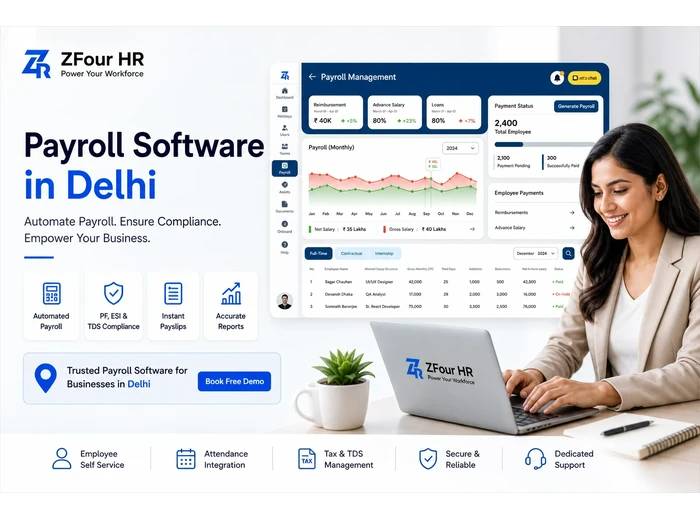
ZFour's platform integrates automated payroll, native attendance tracking, leave management, self-service portals, regulatory compliance workflows, analytics, and cloud accessibility — built around Indian statutory requirements from the ground up rather than adapted from a platform designed for a different market.
For Gurgaon businesses specifically, that means PF, ESI, and TDS calculations that reflect current Indian compliance rules by default, and attendance handling suited to the hybrid and shift-based work patterns common across the city's IT, BPO, and manufacturing employers.
The Future of Payroll Technology
Payroll technology is moving beyond basic automation toward AI-assisted processing, predictive analytics that flag anomalies before they become errors, real-time compliance monitoring that adapts to regulatory changes as they happen, and increasingly automated end-to-end employee workflows that connect payroll to the broader employee lifecycle — onboarding, performance, and offboarding — rather than treating it as an isolated function.
For Gurgaon's fast-scaling business base, platforms that combine this kind of automation with genuinely responsive local support are likely to matter most, since speed of issue resolution counts disproportionately during payroll-critical windows.
External References:
Related reading:
Ready to see it in action? Schedule a free ZFour HRMS demo or talk to an HR specialist about your Gurgaon business's payroll needs.

Farheen Ahmed
HR Tech Content Strategist at ZFour Technology Private Limited
Research-driven content on HRMS, payroll, attendance management, employee management, and modern HR technology for Indian businesses.