18 min read
Quick answer
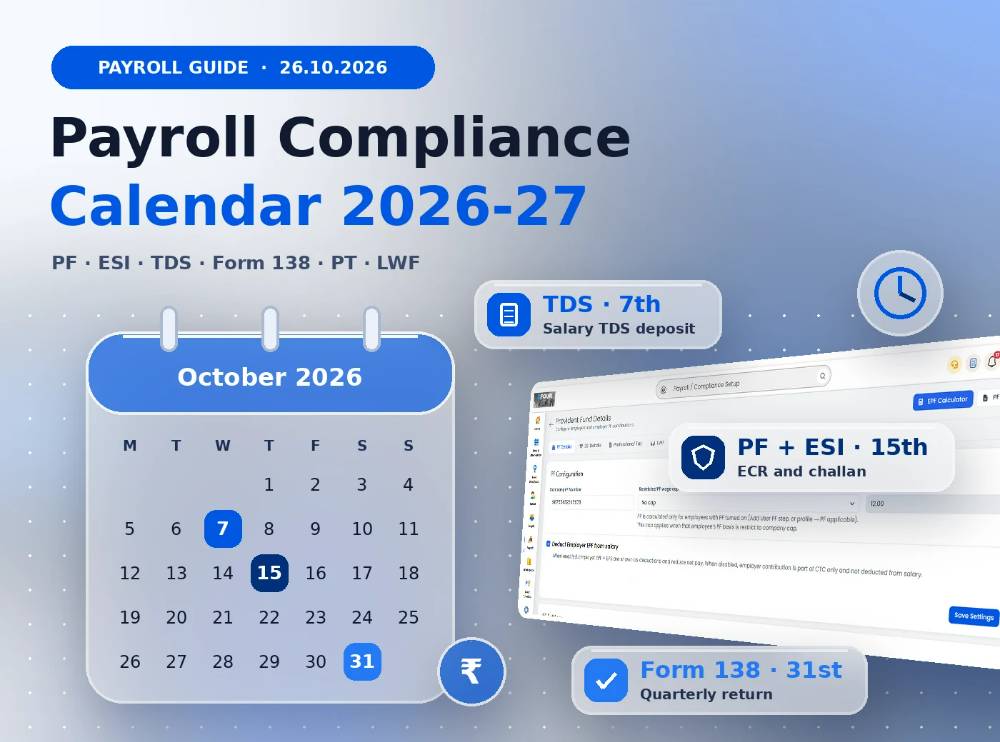
Every month, Indian employers deposit salary TDS by the 7th and pay PF (with the ECR) and ESI by the 15th of the following month. The quarterly salary TDS return — now Form 138, formerly Form 24Q — is due on 31 July, 31 October, 31 January and 31 May. Salary certificates (Form 130, formerly Form 16) go to employees by 15 June. Professional Tax and Labour Welfare Fund dates are set by each state. This 2026-27 payroll and statutory compliance calendar for India puts every date, rule change and checklist in one place.
Key takeaways
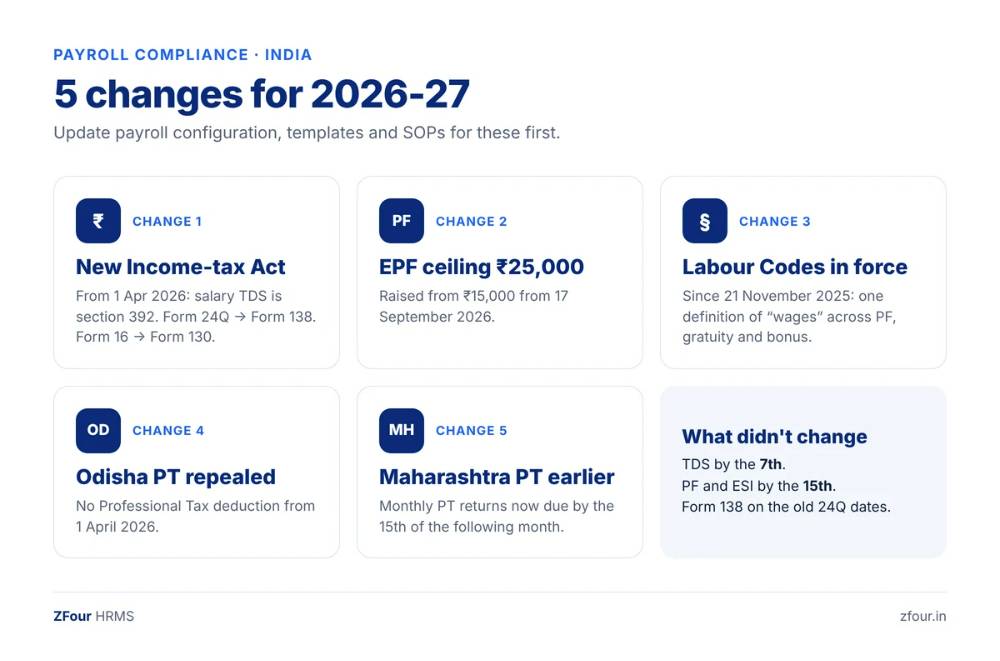
The Income-tax Act, 2025 applies from 1 April 2026: salary TDS is now section 392, Form 24Q is Form 138 and Form 16 is Form 130. Due dates did not change.
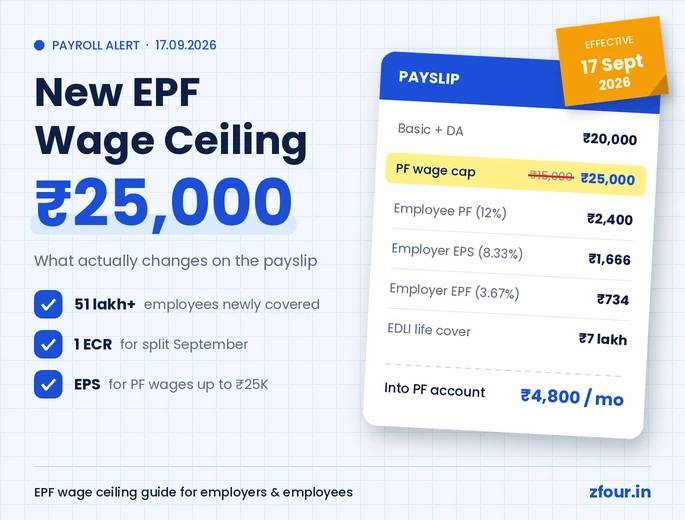
The EPF wage ceiling rose from ₹15,000 to ₹25,000 from 17 September 2026, so PF deductions went up for many employees from September payroll.
The four Labour Codes have applied since 21 November 2025, changing wage definitions and record-keeping.
Odisha stopped levying Professional Tax from 1 April 2026; Maharashtra moved its PT return dates earlier.
Almost every missed due date starts with a late payroll close. Fix the close and the calendar takes care of itself.
Want it on paper? Download the printable 2026-27 calendar (PDF, 5 pages.
Who this calendar is for
This guide is written for the people who actually run payroll in Indian businesses with 20 to 1,000 employees: HR managers, accounts teams, founders who still sign off salaries, and payroll outsourcing firms. It assumes your establishment is registered for PF and ESI and that you deduct TDS from salaries. If you have staff in more than one state, the state section matters as much as the national dates.
It is especially useful if your workforce includes shift workers, field staff or contract labour. Those teams generate overtime, night allowances, travel claims and attendance disputes that delay the payroll close, and a late close is the most common reason a statutory due date is missed.
What changed for 2026-27
The 2026-27 tax year brought more change to payroll compliance than any year in the last decade. If your team is still working from last year’s calendar or last year’s payroll configuration, these five changes need attention first.
1. A new Income-tax Act from 1 April 2026
The Income-tax Act, 2025 replaced the Income-tax Act, 1961 from 1 April 2026. For payroll teams the changes are mostly renumbering, but every template, checklist and payslip note that mentions old section and form numbers needs updating:
What | Under the 1961 Act | Under the 2025 Act |
|---|---|---|
TDS on salary | Section 192 | Section 392 |
Quarterly salary TDS return | Form 24Q | Form 138 |
Annual salary TDS certificate | Form 16 | Form 130 |
The year income is taxed | Previous year / assessment year | Tax year |
The due dates for depositing TDS and filing quarterly returns are the same as before. Certificates for 2025-26, issued in mid-2026, still used Form 16; certificates for tax year 2026-27 will be issued as Form 130 by 15 June 2027.
What to update in your payroll process
Payslip footers and tax computation sheets that mention “section 192”.
Internal SOPs and auditor checklists that list “Form 24Q” and “Form 16”.
Employee communication about investment declarations and proofs, so employees aren’t confused by new form names.
2. EPF wage ceiling raised to ₹25,000
From 17 September 2026, the EPF wage ceiling rose from ₹15,000 to ₹25,000 a month, so PF deductions went up for many employees. September 2026 is a split month, filed in a single ECR due 15 October 2026. Our EPF wage ceiling ₹25,000 guide explains who is newly covered, the impact on take-home pay and the September split with worked examples.
3. The Labour Codes are in force
The four Labour Codes — on Wages, Industrial Relations, Social Security, and Occupational Safety, Health and Working Conditions — came into force on 21 November 2025, replacing 29 older labour laws. For payroll, the main effects are a common definition of “wages” across PF, gratuity and bonus, gratuity eligibility after one year for fixed-term employees, mandatory appointment letters, and a shift towards digital records and a guidance-led inspection system. State rules under the Codes are still being notified, so some state-level procedures may change during the year. Read the Labour Codes guide for the payroll impact.
4. Odisha stopped levying Professional Tax
Odisha repealed its Professional Tax Act through an ordinance notified on 21 April 2026, with effect from 1 April 2026. Employers stop deducting PT from Odisha salaries from April 2026. Dues for periods before 1 April 2026 remain payable, so don’t close the PT account until earlier returns and assessments are settled.
5. Maharashtra moved PT return dates earlier
Maharashtra’s 2026 amendment rules moved the monthly PT return to the 15th of the following month and the annual return for small employers to 15 March. If your Maharashtra PT is filed by a consultant on the last day of the month out of habit, it is now late.
The monthly payroll compliance cycle
Every statutory payment in a month depends on one thing: a finished payroll. A good monthly cycle works backwards from the earliest due date.
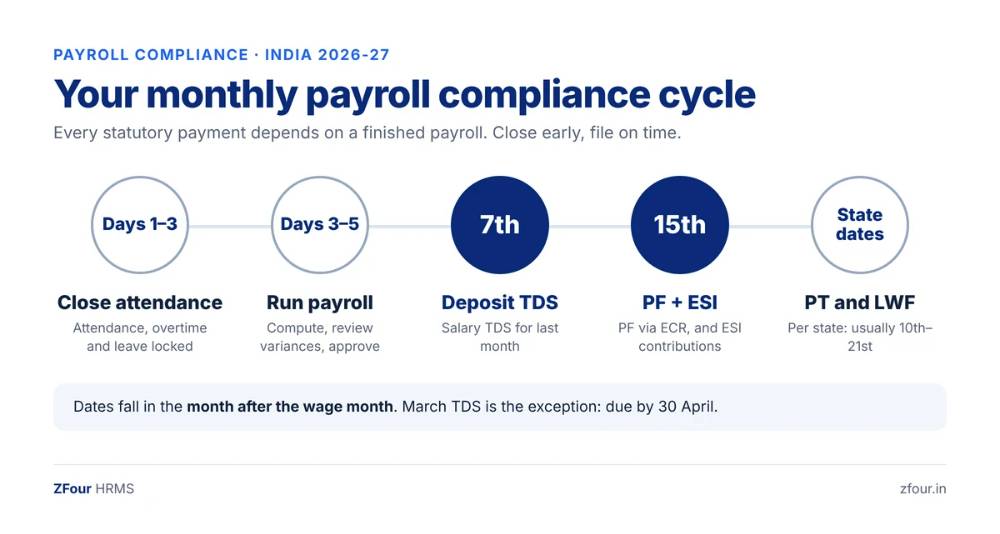
Days 1–3: close attendance, overtime and leave
Before salaries can be computed, three inputs must be locked:
Attendance: present, absent, half-day, late marks and loss of pay for every employee.
Overtime: approved hours, at the correct rate for the employee’s category and state.
Leave: approved leave, encashment and comp-offs.
For office teams this takes hours. For shift, field and contract teams it often takes days, because punches are missing, regularisation requests are pending and overtime approvals sit in WhatsApp chats. Geo-fenced punch-in and automatic overtime calculation shorten this step more than anything else in the cycle.
Days 3–5: run payroll and approve
Compute gross pay, statutory deductions (PF, ESI, PT, LWF where due, TDS) and net pay. Review variances against last month: any employee whose net pay moved by more than 10% should be checked before approval. Approve, release salaries and generate payslips.
By the 7th: deposit TDS
TDS on salary under section 392 is deposited by the 7th of the following month. TDS deducted in March is the exception: it can be deposited by 30 April.
How salary TDS is calculated
Salary TDS is an estimate of each employee’s annual tax, spread across the remaining months of the tax year. It depends on the tax regime the employee chose (new or old), their declared investments and exemptions under the old regime, and income from previous employers in the same year. Recalculate it every month; don’t fix a monthly figure in April and leave it.
By the 15th: pay PF and file the ECR
The PF ECR due date is the 15th of the following month: PF contributions for a wage month are paid through the Electronic Challan cum Return (ECR) on the EPFO portal. The ECR lists every member’s wages and contributions; payment is linked to it.
PF contribution rates
Component | Rate | On what |
|---|---|---|
Employee EPF | 12% | PF wages |
Employer EPF | 3.67% | PF wages |
Employer EPS (pension) | 8.33% | PF wages, up to the ₹25,000 ceiling |
EDLI (insurance) | 0.5% | PF wages, up to the ceiling |
EPF administration charges | 0.5% | PF wages |
“PF wages” are basic pay plus dearness allowance (and, under the Labour Codes, a broader wage definition — see the 50% rule below). Employees earning above the ceiling can contribute on the ceiling or, by choice, on higher wages.
By the 15th: pay ESI
ESI contributions are also due by the 15th of the following month. The employee pays 0.75% and the employer 3.25% of gross wages, for employees whose wages are within the ESI limit (₹21,000 a month; ₹25,000 for persons with disability). ESI runs in two contribution periods, April–September and October–March; an employee covered at the start of a period stays covered until the period ends, even if their pay rises above the limit.
State dates: Professional Tax and Labour Welfare Fund
PT and LWF are state laws, so the dates differ. In most monthly-PT states, payment and returns fall between the 10th and the 21st of the following month. LWF is deducted monthly in a few states (such as Haryana) and half-yearly or annually in most others, typically in June and December payrolls with payment by 15 July and 15 January. The state table later in this guide lists them.
The quarterly cycle: Form 138
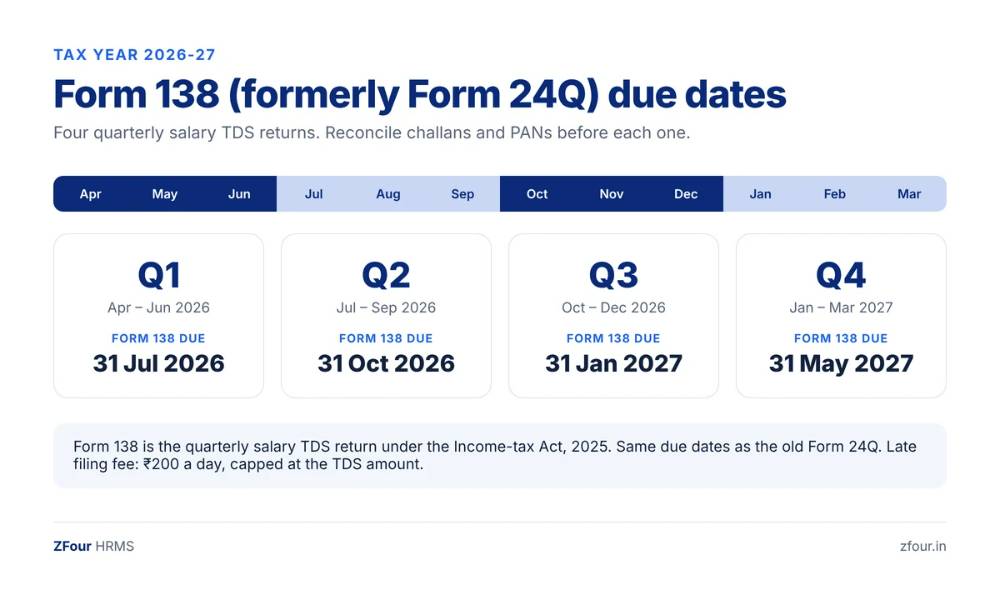
Four times a year, employers file a quarterly statement of salary TDS — now Form 138. It reports each employee’s salary, the tax deducted and the challans used to deposit it. The Form 138 due dates for 2026-27 are:
Quarter | Months | Form 138 due |
|---|---|---|
Q1 | April–June 2026 | 31 July 2026 |
Q2 | July–September 2026 | 31 October 2026 |
Q3 | October–December 2026 | 31 January 2027 |
Q4 | January–March 2027 | 31 May 2027 |
Reconcile before you file
Most notices on salary TDS come from mismatches, not unpaid tax. Before filing each quarter:
Match the TDS deducted in payroll for each month against the challans deposited.
Check PAN for every employee; a missing or invalid PAN raises the deduction rate and causes mismatches.
Make sure employees who left during the quarter are included with their final settlement.
In Q4, include the annual salary break-up for every employee, because it feeds their salary certificate.
The annual cycle
Some obligations come once a year, and most of them cluster around the end of the tax year.
January–March: investment proofs
Under the old tax regime, employees submit proofs of the investments and expenses they declared in April. Ask for proofs in January, verify them in February and adjust TDS in the remaining months, so no employee faces a large deduction in March.
By 15 June: salary certificates (Form 130)
The Form 130 due date for tax year 2026-27 is 15 June 2027: every employee from whom TDS was deducted gets this annual salary certificate. It is generated from the TDS data filed in Form 138, which is why clean quarterly returns matter.
Bonus
Under Section 39 of the Code on Wages, 2019, statutory bonus must be credited to employees’ bank accounts within eight months of the close of the accounting year — by 30 November for an April–March year. Under the Code on Wages the eligibility and calculation rules sit in the same wage definition as other benefits. Confirm eligibility with your adviser for your sector.
April: revisions
The first payroll of a new tax year is the moment to update everything that changes by notification: minimum wages and variable dearness allowance (VDA) in many states, PT slabs where states revise them, and employees’ tax regime choices.
Month-by-month calendar for tax year 2026-27
Use this as a checklist. Dates already past are included so you can check nothing was missed.
April 2026
7 April: TDS for March 2026 (government deductors); 30 April for others.
15 April: PF and ESI for March wages.
New tax year: new Income-tax Act forms apply; update regime choices and state wage revisions.
Odisha PT: stop deductions from April salaries.
May 2026
7 May: TDS for April.
15 May: PF and ESI for April.
31 May: Q4 2025-26 salary TDS return (filed under the transition rules).
June 2026
7 June: TDS for May.
15 June: PF and ESI for May.
15 June: Form 16 for 2025-26 issued to employees.
June payroll: deduct half-yearly LWF in half-yearly states.
July 2026
7 July: TDS for June.
15 July: PF and ESI for June; half-yearly LWF payment in several states.
31 July: Form 138 for Q1.
August 2026
7 August: TDS for July.
15 August: PF and ESI for July.
September 2026
7 September: TDS for August.
15 September: PF and ESI for August.
17 September: EPF wage ceiling rises to ₹25,000.
30 September: ESI contribution period April–September ends.
October 2026
7 October: TDS for September.
15 October: PF (split-month ECR for September) and ESI for September.
31 October: Form 138 for Q2.
November 2026
7 November: TDS for October.
15 November: PF and ESI for October.
30 November: statutory bonus for accounting year 2025-26 credited to employees’ bank accounts (Section 39, Code on Wages).
December 2026
7 December: TDS for November.
15 December: PF and ESI for November.
December payroll: deduct half-yearly or annual LWF where due.
January 2027
7 January: TDS for December.
15 January: PF and ESI for December; half-yearly LWF in several states; annual LWF in Karnataka.
31 January: Form 138 for Q3; annual LWF in Tamil Nadu, Andhra Pradesh and Telangana.
Start collecting investment proofs.
February 2027
1 February: Union Budget — note any tax changes that apply from 1 April 2027.
7 February: TDS for January.
15 February: PF and ESI for January.
February payroll: deduct the higher February PT amount in Maharashtra and Karnataka.
March 2027
7 March: TDS for February.
15 March: PF and ESI for February; Maharashtra annual PT return for annual filers.
31 March: tax year ends; finalise salary TDS for every employee; ESI contribution period October–March ends.
April–June 2027 (closing tax year 2026-27)
15 April: PF and ESI for March.
30 April: TDS for March.
31 May: Form 138 for Q4.
15 June: Form 130 salary certificates for tax year 2026-27.
Professional Tax and LWF dates by state
The table below is a starting point. State notifications change, so check the state’s own notification before you rely on these dates.
State | Professional Tax payment / return | Labour Welfare Fund |
|---|---|---|
Maharashtra | Monthly return by the 15th of the following month; annual filers by 15 March | Half-yearly: 15 July and 15 January |
Karnataka | Monthly, by the 20th of the following month | Annual, by 15 January |
West Bengal | Monthly, by the 21st of the following month | Half-yearly: 15 July and 15 January |
Telangana | Monthly, by the 10th of the following month | Annual, by 31 January |
Andhra Pradesh | Monthly, by the 10th of the following month | Annual, by 31 January |
Tamil Nadu | Half-yearly through local bodies: 30 September and 31 March | Annual, by 31 January |
Gujarat | Monthly, by the 15th of the following month | Half-yearly: 15 July and 15 January |
Haryana | No Professional Tax | Monthly: 0.2% of wages up to ₹35 (employee), twice that from the employer |
Delhi | No Professional Tax | Half-yearly: 15 July and 15 January |
Uttar Pradesh, Rajasthan | No Professional Tax | No Labour Welfare Fund |
Odisha | Not levied from 1 April 2026 | Half-yearly: 15 July and 15 January |
Situations that trip up payroll teams
The calendar is the easy part. Most errors come from people who don’t fit the standard monthly pattern.
New joiners in the middle of the month
Prorate wages for the days worked, and remember that PF and ESI are calculated on the wages actually paid for the month. Enrol new PF members in the same month’s ECR; collect the UAN of anyone who worked elsewhere before. For TDS, ask for the previous employer’s salary and tax details so the annual estimate is right.
Exits and full-and-final settlement
Include the leaver’s final wages, leave encashment and any notice pay in the month they’re paid. Deduct PF on the PF-wage components, and capture the final TDS in that quarter’s Form 138. Gratuity, where payable, is due within the statutory time limit after it becomes payable. Delayed settlements are a common source of disputes in high-attrition workforces such as security and retail.
Employees in more than one state
PT and LWF follow the employee’s place of work, not the head office. A company headquartered in Delhi (no PT) with a team in Bengaluru deducts Karnataka PT for that team only. If an employee transfers mid-year, switch the state from the next payroll and keep records of the move. For the full picture, see our multi-state payroll compliance guide.
Contract labour
The principal employer remains liable for PF and ESI of contract workers if the contractor fails to pay. Ask contractors for monthly proof of PF and ESI payment (ECR and challan copies) for the workers deployed at your site, and hold back payment until you receive it.
Employees crossing the ESI limit
An employee whose wages rise above ₹21,000 during a contribution period stays covered until that period ends on 30 September or 31 March. Stop ESI from the start of the next period, not from the month of the increment.
Employees above the EPF ceiling
Employees earning above ₹25,000 can contribute on ₹25,000 or, with the employer’s agreement, on full wages. Record the choice for each employee and keep it consistent; switching back and forth creates reconciliation problems.
The 50% wage rule under the Labour Codes
Under the Code on Wages, allowances beyond 50% of total remuneration are added back to “wages”. Salary structures with a very low basic and large allowances therefore produce higher PF and gratuity liabilities than before. Review structures before increments are processed. Our guide to the 50% basic pay rule explains the calculation.
What a missed due date costs
Penalties differ by law and change over time, so confirm current rates with your adviser. Broadly:
Late TDS deposit: interest at 1.5% a month (or part of a month) from the date of deduction to the date of deposit under section 398(3) of the Income-tax Act, 2025, and a late fee of ₹200 a day for late Form 138 filing under section 427, capped at the TDS amount.
Late PF payment: simple interest at 12% a year plus damages for the period of delay.
Late ESI payment: simple interest at 12% a year for each day of delay, plus damages that rise with the length of the delay.
Late PT or LWF: interest and penalties under each state’s law.
The bigger costs are indirect: employees whose PF passbook shows missing months lose trust quickly; mismatched TDS creates notices that take hours to resolve; and contractors’ unpaid PF can land on you as principal employer.
How the calendar differs by type of business
The due dates are the same for everyone. What changes is which of them carries the most risk.
Factories and manufacturing units
Factories run shifts, pay overtime and often engage contract labour, so the payroll close is the critical path. Overtime under the Factories Act and state rules is usually paid at twice the ordinary rate, and inspectors look at overtime registers. Two things matter most: approve overtime daily rather than at month end, and collect contractors’ PF and ESI proofs every month. A factory with 300 workers and three contractors can easily have 100 contract workers whose PF the principal employer is ultimately responsible for.
Security agencies and facility management firms
Guards are deployed across many client sites, often on 12-hour shifts, with high attrition. The heaviest compliance load is ESI and PF for a large, changing workforce, plus state minimum wages for each category of guard. Enrol new joiners in the same month’s ECR and ESI filing, and process exits promptly so final settlements and PF transfers don’t pile up. Attendance verified at the client site — by GPS geo-fence or site QR codes — also supports client billing.
Field sales, service and delivery teams
Field teams generate travel allowances, fuel reimbursements and incentives that must be classified correctly: reimbursements against actual expenses are usually outside “wages”, while fixed allowances and incentives are generally inside. Getting the classification wrong changes PF wages, ESI wages and TDS. Verified field attendance and kilometre-based claims make the monthly close faster and the classification defensible.
Retail and multi-location businesses
Stores spread across states multiply PT and LWF obligations. A retail chain with stores in Maharashtra, Karnataka and Delhi has three different PT positions and different LWF dates. Keep a state master for every store and every employee’s work location, and review it whenever a store opens or an employee transfers. Our multi-state payroll compliance guide covers this in detail.
IT companies, agencies and startups
Office-based teams have simpler attendance but more complex tax: flexible benefit plans, regime choices, ESOPs and employees joining mid-year with income from a previous employer. The highest-risk dates are the quarterly Form 138 filings and the March TDS true-up. Collect previous-employer details at joining and investment proofs in January.
Build a process that never misses a date
Give every filing an owner
Filing | Owner | Backup | Due |
|---|---|---|---|
Payroll close and approval | HR manager | Founder / finance head | 5th |
TDS deposit | Accounts | HR manager | 7th |
PF ECR and payment | HR / payroll | Accounts | 15th |
ESI payment | HR / payroll | Accounts | 15th |
PT and LWF (per state) | HR / payroll | Consultant | Per state |
Form 138 | Accounts / tax consultant | HR | Quarterly |
Form 130 | Accounts | HR | 15 June |
A four-week monthly payroll checklist
Week 1
Lock attendance, overtime and leave by the 2nd.
Run payroll, review variances, approve by the 5th.
Deposit TDS by the 7th.
Week 2
File the ECR and pay PF by the 15th.
Pay ESI by the 15th.
Pay PT in states with early due dates.
Week 3
Pay remaining state PT.
Collect contractors’ PF and ESI proofs.
Week 4
Reconcile TDS deducted against challans.
Prepare the next month’s joiner and leaver list.
Check for new notifications: EPFO, ESIC, state labour and tax departments.
Keep one source of truth
Most errors come from re-typing numbers between attendance sheets, payroll spreadsheets and government portals. When attendance, payroll and statutory reports come from one system, the PF wages in the ECR, the ESI wages and the TDS in Form 138 all match the salaries actually paid.
Case study: from three days to twenty minutes
DNA Digital Studio, a digital agency with more than 35 employees, ran payroll and compliance largely by hand. Founder Dhana Sekaran told us that processing which once took three days now finishes in twenty minutes, the HR team saves around fifteen hours a week on payroll and compliance work, and PF compliance has run with zero statutory penalties across eighteen months.
How ZFour HRMS handles the calendar
ZFour HRMS runs attendance, payroll and statutory compliance from one set of data:
Attendance that closes itself: geo-fenced punch-in, biometric sync, shift rosters and automatic overtime mean the payroll close starts with clean data.
Statutory calculations: PF, ESI, PT by state and TDS are calculated in every payroll run, with the EPF ceiling and state slabs applied automatically.
Returns and reports: PF ECR, ESI and PT reports and the data for Form 138 are generated from the same payroll.
Employee self-service: payslips, tax declarations and leave in the mobile app, in Hindi and English.
Statutory compliance is included from the Workforce Pro plan at ₹70 per user per month plus GST. See payroll compliance software or check contributions with the PF calculator and TDS calculator.
Sources

Farheen Ahmed
HR Tech Content Strategist at ZFour Technology Private Limited
Research-driven content on HRMS, payroll, attendance management, employee management, and modern HR technology for Indian businesses.