7 min read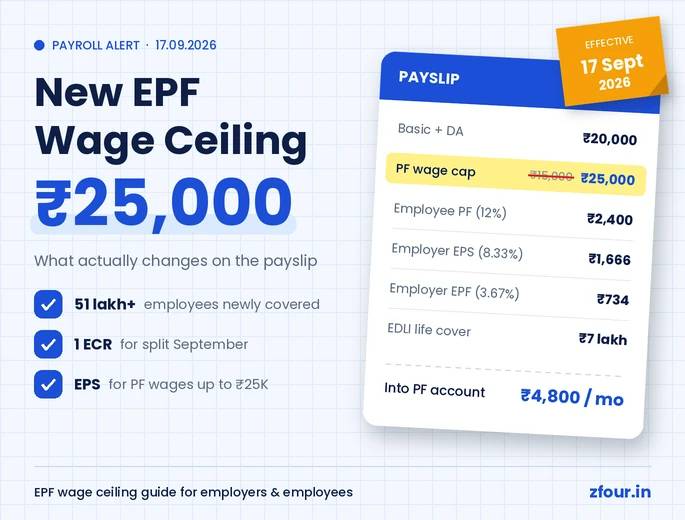
Quick Answer
From 17 September 2026, the EPF wage ceiling is ₹25,000 a month, up from ₹15,000. If an employee's PF wages are ₹25,000 or less, they now have to be covered under EPF, EPS and EDLI. That includes people already on your payroll who were excluded earlier, not just new hires. September 2026 is calculated in two parts, and from October it's the new ceiling all the way.
Key Takeaways
It's about PF wages (Basic + DA + retaining allowance), not gross salary or CTC.
Excluded employees already on the payroll must be enrolled from 17 Sept 2026, not just new joiners.
September 2026 goes in one ECR, split in two: 1–16 Sept on ₹15,000, 17–30 Sept on ₹25,000.
Missed the employee's share in September's salary? You can recover it in the next payroll, no prior approval needed.
You can't pass the employer's PF share on to employees by reworking their CTC.
What Changed
For 12 years, ₹15,000 was the magic number in Indian payroll. Not any more. On 17 September 2026, the Ministry of Labour and Employment raised the EPF wage ceiling to ₹25,000 a month through Gazette Notification S.O. 5109(E), issued under Chapter III of the Code on Social Security, 2020. It took effect the same day.
So what is the wage ceiling? It's the monthly wage limit that decides who must be covered under EPF, EPS (pension) and EDLI (insurance). Raise it, and more people come in. EPFO expects more than 51 lakh employees to be newly covered, and many existing members will start contributing on a bigger wage base.
Particulars | Earlier | From 17 Sept 2026 |
|---|---|---|
Wage ceiling | ₹15,000/month | ₹25,000/month |
Max employee EPF (12%) | ₹1,800 | ₹3,000 |
Max employer EPS (8.33%) | ₹1,250 | ₹2,083 |
Max employer EPF (3.67%) | ₹550 | ₹917 |
Why the Ceiling Was Raised
Simply put, ₹15,000 had stopped making sense. Wages have climbed a lot since 2014, and in at least eight major States and UTs, even the minimum wage for unskilled workers is now above ₹15,000. So some minimum-wage earners were falling outside social security altogether.
Both trade unions and employer bodies had raised this. There was another quirk too: plenty of members earning well above ₹15,000 were still contributing only on ₹15,000. The new limit is a long-overdue catch-up with real salaries.
Who Is Now Covered
If an employee's PF wages are ₹25,000 or less, they must now be in EPF, EPS and EDLI. Note the words "PF wages" (as defined in section 2(88) of the Code). It's not their gross salary. And nobody has to apply: enrolling them is the employer's job.
Situation | What happens now |
|---|---|
Excluded employee earning ₹20,000, working on 17 Sept 2026 | Must be enrolled in EPF, EPS and EDLI from 17 Sept 2026 |
EPF member at ₹20,000 but not in EPS | Must be enrolled in EPS from 17 Sept 2026 |
New joiner at ₹20,000 | Must be enrolled in EPF and EPS (earlier stayed outside) |
Gross ₹50,000, PF wages ₹25,000 | Covered under all three schemes |
Gross ₹60,000, PF wages ₹30,000 | Not mandatorily covered; can join voluntarily with employer consent |
Already contributing on wages above ₹25,000 | No need to reduce; existing arrangement continues |
One common mix-up: the new ceiling doesn't mean everyone now contributes on ₹25,000. If someone's PF wages are ₹18,000, contributions are on ₹18,000. So look at each employee's PF status individually rather than applying ₹25,000 across the board.
Monthly Contributions from October 2026
From the October 2026 wage month, it's simple: the new ceiling applies for the whole month. Here's how the numbers work out, based on EPFO's own illustrations:
PF wages (Basic + DA) | Employee EPF (12%) | Employer EPS (8.33%) | Employer EPF (3.67%) | EDLI (0.5%) | Admin (0.5%) |
|---|---|---|---|---|---|
₹10,000 | ₹1,200 | ₹833 | ₹367 | ₹50 | ₹50 |
₹15,000 (old cap) | ₹1,800 | ₹1,250 | ₹550 | ₹75 | ₹75 |
₹20,000 (new bracket) | ₹2,400 | ₹1,666 | ₹734 | ₹100 | ₹100 |
₹25,000 (new cap) | ₹3,000 | ₹2,083 | ₹917 | ₹125 | ₹125 |
₹35,000 (above cap) | ₹3,000 | ₹0* | ₹3,000 | ₹125 | ₹125 |
*EPS membership is only for employees whose wages on joining (or on 17 Sept 2026) do not exceed ₹25,000. Minimum admin charges are ₹500 per month per establishment with at least one contributing member.
September 2026: The Split Month
September is the tricky month. You still file one ECR, but the contributions are worked out in two parts:
1–16 September (16 days): old ceiling of ₹15,000
17–30 September (14 days): new ceiling of ₹25,000
Here's what that looks like for an employee with PF wages of ₹20,000, using EPFO's worked example:
Contribution head | A: Excluded employee, enrolled from 17 Sept | B: EPF member, newly in EPS from 17 Sept | C: EPF + EPS member, capped at ₹15,000 till 16 Sept |
|---|---|---|---|
EPF wages for Sept | ₹9,333.33 | ₹20,000.00 | ₹17,333.33 |
EPS wages for Sept | ₹9,333.33 | ₹9,333.33 | ₹17,333.33 |
Employee EPF (12%) | ₹1,120.00 | ₹2,400.00 | ₹2,080.00 |
Employer EPF (A/c 1) | ₹342.53 | ₹1,622.53 | ₹636.13 |
Employer EPS (A/c 10) | ₹777.47 | ₹777.47 | ₹1,443.87 |
EDLI (A/c 21) | ₹46.67 | ₹100.00 | ₹86.67 |
Admin (A/c 2) | ₹46.67 | ₹100.00 | ₹86.67 |
Total remittance | ₹2,333.34 | ₹5,000.00 | ₹4,333.34 |
The September ECR was ordinarily due by 15 October 2026. If yours isn't filed yet, do it right away, since late remittance attracts interest and penalty.
Some relief on the employee share: Couldn't deduct the employee's contribution from September salary for someone newly covered? You can recover it in the next payroll, without prior approval from the Inspector-cum-Facilitator. Just remember, the ECR and the full remittance (both shares) for September still have to go in on time. And no, the effective date isn't moving to 1 October; EPFO has confirmed that.
What It Means for Take-Home, CTC, Pension and Insurance
Take-home pay
Take Ravi, whose PF wages are ₹20,000 but who was contributing only on the old ₹15,000 cap. His PF deduction goes from ₹1,800 to ₹2,400 a month, so his take-home dips by ₹600. But his employer now puts in ₹2,400 too, part of it towards his pension. EPFO calls this moving money from the "take-home pocket" to the "PF account pocket". It earns 8.25% interest (FY 2025-26), comes with tax benefits, and up to 75% can be withdrawn when needed. For a full breakdown of salary deductions, see our guide on why your in-hand salary is low.
CTC
This is one we get asked about a lot. CTC isn't a statutory concept for PF, so you can't recover the employer's extra contribution from employees by restructuring their CTC. Statutory wages can't be cut against the law either.
Pension (EPS)
Pensionable wages can now count up to ₹25,000, so eligible members may end up with a higher pension, depending on the EPS formula and their service. Existing pensioners won't see an automatic increase, though. The Government's EPS share stays at 1.16% of wages up to ₹15,000 (max ₹174 a month), and that doesn't affect the member's pension.
Insurance (EDLI)
Newly covered employees get life cover of up to ₹7 lakh, at no cost to them. The maximum stays at ₹7 lakh for now. On paper the formula could reach ₹10.5 lakh, but EPFO will only revisit the cap after an actuarial review.
Employer cost
Yes, costs go up: a 12% matching contribution on wages up to ₹25,000. Part of it can be offset through the PMVBRY incentive of up to ₹3,000 a month for each additional job you create. (The PMVBRY Part A benefit for first-time employees stays capped at ₹15,000.)
Employer Checklist
EPFO sums it up in six words: identify, calculate, enrol, report, remit and reconcile. In practice, that means:
Identify employees in the ₹15,000–₹25,000 PF wage band
Identify existing members whose contribution was capped at ₹15,000
Enrol newly covered employees in EPF, EPS and EDLI from 17 Sept 2026
Review the wage components used for PF (Basic + DA + retaining allowance)
Calculate September contributions separately for 1–16 and 17–30 Sept
File the September ECR with the correct split (due 15 Oct 2026)
Update payroll and HR systems for October onwards
Check compliance by contractors engaged at your sites
Explain the change and its benefits to employees
Keep an audit trail of calculations and changes
Watch for further EPFO circulars and portal updates
Conclusion
For employees in the ₹15,000–₹25,000 band, this is a real upgrade: PF savings, a lifelong pension and free life cover they simply didn't have before. For employers, it's a payroll change that can't wait for the next cycle. Get September right, and October onwards becomes routine.
Get the New Ceiling Right for Every Employee
Split-month maths, EPS enrolments and ECR changes are exactly the kind of work that goes wrong in spreadsheets. ZFour's payroll compliance software applies the right PF wage ceiling for each period and each employee automatically, so your team doesn't have to.
Sources:
Gazette of India, Notification S.O. 5109(E), Ministry of Labour and Employment, 17 September 2026
EPFO, Frequently Asked Questions: Revision of EPFO Statutory Wage Ceiling from ₹15,000 to ₹25,000

Farheen Ahmed
HR Tech Content Strategist at ZFour Technology Private Limited
Research-driven content on HRMS, payroll, attendance management, employee management, and modern HR technology for Indian businesses.