17 min read
Quick answer
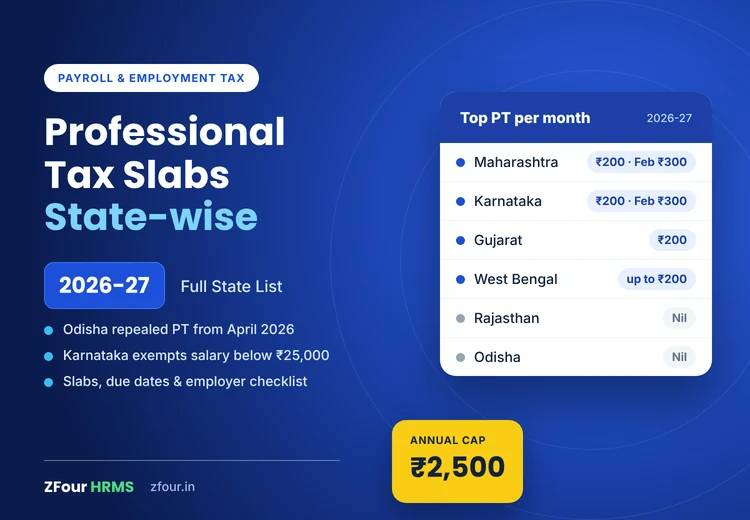
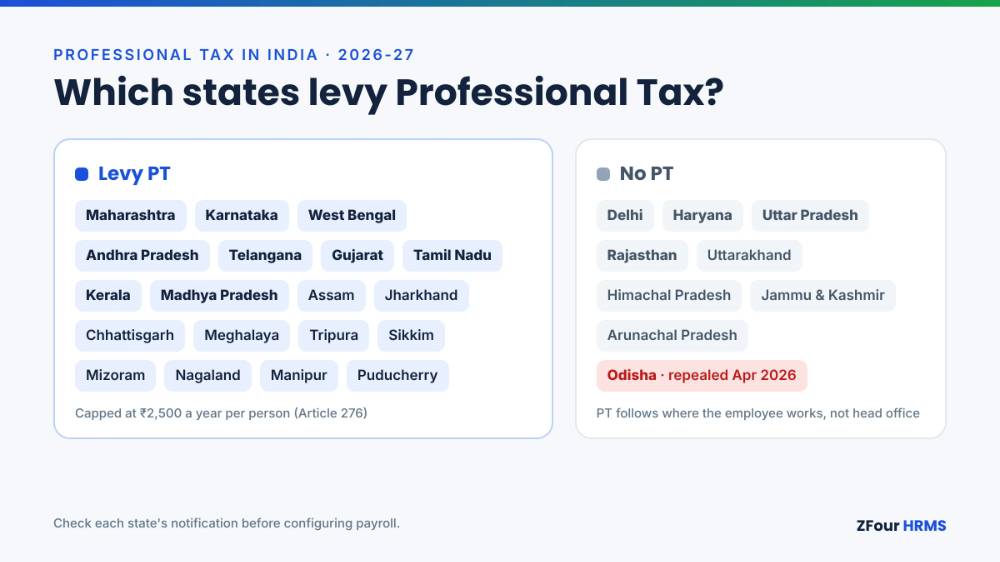
Professional Tax (PT) is a state tax on salaries and professions. Employers deduct it from employees' salaries and pay it to the state where the employee works. The Constitution caps it at ₹2,500 per person per year, so most monthly-PT states charge up to ₹200 a month, and Maharashtra and Karnataka charge ₹300 in February to reach the cap. Delhi, Haryana, Uttar Pradesh and Rajasthan don't levy PT, and Odisha stopped levying it from 1 April 2026. This guide lists the professional tax slab state wise for 2026-27, with how to register, deduct, pay and file.
Key takeaways
PT is capped at ₹2,500 a year per person by Article 276 of the Constitution.
PT follows the employee's place of work, not the company's head office.
Odisha repealed PT from 1 April 2026; Karnataka now exempts salaries below ₹25,000; Maharashtra moved some return dates earlier.
Employers register as deductors in each state where they have employees, deduct monthly or half-yearly, and file returns on the state's schedule.
Under the new tax regime, employees cannot deduct PT from taxable salary; under the old regime they can.
What is Professional Tax?
Download 2026-27 State-Wise Professional Tax Slab Card
Accurate monthly PT rates and salary deduction slabs for all Indian states in one cheat sheet.
Professional Tax is a tax levied by state governments on people who earn a living through a profession, trade, calling or employment. For salaried employees, PT is a payroll deduction: the employer deducts it from salary and pays it to the state. Self-employed professionals and businesses pay it directly. In India, professional tax on salary is the most common form, and it never exceeds ₹2,500 a year for any person.
The power to levy it comes from Article 276 of the Constitution, which allows states to tax professions, trades, callings and employments but limits the total to ₹2,500 per person per year. Because each state passes its own law, the slabs, thresholds, due dates and forms vary widely — and some states have chosen not to levy it at all.
Who pays Professional Tax?
Salaried employees in states that levy PT, through deduction by the employer.
Employers, as businesses, in many states pay a fixed annual PT for the entity itself — separate from what they deduct from staff.
Self-employed professionals — doctors, lawyers, chartered accountants, consultants — in states that levy it.
Who is commonly exempt?
Exemptions are set by each state, but these categories are frequently exempt:
Persons with a disability above a specified percentage.
Parents or guardians of children with certain disabilities.
Senior citizens above a specified age (in some states).
Members of the armed forces.
Women earning up to ₹25,000 a month (Maharashtra).
Why some states levy PT and others don't
PT gives states and local bodies a small, steady revenue stream collected through employers. The ₹2,500 constitutional ceiling has stayed the same for decades, so for large states PT is a modest share of revenue, and some have chosen not to levy it at all or, like Odisha in 2026, to repeal it. States that keep it often use the money for local bodies and administration. For employers, the consequence is a patchwork: the same salary attracts ₹2,500 a year in Mumbai and nothing in Gurugram.
Why PT matters to employers
PT amounts are small per person — ₹200 a month at most — so it's tempting to treat it as an afterthought. That's a mistake for three reasons:
It is the employer's liability. If you fail to deduct PT, the state recovers it from you, with interest and penalties.
It multiplies across states. A company with staff in five states has up to five PT registrations, five sets of returns and five sets of due dates.
It changes more often than people expect. In just over a year, Karnataka raised its threshold, Maharashtra moved its return dates and Odisha abolished PT. Payroll configured once and left alone drifts out of compliance.
PT is one of several state-level rules — for Labour Welfare Fund and minimum wages across states, see our multi-state payroll compliance guide.
What changed for professional tax in 2026-27
Odisha abolished Professional Tax
The Odisha State Tax on Professions, Trades, Callings and Employment (Repeal) Ordinance, 2026, notified on 21 April 2026, repealed Odisha's PT law with effect from 1 April 2026. Employers stop deducting PT from Odisha salaries from April 2026. Assessments, returns and dues for periods before 1 April 2026 continue, so keep records until earlier years are closed.
Karnataka exempted salaries below ₹25,000
Karnataka's 2025 amendment, applied from 1 April 2025, levies PT only on monthly salaries of ₹25,000 and above, at ₹200 a month and ₹300 in February. Employees earning less than ₹25,000 pay nothing.
Maharashtra moved return dates earlier
Under the Maharashtra amendment rules notified on 28 February 2026, employers with a monthly PT liability of ₹20,000 or more now file monthly returns by the 15th of the following month, instead of the last day. Employers whose PT liability in the previous year was under ₹5,000 file their annual return by 15 March, instead of 31 March. Check which category your registration falls in.
Professional Tax slab state-wise list
States with monthly PT
Professional tax in Maharashtra
Monthly gross salary | PT per month |
|---|---|
Up to ₹7,500 | Nil |
₹7,501 – ₹10,000 | ₹175 |
Above ₹10,000 | ₹200 (₹300 in February) |
Women employees earning up to ₹25,000 a month are exempt (from 1 April 2023). Above ₹25,000, the normal ₹200 a month and ₹300 in February applies.
Annual maximum: ₹2,500.
Employers deducting PT from employees register for a PT Registration Certificate (PTRC); the business itself enrols separately for a PT Enrolment Certificate (PTEC) and pays its own annual PT.
Returns: employers with monthly PT liability of ₹20,000 or more file by the 15th of the following month; employers with previous-year liability under ₹5,000 file an annual return by 15 March.
Professional tax in Karnataka
Monthly gross salary | PT per month |
|---|---|
Below ₹25,000 | Nil |
₹25,000 and above | ₹200 (₹300 in February) |
In force from 1 April 2025.
Annual maximum: ₹2,500.
Professional tax in West Bengal
Monthly gross salary | PT per month |
|---|---|
Up to ₹10,000 | Nil |
₹10,001 – ₹15,000 | ₹110 |
₹15,001 – ₹25,000 | ₹130 |
₹25,001 – ₹40,000 | ₹150 |
Above ₹40,000 | ₹200 |
Professional tax in Andhra Pradesh
Monthly gross salary | PT per month |
|---|---|
Up to ₹15,000 | Nil |
₹15,001 – ₹20,000 | ₹150 |
Above ₹20,000 | ₹200 |
Professional tax in Telangana
Monthly gross salary | PT per month |
|---|---|
Up to ₹15,000 | Nil |
₹15,001 – ₹20,000 | ₹150 |
Above ₹20,000 | ₹200 |
Same slabs as Andhra Pradesh.
Professional tax in Gujarat
Monthly gross salary | PT per month |
|---|---|
Up to ₹12,000 | Nil |
Above ₹12,000 | ₹200 |
There is no separate February amount, so the annual total is ₹2,400.
Professional tax in Madhya Pradesh
Madhya Pradesh levies PT on annual salary bands, from ₹1,500 to ₹2,500 a year, usually recovered in monthly instalments. Confirm the current bands with the MP commercial tax department before configuring payroll.
Other states and UTs that levy PT
Assam, Meghalaya, Tripura, Sikkim, Mizoram, Nagaland, Manipur, Puducherry, Jharkhand and Chhattisgarh also levy PT, capped at ₹2,500 a year. Slabs differ from state to state, so check each state's current notification before adding it to payroll.
States with half-yearly PT
Professional tax in Tamil Nadu
PT in Tamil Nadu is levied half-yearly by local bodies. The Greater Chennai Corporation's current schedule is:
Half-yearly gross salary | PT per half-year |
|---|---|
Up to ₹21,000 | Nil |
₹21,001 – ₹30,000 | ₹180 |
₹30,001 – ₹45,000 | ₹425 |
₹45,001 – ₹60,000 | ₹930 |
₹60,001 – ₹75,000 | ₹1,025 |
Above ₹75,000 | ₹1,250 |
These rates apply from the second half of 2024-25 (Greater Chennai Corporation circular dated 20 January 2025). Other local bodies in Tamil Nadu may use different schedules. Deduction typically happens in the half-years ending September and March.
Professional tax in Kerala
Kerala's PT is also half-yearly and collected by local bodies, on half-yearly salary bands up to ₹1,250 per half-year. Check the current bands with the relevant local body.
Get every state’s Professional Tax slabs in one Excel file
One sheet per state with the slab table, February amount, due dates and source link — free for HR and payroll teams.
Download the State PT workbook
States without professional tax in 2026-27
State / UT | Status for 2026-27 |
|---|---|
Delhi | No PT |
Haryana | No PT |
Uttar Pradesh | No PT |
Rajasthan | No PT |
Uttarakhand | No PT |
Himachal Pradesh | No PT |
Jammu and Kashmir | No PT |
Arunachal Pradesh | No PT |
Odisha | No PT from 1 April 2026 (repealed) |
A company headquartered in a no-PT state still deducts PT for employees who work in PT states.
How Professional Tax works for employers
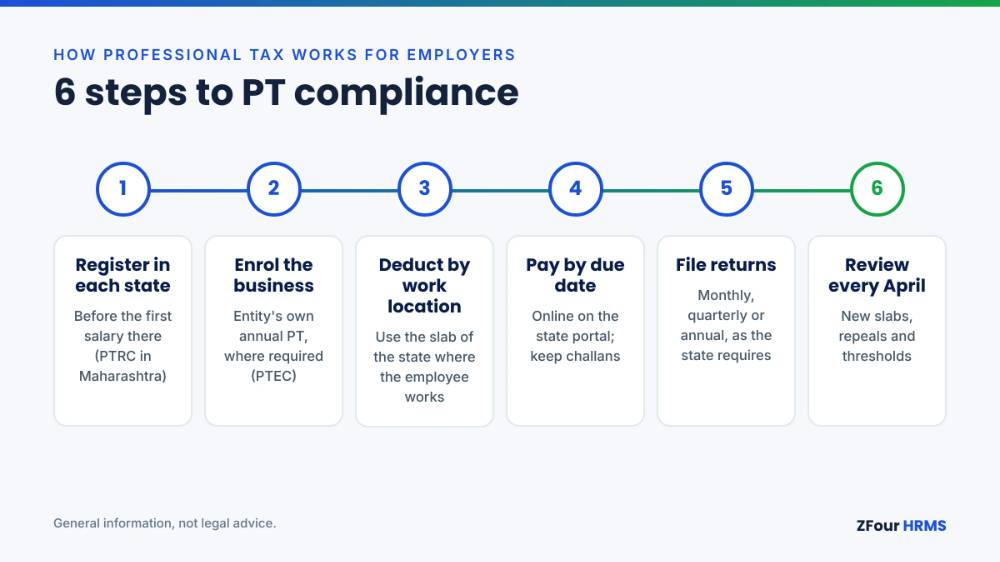
Step 1: Register in each state
Register as an employer (deductor) under each state's PT law where you have employees on payroll. In Maharashtra this is the PTRC; most states have an equivalent registration, usually online through the commercial tax department. Register before the first salary is paid in that state.
Step 2: Enrol the business itself (where required)
Several states also require the business entity to pay PT on its own account — a fixed annual amount, often ₹2,500. In Maharashtra this is the PTEC. Requirements vary by state.
Step 3: Deduct from salary
Apply the slab for the state where the employee works, based on their monthly gross salary (or half-yearly gross in half-yearly states). Show the deduction on the payslip.
Step 4: Pay to the state
Pay the total deducted by the state's due date, usually online through the state's tax portal. Keep challans.
Step 5: File returns
File monthly, quarterly or annual returns as the state requires. Many states link the return frequency to the size of the employer's PT liability.
Step 6: Review every April
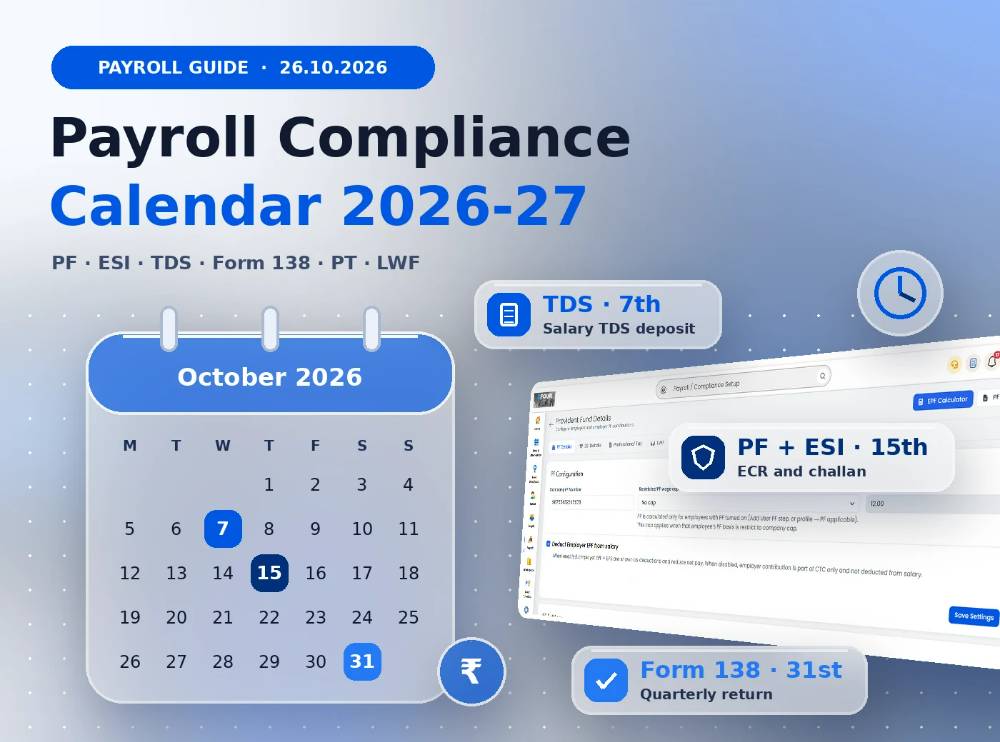
Check each state's notifications at the start of the tax year and whenever a new state is added to payroll. Our payroll compliance calendar lists the due dates through the year.
How to register for professional tax: documents needed
Requirements vary by state, but most PT registrations ask for:
PAN of the business and of the authorised signatory.
Certificate of incorporation, partnership deed or proof of proprietorship.
Proof of address for the place of business in that state — rent agreement or utility bill.
GST registration, where available.
Bank account details for the business.
Number of employees and their salary details in that state.
Shops and Establishments registration or factory licence for that location.
Register as soon as you hire the first employee in a new state. Back-dated registration usually means paying the PT that should have been deducted, plus interest — out of the company's pocket if it's too late to deduct from salaries.
What counts as "salary" for PT
PT slabs apply to the employee's salary or wages for the month (or half-year), but each state's law defines what's included. As a general guide (rules vary by state):
Component | Usually included in PT salary? |
|---|---|
Basic pay and dearness allowance | Yes |
House rent allowance and other fixed allowances | Yes |
Overtime paid in the month | Generally yes |
Incentives and commissions paid in the month | Generally yes |
Bonus paid in the month | Depends on the state |
Arrears paid in the month | Depends on the state; often counted in the month paid |
Reimbursement of actual expenses (fuel, travel against bills) | Generally no |
Employer's PF and ESI contribution | No |
The practical point: PT is calculated on each month's actual gross. For employees near a slab boundary, overtime or an incentive can move them into a higher slab for that month. Payroll should calculate PT on the month's actual gross, never on a fixed annual figure divided by twelve.
PT for different kinds of workers
Contract workers
Workers engaged through a contractor are on the contractor's payroll, so the contractor deducts and pays their PT. As the principal employer, ask contractors for PT challans along with PF and ESI proofs; unpaid statutory dues have a way of becoming the principal employer's problem.
Apprentices and trainees
If an apprentice or trainee receives a stipend above the state's threshold, PT may apply. Some states treat apprentices under the Apprentices Act differently. Check the state's rules before deducting.
Part-time employees
Part-time employees are covered like any other employee if their monthly salary crosses the threshold. Many part-timers fall below it.
Employees on leave without pay
If an employee receives no salary in a month, or salary below the threshold, PT for that month is nil or lower. Don't deduct PT on salary that wasn't paid.
Employees with two employers
Someone working for two employers in the same state may find PT deducted twice. Because the annual cap is per person, the employee can generally give one employer a certificate showing PT is paid through the other, and that employer stops deducting. Procedures vary by state.
Directors and partners
Directors who draw a salary are treated like employees for PT on that salary. Partners and directors may also be liable for PT as individuals under the "profession" category in some states.
Joiners, leavers, arrears and bonus months
New joiners
Deduct PT from the first month's salary if it crosses the threshold, even if the employee joined mid-month. For an employee who joins in, say, October in Maharashtra, annual PT will be below ₹2,500 — that's correct; the cap is a maximum, not a target.
Leavers
Deduct PT in the final month on the salary actually paid, including encashment where the state counts it. An employee who leaves before February never pays the ₹300 February amount in Maharashtra or Karnataka; there is no catch-up.
Arrears
When a salary revision is paid with arrears in a later month, the arrears inflate that month's gross. In states where arrears count in the month paid, this may move the employee to a higher slab that month — but in most states the top slab is already ₹200, so the effect is usually limited to employees near the lower thresholds.
Bonus and incentive months
Diwali bonuses and quarterly incentives can push lower-paid employees over a threshold for one month. Calculate PT on that month's actual gross and expect it to vary.
Employees who transfer
When an employee moves states mid-month, apply the PT of the state where they worked for the greater part of the month, or follow the state's rule if it specifies one, and record the transfer date.
PT for businesses and self-employed professionals
Founders, consultants and professionals sometimes forget that PT applies to them too, not just to salaried staff.
Businesses: in many PT states, every company, LLP, partnership or proprietorship pays an annual PT for the entity itself, often ₹2,500, usually by a fixed date early in the financial year. Requirements vary by state.
Self-employed professionals: doctors, lawyers, chartered accountants, architects, consultants and similar professionals in PT states usually pay an annual amount, often ₹2,500, depending on years in practice or income.
Branches: a business with offices in several PT states may need entity-level enrolment in each.
Switching payroll systems mid-year: a PT checklist
Changing payroll software or provider in the middle of the year is a common moment for PT errors. Before the first payroll on the new system:
Export each employee's PT deducted to date in the current tax year, by state.
Confirm every employee's work-location state in the new system.
Load current slabs and February amounts for each state.
Re-enter exemptions with their documents.
Confirm registrations and the person responsible for each state's returns.
Run a parallel payroll for one month and compare PT by employee.
Worked example: one company, three states
A company has three teams:
40 employees in Mumbai (Maharashtra), all earning more than ₹10,000 a month (male employees; women's exemption checked separately).
30 employees in Bengaluru (Karnataka): 20 earning ₹25,000 or more, 10 earning less.
25 employees in Gurugram (Haryana).
Location | Employees liable | Monthly PT (April–January, March) | February PT | Annual PT |
|---|---|---|---|---|
Mumbai | 40 | 40 × ₹200 = ₹8,000 | 40 × ₹300 = ₹12,000 | ₹1,00,000 |
Bengaluru | 20 | 20 × ₹200 = ₹4,000 | 20 × ₹300 = ₹6,000 | ₹50,000 |
Gurugram | 0 | Nil | Nil | Nil |
Total | 60 | ₹12,000 | ₹18,000 | ₹1,50,000 |
Annual PT per liable employee: 11 months × ₹200 + ₹300 = ₹2,500 — exactly the constitutional cap.
The company needs PT registrations in Maharashtra and Karnataka, two sets of returns, and a payroll that knows each employee's work location.
Same salary, different states
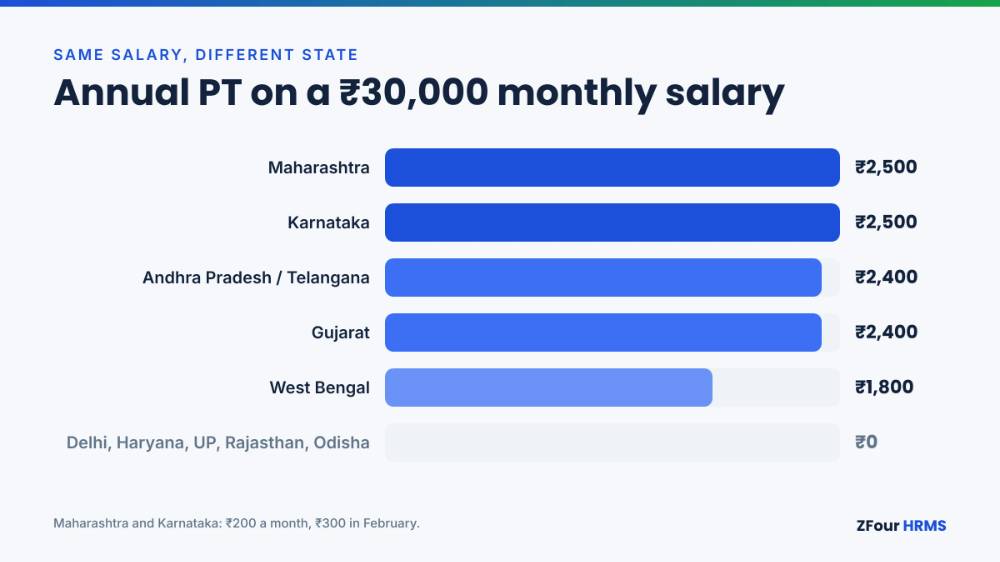
How much PT does one employee earning ₹30,000 a month pay in a year? It depends entirely on where they work:
Work state | Monthly PT | Annual PT |
|---|---|---|
Maharashtra | ₹200 (₹300 in February) | ₹2,500 |
Karnataka | ₹200 (₹300 in February) | ₹2,500 |
Andhra Pradesh / Telangana | ₹200 | ₹2,400 |
Gujarat | ₹200 | ₹2,400 |
West Bengal | ₹150 | ₹1,800 |
Delhi, Haryana, Uttar Pradesh, Rajasthan, Odisha | Nil | Nil |
For an employee the difference is small. For an employer with hundreds of staff across states, it is a meaningful line in the budget and, more importantly, a calculation that must be right for every person, every month.
Check your take-home pay after PT — use our free salary calculator and email yourself the breakdown.
Professional Tax and income tax
PT paid by an employee reduces their taxable salary under the old tax regime. Under the new tax regime, which is the default, this deduction is not available. So for most employees on the new regime, PT is a cost that doesn't reduce their income tax.
For the employer, PT deducted from employees is simply passed on to the state. The employer's own PT on the business entity is generally a deductible business expense.
Common Professional Tax mistakes
Using the head-office state for everyone
The most common error. PT depends on where each employee works. A Delhi company with a Pune branch must deduct Maharashtra PT for its Pune staff.
Forgetting the February amount
In Maharashtra and Karnataka, February PT is ₹300. Payroll configured with a flat ₹200 leaves ₹100 per employee short and triggers a demand.
Not updating for repeals and thresholds
Odisha employers still deducting PT after April 2026, and Karnataka employers deducting from employees earning under ₹25,000, are both over-deducting. Refunds to employees and corrections with the state take time.
Missing registrations when a new branch opens
PT registration should be on the checklist for every new location, before the first payroll.
Ignoring employees who transfer mid-year
When an employee moves from a PT state to a non-PT state, stop deductions from the month they move; when they move into a PT state, start. Keep transfer dates on record.
Treating PT as optional for small teams
Even a two-person branch must deduct and pay PT if the state levies it and salaries exceed the threshold.
Industry notes
Manufacturing and factories
Large shop-floor teams often include employees just above and below thresholds. Small changes in overtime or allowances can push monthly gross over a slab boundary, changing PT that month. Payroll should compute PT on each month's actual gross, not a fixed figure.
Security and facility services
Guards deployed across states — Maharashtra one month, Karnataka the next — need their work location updated with each deployment, or PT will be paid to the wrong state.
Field sales teams
Reps covering territories across state borders should have a single assigned base location for PT, documented in their appointment letter.
IT companies and startups
Hybrid and remote employees create PT questions when someone works from a different state than their assigned office. Assign a base location per employee and review it when work arrangements change.
Retail chains
Stores in many states mean many PT registrations. Maintain a state master linking every store to its PT registration, due dates and the person responsible for filing.
Penalties for getting PT wrong
Each state sets its own interest and penalty rules for late registration, late payment, non-deduction and late returns. Typical consequences include interest on late payments, a penalty for failing to register and a penalty linked to the unpaid tax. Confirm current rates for each state with your adviser.
The practical risk for multi-state employers is cumulative: small amounts across many employees and months add up, and assessments can go back several years.
A Professional Tax checklist for HR and payroll
List every state where you have employees on payroll.
Confirm PT registration (and entity enrolment where required) in each PT state.
Record each employee's work-location state in payroll.
Configure current slabs, including February amounts, for each state.
Apply exemptions (women's threshold in Maharashtra, disability and other state exemptions) with supporting documents.
Stop Odisha deductions from April 2026; apply Karnataka's ₹25,000 threshold.
Set due-date reminders for each state's payment and returns.
Reconcile PT deducted with PT paid every month.
Review slabs and notifications every April.
For employees: how to check PT on your payslip
If you're an employee wondering whether your PT deduction is right, three checks cover almost every case:
Find the line. PT appears on the payslip as "Professional Tax", "PT" or "Prof. Tax", under deductions.
Check your work state. If you work in Delhi, Haryana, Uttar Pradesh, Rajasthan or (from April 2026) Odisha, there should be no PT. If you work in Karnataka and earn less than ₹25,000 a month, there should be none either.
Check the amount. In most PT states it should be ₹200 a month or less, with ₹300 in February in Maharashtra and Karnataka, and no more than ₹2,500 across the year.
If something looks wrong, ask HR which state your PT is paid to and on what salary it was calculated. Over-deducted PT can be refunded through payroll; under-deducted PT is the employer's liability to correct.
How ZFour HRMS handles Professional Tax
ZFour HRMS applies the PT slab of each employee's work location automatically in every payroll run, including February amounts and state thresholds, alongside PF, ESI and TDS. When an employee transfers, PT switches state from the next payroll. PT reports by state support payment and returns.
Statutory compliance, including PT, is included from the Workforce Pro plan at ₹70 per user per month plus GST. See payroll compliance software, check take-home pay with the salary calculator, and use our payroll compliance calendar for every due date.
Stay on top of PT in every state
Download the State PT workbook
See multi-state PT handled automatically → Pick a demo time
Sources
SCC Online — Odisha repeals levy of Professional Tax from 1 April 2026
Lexplosion — Karnataka notifies revised Professional Tax rate (Amendment Act, 2025)
Lexplosion — Maharashtra Professional Tax return dates revised
Lexplosion — Maharashtra exempts women earning up to ₹25,000
Greater Chennai Corporation — Professional Tax circular R.D.(HQ).C.No.PT/SPL/2024, dated 20 January 2025

Farheen Ahmed
HR Tech Content Strategist at ZFour Technology Private Limited
Research-driven content on HRMS, payroll, attendance management, employee management, and modern HR technology for Indian businesses.