6 min read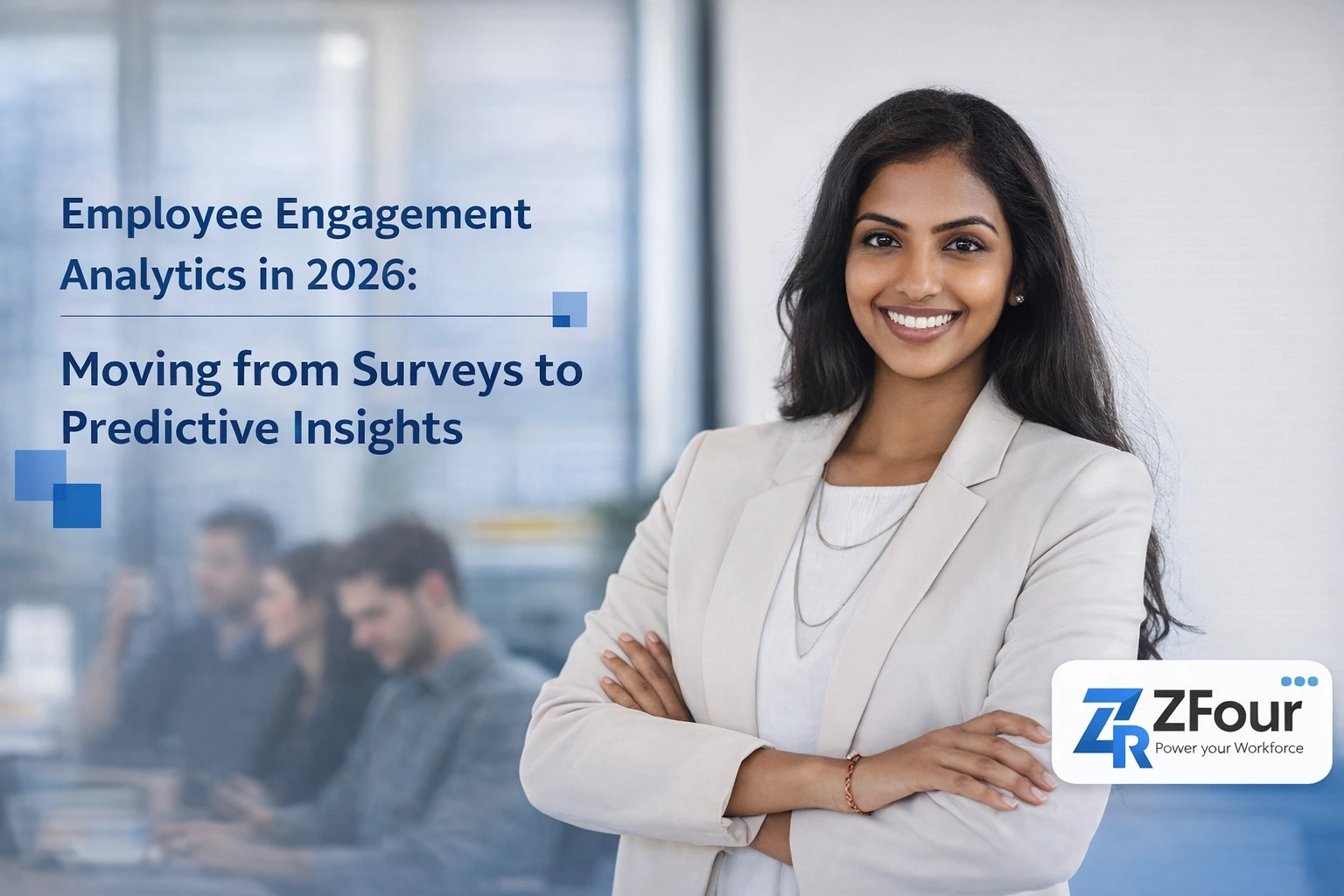
Employee engagement has shifted from an annual HR survey topic to a metric organizations track continuously. By 2026, companies are no longer asking whether engagement matters — they're asking how to measure it accurately and respond before disengagement becomes attrition.
This guide explains what employee engagement analytics actually measures, why traditional annual surveys increasingly miss the real picture, and how organizations are using ongoing data to inform retention strategy.
Quick Answer: What Is Employee Engagement Analytics?
Employee engagement analytics is the practice of using ongoing behavioral, participation, and feedback data — rather than periodic surveys alone — to understand how employees feel about their work over time. Instead of measuring engagement once or twice a year, it tracks patterns like feedback frequency, leave usage, and participation trends to identify disengagement risk earlier, giving managers a chance to intervene before an employee decides to leave.
Why Traditional Annual Surveys Are Losing Relevance
Annual and quarterly engagement surveys were built for a slower-moving workplace. By the time survey results are compiled and reviewed, the underlying sentiment they captured may have already shifted — an employee's motivation may have already declined, or a resignation decision may already be underway.
According to Gallup's State of the Global Workplace research, global employee engagement has been declining for two consecutive years, falling to 20% in 2025, down from a peak of 23% in 2022.
What's Actually Driving the Decline
Gallup's research points to a specific, measurable driver: manager engagement has dropped sharply, falling from 27% in 2024 to 22% in 2025 — the steepest single-year decline Gallup has recorded for this group. Individual contributor engagement, by contrast, has held relatively steady. Gallup attributes roughly 70% of the variance in team-level engagement to the manager, which means a decline concentrated among managers has an outsized effect on the teams they lead.
This is a meaningfully different picture than a generic "engagement is falling everywhere" narrative — it points specifically to manager support, training, and workload as the areas most worth investing in.
Global Engagement Trends at a Glance
Metric | 2022 | 2024 | 2025 |
|---|---|---|---|
Overall employee engagement (global) | 23% | 21% | 20% |
Manager engagement | — | 27% | 22% |
Individual contributor engagement | — | 18% | ~18% (relatively stable) |
Managers who received formal management training | — | — | 44% |
Source: Gallup, State of the Global Workplace, 2025–2026 reports
Gallup estimates that declining engagement cost the global economy over $10 trillion in lost productivity in 2024 alone — roughly 9% of global GDP — underscoring that this isn't just an HR metric but a measurable economic one.
What Employee Engagement Analytics Measures
Rather than relying solely on periodic questionnaires, engagement analytics draws on ongoing signals, including:
Feedback frequency — how often and how substantively employees engage with feedback channels
Leave usage patterns — unusual changes in leave-taking behavior, which can indicate burnout or disengagement
Participation trends — involvement in optional meetings, initiatives, or collaborative work
Response and communication tone — shifts in how employees communicate over time
The goal isn't to replace human judgment with data — it's to surface patterns a manager might not notice through occasional, informal check-ins alone.
Burnout: A Measurable Contributor to Disengagement
Burnout is formally recognized by the World Health Organization as an occupational phenomenon, defined in the ICD-11 as resulting from chronic workplace stress that has not been successfully managed, characterized by feelings of energy depletion, increased mental distance from one's job, and reduced professional efficacy.
This matters for engagement analytics specifically because burnout indicators — reduced communication, skipped planned leave, extended working hours — often precede visible disengagement or a resignation decision, making them a useful early signal rather than just a wellness concern.
Common Burnout-Related Signals
Indicator | What It May Suggest |
|---|---|
Extended working hours over time | Rising workload pressure |
Reduced use of planned leave | Difficulty disconnecting from work |
Declining communication or participation | Emotional withdrawal |
Flat or negative feedback tone | Reduced engagement with the role |
No single indicator confirms burnout or an intent to leave — these are useful as directional signals that warrant a genuine conversation, not automatic conclusions.
From Reactive to Predictive: How Retention Analysis Is Changing
Traditional retention analysis is backward-looking — it relies on exit interviews and historical attrition data to explain why employees have already left. This tells an organization what happened, but not what's currently at risk.
Predictive retention analytics, by contrast, looks at patterns that tend to appear before disengagement becomes obvious — combining engagement trends, burnout-related signals, and participation data to identify which teams or roles may carry higher retention risk in the near term. The goal is enabling a manager conversation or workload adjustment while an employee is still engaged, rather than reacting after a resignation letter arrives.
Why This Matters for Retention Economics
While exact figures vary significantly by role, industry, and location, the pattern holds broadly: replacing an employee typically costs meaningfully more than retaining one, which is why even a modest reduction in voluntary attrition can produce a disproportionate return. Since attrition often intersects with payroll and exit processing, see our guide to Full & Final settlement and exit workflows for how structured offboarding connects to this.
Quiet Quitting Is Usually a Late-Stage Signal, Not a Sudden One
What's often labeled "quiet quitting" — an employee continuing to perform required tasks while withdrawing discretionary effort — rarely happens overnight. It typically follows a period of gradually declining engagement that wasn't caught early: reduced initiative, more neutral communication, and less voluntary collaboration.
This is exactly the kind of gradual pattern that ongoing engagement analytics is better positioned to catch than an annual survey, which only captures a single point in time.
Practical Ways to Act on Engagement Data
Treat manager support as a primary lever, not a secondary one.
Given Gallup's finding that managers account for roughly 70% of team engagement variance, and that only 44% of managers report receiving formal management training, investing in manager training and support may have outsized impact relative to broader, less targeted engagement initiatives.
Use engagement signals to prompt conversations, not conclusions.
A declining participation pattern or a burnout indicator should trigger a genuine one-on-one conversation, not an assumption about someone's intentions.
Don't replace human judgment with dashboards.
Engagement analytics surfaces patterns worth investigating — it doesn't replace the manager relationship or the conversation that actually addresses the underlying issue. For a broader look at how HR analytics and reporting support these kinds of workforce decisions, see our HR Compliance and analytics readiness guide.
Review trends at the team level, not just individually.
Since manager engagement has an outsized effect on team engagement, patterns worth investigating often show up at the team level before they're visible in any single employee's data.
Final Thoughts
Employee engagement has moved from a once-a-year survey topic to something organizations increasingly track continuously, and the data behind this shift is genuinely significant — global engagement has declined for two consecutive years according to Gallup, driven specifically by a sharp drop in manager engagement rather than a broad decline across all roles. Engagement analytics doesn't replace human leadership; it gives managers earlier visibility into patterns worth a real conversation, which is where the actual retention value comes from.
Want to see how ZFour HRMS supports engagement and workforce analytics?
Book a ZFour HRMS demo.

Farheen Ahmed
HR Tech Content Strategist at ZFour Technology Private Limited
Research-driven content on HRMS, payroll, attendance management, employee management, and modern HR technology for Indian businesses.