11 min read
Employee satisfaction is an important indicator of how employees perceive their work, workplace, management, and overall employee experience. However, simply asking whether employees are happy does not give HR teams enough information to improve the workplace.
Employee satisfaction metrics help organizations turn employee feedback and workforce data into measurable insights. By tracking the right metrics over time, HR teams can identify areas of concern, understand employee sentiment, evaluate workplace initiatives, and make more informed people-management decisions.
This guide explains the most useful employee satisfaction metrics, how to measure them, what they can reveal, and how organizations can use the results to improve employee experience and retention.
What Are Employee Satisfaction Metrics?
Employee satisfaction and employee engagement are related but distinct concepts. The CIPD notes that employee engagement goes beyond motivation and job satisfaction and includes employees' commitment to the organization and willingness to contribute.
These metrics can cover areas such as:
Job satisfaction
Employee engagement
Workplace experience
Manager effectiveness
Recognition
Career development
Work-life balance
Compensation and benefits
Employee retention
Workplace relationships
No single metric can fully represent employee satisfaction. HR teams should combine survey responses, workforce data, and qualitative feedback to develop a more complete picture.
Why Should Businesses Measure Employee Satisfaction?
Measuring employee satisfaction gives HR teams a structured way to understand employee experiences instead of relying only on assumptions or informal feedback. Organizations can also use broader employee engagement strategies to turn these insights into practical workplace improvements.
Regular measurement can help organizations:
Identify recurring employee concerns
Understand changes in workplace sentiment
Evaluate HR initiatives
Identify areas requiring management attention
Support employee experience improvements
Monitor potential retention risks
Make more informed workforce decisions
The results should not simply be collected and stored. The most useful satisfaction programs connect measurement with action.
For example, if survey responses indicate that employees are unclear about career progression, HR may investigate development opportunities, manager communication, and internal mobility rather than assuming compensation is the primary concern.
Key Employee Satisfaction Metrics to Track
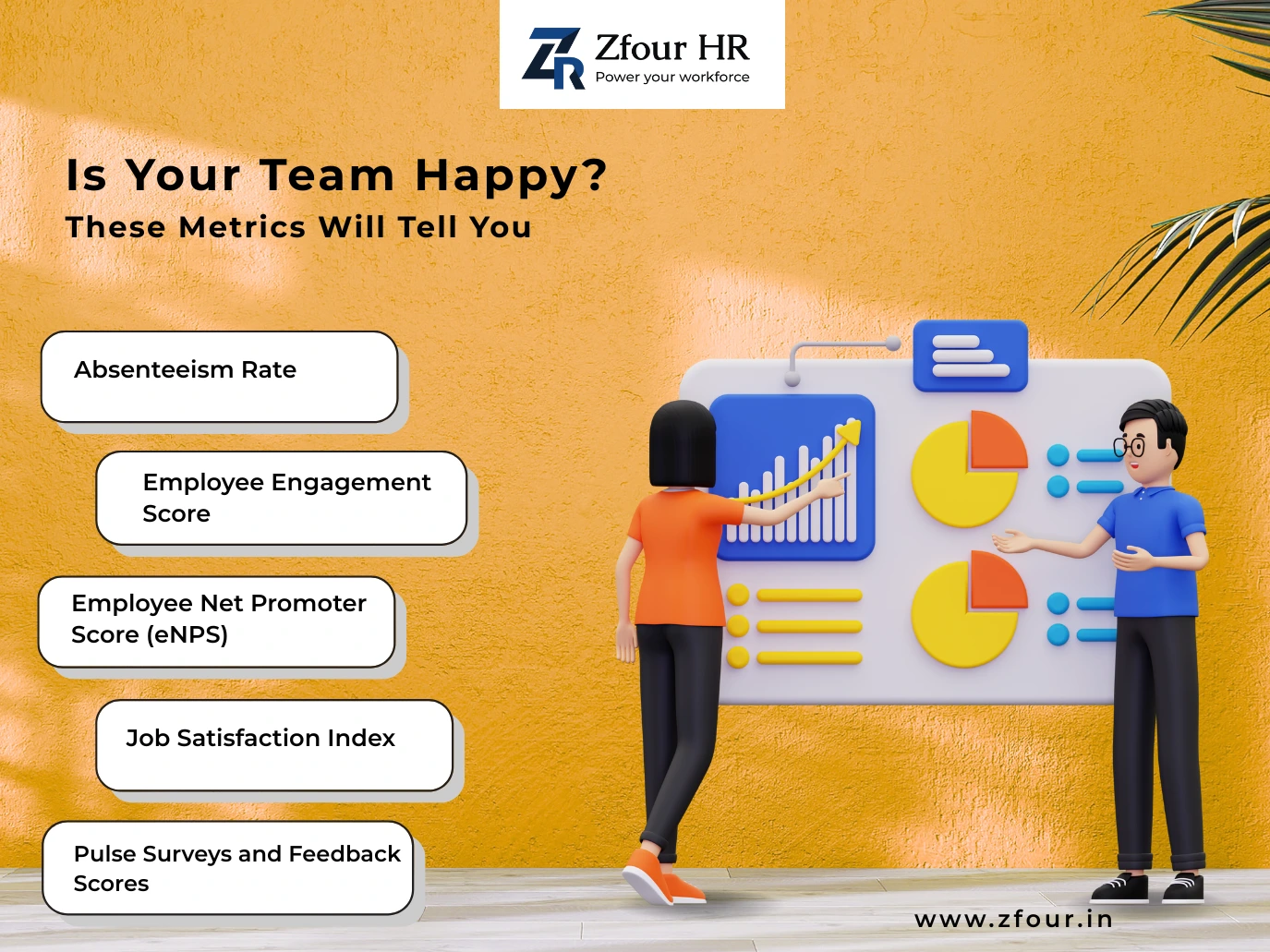
Different organizations may need different metrics depending on their workforce, industry, size, and objectives. The following provide a practical starting point.
1. Employee Satisfaction Score
The Employee Satisfaction Score (ESS) measures how satisfied employees are with their overall work experience or a specific aspect of their employment.
A simple survey might ask:
“How satisfied are you with your overall experience at the organization?”
Employees can respond using a numerical scale, such as 1–5.
Example calculation
If 80 employees respond and their total satisfaction score is 320:
Employee Satisfaction Score = 320 ÷ 80 = 4.0
Organizations can track the score over time rather than relying on a single survey.
2. Employee Net Promoter Score (eNPS)
Employee Net Promoter Score (eNPS) measures employees' willingness to recommend their organization as a place to work.
A common question is:
“On a scale of 0 to 10, how likely are you to recommend this organization as a place to work?”
Responses are generally grouped into:
Promoters: 9–10
Passives: 7–8
Detractors: 0–6
Formula
eNPS = % Promoters − % Detractors
The score can range from -100 to +100.
eNPS should be interpreted in context. Comparing your organization's score against its own historical results, rather than treating a generic external benchmark as universally applicable, can provide more useful insight.
3. Employee Engagement Score
Employee satisfaction and employee engagement are related but not identical.
Satisfaction generally reflects how employees perceive their employment experience, while engagement can also consider factors such as involvement, commitment, and willingness to contribute.
An engagement survey may examine:
Connection to organizational goals
Motivation
Recognition
Manager support
Opportunities to grow
Intention to remain
Willingness to recommend the organization
Tracking engagement alongside satisfaction can help HR distinguish between employees who are comfortable in their roles and employees who are actively engaged with their work.
4. Pulse Survey Participation and Results
Pulse surveys are short, frequent employee surveys designed to capture changes in workplace sentiment.
Instead of conducting one large survey every year, organizations can use shorter surveys periodically.
Useful pulse-survey questions might cover:
Workload
Manager support
Communication
Recognition
Team collaboration
Workplace flexibility
Overall satisfaction
What to measure
Track both:
Participation rate:
Number of employees responding ÷ number of employees invited × 100
Average response score:
Total scores ÷ number of responses
Participation matters because a satisfaction score based on a very small or consistently narrow group may not represent the broader workforce.
5. Employee Turnover Rate
Employee turnover can provide an important workforce signal, although it should not be treated as a direct measure of satisfaction.
A commonly used formula is:
Turnover Rate = Number of employee departures during a period ÷ Average number of employees during the period × 100
HR teams can analyze turnover alongside survey results to identify potential relationships.
For example, if satisfaction scores decline in a particular department while voluntary turnover rises, that area may deserve further investigation.
6. Voluntary Turnover Rate
Voluntary turnover focuses specifically on employees who choose to leave the organization.
This distinction matters because employee departures can occur for many reasons, including:
Resignation
Retirement
Redundancy
Termination
Contract completion
Separating voluntary and involuntary turnover can give HR teams a clearer view of employee retention patterns.
7. Absenteeism Rate
Absenteeism measures employee absence over a defined period.
A basic formula is:
Absenteeism Rate = Total days absent ÷ Total scheduled working days × 100
Absenteeism should be interpreted carefully because absence can have many causes unrelated to satisfaction.
However, when absenteeism changes alongside other workforce indicators, it can provide additional context for HR analysis.
8. Manager Effectiveness Score
Managers can have a significant influence on employees' day-to-day experience.
HR teams can use employee surveys to measure perceptions of:
Manager communication
Feedback quality
Recognition
Support
Fairness
Goal clarity
Availability
A manager effectiveness score can be tracked by team or department, provided reporting practices protect employee confidentiality.
9. Recognition Satisfaction
Recognition can be included as a dedicated satisfaction metric.
Ask employees questions such as:
“I feel that my contributions are appropriately recognized.”
Responses can be tracked over time to identify whether recognition initiatives are reaching employees effectively.
HR teams can also compare results across departments or employee groups where the sample size allows meaningful analysis.
10. Career Development Satisfaction
Employees may evaluate their experience partly through opportunities to learn and grow.
Useful survey questions include:
Do you understand your career opportunities?
Do you have access to relevant learning opportunities?
Do you receive useful development feedback?
Do you feel supported in developing new skills?
Tracking these responses can help HR identify gaps in learning, career planning, or manager support.
11. Work-Life Balance Satisfaction
Work-life balance can be measured through questions about:
Workload
Working hours
Flexibility
Time-off experience
Work-related stress
Ability to disconnect from work
Because employees' circumstances differ, organizations should avoid assuming that one working arrangement will produce the same experience for everyone.
12. Compensation and Benefits Satisfaction
Compensation and benefits can be included in employee satisfaction surveys to understand how employees perceive their overall rewards package.
Questions might examine:
Pay satisfaction
Benefits
Perceived fairness
Transparency
Understanding of benefits
This metric should be interpreted alongside market conditions, role expectations, location, and other relevant factors.
Employee Satisfaction Metrics: Quick Comparison
Metric | What It Measures | How It Helps |
|---|---|---|
Employee Satisfaction Score | Overall satisfaction | Tracks workplace sentiment |
eNPS | Likelihood to recommend employer | Indicates employee advocacy |
Engagement Score | Connection and involvement | Identifies engagement patterns |
Pulse Survey Score | Short-term sentiment | Detects changes more frequently |
Turnover Rate | Employee departures | Monitors workforce stability |
Voluntary Turnover | Resignation patterns | Helps analyze retention |
Absenteeism Rate | Employee absence | Adds workforce context |
Manager Effectiveness | Manager-related experience | Identifies leadership areas |
Recognition Satisfaction | Perceived recognition | Evaluates recognition practices |
Career Development Satisfaction | Growth opportunities | Identifies development gaps |
How to Measure Employee Satisfaction Effectively
Collecting employee satisfaction data is only useful when the measurement process is designed properly.
1. Define What You Want to Measure
Start with a clear objective.
For example:
Overall employee satisfaction
Manager experience
Career development
Work-life balance
Recognition
Workplace communication
Avoid trying to measure everything in one survey.
2. Use a Mix of Quantitative and Qualitative Questions
Numerical questions make results easier to compare.
However, open-ended questions can explain why employees gave a particular score.
For example:
“How satisfied are you with your career development opportunities?”
Follow it with:
“What is one thing we could improve?”
This combination gives HR both measurable data and context.
3. Maintain Survey Consistency
If you want to track satisfaction over time, keep some core questions consistent.
Changing every question in every survey makes trend analysis more difficult.
You can still introduce additional questions when a new issue needs investigation.
4. Protect Employee Confidentiality
Employees are more likely to provide useful feedback when they understand how their responses will be handled.
Organizations should establish clear rules around:
Data access
Reporting
Anonymity or confidentiality
Minimum reporting groups
Storage
Employee communication
The appropriate approach depends on the organization's structure and applicable privacy requirements.
5. Segment Results Carefully
Aggregate results can hide important differences.
Where sample sizes are sufficient, HR teams can examine results by:
Department
Location
Tenure
Role
Manager
Work arrangement
However, small groups should not be reported in a way that could compromise employee confidentiality.
How Often Should Employee Satisfaction Be Measured?
There is no universal frequency that works for every organization.
A practical approach could be:
Annual Employee Survey
Use a more comprehensive survey to evaluate broad employee experience.
Quarterly or Periodic Pulse Surveys
Use shorter surveys to identify changing sentiment.
Event-Based Feedback
Collect feedback after important employee experiences such as:
Onboarding
Training
Performance reviews
Internal transfers
Exit processes
The right frequency depends on survey fatigue, workforce size, organizational changes, and the ability of HR teams to act on the results.
How to Interpret Employee Satisfaction Metrics
A metric should never be viewed in isolation.
For example:
High satisfaction + high turnover
may indicate that employees generally like the workplace but are leaving for external opportunities or specific role-related reasons.
Low satisfaction + high absenteeism
may justify further investigation into workload, management, scheduling, or other workplace factors.
High engagement + low recognition satisfaction
could indicate that employees are committed to their work but believe their contributions are not sufficiently recognized.
These are signals for investigation, not proof of causation.
HR teams should combine quantitative results with employee comments, manager feedback, and workforce data before deciding what action to take.
How HR Teams Can Improve Employee Satisfaction
Measuring satisfaction is only the first step. The next is turning insights into practical improvements.
Improve Internal Communication
Create clear communication channels and give employees appropriate opportunities to ask questions and provide feedback.
Strengthen Recognition
Recognize contributions consistently and make recognition meaningful rather than purely symbolic.
Support Career Development
Provide relevant learning opportunities, development conversations, and clearer visibility into potential career paths.
Improve Manager Support
Give managers the training and resources they need to communicate expectations, provide feedback, and support their teams.
Review Workload and Flexibility
Use employee feedback to identify workload concerns and evaluate whether existing working arrangements meet business and employee needs.
Close the Feedback Loop
Tell employees what was learned and, where appropriate, what actions will follow.
A survey without visible follow-up can reduce employees' confidence in the feedback process.
Using HR Analytics to Understand Employee Satisfaction
Employee satisfaction data becomes more useful when combined with broader workforce information.
HR analytics can help teams examine relationships between satisfaction scores, turnover, absenteeism, performance, tenure, and training participation.
Satisfaction scores
Turnover
Absenteeism
Performance
Tenure
Training participation
Department-level trends
For example, HR teams could investigate whether satisfaction differs between newer employees and longer-tenured employees, or whether particular departments consistently report lower scores.
The objective should be to identify patterns worth investigating, rather than assuming that one metric explains employee behavior.
How HR Software Can Support Employee Satisfaction Measurement
HR technology can help centralize workforce information and simplify the collection and analysis of satisfaction data.
Where genuinely useful, this looks less like "the software collects surveys" and more like connecting satisfaction data to context that would otherwise require manual cross-referencing.
For example, if satisfaction scores in one team are dropping, being able to check that team's attendance patterns, tenure distribution, and recent manager changes in the same system — rather than pulling three separate reports — is what actually turns a survey result into an investigable pattern.
Depending on the platform and configuration, HR software may support:
Employee records connected to survey responses
Attendance and leave data for cross-referencing
Performance data alongside satisfaction trends
Workforce reports segmented by department or tenure
Employee self-service for submitting feedback directly
For organizations using ZFour HRMS, this kind of cross-referencing depends on which modules are configured — a survey tool that sits disconnected from attendance and tenure data still requires the same manual correlation work a spreadsheet would.
The purpose of using HR technology is not simply to collect more data. It is to make it possible to investigate a satisfaction signal against the workforce context that explains it, without that investigation itself becoming a multi-day data-gathering exercise.
Common Mistakes When Measuring Employee Satisfaction
Measuring Only Once a Year
Annual surveys can provide valuable information, but they may miss changes that happen between survey cycles.
Tracking Too Many Metrics
A large collection of disconnected metrics can make it difficult to identify what actually matters.
Start with a small set of meaningful indicators.
Focusing Only on Scores
A score tells you what changed. Qualitative feedback can help explain why.
Ignoring Low Participation
A satisfaction score based on limited participation may not represent the overall workforce.
Treating Satisfaction as the Same as Engagement
The two concepts overlap but should not automatically be treated as identical.
Collecting Feedback Without Taking Action
Employees may become less willing to participate when they repeatedly provide feedback without seeing meaningful follow-up.
Employee Satisfaction Survey Questions
HR teams can use questions such as:
How satisfied are you with your overall employee experience?
Do you understand what is expected of you in your role?
Do you feel supported by your manager?
Do you receive useful feedback?
Do you feel your contributions are recognized?
Are you satisfied with your opportunities for learning and development?
Do you feel comfortable sharing feedback with the organization?
How satisfied are you with your current workload?
Do you feel that communication within your team is effective?
How likely are you to recommend the organization as a place to work?
Use a consistent response scale where possible so results can be compared over time.
Final Thoughts
Employee satisfaction metrics give HR teams a structured way to understand the employee experience and identify areas that may need attention.
The most effective approach is not to chase a single “happiness score.” Instead, organizations should combine satisfaction surveys, eNPS, engagement indicators, turnover, absenteeism, manager feedback, and qualitative employee comments.
Most importantly, measurement should lead to action.
When HR teams identify a recurring issue, investigate its underlying causes, communicate what they have learned, and make appropriate improvements, employee feedback becomes a practical input into workforce management.
The goal is simple: measure what matters, understand why it matters, and use the insight to create a better employee experience.

Farheen Ahmed
HR Tech Content Strategist at ZFour Technology Private Limited
Research-driven content on HRMS, payroll, attendance management, employee management, and modern HR technology for Indian businesses.