7 min read
February has become one of the most compliance-dense months on the Indian HR calendar — not because of a single new rule, but because multiple statutory deadlines (PF, ESIC, Professional Tax, TDS, Labour Welfare Fund, and annual return filings under the Labour Codes) tend to converge in a single month. With the Labour Codes now in force and digital cross-verification through the Shram Suvidha Portal becoming standard, inconsistencies between payroll data and statutory filings are easier to detect than they were under the previous, more fragmented system.
This guide walks through what Indian employers genuinely need to track in February, clarifies a source of real confusion around annual return deadlines, and explains the state-specific risks that catch many businesses off guard.
Quick Answer: What Should Employers Prioritize in February?
The core February compliance areas for Indian employers are:
TDS deposit — due by the 7th of the month
PF and ESIC contributions — due by the 15th
State-specific Professional Tax deadlines — vary by state (some by mid-February, others by month-end)
Annual return filings under the Labour Codes — deadline details are genuinely contested across sources; verify directly (explained below)
State-specific Labour Welfare Fund contributions — applicable in certain states with February or late-January deadlines
Given genuine ambiguity in some annual return deadlines this year, the most reliable approach is confirming your specific obligation directly through the Shram Suvidha Portal or your state's labour department, rather than relying on a single blanket date.
Why February Specifically Is Compliance-Dense
February isn't compliance-heavy because of one dramatic new requirement — it's dense because several separate obligations, each with their own statutory basis, happen to land in the same 28-day window:
Monthly filings (PF, ESIC, TDS) that occur every month, but with February being a shorter month, timelines feel tighter
State-specific annual adjustments, like Maharashtra's Professional Tax structure, which concentrates part of the annual liability into February
Annual or year-end filings that some states and frameworks schedule for February specifically
This concentration effect — rather than a single unified "February surprise" — is what makes the month operationally demanding for HR and payroll teams managing multiple states.
The Genuine Confusion Around "Form III" and Annual Return Deadlines
This is worth addressing directly, because there's real inconsistency across sources on this point, and getting it wrong has genuine compliance consequences.
What's clear:
Form III has historically referred to the Annual Return under the Minimum Wages Act, 1948, and the applicable rule specifies this should be uploaded on or before the 1st day of February each year, per the government's official rule text.
Separately, under the newer OSH (Central) Rules, 2026, annual returns for establishments under that Code's jurisdiction are reported by some legal analysts to be due by the last day of February.
Form III is also used elsewhere in the Labour Codes — for instance, as the registration certificate form issued after establishment registration, and separately for gratuity nomination purposes under the Code on Social Security. These are different requirements that share the same form number, which is a genuine source of confusion in secondary compliance content.
What this means practically: Rather than treating "Form III deadline" as a single date, employers should identify which specific return applies to their establishment (Minimum Wages annual return vs. OSH Code annual return vs. registration-related Form III vs. gratuity nomination Form III) and confirm the applicable deadline for that specific filing through official Shram Suvidha Portal guidance or a labour law advisor, rather than relying on a single generalized date.
February 2026 Statutory Due Dates Calendar (India)
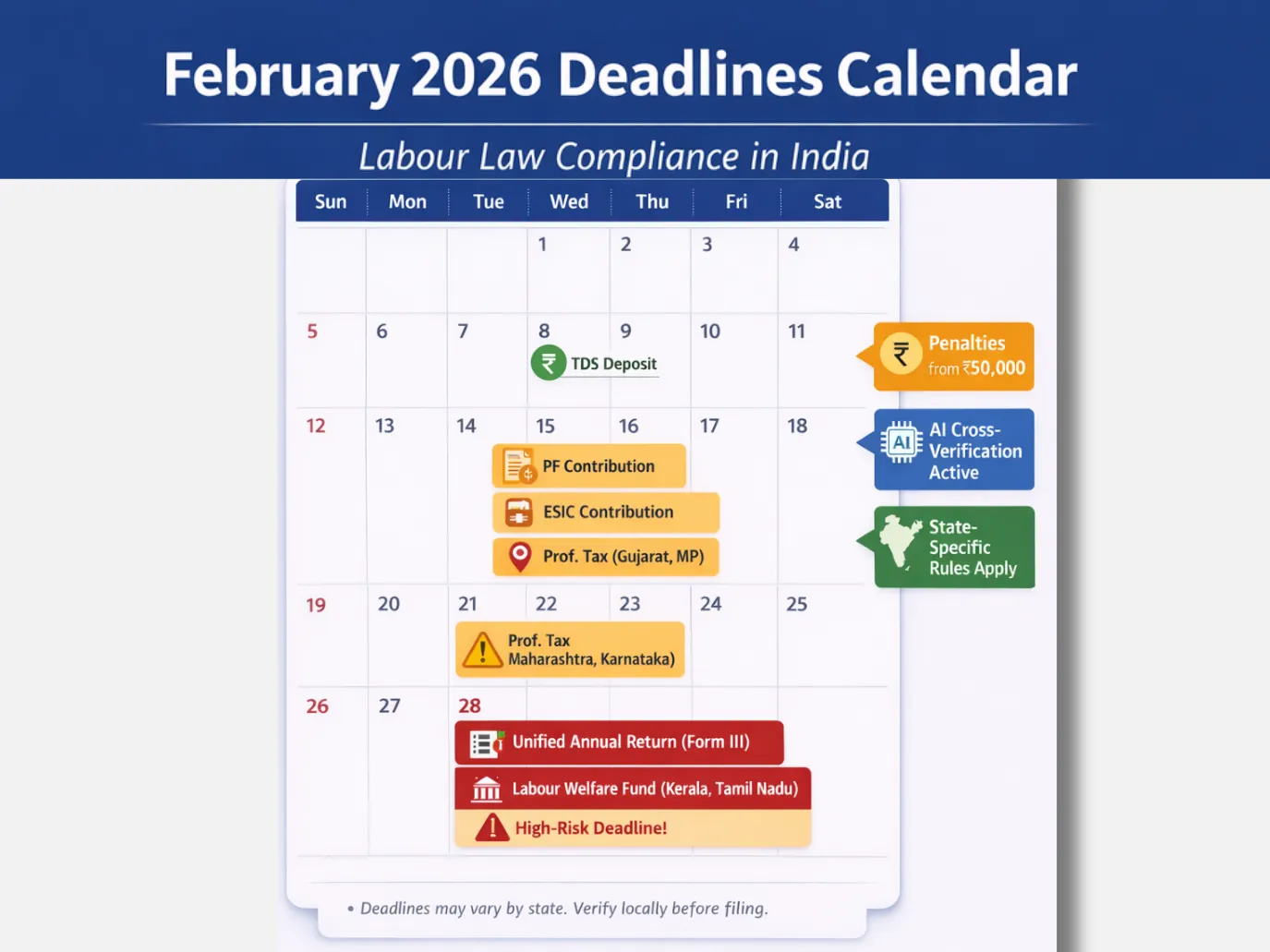
February 2026 Statutory Deadlines at a Glance
Compliance Requirement | Typical Deadline | Governing Framework | Notes |
|---|---|---|---|
TDS Deposit | 7th of the month | Income Tax Act | Standard monthly deadline |
PF & ESIC Contribution | 15th of the month | EPF & MP Act / ESI Act | Standard monthly deadline |
Professional Tax (varies by state) | Mid to late February | State PT Laws | Confirm exact date per state |
Annual Return (Minimum Wages framework) | On or before 1st February | Minimum Wages (Central) Rules | Per government rule text |
Annual Return (OSH Code framework) | Reported as last day of February by some analysts | OSH (Central) Rules, 2026 | Confirm applicability to your establishment |
Labour Welfare Fund (select states) | Varies — some late January/early February | State LWF Acts | State-specific; Karnataka and Tamil Nadu among applicable states |
Note: This table reflects general patterns reported across multiple sources as of this writing. Given the genuine ambiguity around specific annual return deadlines discussed above, employers should verify the exact date applicable to their establishment type and state directly, rather than relying solely on this or any other secondary summary.
State-Specific Risks Employers Should Watch
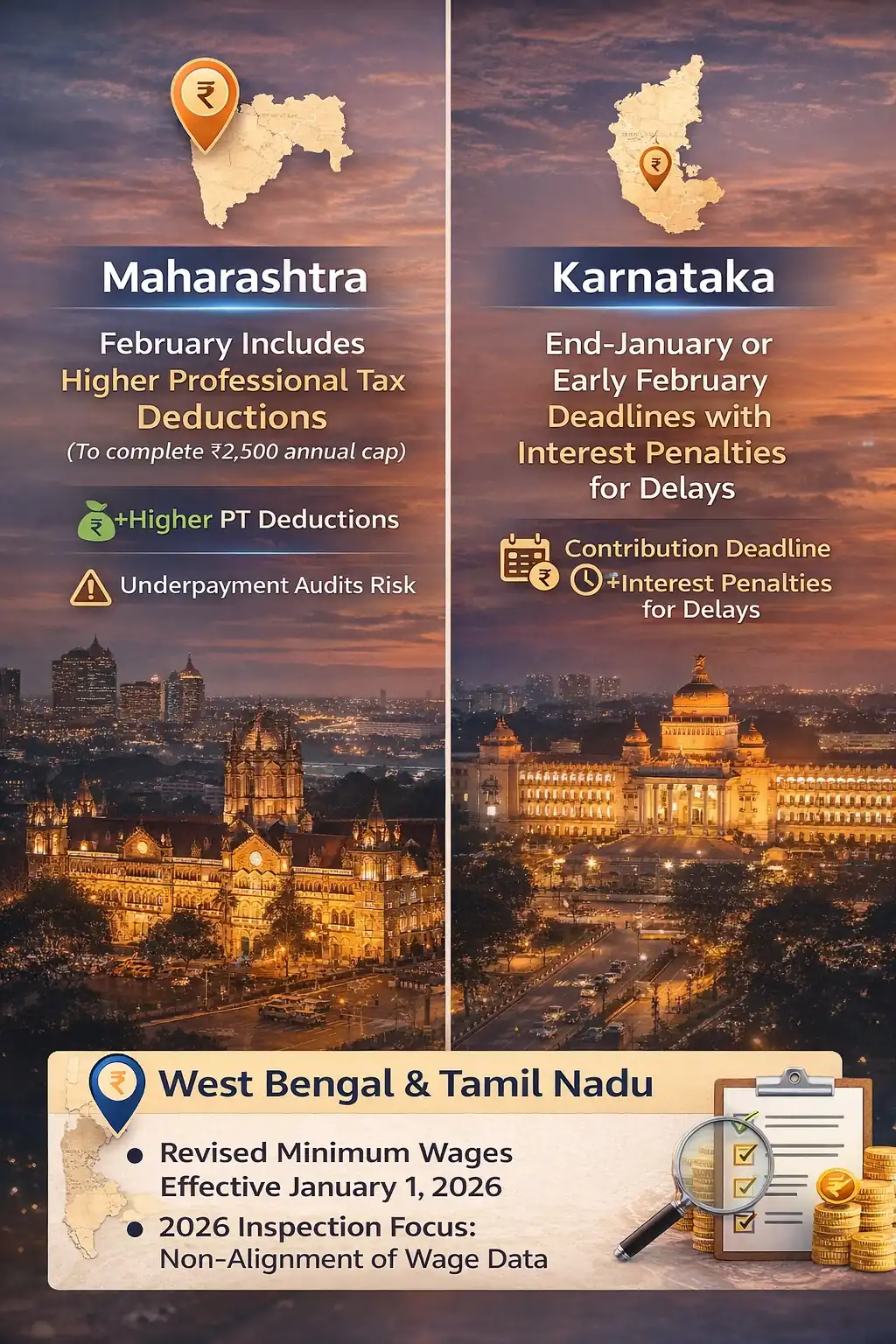
Maharashtra Professional Tax
Maharashtra structures its Professional Tax collection so that February often includes an adjusted deduction to complete the employee's annual liability under the applicable slab. Payroll teams operating in Maharashtra should confirm their February PT deduction against the current year's notified slab rather than assuming it matches earlier months' deductions.
Karnataka Labour Welfare Fund
Karnataka's Labour Welfare Fund employer contribution deadline typically falls in the late January to early February window, and delayed payment can attract interest. Businesses with Karnataka establishments should confirm the current notified due date rather than assuming it's identical to the prior year.
Multi-State Wage Notifications
Several states periodically revise minimum wage notifications, and these revisions can take effect at different points in the year depending on the state. When annual filings or year-end reconciliations occur after a state has revised its minimum wage, using outdated wage figures in that reconciliation can create a genuine mismatch that's more visible now that cross-verification is more common.
For a broader look at how payroll compliance varies across states beyond February specifically, see our Multi-State Payroll Compliance guide.
Why Digital Cross-Verification Changes the Risk Profile
The Shram Suvidha Portal has increasingly consolidated multiple compliance-related filings and registrations into a single digital system. This has a genuine practical implication: when monthly PF/ESIC contribution data, annual wage declarations, and other filings exist within a more connected digital ecosystem, an inconsistency between one filing and another is more likely to be visible than it would be if each filing existed in an isolated, paper-based system.
This doesn't necessarily mean a fully automated, real-time "AI risk-scoring" system flags every discrepancy instantly — the specific mechanics of how discrepancies are detected and acted upon depend on the systems and processes each government department has implemented. What's more reliably true is the underlying principle: digitized, cross-referenced data makes inconsistency between filings easier to detect than manual, siloed record-keeping did.
Practical Steps for February Readiness
Reconcile before you file, not after. Cross-check your gross wage figures across payroll records, PF/ESIC filings, and any annual return you're preparing before submission — catching a mismatch internally is far less costly than a discrepancy notice.
Confirm your specific annual return obligation directly. Given the genuine ambiguity discussed above around which Form III applies to your establishment and when it's due, don't rely on a single blanket date — verify through the Shram Suvidha Portal or your compliance advisor.
Track state-specific deadlines separately from central ones. Professional Tax, Labour Welfare Fund, and certain other obligations vary meaningfully by state — a single national compliance calendar that doesn't account for state variation will miss deadlines.
Update payroll immediately after a minimum wage revision. If your operating state has revised its minimum wage, reflect this in payroll before the next reconciliation or annual filing, not retroactively during it.
Maintain records that reconcile automatically, not just records that exist. The value of digital record-keeping is in internal consistency, not merely digitization — a digitized record that doesn't match your other filings creates the same exposure a paper mismatch would.
How HRMS Systems Support This Kind of Compliance
Manual, spreadsheet-based payroll makes it easy for small inconsistencies — a wage figure that wasn't updated after a minimum wage revision, a state-specific deduction applied incorrectly — to go unnoticed until a filing surfaces the discrepancy. An HRMS that connects attendance, payroll, and statutory calculation reduces this risk by keeping the underlying data consistent across the records that eventually get compared to each other during filing.
This doesn't eliminate the need to verify the specific rules applicable to your establishment and state — automation reduces calculation and reconciliation errors, but doesn't substitute for confirming the correct deadline and applicable framework for your specific filings. For a broader look at how automated systems support statutory compliance generally, see our HR Compliance in 2026 guide.
Final Thoughts
February's compliance density comes from the overlap of standard monthly filings (TDS, PF, ESIC), state-specific obligations (Professional Tax, Labour Welfare Fund), and annual return requirements whose exact deadlines depend on which specific framework and form applies to your establishment — a point genuinely confused across secondary sources this year. Rather than treating February as a single deadline to prepare for, employers are better served identifying each applicable obligation specifically, confirming its current deadline directly through official sources, and reconciling payroll data internally before any filing rather than after.
Want to see how ZFour HRMS supports reconcilable payroll and compliance-ready records?
Book a ZFour HRMS demo.

Farheen Ahmed
HR Tech Content Strategist at ZFour Technology Private Limited
Research-driven content on HRMS, payroll, attendance management, employee management, and modern HR technology for Indian businesses.