6 min read
Running HR manually — chasing timesheets, correcting payroll errors, managing leave requests through email threads — consumes real time and, over a long enough period, real money. An HRMS can reduce a meaningful share of that administrative load, though the actual savings depend heavily on which processes are automated, how well the system is configured, and whether an organization's HR problems are the kind software actually solves.
This guide explains where HRMS software typically saves time and money, what determines the size of that saving, and what to verify before assuming a platform will deliver it.
Quick Answer: How Does HRMS Software Save Time and Money?
HRMS software reduces HR time and cost primarily by automating repetitive administrative work — payroll calculations, attendance tracking, employee record-keeping, and routine reporting — and by giving employees self-service access to information they'd otherwise request from HR directly. The size of the actual saving depends on which processes were previously manual, how the system is configured, and how consistently it's used. Software does not automatically guarantee compliance or eliminate the need for HR review.
Key takeaways:
The biggest time savings usually come from payroll and attendance, since these are the most repetitive, highest-frequency HR tasks
Cost savings come from reduced administrative labor, fewer correction-driven errors, and lower recruitment overhead — not from a single feature
HRMS software does not guarantee legal compliance; it supports compliance-related record-keeping
Savings scale with workforce size and transaction volume — a 200-employee company sees a different return than a 15-employee one
What Is HRMS Software?
An HRMS (Human Resource Management System) is a platform that helps organizations manage employee data, payroll, attendance, recruitment, performance, and related HR processes within one connected environment, rather than across disconnected spreadsheets and manual records.
The exact capabilities — and therefore the exact savings — vary significantly by provider, plan, and configuration. A platform marketed as "all-in-one" doesn't necessarily include every module a specific business needs; verifying actual feature availability against a business's own requirements matters more than the general category label.
Where HRMS Software Typically Saves Time
HR Process | What Changes | Time Saved Depends On |
|---|---|---|
Payroll processing | Calculations pull from attendance/leave data instead of manual entry | Integration between modules being correctly configured |
Employee onboarding | Digital document collection replaces paper-based intake | Hiring volume; workflows actually being configured |
Employee records | Centralized data instead of searching multiple files | Data being properly migrated and maintained |
Attendance tracking | Automated logging instead of manual timesheets | Attendance method matching how the workforce actually works |
Reporting | Generated from existing data instead of manually compiled | Underlying data being accurate and complete |
Employee queries | Self-service replaces routine HR requests | Employee adoption of self-service tools |
Payroll Processing
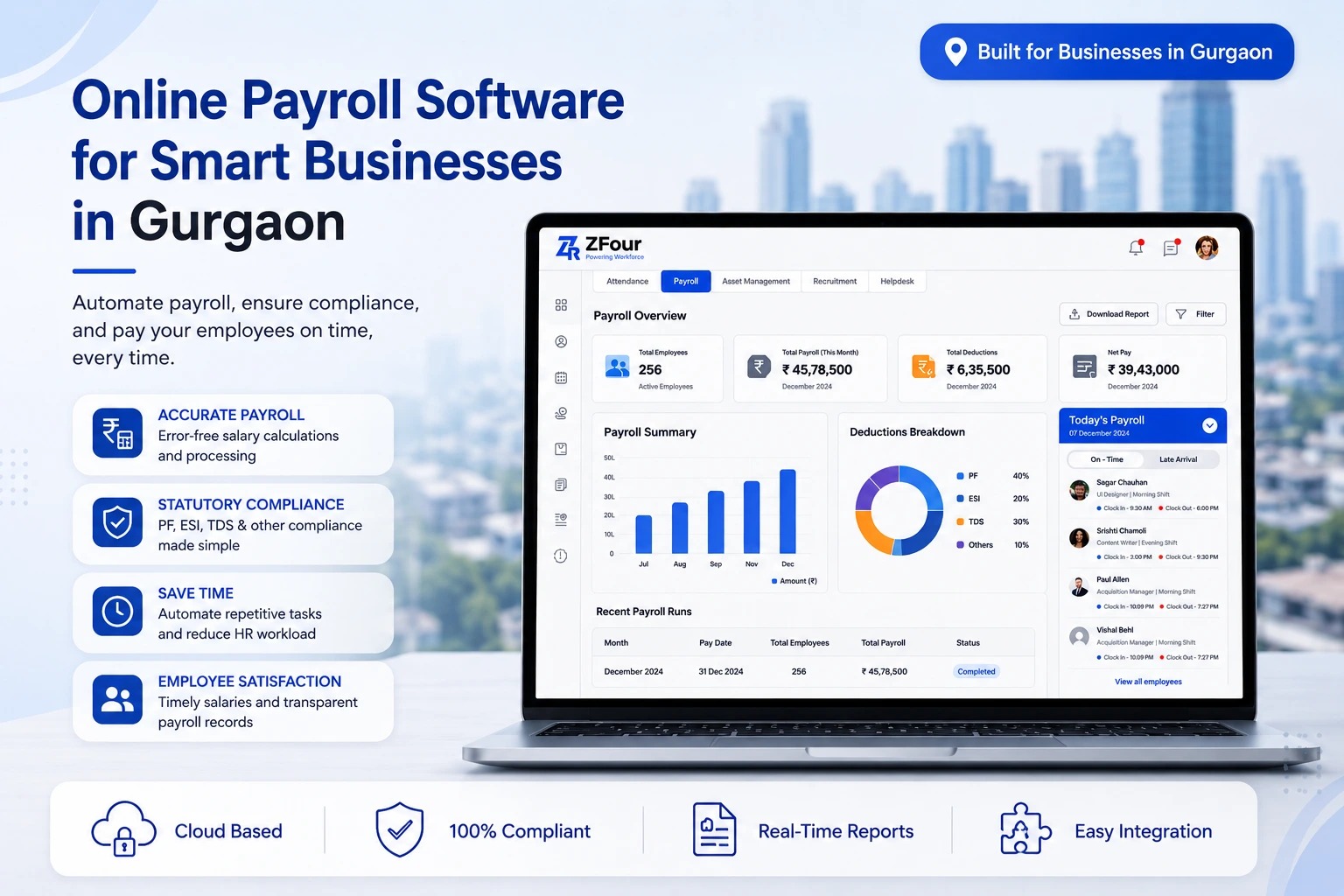
Payroll is one of the more time-consuming recurring HR tasks, particularly when attendance, leave, and salary data live in separate systems that need manual reconciliation each cycle. Connecting these processes within an HRMS reduces the repetitive data transfer between systems and can shorten the payroll cycle itself.
This doesn't eliminate the need for review. HR and payroll teams should still verify calculations before finalizing payroll, particularly for exceptions like overtime, unpaid leave, or mid-cycle salary changes — automation reduces routine data entry, not the need for oversight on exceptions.
Employee Onboarding
Digital onboarding workflows replace paper forms and manual document collection, letting new hires complete required paperwork before or on their first day rather than working through it manually with HR. The time saved scales directly with hiring volume — a business hiring occasionally sees a smaller benefit than one onboarding dozens of employees monthly.
Employee Records
Centralizing employee information — contact details, employment history, documents, compensation records — into one system reduces the time spent locating information across separate files or spreadsheets. This is most valuable for organizations that have historically split records across multiple tools or physical files, and least valuable for organizations that already maintain a single, clean employee database.
Attendance and Time Tracking
Automated attendance tracking (biometric, GPS-based, mobile, or web check-in depending on workforce structure) reduces manual timesheet reconciliation and can lower the frequency of disputes stemming from unclear or inconsistently recorded hours.
Reporting
Reports drawn directly from centralized HR data can be generated without manually compiling numbers from separate sources. The usefulness of any report still depends on the accuracy of the underlying data — automation speeds up generation, not accuracy.
Employee Queries
When employees can access payslips, apply for leave, or check attendance directly rather than routing every request through HR, the team spends measurably less time on repetitive, low-value queries — a real, if harder-to-quantify, time saving that compounds as workforce size grows.
Where HRMS Software Typically Reduces Cost
Cost Area | How It's Reduced | Limiting Factor |
|---|---|---|
Administrative labor | Automating routine tasks frees HR hours for higher-value work | Only applies to genuinely automatable, repetitive tasks |
Error-related costs | Fewer manual-entry errors in payroll and attendance | Does not eliminate errors from bad source data or misconfiguration |
Recruitment overhead | Structured workflows reduce time-to-hire admin burden | Effect scales with recruitment volume |
Compliance-related risk | Better record-keeping supports statutory processes | Does not itself guarantee compliance |
Administrative labor. Automating routine tasks — payroll runs, attendance reconciliation, basic reporting — reduces the hours HR staff spend on repetitive work, freeing time for higher-value activities like workforce planning or employee development.
Error-related costs. Manual payroll and attendance processes carry a real risk of errors — overpayments, underpayments, missed deductions — that are costly to correct after the fact. Reducing manual data entry lowers this risk, though it does not eliminate it: incorrect source data or misconfiguration can still produce incorrect results.
Recruitment costs. Structured recruitment workflows reduce the administrative overhead of managing candidates across spreadsheets and email, though the effect on actual hiring cost depends heavily on recruitment volume and how mature the existing process already is.
Compliance-related risk. Organized, accurate records make compliance processes easier to manage and audit-ready — but this reduces risk, it does not guarantee compliance outright (see the section below).
What HRMS Software Does Not Guarantee
Overstating these limits undermines the genuine, real benefits — worth being direct about them:
It does not guarantee compliance. HRMS software can support compliance-related record-keeping and calculations (PF, ESI, TDS, and other statutory requirements), but businesses remain responsible for verifying that their configuration reflects current legal requirements. The Ministry of Labour & Employment and EPFO publish official guidance on statutory obligations.
It does not eliminate errors. Automation reduces certain categories of manual-entry error but does not correct inaccurate source data or flawed configuration.
It does not replace HR judgment. Structured workflows organize information and reduce administrative friction; they don't make sensitive employment decisions.
Data protection remains the organization's responsibility. Any HRMS handling employee data should be evaluated against India's Digital Personal Data Protection Act, 2023, rather than assuming software use alone satisfies data-protection obligations.
What Determines the Actual Savings
Factor | Why It Matters |
|---|---|
Which processes were genuinely manual before | Automating an already-efficient process yields less benefit than automating a broken one |
Workforce size and hiring volume | Onboarding and recruitment savings scale with how often those processes run |
Configuration quality | A poorly configured system can create new administrative work rather than reducing it |
Employee adoption | Self-service savings only materialize if employees actually use the tools |
Data accuracy | Automation speeds up processes built on accurate data; it doesn't fix inaccurate data |
HRMS Software vs. Manual Processes: A Practical Comparison
Factor | Manual Process | HRMS-Based Process |
|---|---|---|
Payroll calculation | Manual entry, cross-checking multiple sources | Pulls from connected attendance/leave data |
Employee records | Spreadsheets, physical files | Centralized digital records |
Onboarding | Paper forms, manual document collection | Digital collection, pre-arrival completion |
Reporting | Manually compiled | Generated from existing data |
Employee self-service | HR handles every request individually | Employees access payslips, leave, attendance directly |
Compliance record-keeping | Manually tracked, easy to overlook | Organized, but still requires verification |
Next Steps
Before evaluating specific HRMS platforms, it's worth identifying exactly where your team's time and cost actually go — see our guide on running an HR time audit for a structured way to measure this before choosing software.
If payroll specifically is the primary driver, the complete guide to HR payroll software covers evaluation criteria, pricing, and implementation in depth.
If disconnected spreadsheets are the core problem across multiple HR functions, see why businesses switch from spreadsheets to HRMS software for a step-by-step migration approach.
ZFour HRMS brings payroll, attendance, employee records, onboarding, and recruitment into a connected platform — explore ZFour HRMS to see whether its modules match where your organization's time and cost are actually going.

Farheen Ahmed
HR Tech Content Strategist at ZFour Technology Private Limited
Research-driven content on HRMS, payroll, attendance management, employee management, and modern HR technology for Indian businesses.