13 min read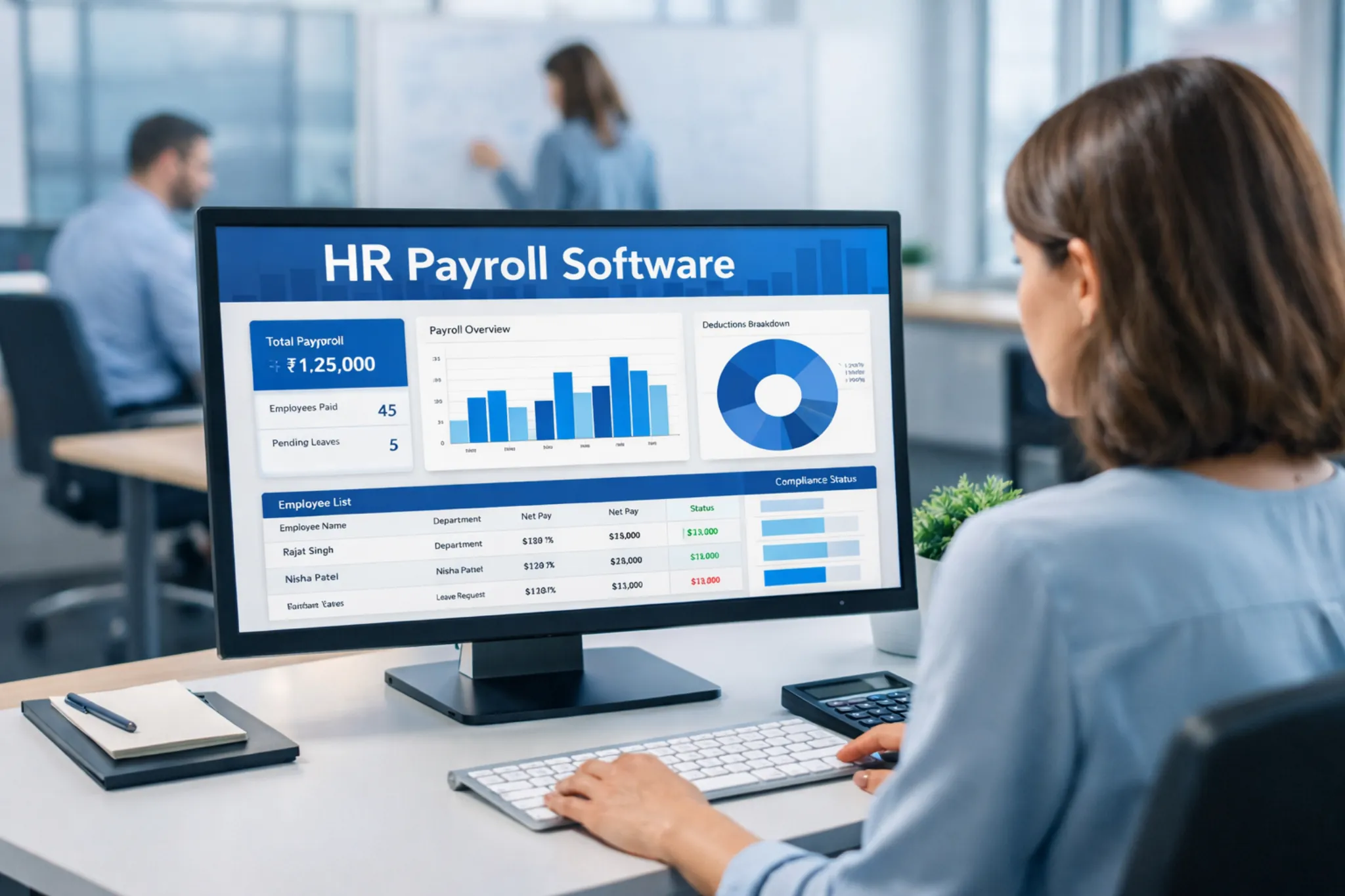
Is your HR team still calculating salaries on Excel sheets, double-checking attendance registers by hand, and hoping nothing goes wrong with PF or ESI filings this month?
You're not alone. As companies in Noida grow adding new hires, new shifts, new branches the manual approach that worked for 15 employees starts breaking down at 50, and becomes unmanageable well before 200. Salary calculation mistakes creep in, attendance records stop matching payslips, and compliance filings become a monthly source of stress rather than a routine task.
This guide explains what HR payroll software with compliance actually does, why it matters specifically for businesses operating in Noida's regulatory environment, and how to evaluate whether it's the right move for your organization. Rather than listing generic benefits, we'll walk through the real problems manual payroll creates, how automated systems solve them, and what to look for when choosing a platform — including a practical comparison, real-world scenarios, and common mistakes companies make during the switch.
Whether you're running a 30-person startup or a 500-employee manufacturing unit, the goal here is the same: help you make an informed decision about payroll compliance, not just sell you on automation for its own sake.
What Is HR Payroll Software with Compliance?
HR payroll software with compliance is a digital system that calculates employee salaries, tracks attendance and leave, and automatically applies statutory deductions — PF, ESI, professional tax, and TDS — in line with current government regulations.
The "compliance" part matters as much as the "payroll" part. A tool that only calculates salary but doesn't keep pace with changing PF contribution rates, ESI wage ceilings, or TDS slab updates can leave a company technically non-compliant even while payroll runs smoothly on the surface. That gap is usually invisible until an audit or a labour department notice surfaces it.
Historically, companies managed this through registers or Excel formulas maintained by one or two HR staff members. This worked when headcount was small and rules rarely changed. It becomes fragile once a company scales more employees means more room for manual error, and more exposure if a compliance detail is missed.
Core functions of payroll software with compliance include:
Automatic salary calculation based on attendance, leave, and salary structure
Attendance system integration (biometric, geofenced, or manual entry sync)
PF and ESI deduction, calculated against current statutory rates
TDS and income tax computation
Leave management and balance tracking
Instant payslip generation
Centralized employee record management
Compliance and audit-ready reporting
When these functions run in one connected system rather than across separate spreadsheets, HR teams spend less time reconciling numbers and more time catching errors before payroll is finalized not after an employee complains about their payslip.
Quick Overview
Aspect | Details |
|---|---|
What it does | Automates salary calculation, attendance tracking, and statutory compliance (PF, ESI, TDS) |
Best for | Growing SMEs, IT companies, manufacturing units, and multi-branch organizations in Noida |
Core compliance covered | Provident Fund (EPFO), ESI (ESIC), Professional Tax, TDS/Income Tax |
Deployment | Typically cloud-based, with mobile and self-service access |
Key risk it reduces | Manual calculation errors, missed compliance deadlines, audit exposure |
Who uses it | HR teams, payroll administrators, finance departments, and employees (via self-service) |
What Can HR Payroll Software Do?
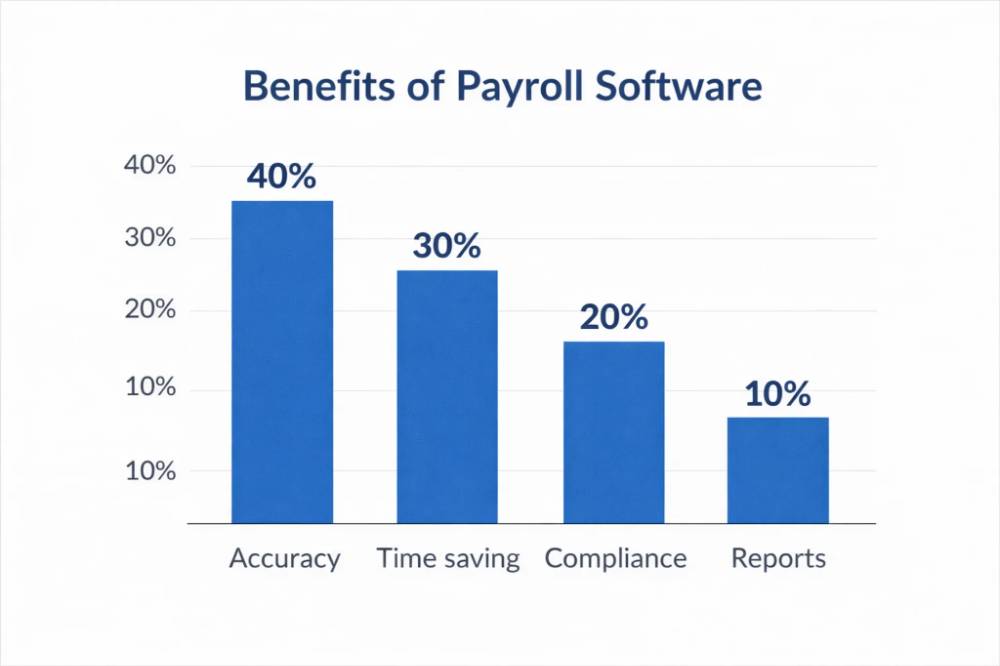
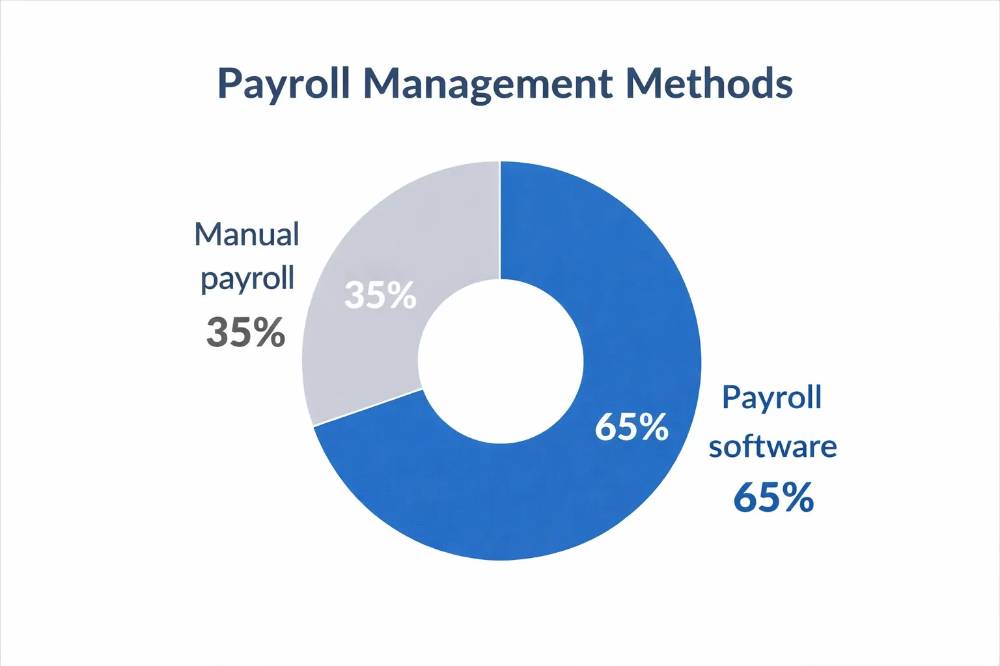
Beyond the core functions already listed, a well-built payroll system extends into day-to-day HR operations rather than staying limited to month-end salary runs.
Process salary automatically — factoring in attendance, approved leave, overtime, and any salary structure changes without manual re-entry
Generate payslips instantly — accessible to employees the moment payroll is finalized, not days later
Track attendance in real time — synced from biometric devices, geofenced mobile apps, or manual entry
Maintain a single employee record — personal details, salary history, tax declarations, and documents in one place instead of scattered files
Produce reports on demand — salary registers, PF/ESI summaries, and TDS reports without rebuilding them each time from raw data
Handle compliance changes automatically — when a statutory rate or slab changes, the system applies it going forward without HR needing to manually update formulas
The practical effect is that payroll shifts from a multi-day monthly task involving several people to a process that mostly runs itself, with HR reviewing and approving rather than manually building it from scratch each cycle.
Why Businesses in Noida Need Payroll Compliance Software
Noida has grown into one of the NCR region's busiest business corridors — IT and ITeS companies concentrated in Sectors 62, 63, 125, and 142, manufacturing units across Greater Noida and Phase II, and a steady stream of startups and SMEs setting up here for its infrastructure and connectivity.
This mix creates a specific compliance reality: businesses here must follow national frameworks (PF via EPFO, ESI via ESIC, income tax/TDS via the Income Tax Department) alongside state-specific requirements under the Uttar Pradesh Shops and Commercial Establishments Act, which governs working hours, leave entitlements, and record-keeping for establishments operating in the state.
A generic payroll setup that isn't configured for these state-specific rules can create compliance gaps that only surface during an inspection or audit by which point correcting them is far more disruptive than getting the configuration right from the start.
For a Noida-based company specifically, this means payroll software needs to do more than calculate salary correctly. It needs to:
Apply UP-specific labour law rules alongside national PF/ESI/TDS requirements
Handle both IT-style hybrid attendance and factory-style shift attendance, since Noida's business base spans both
Keep pace with periodic minimum wage revisions specific to the state
Maintain records in a format that satisfies both central and state-level audit requirements
Common Challenges Without Payroll Software
Companies relying on registers or spreadsheets tend to run into the same set of problems, regardless of industry:
Challenge | Why It Happens |
|---|---|
Salary calculation mistakes | Manual formulas break when attendance, leave, or salary structures change mid-cycle |
Attendance mismatch | Registers or standalone attendance sheets don't automatically sync with payroll |
PF/ESI errors | Statutory rates and wage ceilings change periodically; manual updates are easy to miss |
Delayed payroll processing | Reconciling attendance, leave, and deductions by hand takes days, not hours |
Difficult report generation | Building compliance or audit reports from raw spreadsheet data is slow and error-prone |
Compliance risk | A single missed deduction or late filing can trigger penalties or a labour department notice |
HR overload | Payroll consumes disproportionate HR time that could go toward hiring, culture, and policy work |
None of these problems are unique to badly-run HR teams — they're structural issues with doing high-volume, rule-based calculations by hand. Software doesn't fix bad policy, but it does remove the class of errors that come from manual data-handling.
How HR Payroll Software Works
At a high level, payroll software follows a consistent monthly workflow, with most steps running automatically once the system is configured correctly.
Step | What Happens |
|---|---|
1. Attendance sync | Biometric, geofenced, or manually logged attendance data flows into the system |
2. Leave reconciliation | Approved leave is matched against attendance to calculate actual working days |
3. Salary computation | Base salary, allowances, overtime, and deductions are calculated automatically |
4. Statutory deduction | PF, ESI, professional tax, and TDS are applied based on current rates |
5. Review and approval | HR reviews the computed payroll before final processing |
6. Payslip generation | Payslips are generated and made available to employees instantly |
7. Compliance reporting | Salary registers, PF/ESI summaries, and TDS reports are generated for records and filing |
The key difference from a manual process isn't any single step — it's that steps 1 through 4 happen without someone manually pulling data from three different sources and building the calculation by hand each time.
Real-World Example
The following is an illustrative scenario, not a specific named case study, meant to show how this plays out in practice.
Consider a 60-employee IT company in Sector 63 running payroll manually. Each month, HR pulls attendance from a biometric export, cross-checks it against a leave tracker maintained separately, manually calculates PF and ESI for each employee, and builds payslips individually. This typically takes 3-4 working days and involves at least two people cross-checking each other's calculations to catch errors.
After moving to a payroll system with compliance built in, the same company's attendance data feeds directly into payroll, PF and ESI are calculated automatically against current rates, and payslips generate the moment payroll is approved. The monthly cycle that took several days of dedicated effort typically compresses into a same-day review-and-approve process — freeing HR to spend that time on higher-value work instead of manual reconciliation.
The exact time saved will vary by company size and how clean the underlying data is, but the direction of the change from multi-day manual reconciliation to a same-day review is consistent across companies making this switch.
Manual vs. Automated Payroll: A Comparison
Feature | Manual Payroll | Payroll Software |
|---|---|---|
Salary calculation | Manual, formula-based | Automatic |
Attendance tracking | Register or spreadsheet | Integrated, real-time sync |
PF/ESI calculation | Manual, rate updates tracked by hand | Automatic, updated with statutory changes |
Report generation | Built manually from raw data | Instant, on-demand |
Error rate | Higher, especially at scale | Lower, though not zero — configuration still matters |
Compliance risk | Higher, dependent on manual rate-tracking | Lower, provided the system is kept correctly configured |
Time required | Several days per cycle | Hours, mostly review and approval |
Data security | Dependent on file storage practices | Centralized, typically with access controls and backups |
This comparison isn't a case of manual payroll being universally wrong — a very small team with stable headcount can manage manually for a while. The problems compound specifically as headcount, shift complexity, or multi-branch operations increase.
Why Automation Is Better for Growing Businesses
The case for automation isn't about replacing HR judgment it's about removing the manual, repetitive parts of payroll where errors are most likely and least valuable to catch by hand.
As a company grows past a few dozen employees, three things typically happen at once: attendance data becomes harder to reconcile manually, compliance rules require more consistent tracking across a larger base, and HR's time becomes more valuable spent on hiring, retention, and policy rather than recalculating spreadsheets. Automation addresses all three simultaneously not by eliminating HR's role in payroll, but by shifting it from manual calculation to review and exception-handling, which is a better use of a trained HR professional's time.
Industry Use Cases
Different industries in and around Noida rely on payroll software for different reasons:
IT and ITeS companies (concentrated in Sectors 62, 63, 125, 142) typically deal with hybrid work schedules, flexible shifts, and self-service expectations from a tech-literate workforce — payroll software here needs to handle remote attendance and give employees direct access to payslips and leave balances.
Manufacturing units (Greater Noida, Phase II) need strong shift management, biometric attendance for shop-floor workers, and rigorous PF/ESI compliance across a typically larger and more diverse workforce.
Startups prioritize fast setup and low administrative overhead, since dedicated HR headcount is often limited in the early stages.
Schools, colleges, and hospitals need reliable staff attendance and leave tracking, often across multiple shifts or academic/clinical schedules.
Call centers and corporate offices typically run multiple shifts with high headcount turnover, making automated attendance-to-payroll sync particularly valuable.
The common thread across all of these is that manual payroll scales poorly with either headcount or shift complexity — and most growing organizations eventually hit one or both.
How to Choose the Best HR Payroll Software
Not all payroll software is built the same way, and the right choice depends on matching features to your actual constraints rather than picking the platform with the longest feature list.
What to Check | Why It Matters |
|---|---|
Compliance coverage | Confirm PF, ESI, professional tax, and TDS are calculated automatically — and updated when rates change |
State-specific rule support | For Noida businesses, confirm the platform accounts for UP Shops and Commercial Establishments Act requirements, not just national rules |
Attendance integration | Check whether it connects with your existing biometric or geofencing setup, or requires switching hardware |
Ease of use | A simple dashboard reduces both training time and the chance of HR error |
Cloud access | Confirms data is accessible securely from anywhere, useful for multi-branch or hybrid HR teams |
Data security | Ask about encryption, access controls, and backup practices before assuming this is handled |
Customer support | Payroll issues are time-sensitive — confirm what support looks like, not just that it exists |
Scalability | Consider whether the platform handles multi-branch, multi-shift, or multi-state operations if you expect to grow into that |
A useful practice before evaluating vendors: document your current payroll workflow, including edge cases (contractors, mid-month joiners, multiple salary structures). Comparing a platform against your actual process is a more reliable test than reviewing a generic feature list.
Why Choose ZFour HRMS
Before choosing any platform, it's worth comparing a few options against your specific compliance needs, attendance setup, and budget — not selecting based on marketing claims alone.
ZFour HRMS is built for Indian businesses, including SMEs and growing companies in Noida, with payroll, attendance, and compliance handled in one system. It's designed around the kind of setup this guide has described: automatic salary calculation tied to attendance, PF/ESI/TDS compliance built in, and configuration that accounts for state-specific requirements like the UP Shops and Commercial Establishments Act rather than treating compliance as a one-size-fits-all national checklist.
For companies weighing manual payroll against a first move to software, ZFour HRMS aims to make that transition straightforward — without requiring a large IT or HR-tech team to configure and maintain it.
Explore ZFour HRMS payroll and compliance features,
Compliance, Privacy, and Security
Payroll data is inherently sensitive — salary details, bank account numbers, PAN and identity information, and in some cases health-related leave data. This makes security a genuine evaluation criterion when choosing software, not a checkbox.
At minimum, payroll software should offer:
Role-based access control, so only authorized personnel can view or edit sensitive salary data
Data encryption, both in transit and at rest
Audit logs, recording who accessed or changed payroll records, and when
Secure, regular backups to prevent data loss
Compliance with India's Digital Personal Data Protection (DPDP) Act, 2023, which governs how employee personal data must be collected, stored, and processed
On the compliance side, it's worth remembering that software reduces calculation risk but doesn't remove the employer's underlying legal responsibility. Staying current with EPFO, ESIC, and Income Tax Department rules remains the employer's obligation — the software is a tool to execute that responsibility accurately and consistently, not a substitute for understanding it.
Common Mistakes to Avoid
Choosing software based on features alone, without checking whether it handles your state-specific compliance requirements (a common gap for companies assuming national PF/ESI coverage is sufficient on its own).
Skipping a data cleanup before migration. Inconsistent employee records or incomplete leave history are the most common causes of a delayed or messy go-live.
Not running a pilot cycle. Rolling out to the entire company in month one, without testing a single payroll cycle first, makes it harder to catch configuration errors before they affect real paychecks.
Assuming automation removes all compliance responsibility. Software calculates correctly based on its configuration — someone still needs to confirm that configuration reflects current, correct rules.
Ignoring employee-side adoption. If employees don't know how to access self-service features, HR ends up fielding the same manual questions the software was meant to eliminate.
Conclusion
Manual payroll works until it doesn't. For most growing companies in Noida, that breaking point arrives well before it becomes obvious, showing up first as small calculation errors, then as compliance gaps, and eventually as HR time that's disproportionately consumed by repetitive administrative work instead of higher-value priorities.
HR payroll software with compliance addresses this by automating the calculation-heavy, error-prone parts of payroll while keeping PF, ESI, TDS, and state-specific requirements current without manual tracking. The right choice depends on matching a platform to your actual company size, industry, and compliance needs not simply picking the tool with the most features.
If you're currently managing payroll manually and recognizing some of the challenges described in this guide, it may be worth evaluating whether a dedicated system like ZFour HRMS fits your requirements.
Book a free demo to see how ZFour HRMS handles payroll and compliance for businesses in Noida.
Sources for further reading: Employees' Provident Fund Organisation (EPFO), Employees' State Insurance Corporation (ESIC), Income Tax Department, Government of India

Farheen Ahmed
HR Tech Content Strategist at ZFour Technology Private Limited
Research-driven content on HRMS, payroll, attendance management, employee management, and modern HR technology for Indian businesses.