14 min read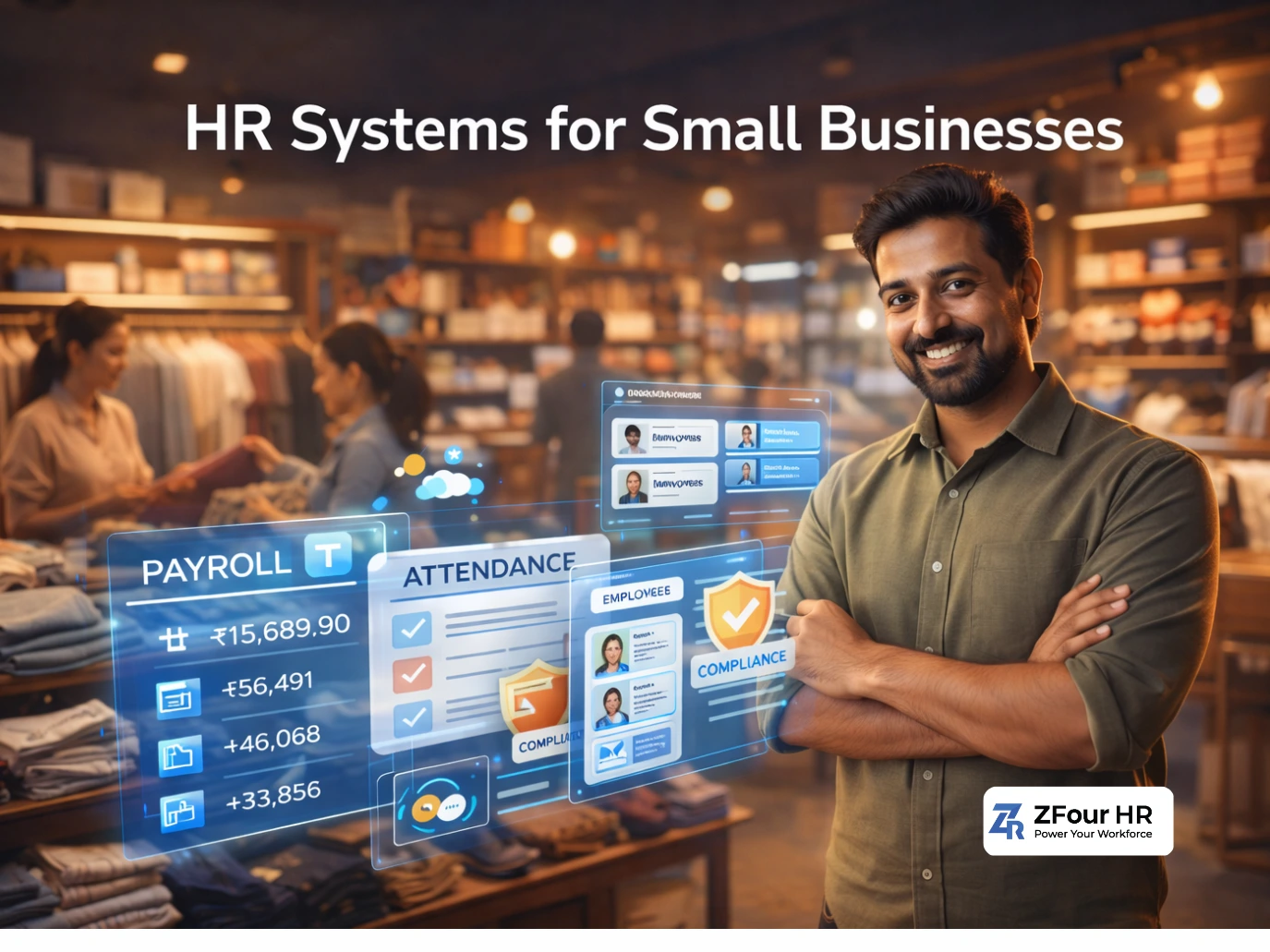
Key Takeaways
Most small businesses in India don't struggle because of a lack of customers — they struggle because of internal HR chaos: scattered employee records, manual payroll, and spreadsheet-based attendance.
An HR system for small businesses centralizes payroll, attendance, leave, employee data, and compliance into one platform, cutting down errors and administrative workload.
Manual HR processes become unsustainable once a company crosses roughly 20–30 employees, because the volume of exceptions, corrections, and compliance filings grows faster than headcount.
The real cost of avoiding HR software isn't the subscription fee you're saving — it's the payroll errors, compliance penalties, and employee attrition you're absorbing instead.
Indian labour law (PF, ESI, Payment of Wages Act, Shops & Establishments Act, and POSH Act obligations) makes compliance automation a genuine business necessity, not a luxury.
The right HRMS should be judged on usability, scalability, and integration — not just sticker price.
ZFour HRMS is designed specifically around the operational realities of Indian small and mid-sized businesses, combining payroll, attendance, leave, and compliance in one system built to scale with you.
Quick Answer: What Is an HR System?
An HR system (HRMS) is software that centralizes payroll processing, attendance tracking, employee records, leave management, and statutory compliance into a single platform. For small businesses, it replaces spreadsheets and manual paperwork with automated workflows, reducing errors, saving administrative time, and keeping the company compliant with Indian labour regulations as it scales.
Why Small Businesses Struggle Without HR Systems
Ask any founder or operations head at a growing Indian company what keeps them up at night, and "not enough customers" is rarely the answer past the first year or two. The real headache is usually internal: a spreadsheet with three different versions floating around, an employee who didn't get paid on time because someone forgot to update a leave balance, or a labour inspector asking for records nobody can locate quickly.
At five or ten employees, this is manageable. One person can track attendance in a notebook, calculate salaries in Excel, and keep offer letters in a folder. It's inefficient, but it works.
The trouble starts as the team grows. What was a minor inconvenience at 10 employees becomes a genuine operational risk at 50. Payroll takes days instead of hours. Attendance disputes turn into HR-versus-employee arguments. Compliance filings get missed because nobody owns the process end-to-end.
This is exactly why HR systems for small businesses have moved from "nice to have" to "operational necessity" for companies serious about scaling in India.
Why 2026 Has Changed the HR Game
The expectations of the Indian workforce have shifted noticeably in the last few years. Employees today expect:
On-time, error-free salaries — a single payroll mistake damages trust fast.
Transparent processes — visibility into leave balances, tax deductions, and attendance records.
Digital-first interactions — self-service access instead of emailing HR for every request.
At the same time, businesses are managing more distributed teams, more compliance touchpoints, and more data than they did five years ago. Without a structured system, this combination creates:
Payroll errors that snowball into employee dissatisfaction
Attendance mismanagement that leads to salary disputes
Compliance exposure under Indian labour law
HR teams stretched too thin to focus on anything strategic
Adopting an HR system for small businesses directly addresses each of these pressure points.
Common Problems Small Businesses Face Without HR Software
Many founders underestimate just how much poor HR processes cost until the problems compound. The most frequent issues include:
Salary delays and payroll errors from manual calculations
Attendance disputes between employees and managers over hours worked
Lack of transparency, which erodes employee trust over time
Compliance risk around PF, ESI, and statutory filings
Overloaded HR staff doing repetitive manual work instead of strategic work
None of these problems are unique to any one industry — they show up in IT services firms, manufacturing units, retail chains, and professional services businesses alike.
Talk to an HR Expert → if any of these sound familiar in your own business.
HR Systems vs. Manual HR Management
Factor | Manual HR (Spreadsheets/Paper) | HR System (HRMS Software) |
|---|---|---|
Accuracy | Low — dependent on manual entry | High — automated calculations |
Time Required | High — hours per payroll cycle | Low — minutes with automation |
Error Risk | High, especially at scale | Minimal, with built-in checks |
Compliance | Difficult to track manually | Automated statutory compliance |
Scalability | Limited beyond ~20–30 employees | High — grows with headcount |
Employee Experience | Email-dependent, opaque | Self-service, transparent |
Manual systems can limp along for a while, but they are not a sustainable foundation for a business that intends to grow.
Key Features Every Small Business HR System Should Have
1. Payroll Management
Automates salary calculations, statutory deductions, and tax computations — removing one of the most error-prone manual tasks in any business. A dedicated payroll management module should also generate payslips and handle full-and-final settlements without manual recalculation.
2. Attendance Tracking
Real-time tracking of employee clock-ins, shifts, and overtime — feeding directly into payroll so hours worked and salary paid always match. This is where an attendance management system earns its keep, especially for businesses with field staff, shift workers, or multiple locations.
3. Employee Database
A secure, centralized system of records for employee documents, personal details, and employment history—replacing scattered folders and outdated spreadsheets.
4. Compliance Management
Automated tracking of statutory requirements—PF, ESI, professional tax, and other Indian labour law obligations—so nothing falls through the cracks as the business scales.
5. Leave Management
Simplifies leave applications, approvals, and balance tracking through a leave management workflow, reducing the back-and-forth between employees and managers.
6. Recruitment and Onboarding
Structured recruitment workflows that track candidates from application to offer, paired with a smoother onboarding experience for new hires.
7. Performance Management
A performance management module to track goals, reviews, and feedback cycles — turning appraisals from an annual scramble into an ongoing process.
8. Employee Self-Service (ESS)
An Employee Self-Service (ESS) portal lets employees check payslips, apply for leave, and update details themselves, cutting down routine HR queries significantly.
Benefits of Using an HR System
⏱ Saves Time — automation removes repetitive manual work
🎯 Improves Accuracy — fewer payroll and data-entry errors
🔍 Enhances Transparency — employees see their own records
⚖ Ensures Compliance — statutory obligations are tracked automatically
📊 Supports Business Growth — systems that scale as headcount grows
HR practitioner bodies such as the Society for Human Resource Management (SHRM) regularly publish guidance on HR technology adoption, and a recurring theme in that field is that how well a system is integrated into daily workflows matters as much as the software itself. That's a useful distinction for small businesses evaluating HR software — the tool matters, but so does how it's rolled out.
The Hidden Cost of Delaying HR Software Adoption
It's tempting to think of HR software as an expense you can put off. In practice, avoiding it doesn't save money — it just moves the cost somewhere less visible. Businesses without HR systems typically lose out on:
Time — hours spent on manual payroll and data reconciliation every cycle
Money — payroll errors that require corrections, refunds, or awkward conversations
Compliance standing — penalties or legal exposure from missed statutory filings
Employee trust — repeated salary errors damage morale faster than almost anything else
Productivity — HR staff stuck on admin instead of strategic work
The cost of not using HR software is almost always higher than the cost of the software itself — it's just spread out and harder to see on a single invoice.
Request a Free Demo → to see exactly how much time an HRMS could save your team.
Common Mistakes Businesses Make When Choosing HR Software
Choosing based only on price — the cheapest tool often lacks compliance features you'll need later.
Ignoring scalability — a system that works for 15 employees may buckle at 100.
Poor integration — payroll, attendance, and compliance modules that don't talk to each other create new manual work.
Lack of training — even great software fails if the team doesn't know how to use it.
Incomplete implementation — rolling out only half the features (e.g., payroll but not attendance) undermines the whole point of consolidation.
HR Systems and Compliance in India
Indian labour law places specific record-keeping and filing obligations on employers — covering Provident Fund (PF), Employee State Insurance (ESI), professional tax, and workplace policies under laws like the Payment of Wages Act and the POSH Act. Guidance and updates on these obligations are published by the Ministry of Labour & Employment, Government of India, and staying current with them is a genuine compliance responsibility — not paperwork you can defer indefinitely.
Without a structured HR system, businesses risk:
Missed or late statutory filings
Incomplete or inconsistent employee records
Legal exposure during audits or inspections
Operational disruption when compliance issues surface unexpectedly
An HRMS with built-in compliance tracking reduces this risk substantially by automating calculations and flagging deadlines before they're missed.
Why Some HR System Rollouts Fail
Not every HR software implementation succeeds — and it's worth understanding why, so your business doesn't repeat the same mistakes:
Lack of proper setup — rushing implementation without configuring the system to match actual business processes
Partial automation — using the system for payroll but keeping attendance in spreadsheets, which reintroduces the same reconciliation problems
Poor integration — modules that don't sync data automatically
Resistance to change — employees and managers who default back to old habits
A successful rollout requires proper planning, clear communication, and a system that's genuinely built for how the business actually operates — not just a generic template.
Signs Your Business Needs an HR System Now
If any of the following sound familiar, it's a strong signal that your business has outgrown manual HR management:
Frequent payroll errors or last-minute salary corrections
Employees regularly complaining about pay or leave discrepancies
An HR team that's constantly playing catch-up
Lack of visibility into attendance, leave balances, or compliance status
Growing headcount that's making spreadsheets unmanageable
These are not "someday" problems — they compound the longer they're left unaddressed.
Book a Consultation → to get a clear picture of where your HR processes currently stand.
Types of HR Systems Explained
1. HRMS (Human Resource Management System)
A comprehensive platform covering payroll, attendance, leave, recruitment, performance, and compliance in one place — the most practical option for small businesses that want to avoid juggling multiple disconnected tools.
2. Payroll Systems
Tools focused specifically on salary processing and tax calculations. Useful as a starting point, but limited if attendance and compliance remain manual.
3. Attendance Systems
Dedicated tools for tracking clock-ins, shifts, and overtime — often most valuable when integrated directly with payroll.
4. Cloud-Based HR Systems
Accessible from anywhere, cloud HRMS platforms suit businesses with remote employees, multiple locations, or field staff who need to check in from outside a central office.
HR Software Adoption Trends Among Indian SMBs
Analyst firms such as Gartner and Deloitte both publish ongoing research on HR technology adoption, and a consistent theme across that body of work is that integrated systems tend to outperform fragmented, manual ones on process efficiency. For India specifically, industry body NASSCOM has tracked the broader digitization of business operations across sectors, a trend that extends naturally into HR functions as companies scale.
Insight: A large share of small and mid-sized Indian businesses are still managing HR manually — which represents a significant opportunity for those willing to modernize early and gain an operational edge over competitors who haven't.
How HR Systems Improve the Employee Experience
Employees today expect the same digital convenience at work that they get from consumer apps in their personal lives. An HRMS delivers this through:
Transparent salary details — payslips and deduction breakdowns available on demand
Easy leave management — apply, track, and get approvals without email chains
Accurate attendance records — fewer disputes over hours worked
Better communication — announcements, policy documents, and updates in one place
This transparency directly improves satisfaction and, over time, retention — both of which matter enormously for small businesses that can't easily absorb high turnover.
How HR Systems Drive Business Growth
HR systems aren't just administrative tools — they have a direct line to business outcomes:
Productivity — less time lost to manual admin means more time on actual work
Retention — employees stay longer at companies that pay them accurately and on time
Decision-making — centralized data gives leadership real visibility into headcount costs and trends
Scalability — systems built to handle growth prevent HR from becoming a bottleneck
Case Example
A small business with around 30 employees managed HR entirely through spreadsheets and manual processes. As the company grew:
Payroll errors became more frequent
HR workload roughly doubled
Employees began raising complaints about pay accuracy and leave tracking
After implementing a structured HR system, the business saw:
Payroll cycles that took a fraction of the previous time
A noticeable drop in salary-related errors
Improved employee satisfaction scores in internal surveys
This pattern — chaos at scale, followed by clarity after adoption — is one of the most common stories among growing Indian small businesses.
How to Evaluate an HR System for Your Small Business
Choosing the right HR system isn't just about feature checklists — it's about solving real operational problems. Here's a practical comparison framework:
Feature | Basic Tools | Advanced HR Systems (like ZFour HRMS) |
|---|---|---|
Payroll Automation | Limited | Full automation with statutory compliance |
Attendance Tracking | Manual or basic | Real-time, multi-location tracking |
Compliance Management | Manual | Automated PF/ESI/tax tracking |
Reporting | Basic exports | Advanced analytics and dashboards |
Employee Access | Limited or none | Full self-service portal |
Scalability | Low | High — grows with your headcount |
When evaluating HR systems for small businesses, prioritize usability, integration, and scalability over price alone. A system that grows with your business will consistently deliver better long-term value than the cheapest option on the market.
Accurate tracking of employee working hours through a proper employee attendance management system also directly improves payroll accuracy and overall productivity.
Step-by-Step Guide to Implementing an HR System
Many businesses hesitate to adopt HR software because they assume implementation will be complicated. In practice, it's straightforward when approached methodically.
Step 1: Identify Current Problems Start by honestly mapping out your existing HR pain points — payroll errors, attendance disputes, or compliance gaps.
Step 2: Define Requirements List the specific features your business needs: payroll automation, attendance tracking, leave management, or reporting.
Step 3: Choose the Right System Select an HR system sized appropriately for your business today, with room to grow into it over the next few years.
Step 4: Data Migration Move employee data from spreadsheets or paper records into the new system — ideally with support from the vendor's implementation team.
Step 5: Train Your Team Make sure both HR staff and general employees understand how to use self-service features and submit requests correctly.
Step 6: Monitor and Optimize Track how the system is performing after go-live and refine configurations as your processes evolve.
A structured rollout — rather than a rushed one — is what separates HR systems that deliver value from ones that get abandoned within a year.
Schedule a Live Product Demo → to see this implementation process in action with ZFour HRMS.
Integrating Payroll, Attendance, and Compliance
HR systems deliver the most value when their modules work together rather than as isolated tools. Integration ensures:
Seamless data flow between attendance, leave, and payroll
Accurate salary calculations based on actual hours worked and approved leave
Better, more reliable reporting for management and compliance purposes
For example, attendance data feeds directly into payroll. If attendance records are wrong, salary calculations will be wrong too — regardless of how good the payroll engine itself is. An integrated system, such as ZFour HRMS, eliminates this disconnect by keeping every module synchronized automatically.
Quick Self-Check: Does Your Business Need an HR System?
Ask yourself honestly:
Do you face frequent payroll errors or last-minute corrections?
Is your HR team consistently overloaded with manual admin work?
Are employees complaining about transparency around pay or leave?
Do you still rely heavily on spreadsheets for core HR functions?
If you answered yes to any of these, your business is very likely ready to benefit from a proper HR system.
Why ZFour HRMS Is Built for Indian Small Businesses
ZFour HRMS is designed around one core idea: small and growing Indian businesses need HR software that handles local compliance realities out of the box, without requiring a large IT team to configure or maintain it. That means:
Payroll built around Indian statutory requirements from day one
Attendance and leave management that work for office, field, and remote teams
An implementation process designed for teams without dedicated HR technology staff
Pricing and plans structured for businesses that are scaling, not enterprises that have already scaled
Get Started Today → and see how ZFour HRMS can replace your spreadsheets with a system built for how Indian small businesses actually operate.
Final Thoughts and Next Steps
Small businesses rarely fail because of a lack of ambition or customers. More often, it's the accumulation of small operational inefficiencies — a payroll error here, a missed compliance deadline there — that quietly drains time, money, and employee trust.
A well-implemented HR system doesn't just fix these problems; it removes the ceiling that manual processes place on how fast and how smoothly your business can grow.
If your team is still juggling spreadsheets, manual payroll, and scattered employee records, now is the time to make the switch.
Ready to move from HR chaos to business clarity?

Farheen Ahmed
HR Tech Content Strategist at ZFour Technology Private Limited
Research-driven content on HRMS, payroll, attendance management, employee management, and modern HR technology for Indian businesses.