8 min read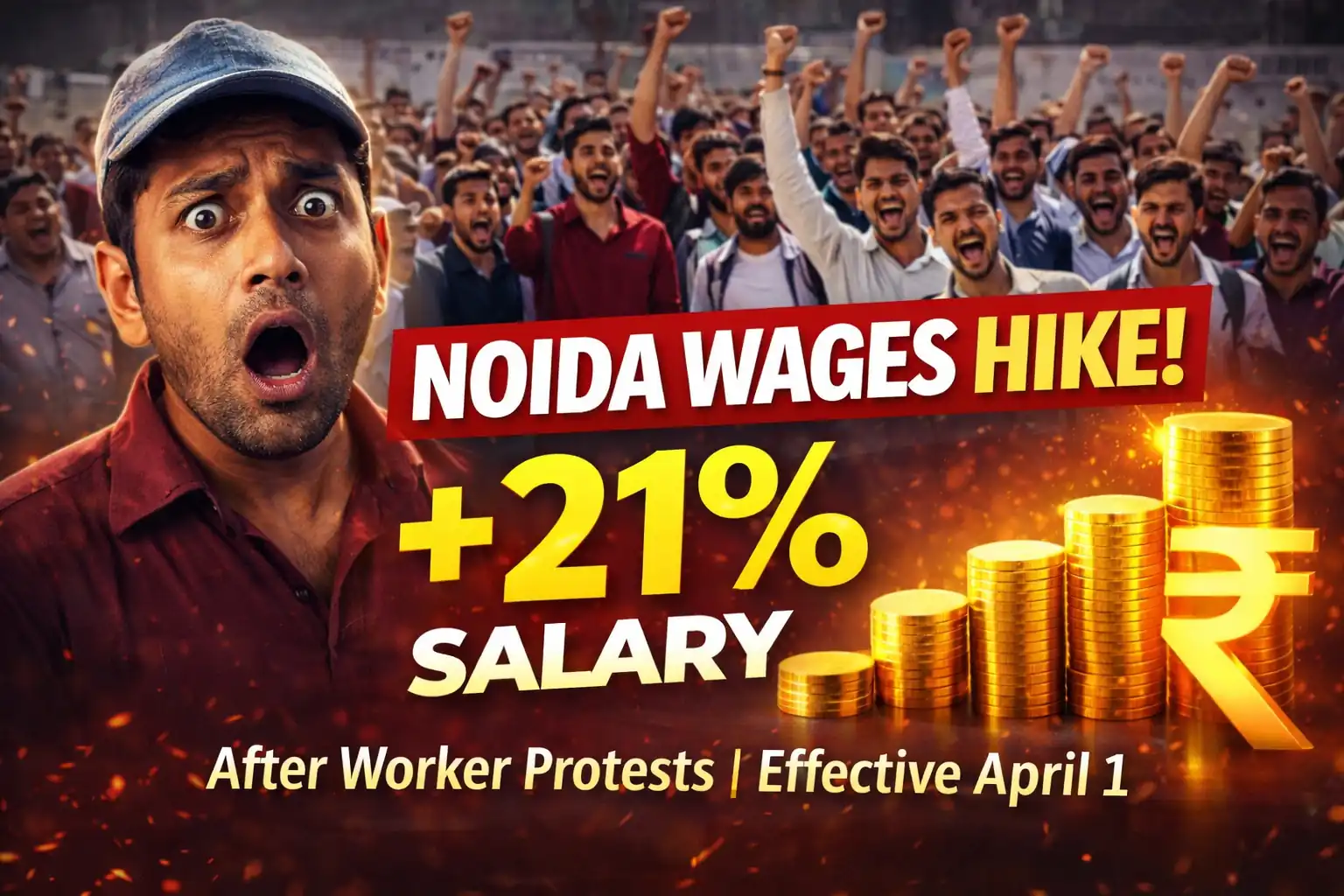
In April 2026, worker protests in Noida turned violent enough that the Uttar Pradesh government stepped in within days. The result was an interim minimum wage hike of up to 21% across skill categories — and, a month later, an announcement that a permanent Wage Board would be set up to decide the long-term structure. For any business running payroll in Gautam Buddha Nagar, Ghaziabad, or elsewhere in UP, this isn't a one-line policy update. It's a live compliance obligation with a moving target.
This guide breaks down the updated wage slabs by district tier, what triggered the revision, what's still pending from the Wage Board, and the exact payroll and compliance steps businesses need to take now.
Quick Answer
Uttar Pradesh raised minimum wages by up to 21% for unskilled, semi-skilled, and skilled workers in Noida and Ghaziabad, effective April 1, 2026 (retrospectively notified). Unskilled wages in Gautam Buddha Nagar rose from ₹11,313 to ₹13,690 per month. This is an interim measure — a state Wage Board is now working on a permanent structure, so businesses should expect further revisions rather than treating this as a final number.
Key Takeaways
The hike followed real, large-scale worker unrest in Noida in April 2026, including protests that turned violent and led to roughly 300 arrests, according to contemporaneous reporting.
Wage increases are tiered by district classification (Gautam Buddha Nagar/Ghaziabad, municipal corporation areas, and other districts) — not a flat statewide number.
The government explicitly called this an interim hike; a Wage Board is being constituted to recommend a permanent structure, meaning payroll teams should plan for further change.
The state also clarified that claims of a flat ₹20,000 minimum wage were inaccurate — relying on unofficial figures circulating online is a real compliance risk right now.
For a 100-person unskilled workforce in Gautam Buddha Nagar, the wage hike alone adds roughly ₹27–28 lakh a year in payroll cost — before overtime, PF, and ESI recalculation.
What Triggered the Noida Wage Hike?
The revision wasn't a routine annual adjustment — it followed sustained worker protests in Noida's industrial belt in April 2026 that escalated over several days, with reports of the unrest turning violent and roughly 300 arrests by the fourth day. Workers cited rising housing and living costs, and pointed to the wage gap with neighboring Haryana, according to government committee findings.
In response, the Uttar Pradesh government constituted a high-level committee under the Infrastructure and Industrial Development Commissioner, which visited Gautam Buddha Nagar to consult workers, employers, and contractors before recommending the interim hike.
Key contributing factors:
Rising cost of living, particularly housing, in the Noida–Ghaziabad belt
A visible wage gap compared to Haryana's rates for similar work
Employer-side pressure from global tariff changes and supply-chain costs, which complicated negotiations
Long-standing worker complaints about delayed payments and overtime disputes
Updated Minimum Wages in Noida (2026)
For Gautam Buddha Nagar (Noida) and Ghaziabad, the revised monthly rates are:
Category | Previous Wage | New Wage (from April 1, 2026) | Increase |
|---|---|---|---|
Unskilled | ₹11,313 | ₹13,690 | ~21% |
Semi-Skilled | ₹12,445 | ₹15,059 | ~21% |
Skilled | ₹13,940 | ₹16,868 | ~21% |
Source: People Matters, April 2026
Explore this: Delhi Minimum Wages
Important: the state government explicitly denied claims that the new minimum wage was ₹20,000 flat, calling that figure misleading. Payroll teams should work only from officially notified rates, not from numbers circulating on social media.
Wage Rates Across UP District Tiers
The revision wasn't limited to Noida and Ghaziabad — Uttar Pradesh applies a three-tier district classification, and rates differ by tier:
Category | Gautam Buddha Nagar / Ghaziabad | Municipal Corporation Areas | Other Districts |
|---|---|---|---|
Unskilled | ₹13,690 | ₹13,006 | ₹12,356 |
Semi-Skilled | ₹15,059 | ₹14,306 | ₹13,591 |
Skilled | ₹16,868 | ₹16,025 | ₹15,224 |
Source: People Matters, April 2026
Why this matters for multi-location businesses: a company with branches in Noida and, say, a smaller UP district cannot apply one payroll rule across all locations. Location-aware payroll configuration isn't optional here — it's the difference between compliant and non-compliant payroll runs.
What's Still Pending: The New Wage Board
This is the detail many businesses miss: the current rates are interim, not final.
The state government has said it will constitute a Wage Board to recommend a permanent minimum wage structure after consulting workers, employers, and other stakeholders. Discussions are also reportedly underway on broader worker welfare measures — including health support, pensions, and education benefits for workers' families, per People Matters' reporting. A district control room has also been set up specifically to handle worker complaints going forward.
What this means practically: businesses that hardcode the current rates into a one-time spreadsheet update will likely have to redo that work again once the Wage Board issues its recommendation. A payroll system that can absorb a rate change without a manual rebuild is a meaningfully better position to be in over the next 6–12 months.
Why This Is a Compliance Turning Point
Beyond the immediate rate change, this episode signals something bigger: India's move toward stricter, faster-moving payroll compliance, partly under the ongoing rollout of the national Labour Codes. Businesses now need:
Real-time visibility into wage law changes by district
Salary structures that can be recalculated without a full manual rebuild
Clear, audit-ready compliance tracking for PF and ESI alongside the new base wage
Transparent payslips that hold up if a labour inspection happens
Manual, spreadsheet-driven payroll wasn't built to absorb a 21% wage change retrospectively across multiple district tiers in the middle of a financial year. That's exactly the kind of event that exposes the limits of manual systems.
Financial Impact: A Worked Example
To see the real scale of this change, look past the per-employee number.
Example: A company with 100 unskilled workers in Gautam Buddha Nagar sees a per-worker increase of ₹2,377/month (₹13,690 − ₹11,313).
Monthly payroll increase: ₹2,37,700
Annual payroll increase: ~₹28.5 lakh
That's before recalculating overtime rates (which are typically tied to the base wage), PF and ESI contributions on the higher base, and any allowances calculated as a percentage of salary. For MSMEs operating on thin margins, this is a material cost shift — one that needs to flow into budgeting and pricing decisions, not just payroll software.
Common Payroll Mistakes After a Wage Revision
The most frequent errors businesses make after a wage revision like this one:
Delayed salary structure updates — continuing to run payroll at the old rate past the effective date
Incorrect worker classification — misclassifying semi-skilled workers as unskilled (or vice versa), which under- or overpays and creates compliance exposure either way
Ignoring overtime recalculation — overtime is typically a multiple of the base wage, so it needs updating alongside the base rate
Manual spreadsheet errors — formula mistakes when applying a percentage increase across hundreds of rows
Missing the retrospective effective date — since the rate applies from April 1, not the notification date, back-pay adjustments are often required and easy to miss
Each of these can result in legal notices, employee grievances, or financial penalties — and in a state actively monitoring compliance through a dedicated control room, the risk of an error surfacing isn't theoretical.
Compliance Checklist for Businesses
After a wage revision like this, payroll and HR teams should confirm:
Salary structures updated to reflect the correct rate for each worker's skill category and district tier
Back-pay calculated correctly for the retrospective period (April 1 onward)
Employment contracts revised where the wage change requires it
Overtime rates recalculated against the new base wage
PF and ESI contributions recalculated on the revised base
Payslips reissued or corrected with transparent line-item detail
Audit-ready documentation maintained in case of a labour department inspection
A process in place to absorb the Wage Board's eventual permanent rate without a manual rebuild
Manual vs Automated Payroll After a Wage Change
A sudden, retrospective, district-tiered wage revision is a useful stress test for any payroll process.
Factor | Manual Payroll | Automated Payroll (e.g., ZFour HRMS) |
|---|---|---|
Applying the new rate | Manual formula updates across every affected row | Rate updated centrally, applied automatically |
Back-pay for retrospective effective date | Calculated by hand, per employee | Calculated automatically from the effective date |
Multi-district rate differences | Easy to apply the wrong tier by mistake | Location-aware rules prevent misapplication |
Overtime recalculation | Separate manual step, easy to forget | Recalculated alongside base wage automatically |
Audit readiness | Scattered records, harder to reconstruct | Centralized, timestamped records |
Why it matters: the businesses most exposed to this kind of sudden regulatory change are the ones still running payroll manually — not because their teams are careless, but because a manual process simply can't absorb this type of retrospective, tiered update without significant rework and error risk.
Impact on Hiring and Workforce Strategy
A wage revision of this size will likely influence workforce planning beyond payroll:
Some businesses may shift toward hiring multi-skilled employees to get more value per wage bracket
Others may accelerate automation investments to offset rising labour costs
Contract-based and flexible staffing models may become more attractive for cost-sensitive roles
Workforce cost modeling becomes a more central part of budgeting, not an afterthought
How ZFour HRMS Helps You Stay Compliant
ZFour HRMS is built to absorb exactly this kind of regulatory change without a manual scramble:
Automated payroll processing — salaries recalculate against updated wage law without a manual formula rebuild
Location-aware compliance — different rates for Gautam Buddha Nagar, municipal corporation areas, and other districts applied automatically per employee location
Retrospective adjustments — back-pay for effective dates like April 1, 2026 calculated automatically, not row by row
Attendance + payroll integration — accurate salary based on actual working hours and overtime, recalculated against the new base wage
Employee self-service — transparent, corrected payslips available instantly, reducing disputes
Audit-ready reporting — centralized records ready for a labour department inspection at any time
Don't wait for the Wage Board's next update to catch you off guard. Book a free ZFour HRMS demo and see how wage changes, back-pay, and multi-district compliance can run automatically instead of through a manual rebuild.
Final Thoughts
The Noida minimum wage revision is a live example of how quickly compliance obligations can shift — and how a retrospective, district-tiered change exposes exactly where manual payroll breaks down. This isn't the end of the story either: with a Wage Board now working on a permanent structure, businesses should expect this rate to move again, not treat the current numbers as fixed.
The practical takeaway isn't just "update your spreadsheet once." It's building a payroll process that can absorb the next change — and the one after that — without a manual scramble each time.
Stay ahead of the next wage revision. Get a free ZFour HRMS demo and automate wage compliance, back-pay, and multi-district payroll from one dashboard.

Farheen Ahmed
HR Tech Content Strategist at ZFour Technology Private Limited
Research-driven content on HRMS, payroll, attendance management, employee management, and modern HR technology for Indian businesses.