8 min read
Payroll is one of the most important HR processes because employees depend on accurate and timely salary payments. However, payroll can become difficult to manage when HR teams rely on spreadsheets, disconnected attendance records, manual calculations, and repeated data entry.
Real-time payroll processing uses connected HR and payroll data to make payroll information available and actionable with less manual intervention. When attendance, leave, employee records, and payroll inputs are connected, HR teams can reduce repetitive work and identify discrepancies earlier in the payroll cycle.
This guide explains what real-time payroll processing means, how it works, its benefits, key features, compliance considerations in India, and how an HRMS can support a more efficient payroll workflow.
What Is Real-Time Payroll Processing?
Real-time payroll processing refers to a payroll workflow in which relevant employee and attendance information is updated and available within the system as changes occur, rather than being collected manually from multiple sources at the end of the payroll period.
Depending on the HRMS and its configuration, payroll inputs may include:
Employee salary information
Attendance records
Leave and absence data
Overtime or approved additional hours
Deductions
Reimbursements
Bonuses or incentives
Applicable statutory deductions
The exact level of automation varies between payroll systems. Real-time data availability does not necessarily mean that salary is continuously calculated or paid instantly.
How Does Real-Time Payroll Processing Work?
A typical workflow connects several HR processes.
1. Employee Data Is Maintained
Employee records such as salary structure, department, designation, joining date, and applicable payroll information are maintained in the HRMS.
2. Attendance and Leave Data Is Updated
Attendance and approved leave information can flow into the payroll process, depending on the system configuration.
3. Payroll Inputs Are Consolidated
The system brings together relevant payroll inputs such as earnings, deductions, approved adjustments, and attendance-related information.
4. Payroll Calculations Are Performed
The payroll system applies the configured salary rules, deductions, and other payroll inputs.
HR teams should review payroll calculations before final approval, particularly where exceptions or manual adjustments are involved.
5. Payroll Is Reviewed and Approved
HR or payroll administrators can review payroll information, identify discrepancies, and make approved corrections before final processing.
6. Payslips and Payroll Records Are Generated
After payroll is approved, the system may generate payslips and relevant payroll reports for employees and administrators.
This connected workflow can reduce the need to repeatedly transfer information between spreadsheets and separate systems.
Key Benefits of Real-Time Payroll Processing
Real-time payroll processing can provide several operational advantages when the underlying employee and payroll data is accurate.
1. Faster Payroll Administration
When payroll inputs are available in one system, HR teams may spend less time collecting information from different sources.
This can simplify recurring activities such as:
Reviewing attendance
Checking leave
Updating payroll inputs
Identifying missing information
Preparing payroll reports
The time saved depends on the organization's workforce size, payroll complexity, and level of automation.
2. Improved Payroll Data Accuracy
Manual data entry can introduce errors when information is transferred between systems or spreadsheets.
Connecting attendance, leave, employee records, and payroll can reduce duplicate data entry and make it easier to identify inconsistencies before payroll is finalized.
However, automation does not eliminate the need for payroll review. Incorrect source data or configuration can still produce incorrect payroll results.
3. Better Visibility Into Payroll Data
Real-time access to payroll information can give authorized HR and finance users better visibility into current payroll inputs.
For example, teams may be able to review:
Attendance-related changes
Leave deductions
Salary components
Payroll adjustments
Employee payroll records
This can support faster investigation when discrepancies occur.
4. Easier Attendance-to-Payroll Integration
Attendance and payroll are closely connected in organizations where working days, absences, overtime, or other attendance-related inputs affect salary calculations.
An integrated HRMS can help move approved attendance information into the payroll workflow, reducing the need to manually reconcile the two datasets.
5. Reduced Repetitive Work
Payroll teams often perform the same administrative tasks every pay cycle.
Automation can help reduce repetitive activities such as:
Data collection
Record consolidation
Payslip generation
Payroll report preparation
Routine payroll updates
This allows HR teams to spend more time on exception handling, employee queries, and payroll review.
6. Improved Employee Access
Depending on the HRMS, employees may be able to access their payslips and relevant payroll information through an employee self-service portal.
This can reduce routine questions to HR and give employees easier access to their own records.
7. Better Payroll Reporting
Centralized payroll information can support reporting and analysis.
HR and finance teams may use payroll reports to review:
Salary expenses
Department-level payroll information
Deductions
Attendance-related payroll changes
Payroll trends
The usefulness of these reports depends on the quality and completeness of the underlying data.
Real-Time Payroll Processing vs Traditional Payroll
Factor | Traditional/Manual Payroll | Real-Time/Connected Payroll |
|---|---|---|
Data collection | Often manual | Can be system-connected |
Attendance input | May require manual transfer | Can flow from attendance system |
Leave information | May be maintained separately | Can be connected to payroll |
Data visibility | Often limited between payroll cycles | More current information available |
Repetitive entry | Higher | Can be reduced through automation |
Error checking | Often manual | System validation may assist |
Payslips | May require manual preparation | Can be generated digitally |
Reporting | Spreadsheet-based in some businesses | Centralized reports may be available |
Human review | Required | Still required |
The term real-time payroll should therefore be understood as improved data connectivity and timely access to payroll inputs—not as a guarantee that every payroll task happens automatically or instantly.
Key Features to Look for in Real-Time Payroll Software
Businesses evaluating payroll software should consider more than just automation.
Attendance and Leave Integration
The system should be able to connect relevant attendance and approved leave information with payroll where required.
Salary Structure Management
Look for the ability to manage salary components and payroll rules according to the organization's requirements.
Payroll Calculations
The software should support configured earnings, deductions, adjustments, and other applicable payroll inputs.
Payslip Generation
Digital payslips can make payroll information easier for employees to access.
Employee Self-Service
An employee portal can allow employees to access relevant payroll information without depending on HR for every request.
Payroll Reports
Reporting capabilities can help HR and finance teams review payroll data and identify discrepancies.
Role-Based Access
Payroll contains sensitive employee information. Access controls should therefore limit payroll data to authorized users based on organizational roles.
Auditability
Organizations should consider whether the system provides appropriate records of payroll changes, approvals, and administrative actions.
Real-Time Payroll and Compliance in India
Payroll processing in India can involve several statutory and tax-related requirements depending on the organization, employee, location, salary structure, and applicable laws.
Depending on the organization's circumstances, payroll may involve areas such as:
Provident Fund (EPF)
Employees' State Insurance (ESI)
Professional Tax
Tax Deducted at Source (TDS)
Gratuity
Bonus-related requirements
Applicable wage and employment regulations
HRMS software can help organize payroll data and automate configured calculations or reports. However, using payroll software does not by itself guarantee legal compliance.
For organizations covered by provident-fund requirements, payroll teams should verify applicable requirements and refer to official EPFO guidance.
How Real-Time Payroll Improves the HR Workflow
Real-time payroll becomes more valuable when payroll is connected with other HR processes.
For example:
Employee records → Attendance → Leave → Payroll inputs → Payroll review → Approval → Payslip
This connected workflow can reduce the need for HR teams to repeatedly collect the same information from different systems.
It can also make it easier to identify where a payroll discrepancy originated—for example, whether it relates to attendance, leave, employee information, or a payroll adjustment.
Connecting attendance management with payroll can reduce repetitive data entry when attendance information affects salary calculations.
Who Can Benefit From Real-Time Payroll Processing?
Real-time or connected payroll can be particularly useful for organizations where payroll involves multiple employees, locations, shifts, attendance rules, or recurring payroll adjustments.
Small Businesses
Small businesses can benefit when payroll administration starts becoming difficult to manage through spreadsheets and manual processes.
Growing Companies
As headcount increases, centralized payroll and employee data can make recurring payroll administration easier to manage.
Multi-Location Businesses
Organizations with employees working across different locations may benefit from connecting attendance and employee information with payroll.
Shift-Based Workforces
Businesses where working hours, shifts, overtime, or attendance affect payroll may benefit from integrated attendance and payroll workflows.
How ZFour HRMS Can Support Payroll Processing
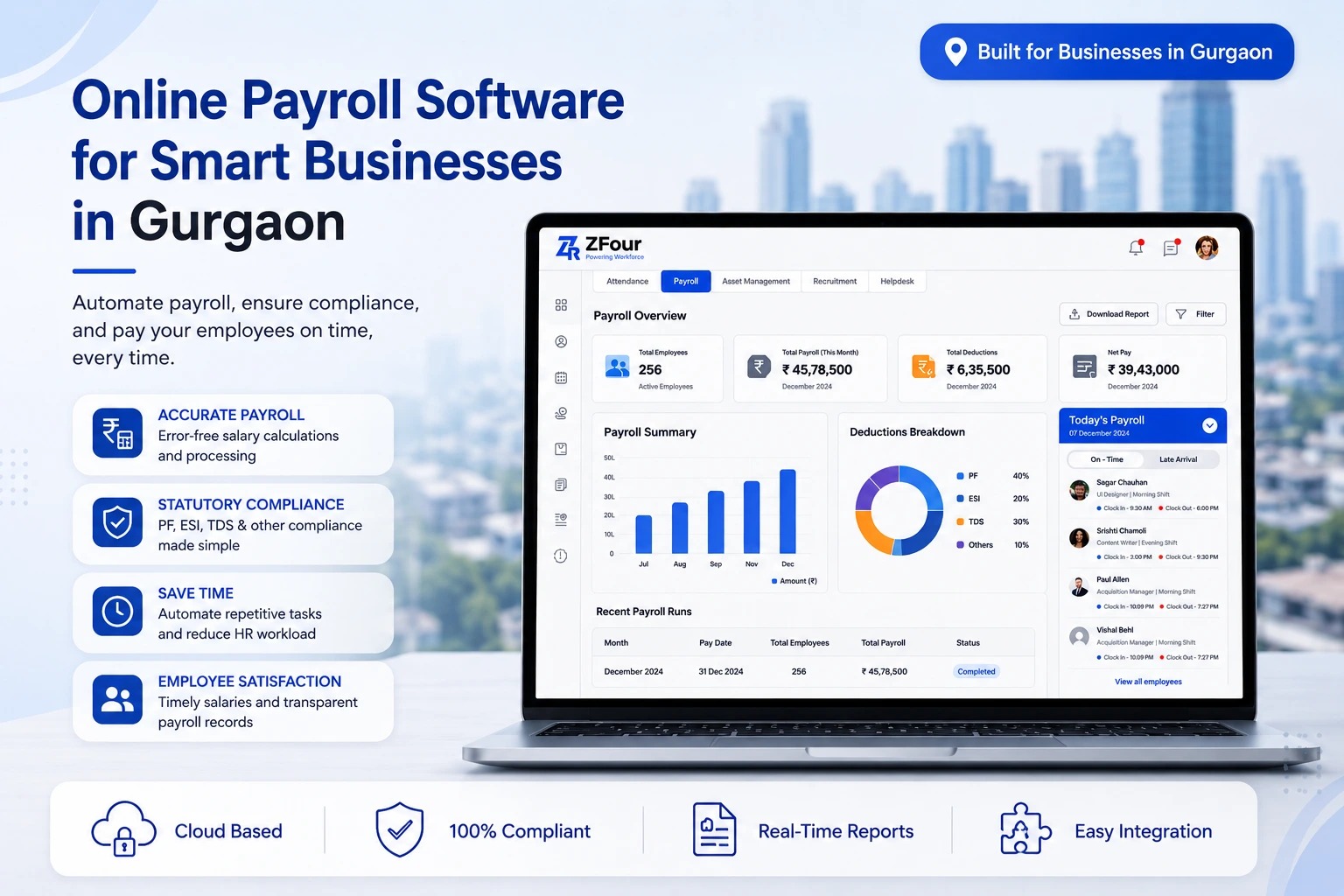
An HRMS payroll software can connect payroll with employee and attendance information to create a more structured payroll workflow. Depending on the organization's selected modules and configuration, relevant processes may include:
Payroll management
Attendance management
Leave management
Employee self-service
Employee records
Payroll reporting
Connecting these processes can help reduce repetitive data entry and give HR teams a more structured payroll workflow.
ZFour HRMS should be evaluated against the organization's specific payroll rules, statutory requirements, integrations, workforce size, and approval processes before implementation.
Best Practices for Implementing Real-Time Payroll
Keep Employee Data Accurate
Payroll automation is only as reliable as the information feeding the system. Regularly review employee records, salary structures, attendance, and leave data.
Define Payroll Approval Workflows
Establish clear responsibilities for payroll preparation, review, correction, and final approval.
Review Exceptions Before Payroll Finalization
Automated payroll should still be checked for unusual deductions, missing attendance, unexpected salary changes, or other exceptions.
Restrict Payroll Access
Use role-based access to limit sensitive payroll information to authorized employees.
Keep Statutory Rules Updated
Payroll teams should review applicable statutory requirements and ensure that payroll configurations are updated appropriately.
Maintain Backup and Recovery Processes
Organizations should have appropriate processes for protecting payroll records and recovering important information if systems become unavailable.
Common Challenges With Real-Time Payroll Processing
Real-time payroll technology can improve workflows, but implementation still requires planning.
Incorrect Source Data
If attendance, leave, or employee information is incorrect, payroll calculations may also be affected.
Poor System Configuration
Salary structures, deductions, and payroll rules need to be configured correctly.
Integration Issues
Connected systems need compatible data and reliable synchronization.
Lack of Payroll Review
Automation should not remove appropriate human oversight.
Employee Data Security
Payroll information is sensitive, so organizations need appropriate access controls and data-handling practices.
Conclusion
Real-time payroll processing can make payroll administration more connected, visible, and efficient by bringing relevant employee, attendance, leave, and payroll information into a structured workflow.
The biggest advantage is not simply faster calculations. A well-designed payroll process can reduce repetitive data entry, improve access to current information, simplify attendance-to-payroll workflows, and make payroll review more organized.
However, automation should not replace payroll oversight. Accurate source data, appropriate system configuration, statutory updates, security controls, and human review remain essential.
For organizations looking to modernize payroll, an HRMS that connects payroll, attendance, leave, employee records, and self-service can provide a practical foundation for a more efficient payroll process.

Farheen Ahmed
HR Tech Content Strategist at ZFour Technology Private Limited
Research-driven content on HRMS, payroll, attendance management, employee management, and modern HR technology for Indian businesses.