10 min read
Quick Answer
A payroll management system for a small business in India is more than payroll software — it's the combination of process, controls, and automation that keeps salary calculation, tax deduction, and compliance accurate as the team grows.
Most small businesses don't fail because they lack software; they fail because payroll was never treated as a system with defined checks, only as a monthly task.
Key Takeaways
Payroll problems rarely appear suddenly — they scale quietly with headcount until a threshold is crossed and errors become frequent enough to damage trust.
International survey data gives a useful directional signal even without India-specific figures: a 2025 Employment Hero survey of 1,000 SME leaders found 84% had experienced payroll errors, and 31% were still managing payroll on spreadsheets (rising to 44% among businesses with 5–19 employees).
Buying payroll software doesn't automatically fix payroll — partial automation without process and controls is one of the most common reasons implementations underdeliver.
A real payroll management system has three layers: people (who owns what), process (defined checks and approval steps), and technology (the automation layer).
The businesses that get the most value from a payroll system are the ones that treat it as infrastructure to design, not a tool to switch on.
Why Payroll Is Becoming a Serious Business Risk
For many small businesses in India, payroll is still treated as a basic administrative task — salaries calculated manually, attendance tracked in spreadsheets, compliance handled separately, often by whoever has time that week.
Initially, this looks manageable. A 10-person team with fixed salaries rarely surfaces problems. But growth doesn't scale payroll risk linearly — it scales it in steps. Each new hire adds another salary structure to track, another attendance record to reconcile, another point where a manual process can quietly drift out of sync with reality. At some point — often without a clear trigger — the business crosses a threshold where errors stop being occasional and start being routine.
Why it matters: payroll risk isn't primarily a software gap. It's a governance gap — the absence of defined ownership, checks, and escalation paths for a process that touches every employee's income and the business's legal compliance every single month.
What Is a Payroll Management System?
A payroll management system is the combination of process, controls, and software that governs how a business calculates, verifies, and disburses salaries while staying compliant.
It's broader than "payroll software" — software is the technology layer; the system also includes who reviews payroll before it's disbursed, what happens when attendance data looks wrong, and how compliance rule changes get incorporated.
Core functions software typically automates within that system:
Salary calculation
Payslip generation
Attendance integration
Compliance tracking
The distinction that matters: a business can own payroll software and still not have a payroll system, if there's no defined process for who checks the output before it goes out, or what happens when something looks wrong.
Why Small Businesses in India Underestimate This Risk
Many small business owners believe payroll software — and payroll governance generally — is only necessary for large companies. This is one of the most common and costly misconceptions in this space.
In reality, small businesses often carry more payroll risk than large ones, not less, because they rely more heavily on manual processes and rarely have a dedicated payroll function to catch errors before they reach employees.
Common challenges at small scale:
Frequent salary errors
Delayed payroll processing
Incorrect tax calculations
Lack of structured compliance tracking
Rising HR/admin workload with every new hire
Who's most exposed? Businesses in the 15–50 employee range can face increasing payroll risk when processes remain heavily manual, particularly when there is no dedicated payroll owner.
What the Data Actually Shows About Payroll Errors
India-specific, large-sample payroll error data is limited in public sources, so the most useful evidence available is international survey data — directionally relevant given similarly high reliance on manual and spreadsheet-based payroll among smaller businesses globally.
A 2025 survey by Employment Hero, covering 1,000 small business leaders, found that payroll errors affected 84% of respondents, and 40% had incurred financial penalties as a result. Manual processing remained common — 31% of businesses were still using spreadsheets or forms for payroll, rising to 44% among the smallest businesses (5–19 employees). More than half reported making payroll errors more than once. The most frequently reported error types were incorrect wage calculations (48%), late or missing payments (38%), incorrect hours (36%), and incorrect tax calculations (27%).
Separately, U.S. Bureau of Labor Statistics-sourced analysis puts the average payroll error rate at roughly 1.2% per pay period across companies generally — a figure that compounds meaningfully over a year of pay cycles.
Why this matters for an Indian small business: these aren't India-specific numbers, and shouldn't be quoted as such — but the underlying pattern (manual processing correlating strongly with error frequency, smaller businesses being disproportionately affected) tracks closely with what's directly observable in India's compliance landscape, where PF, ESI, and state-specific PT rules add further manual-tracking burden on top of salary calculation itself.
The Three Layers of a Real Payroll System
A payroll management system that actually holds up under growth needs three layers working together — most failed implementations are missing one of them, not all three.
1. People — who owns what.
Someone needs clear ownership of payroll accuracy, even in a small team where that person wears multiple hats. Without a named owner, errors get discovered by employees, not caught internally.
2. Process — defined checks.
A specific, repeatable review step before disbursal (checking attendance sync, verifying deduction calculations, reconciling against the prior cycle) catches errors software alone won't, especially during the first few cycles after any change to salary structure or headcount.
3. Technology — the automation layer.
Payroll software reduces the manual-entry surface area where most errors originate, and keeps compliance rules current without someone tracking rate changes by hand.
Why it matters: buying software addresses layer three. Businesses that stop there — without assigning ownership or defining a review step — often see errors persist even after "automating" payroll, because the automation was never connected to a governance process around it.
Manual Payroll vs Payroll Management System
Factor | Manual Payroll | Structured Payroll Management System |
|---|---|---|
Accuracy | Dependent on individual diligence | Automated calculation + defined review step |
Time Required | High, and grows with headcount | Low, scales sub-linearly with headcount |
Error Risk | High, and compounds with complexity | Minimal, with layered checks |
Compliance Tracking | Manual monitoring of rule changes | Centralized tracking and configured workflows |
Ownership | Often informal or undefined | Named ownership with an audit trail |
Scalability | Breaks down predictably past a certain headcount | Designed to scale with the business |
Manual systems can work adequately for a short period at small scale. The risk isn't that they fail immediately — it's that they degrade gradually, in a way that's easy to miss until errors are already frequent.
Why Payroll Systems Fail Even After Adoption
Many businesses adopt payroll software and still encounter the same problems they were trying to solve. This is rarely a software quality issue — it's usually one of these:
Failure Cause | What It Looks Like |
|---|---|
Partial automation | Payroll is automated, but attendance still lives in a separate spreadsheet requiring manual entry into the payroll tool |
Lack of integration | Attendance, leave, and payroll run as disconnected systems, recreating the reconciliation problem the software was meant to solve |
Poor implementation | Data migration was rushed, or the team was never trained on the new process, so old manual habits persist alongside the new tool |
No defined ownership | Nobody specifically checks payroll output before disbursal, so software errors (misconfigured rules, bad data) go uncaught |
Treating setup as one-time | Compliance rules and salary structures change; a system configured once and never revisited drifts out of date |
Why it matters: a payroll system should function as part of a larger HR ecosystem — connected to attendance, employee data, and compliance tracking — rather than as an isolated tool bolted onto otherwise-manual processes.
Signs Your Business Needs to Upgrade
Payroll takes noticeably more time each cycle than it used to
Salary disputes or questions from employees are becoming more frequent
Calculation errors have occurred more than once recently
Compliance tracking (PF, ESI, PT deadlines) feels difficult to stay on top of
The person handling payroll is overloaded, or payroll depends entirely on one individual with no backup
Quick answer: two or more of these consistently present is a reliable signal that the current process has outgrown informal management — not a reason to panic, but a reason to act before an actual error occurs.
What to Look For in a Payroll Management System
Essential:
Automated payroll processing
Native Indian tax and compliance integration (PF, ESI, PT, TDS)
Attendance tracking integration
Cloud-based access
Data security (encryption, access controls)
Valuable additions:
Mobile access for approvals and self-service
Real-time reporting
Integration with a broader HRMS (leave, employee records, recruitment)
Who should weight which factors highest? A business with variable attendance (shift work, field staff) should weight attendance integration highest. A business operating across multiple states should weight compliance depth highest, given how much PT and LWF variation exists state to state.
Payroll Risk Matrix for Small Businesses
Risk | Likelihood (Manual Process) | Impact | Primary Mitigation |
|---|---|---|---|
Salary calculation error | High | Employee trust, correction time | Automated calculation + review step |
Missed PF/ESI deadline | Medium–High | Financial penalty, audit exposure | Automated compliance tracking |
Attendance-payroll mismatch | High (if systems are disconnected) | Under/overpayment, disputes | Integrated attendance-to-payroll sync |
Single point of failure (one person owns payroll) | Medium | Business continuity risk | Named backup, documented process |
Outdated compliance logic | Medium | Penalty exposure as rules change | Software with maintained compliance configurations and review controls |
This isn't meant as a precise probability model — it's a practical framework for prioritizing where to focus first when formalizing payroll for a growing team.
Illustrative Scenario: How Risk Compounds With Growth
Illustrative composite scenario, not a specific case study, used to demonstrate a common pattern.
A small company grows from 10 to 25 employees over roughly a year while continuing to manage payroll manually. In the early months, everything works — salaries are simple, headcount is small, and the person handling payroll knows the details by memory.
As headcount grows, payroll becomes more difficult to manage. Employees may raise more questions about calculations, while the person responsible for payroll spends increasing time on corrections and reconciliation. As the business grows and applicable statutory requirements become more complex, a manual process that worked at a smaller scale can become increasingly difficult to manage reliably.
Businesses that formalize payroll processes by assigning clear ownership, automating calculations, and integrating attendance can reduce repetitive work and make payroll easier to review and manage.
This example is illustrative rather than a prediction of a specific outcome; the impact of payroll automation depends on the business's processes, data quality, payroll complexity, and system configuration.
Integration With HRMS
Payroll doesn't function well in isolation. It depends on:
Attendance systems — for accurate, real-time worked-time data
Employee data — salary structure, tax declarations, bank details
Compliance tracking — PF, ESI, PT, and TDS rules, which change periodically
This is precisely why most growing businesses move toward an integrated HR payroll software rather than a standalone payroll tool — a connected system removes the reconciliation step that can recreate manual risk even after payroll is automated.
The Cost of Not Acting
Ignoring payroll risk doesn't remove it — it defers it, usually at a higher price:
Financial losses from calculation errors, both under- and overpayment
Legal/compliance penalties from missed or incorrect statutory filings
Employee dissatisfaction and attrition risk, since payroll errors erode trust faster than almost any other operational issue
Rising operational cost, as manual correction work consumes increasing HR/owner time
Over time, the cost of manual correction work, payroll delays, and compliance-related issues can become significant compared with the investment required for a structured payroll system.
Future of Payroll Management in India (2026–2030)
Trend | Impact |
|---|---|
Cloud-based payroll systems | Continued shift away from spreadsheet and on-premise processes |
AI-driven payroll analytics | Anomaly detection catching errors before disbursal, not after |
Automated compliance updates | Reduced manual tracking burden as Labour Codes continue rolling out through 2026–2027 |
Real-time employee access | Self-service reducing the query load on HR/owners |
Businesses that formalize payroll governance now — not just adopt software, but define ownership and process around it — will be better positioned as compliance requirements continue evolving through this period.
Why ZFour Hrms
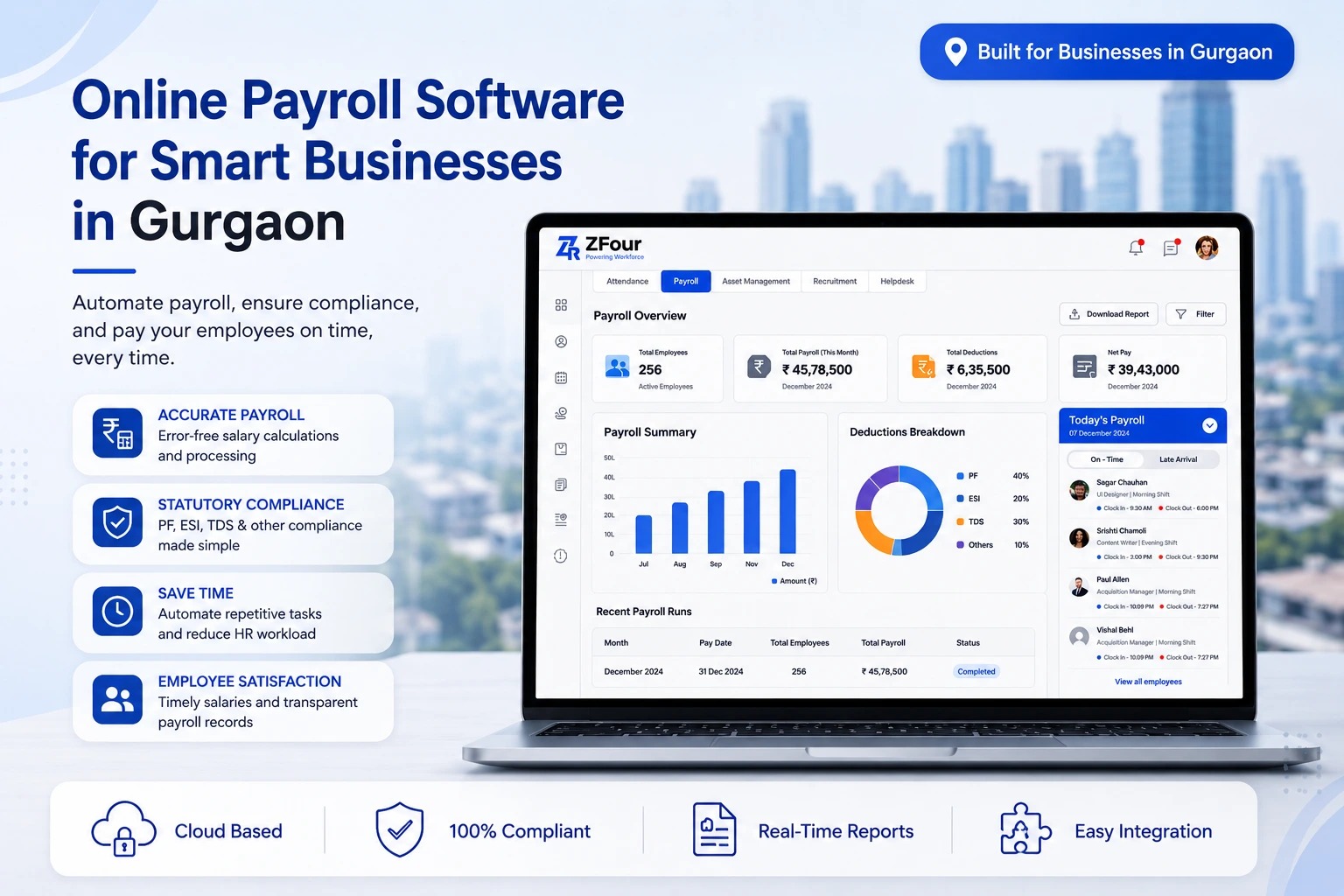
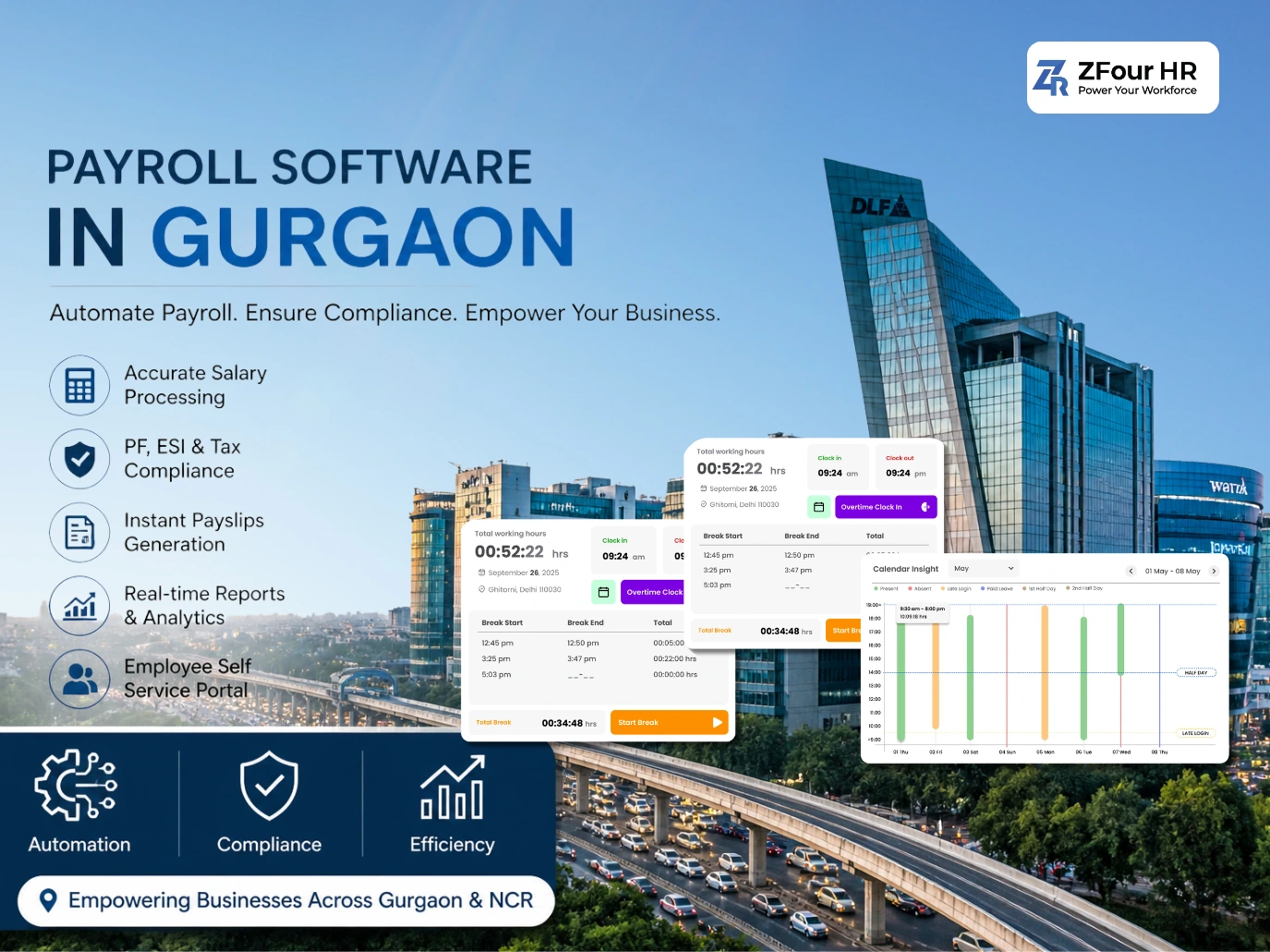
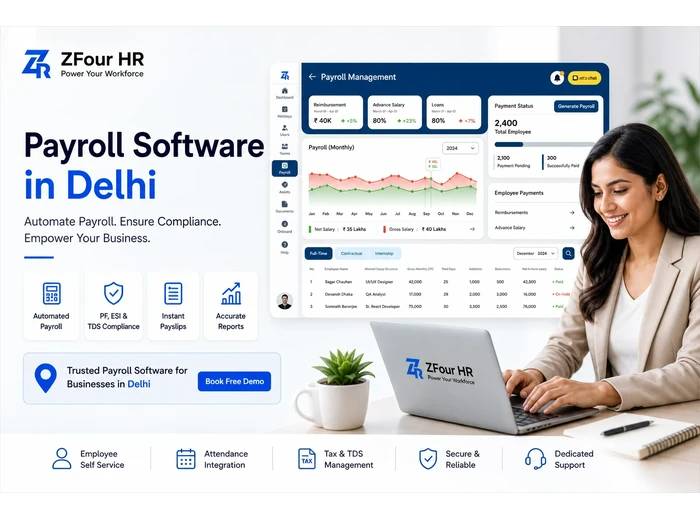
ZFour is built to function as the technology layer of a real payroll system — not a bolt-on tool. Attendance, leave, and payroll are connected natively, so the reconciliation gap that undermines partial automation doesn't appear. ZFour supports payroll workflows involving PF, ESI, PT, and TDS, with configurable compliance processes designed to help businesses manage applicable statutory requirements.
Conclusion
Payroll stops being a simple administrative task earlier than most small businesses expect — often well before it feels urgent. The businesses that manage this transition well aren't the ones with the most expensive software; they're the ones that treat payroll as a system with defined ownership, process, and automation working together, rather than a monthly task performed the same informal way regardless of how much the business has grown.
Have questions about formalizing payroll for your team? Contact ZFour's HR experts →

Farheen Ahmed
HR Tech Content Strategist at ZFour Technology Private Limited
Research-driven content on HRMS, payroll, attendance management, employee management, and modern HR technology for Indian businesses.