9 min read
People are one of the most important factors behind an organization's ability to grow, adapt, and deliver results. Human Resource Management (HRM) helps organizations manage their workforce while creating the conditions employees need to contribute effectively to business objectives.
Modern HRM goes beyond hiring and employee administration. It can support workforce planning, employee development, performance alignment, retention, workplace culture, and organizational change.
For businesses of different sizes, effective HRM can help connect people, processes, and business priorities.
This guide explains why Human Resource Management is important, how it contributes to business success, and how organizations can measure and improve its impact.
What Is Human Resource Management (HRM)?
Human Resource Management (HRM) is the structured approach organizations use to manage employees throughout the employee lifecycle.
It includes activities such as recruitment, employee development, performance management, compensation, workforce planning, employee relations, and compliance.
However, the importance of HRM extends beyond individual HR activities.
The broader purpose is to help an organization:
Attract and develop suitable talent
Build workforce capabilities
Align employee goals with organizational priorities
Support employee experience and engagement
Plan for future workforce requirements
Maintain consistent HR practices
Provide managers with information for better workforce decisions
In simple terms:
HRM helps organizations manage their people effectively while creating a workforce that can support business objectives.
HRM covers several interconnected areas, including recruitment, performance management, employee development, compensation, workforce planning, and employee relations. For a detailed breakdown, explore our guide to the key functions of Human Resource Management.
Why Is Human Resource Management Important?
HRM matters because business performance depends partly on having the right people, capabilities, leadership, and workplace practices in place.
A business may have strong products and technology, but it still needs employees who can execute its strategy.
Effective HRM can help organizations create this connection by supporting:
Business objectives → Workforce requirements → People practices → Employee contribution → Business outcomes
The impact will vary according to the organization's strategy, workforce, industry, and implementation.
7 Ways HRM Can Contribute to Business Success
1. Supports Better Workforce Planning
Organizations need to understand not only how many employees they have today, but also what workforce capabilities they may need in the future.
HRM can support workforce planning by helping organizations assess:
Current workforce capacity
Critical roles
Skills gaps
Future hiring requirements
Internal talent availability
Workforce changes caused by business growth
For example, a company planning to expand into a new market may need additional sales, technology, customer service, or management capabilities.
Workforce planning helps HR and business leaders consider these requirements before staffing gaps become urgent problems.
2. Helps Organizations Attract the Right Talent
Recruitment directly affects an organization's ability to build the workforce it needs.
HRM can help businesses establish structured approaches to:
Workforce requirements
Job design
Candidate evaluation
Recruitment planning
Onboarding
Employer branding
The objective is not simply to hire quickly. Organizations also need to consider whether candidates have the capabilities and experience required for the role and whether the role supports the company's broader workforce strategy.
A structured recruitment process can therefore contribute to building a workforce that is better aligned with organizational needs.
3. Develops Employee Skills and Capabilities
Business requirements change over time.
Employees may need new technical, managerial, or functional skills as organizations introduce new technologies, products, processes, or markets.
HRM can support this through:
Upskilling
Reskilling
Leadership development
Learning programs
Career development
Mentoring
Internal mobility
Employee development can also help organizations build capabilities internally instead of relying exclusively on external hiring.
The most effective development initiatives are connected to both employee career needs and the capabilities the organization expects to need.
4. Aligns Employee Performance With Business Goals
Employees need to understand how their work contributes to organizational priorities.
Performance management can help establish this connection.
A useful structure is:
Business goal → Team objective → Individual goal → Performance measurement
For example, if improving customer retention is a strategic priority, relevant teams may establish goals around customer satisfaction, service quality, response times, or retention-related outcomes.
Clear goal alignment can help employees understand expectations while giving managers a framework for reviewing progress.
5. Supports Employee Retention
Replacing employees can require additional recruitment, onboarding, and training effort.
HRM can help organizations understand factors that may influence employee retention, including:
Career development
Manager effectiveness
Recognition
Compensation
Workload
Workplace culture
Learning opportunities
Internal career mobility
HR teams can use employee feedback and workforce data to identify patterns and investigate potential retention risks.
Retention strategies should be based on the organization's workforce and business context rather than assuming that one approach works for every employee.
6. Builds a Healthy Organizational Culture
HRM also influences how employees experience the workplace.
Policies, leadership practices, communication, recognition, development opportunities, and performance processes can all contribute to workplace culture.
For example, an organization that wants to encourage innovation may need HR practices that support:
Continuous learning
Collaboration
Appropriate recognition
Knowledge sharing
Employee development
Constructive feedback
HR therefore has an important role in reinforcing the behaviors and working practices that support organizational priorities.
7. Helps Organizations Manage Workforce Risk
HRM also contributes to consistent employee processes and responsible workforce management.
Depending on the organization's location and workforce, this can involve areas such as:
Employee documentation
Workplace policies
Employment practices
Payroll-related requirements
Statutory obligations
Employee records
Workplace conduct
HR teams should regularly review applicable laws and organizational policies because compliance requirements can change.
HRM and Business Growth
As organizations grow, workforce complexity generally increases.
A small business may initially manage employees through relatively simple processes. As headcount increases, it may need more structured approaches to recruitment, onboarding, performance management, employee records, workforce planning, and internal communication.
HRM can support this transition by creating repeatable processes and clearer responsibilities.
For Small Businesses
HRM can help small businesses:
Establish consistent employee processes
Plan hiring around business growth
Improve onboarding
Develop employees
Define performance expectations
Reduce administrative confusion
For Growing Organizations
As the workforce expands, HR teams may need more structured systems for:
Workforce planning
Performance management
Employee development
Leadership pipelines
Employee engagement
Workforce reporting
For Large Enterprises
Large organizations may need more sophisticated HR strategies because they often manage multiple locations, departments, job families, and workforce segments.
Their HR approach may therefore include structured succession planning, workforce analytics, skills planning, leadership development, and standardized HR processes.
HRM and Employee Performance
Employee performance is influenced by more than individual effort.
Employees need clear expectations, appropriate resources, relevant skills, feedback, and effective management.
HRM can contribute by creating systems that support:
Clear goals → Regular feedback → Development → Performance review → Continuous improvement
A strong performance management process should not focus only on annual reviews. Organizations may also benefit from regular conversations about goals, development, challenges, and progress.
HRM and Employee Engagement
Employee engagement refers to how employees connect with their work and organization.
HRM can support engagement through practices such as:
Recognition
Career development
Employee communication
Manager training
Feedback mechanisms
Learning opportunities
Employee well-being initiatives
Engagement strategies should be based on employee feedback and organizational circumstances rather than relying on generic initiatives.
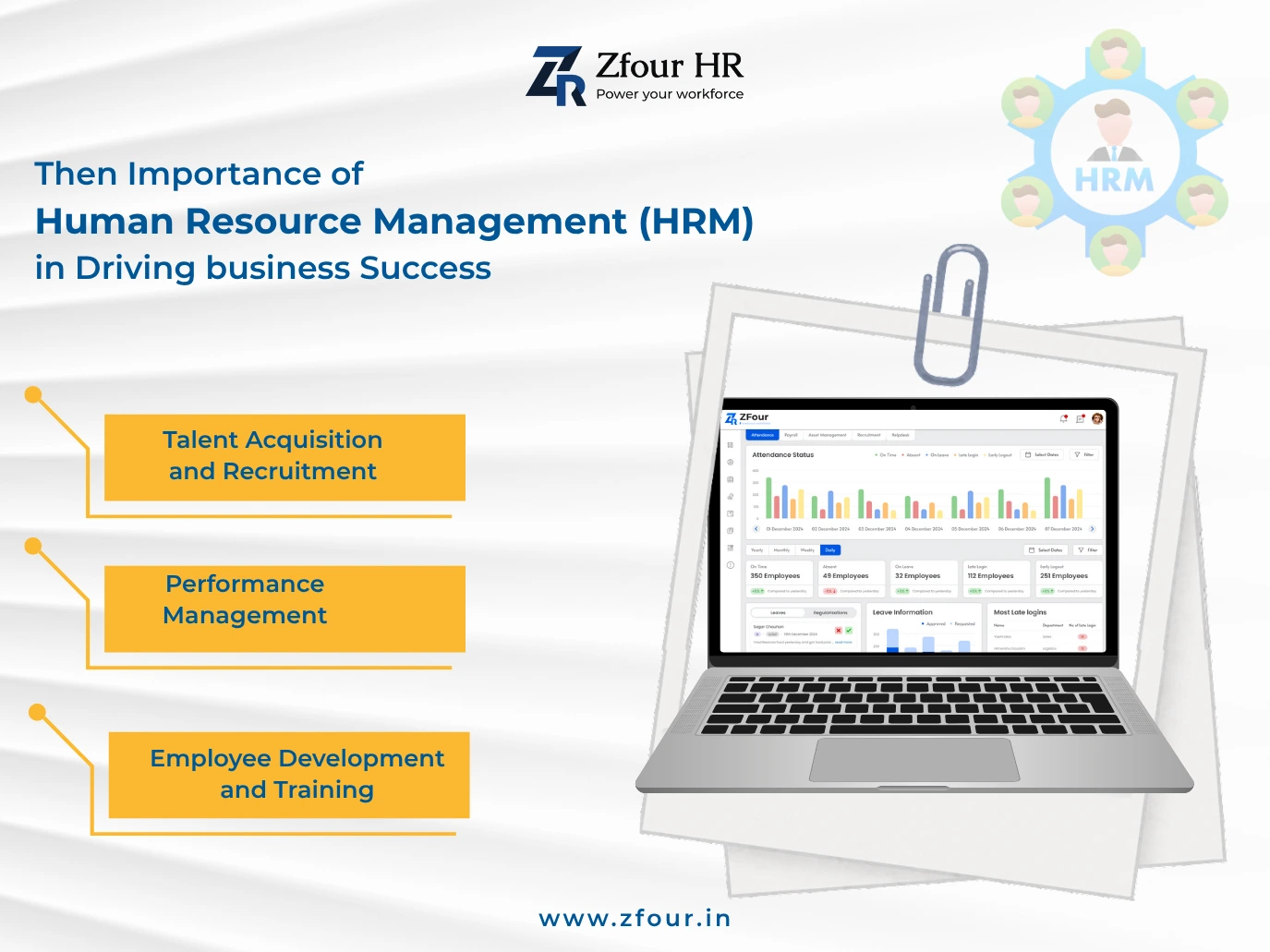
The Role of HR Data in Modern HRM
Workforce data can help HR teams move from assumptions toward more informed decision-making.
Organizations may track metrics such as:
Employee turnover
Absence
Headcount
Time to hire
Training participation
Performance outcomes
Internal mobility
Employee feedback
However, metrics should always be interpreted in context.
For example, an increase in turnover does not automatically explain why employees are leaving. HR teams may need to examine factors such as department, role, tenure, management structure, compensation, workload, and employee feedback.
This makes HR data a decision-support tool, rather than a replacement for human judgment.
Organizations can use HR analytics software to organize workforce information, identify patterns, and support more informed people decisions.
How HR Technology Supports HRM
HR technology can support HRM by centralizing employee information, automating selected workflows, and making workforce information easier to access.
Depending on the platform, HR technology may support areas such as:
Employee records
Attendance
Payroll
Leave management
Performance management
Recruitment
Employee self-service
Workforce reporting
For example, an HRMS can bring employee information and HR processes into a centralized system, potentially reducing repetitive administrative work and making relevant information easier to access.
For a detailed explanation, read our guide on what an HR management system is and how it works.
How to Measure the Business Impact of HRM
There is no single metric that can determine whether HRM is successful.
Organizations should select measurements based on their business objectives.
HRM Area | Example Metrics | What It Can Help Assess |
|---|---|---|
Recruitment | Time to hire, offer acceptance | Hiring process effectiveness |
Retention | Turnover, retention by tenure | Workforce stability |
Development | Training participation, skill progression | Capability development |
Performance | Goal completion, review completion | Performance alignment |
Workforce planning | Headcount, workforce gaps | Future workforce readiness |
Employee experience | Employee feedback, engagement measures | Workplace experience |
Leadership | Succession coverage | Leadership readiness |
The purpose of these metrics is not simply to produce reports. They can help HR and business leaders identify patterns and determine where further investigation or action may be required.
Using relevant people data can help organizations evaluate workforce trends and inform HR decisions. The CIPD provides guidance on using people analytics to support evidence-based HR decisions.
Common HRM Challenges
Even well-designed HR processes can face challenges.
Lack of Strategic Alignment
HR initiatives may have limited impact when they are developed without understanding broader business priorities.
Poor Workforce Data
Incomplete or inconsistent employee information can make workforce analysis more difficult.
Reactive Hiring
Hiring only after a workforce shortage appears can create unnecessary pressure on HR and business teams.
Limited Employee Development
Organizations that do not regularly assess future skill requirements may find it harder to build capabilities internally.
Inconsistent Management Practices
Different approaches across managers or departments can create confusion and affect employee experience.
Resistance to Change
New HR processes or technologies may require employee and manager adoption. Communication and training can help make implementation smoother.
The Step Most Organizations Skip, Not the Step They Get Wrong
Every one of the seven areas usually listed under "improving HRM" — connecting to business goals, assessing the workforce, improving processes, developing employees, using data, strengthening managers, reviewing strategy — is genuinely correct advice.
The reason many organizations still don't improve despite knowing this list is rarely that they skip a step. It's that they treat all seven as equally important starting points, pick whichever feels easiest to act on first, and never actually finish any of them well.
The step that's usually missing isn't on the list at all: deciding, explicitly, which single HR problem is costing the business the most right now, before touching any of the seven areas.
An organization that picks "manager capability" because a specific pattern of team turnover pointed there will make more progress than one that tries to improve workforce data, employee development, and manager training simultaneously because all three sounded reasonable.
This matters because HR improvement efforts compete for the same limited attention and budget as everything else in the business.
Spreading that attention across seven fronts at once usually means shallow progress on all of them rather than real progress on the one that actually mattered.
Human Resource Management and Long-Term Business Success
The value of HRM is not limited to individual HR processes.
When workforce planning, employee development, performance management, retention, culture, and business objectives are connected, HR can become a more effective business partner.
A practical HRM framework can be viewed as:
Plan → Hire → Develop → Align → Retain → Measure → Improve
This creates a continuous process through which organizations can review whether their workforce practices are supporting current and future business requirements.
Where to Start, Practically
If you're not sure which of the seven areas above is actually your gap, the honest answer is usually visible in whatever HR problem keeps recurring regardless of who's handling it — a pattern of turnover, a compliance near-miss, inconsistent hiring outcomes.
Tell us what that recurring problem looks like for your business, and we'll help you figure out whether it's a people issue, a process issue, or one that technology can actually help with.
Conclusion
Human Resource Management (HRM) plays an important role in connecting an organization's people with its business objectives.
Its value extends beyond recruitment and administration. Effective HRM can support workforce planning, employee development, performance alignment, retention, organizational culture, and responsible workforce management.
The strongest HR approach is not simply about implementing more processes or technology. It is about understanding what the business is trying to achieve and ensuring that its workforce has the capabilities, support, and structure needed to contribute.
As organizations grow and workforce requirements change, a thoughtful HRM strategy can help them make more informed people decisions and build a workforce that is better prepared for the future.

Farheen Ahmed
HR Tech Content Strategist at ZFour Technology Private Limited
Research-driven content on HRMS, payroll, attendance management, employee management, and modern HR technology for Indian businesses.