9 min read
Startups need to move quickly, but growing teams also create new HR responsibilities. Employee records, recruitment, onboarding, attendance, payroll, leave, performance, and employee communication can become difficult to manage when handled through spreadsheets, email, and disconnected tools.
That is where HR tools for startups can help.
Modern HR tools can centralize employee information, automate selected administrative workflows, and give growing teams better visibility into their people processes. The right choice depends on the startup's size, workforce, operating model, budget, and the HR processes it needs to manage.
This guide explains what HR tools startups need, which capabilities to prioritize, how different tools can fit different requirements, and how to choose an HR platform as the business grows.
What Are HR Tools for Startups?
HR tools are software applications that help businesses manage one or more people-related processes.
For startups, these tools may cover areas such as:
Recruitment and applicant tracking
Employee records
Payroll
Attendance and leave
Employee self-service
Performance management
Employee engagement
Workforce reporting
HR documentation
Compliance-related record keeping
A startup does not necessarily need every HR tool from day one.
The better approach is to identify the processes creating the most administrative workload and choose technology around those requirements.
In simple terms: HR tools help startups organize people processes, reduce repetitive administrative work, and create scalable HR workflows as the workforce grows.
Why Do Startups Need HR Tools?
In the early stages of a business, founders or small HR teams often manage employee information and processes manually.
That can work with a very small workforce. As headcount increases, however, the number of employee requests, records, approvals, payroll inputs, recruitment activities, and reporting requirements also increases.
HR tools can help startups by providing a more structured way to manage these processes.
As businesses grow, establishing structured employee-management practices becomes increasingly important. The U.S. Small Business Administration provides guidance for businesses on hiring and managing employees.
Common startup challenges that HR tools can address
Startup Challenge | How HR Tools Can Help |
|---|---|
Employee information spread across files | Centralize employee records |
Manual leave approvals | Create digital leave workflows |
Repetitive attendance tracking | Automate selected attendance processes |
Recruitment managed through spreadsheets | Organize candidate and hiring information |
Manual payroll calculations | Support structured payroll processing |
Limited workforce visibility | Provide HR reports and dashboards |
Growing employee requests | Provide employee self-service options |
The actual benefits depend on the software selected and how effectively the startup implements it.
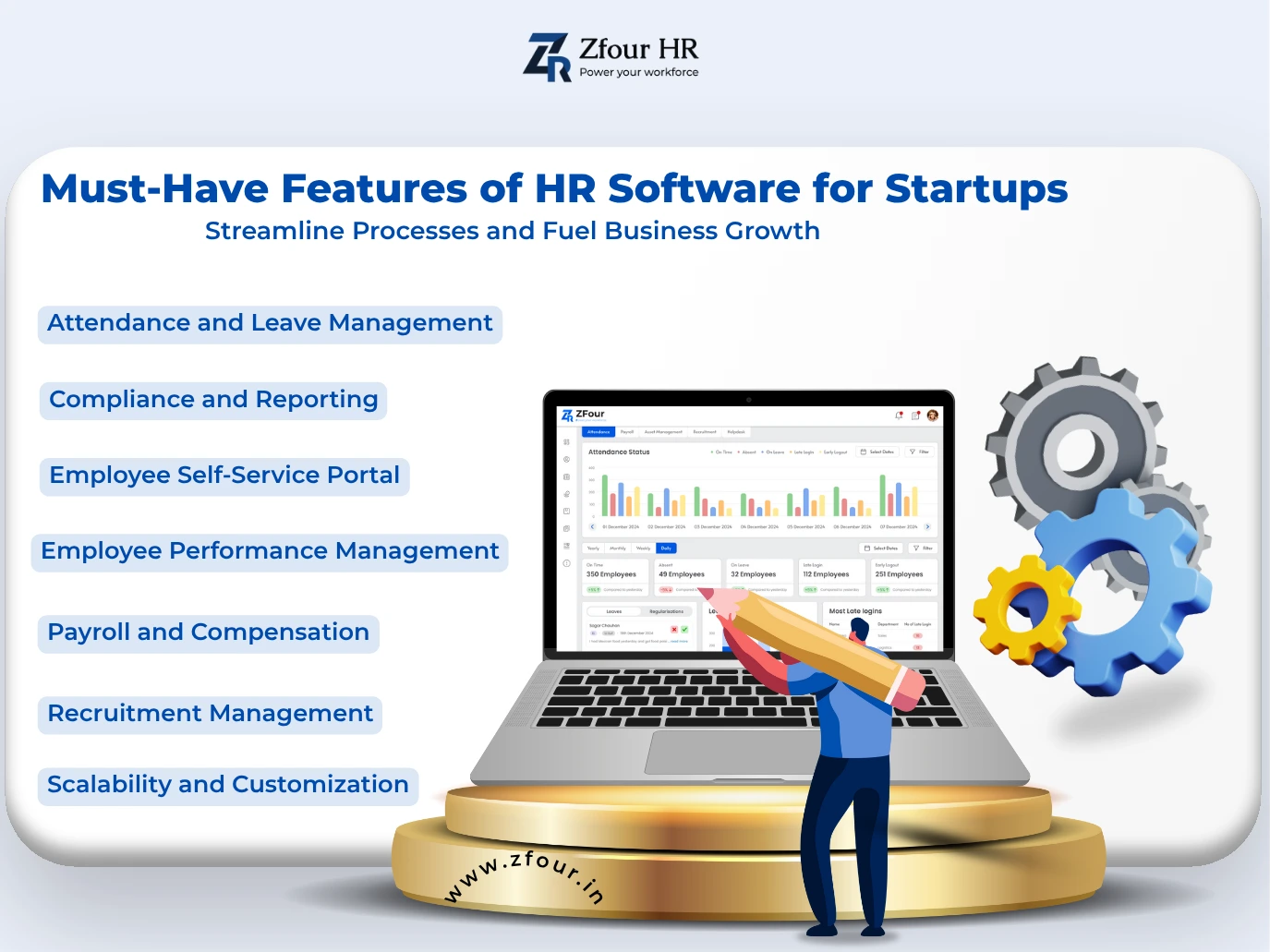
Key Features of HR Software for Startups
What Should Startups Look for in HR Tools?
Before choosing an HR platform, startups should evaluate the problems they need to solve rather than selecting software based only on the number of features.
1. Ease of Use
A startup may not have a dedicated HR technology team.
The platform should therefore be understandable for HR administrators, managers, and employees.
Look for:
Simple navigation
Clear workflows
Employee self-service
Easy reporting
Straightforward administration
2. Scalability
The tool should be capable of supporting the organization as its workforce grows.
Consider whether it can accommodate:
More employees
Additional departments
Multiple locations
New HR processes
Additional reporting requirements
3. Payroll Capabilities
For startups operating in India, payroll requirements may include salary calculations, payslips, deductions, and applicable statutory processes.
Before selecting a payroll tool, verify which statutory calculations and reporting capabilities are actually supported by the provider.
4. Attendance and Leave
If the startup has office-based, hybrid, field, or distributed employees, attendance requirements can vary considerably.
Useful capabilities may include:
Attendance tracking
Leave requests
Approval workflows
Shift management
Mobile attendance
Location-based attendance, where appropriate
5. Recruitment
Growing startups frequently need to hire quickly while maintaining an organized hiring process.
Recruitment tools can help with:
Job openings
Candidate records
Application tracking
Interview coordination
Hiring-stage tracking
Onboarding handoffs
6. Employee Self-Service
Employee self-service can reduce the number of routine requests handled manually by HR.
Depending on the platform, employees may be able to:
View personal information
Access payslips
Apply for leave
Check attendance
Submit requests
Track approvals
7. Performance Management
As teams grow, informal performance discussions may become difficult to maintain consistently.
Performance tools can support:
Goal setting
Performance reviews
Feedback
KPI tracking
Development discussions
8. Reporting and Analytics
HR reporting can help startups understand workforce trends.
Depending on the platform, reports may cover:
Headcount
Attendance
Leave
Recruitment
Turnover
Payroll
Performance
Startups that need deeper workforce insights can also evaluate HR analytics software for organizing workforce data and supporting people-related decisions.
Top HR Tools for Startups in 2026
There is no single HR tool that is best for every startup.
The right choice depends on factors such as company size, location, payroll requirements, hiring volume, existing technology, and budget.
Here are several established options startups may evaluate:
HR Tool | Best Suited For | Key Areas to Evaluate |
|---|---|---|
ZFour HRMS | Startups and growing businesses looking for a broader HR platform | Payroll, attendance, leave, employee management, performance and self-service |
Zoho People | Businesses looking for configurable HR workflows | Employee management, attendance, leave, performance and workflows |
BambooHR | Organizations prioritizing employee management and HR administration | Employee records, onboarding, performance and reporting |
Gusto | US-based small businesses (requires a US business entity to sign up) | Payroll, benefits and employee administration — not usable for an Indian startup's own payroll without a US entity |
Rippling | Businesses looking to connect HR with broader workforce administration | HR, payroll, IT and employee lifecycle workflows |
Workday | Larger organizations with complex workforce requirements | Enterprise HR, talent, workforce management and analytics |
Important: Features, pricing, integrations, availability, and regional capabilities can change. Startups should verify the current offering directly with each provider before making a purchasing decision.
Note specifically on Gusto: it requires a US business entity, US EIN, and a US-based employee to even create an account — it is not a direct option for an Indian startup managing its own India-based payroll, regardless of how it's often listed in general "top HR tools" roundups.
ZFour HRMS for Startups
ZFour HRMS can be considered by startups that want multiple HR processes managed through a centralized platform.
Depending on the organization's requirements and the modules included in its selected plan, ZFour HRMS supports areas such as:
Payroll management
Attendance management
Leave management
Employee self-service
Recruitment
Performance management
HR reporting
For a startup, the potential advantage of a broader HR platform is that employee information and related workflows can be managed within a more centralized environment instead of relying on multiple disconnected systems.
Startups should still evaluate the specific modules, integrations, support, pricing, and statutory capabilities they require before selecting a plan.
HR Tool Categories Startups Should Consider
Not every startup needs the same combination of software.
HRMS Platforms
An HRMS can combine multiple HR functions within one system.
This may be useful when a startup wants to avoid managing separate tools for employee records, attendance, leave, payroll, and other HR processes.
Recruitment Tools
Recruitment-focused platforms are useful when hiring is a major operational requirement.
They can help organize candidate pipelines and hiring workflows.
Payroll Tools
Payroll platforms focus primarily on salary processing and related payroll administration.
They may be appropriate when payroll is the startup's immediate technology priority.
Performance Management Tools
These platforms focus on goals, feedback, reviews, and employee development.
They can become more relevant as teams become larger and performance processes require greater structure.
Employee Engagement Tools
Engagement platforms can support employee surveys, feedback, recognition, and communication.
They are generally more useful when a startup has established a basic HR foundation and wants to improve employee experience.
Best HR Tool for Different Startup Needs
Instead of asking “Which is the best HR tool?”, startups should ask “Which tool is best for our current HR requirement?”
Startup Requirement | Tool Type to Consider |
|---|---|
Need payroll and employee management | HRMS or payroll platform |
Rapidly increasing hiring | Recruitment/ATS tool |
Need attendance and leave management | HRMS with attendance capabilities |
Need employee self-service | HRMS/employee experience platform |
Need structured performance reviews | Performance management platform |
Need workforce reporting | HRMS with analytics/reporting |
Need multiple HR processes together | Integrated HRMS |
This approach can help startups avoid purchasing software that offers capabilities they do not currently need.
When Should a Startup Start Using HR Software?
There is no universal employee-count threshold.
A startup may benefit from HR software when:
Employee records are becoming difficult to manage manually
Payroll takes significant administrative effort
Leave and attendance requests are increasing
Hiring activity is becoming more frequent
Employees need regular access to HR information
HR reporting is becoming difficult
Multiple spreadsheets are being used for the same information
The right time depends on the startup's operational complexity rather than headcount alone.
How Much Should a Startup Spend on HR Tools?
HR software costs vary considerably depending on:
Number of employees
Modules selected
Payroll requirements
Implementation requirements
Integrations
Support
Contract structure
Billing frequency
Instead of selecting software solely because it has the lowest price, startups should consider the total value and administrative workload it can address.
A low-cost tool may become expensive if it requires multiple additional systems to cover essential HR processes.
Similarly, an enterprise platform may provide capabilities that a small startup does not currently need.
The Test That Matters More Than Any Checklist
Most startup HR-tool checklists ask you to rate a platform against ease of use, scalability, integrations, and security — all genuinely relevant, and all things every vendor's pitch already claims to have.
A sharper test: pick the one HR process currently eating the most founder or ops time — usually payroll, attendance, or recruitment tracking — and ask a vendor to demo exactly that process using data that looks like yours, not their clean sample data.
A platform that handles your messiest real scenario (a mid-month salary revision, an attendance dispute, a candidate who reapplies for a different role) well is a better signal than a feature list that checks every box in theory.
If a vendor can't or won't walk through your specific scenario during evaluation, that's worth noting before signing anything — not because they're necessarily bad, but because you won't actually know if the platform fits until you've seen it handle your real complexity, not a demo script.
Common Mistakes Startups Make When Choosing HR Tools
Choosing Based Only on Price
The cheapest platform may not cover the processes the startup actually needs.
Buying Too Many Tools
Using separate applications for every HR function can create duplicate data and additional administration.
Ignoring Scalability
A tool that works for a small team may become restrictive as the workforce grows.
Not Checking Regional Requirements
Startups operating in India should verify whether payroll and other applicable HR requirements are supported for their workforce.
Focusing Only on Features
A long feature list does not necessarily mean a platform is easier or more effective to use.
Skipping User Testing
HR administrators and employees may have very different requirements. Both groups should be considered before implementation.
HR Tools vs HRMS: What's the Difference?
The terms are sometimes used interchangeably, but they are not always referring to the same thing.
HR tools is a broad term covering individual applications or platforms that solve specific HR problems.
An HRMS, or Human Resource Management System, generally brings multiple HR processes into a more centralized system.
For example:
Individual HR tools:
Recruitment + payroll + attendance + performance
Integrated HRMS:
Recruitment + payroll + attendance + performance + employee records within one platform
For startups with relatively simple requirements, individual tools may be sufficient. For businesses managing several connected HR processes, an integrated HRMS may reduce the need to maintain multiple disconnected systems.
For a deeper explanation of how an HRMS works, read what an HR management system is and how it works.
Benefits of Using the Right HR Tools
The right technology can provide several operational advantages.
Reduced Administrative Work
Automating repetitive workflows can reduce the amount of manual data entry and follow-up required.
Better Access to Employee Information
Centralized records can make relevant employee information easier for authorized users to access.
More Consistent Processes
Digital workflows can help standardize routine HR processes such as leave requests and approvals.
Improved Employee Self-Service
Employees can handle certain routine requests themselves rather than depending on HR for every action.
Better Workforce Visibility
Reports and dashboards can help HR teams identify workforce patterns and make more informed decisions.
These outcomes depend on the quality of implementation, employee adoption, configuration, and the capabilities of the selected platform.
Final Takeaway
The right HR tools for startups should make HR processes easier to manage without introducing unnecessary complexity.
Startups should first identify their most important HR challenges, then evaluate tools according to their current workforce, business model, growth plans, budget, security requirements, and regional needs.
For startups looking for a broader HR platform, ZFour HRMS can be evaluated alongside other HR software options based on the specific modules and capabilities required.
The goal is not to choose the tool with the longest feature list. It is to choose technology that solves today's HR problems while providing enough flexibility to support tomorrow's workforce.

Farheen Ahmed
HR Tech Content Strategist at ZFour Technology Private Limited
Research-driven content on HRMS, payroll, attendance management, employee management, and modern HR technology for Indian businesses.