8 min read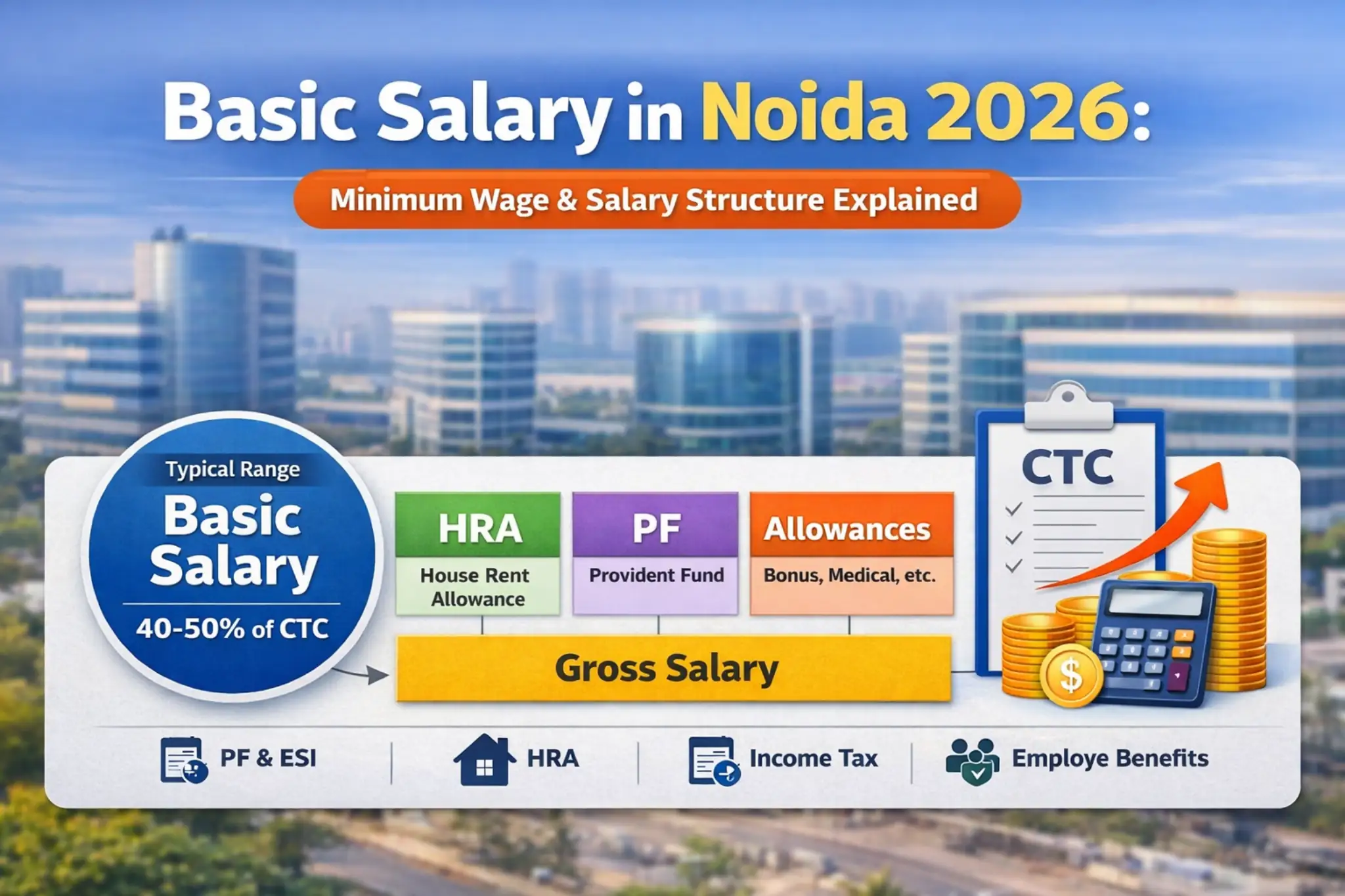
Basic salary sounds like the simplest line on a payslip — until you realize it quietly determines PF contributions, gratuity, HRA exemption, and how a business stays compliant with Uttar Pradesh labour law. Get the basic salary percentage wrong, and the ripple effects show up in payroll errors, compliance exposure, and employee disputes over take-home pay.
This guide focuses on how basic salary actually works inside a CTC structure in Noida — not the statutory minimum wage rate itself, which changes periodically and is covered in full in our Noida Minimum Wages 2026 guide. Here, the focus is on salary structuring, in-hand calculation, and the compliance rules employers need to apply correctly.
Quick Answer
Basic salary is the fixed core component of an employee's pay, before allowances, bonuses, or reimbursements are added. In most Noida companies, it's structured at 40–50% of total CTC. It must never fall below the government-notified minimum wage for the employee's skill category, and it's the base figure used to calculate PF, gratuity, and — under the upcoming Labour Codes — a larger share of statutory benefits than before.
Key Takeaways
Basic salary is the foundation figure for PF, gratuity, HRA exemption, and bonus eligibility calculations — not just a payslip line item.
Most Noida companies keep basic salary between 40–50% of CTC, though many IT and tech firms have historically kept it lower (25–35%) to reduce PF outflow — a practice the incoming Code on Wages is designed to close.
The Code on Wages requires basic wages to form at least 50% of total remuneration once notified rules take effect in a state — businesses keeping basic salary artificially low should expect to restructure CTC and budget for higher PF and gratuity costs.
Basic salary can never legally fall below the current government-notified minimum wage for the employee's category — check the latest Noida minimum wage rates rather than relying on a fixed figure, since these are revised periodically.
Uttar Pradesh does not levy Professional Tax, which is a small but real in-hand salary advantage for Noida employees compared to cities like Mumbai or Bengaluru.
What Is Basic Salary?
Definition: Basic salary is the fixed, guaranteed component of an employee's compensation, paid before any allowances, bonuses, incentives, or reimbursements are added. It does not fluctuate with performance or attendance the way variable pay does.
What basic salary directly determines:
Provident Fund (PF) contribution — calculated as a percentage of basic salary
Gratuity calculation, which is based on the last drawn basic salary
House Rent Allowance (HRA) exemption limits under income tax rules
Bonus eligibility thresholds under the Payment of Bonus Act
The floor that must legally meet or exceed the government-notified minimum wage
Because so many statutory calculations flow from this single number, getting the basic salary percentage right isn't just a payroll preference — it's a compliance decision.
Basic Salary vs Gross Salary vs CTC
These three terms are frequently confused, but they mean very different things:
Term | What It Means |
|---|---|
Basic Salary | The fixed base component, before allowances |
Gross Salary | Basic + HRA + allowances (before deductions) |
CTC (Cost to Company) | Gross salary + employer contributions (PF, gratuity, insurance, etc.) |
Why this distinction matters: CTC is what a company budgets per employee, gross salary is what shows up before deductions, and basic salary is the number statutory calculations actually run on. An employee comparing two job offers by CTC alone can end up with very different in-hand pay if the basic salary percentage differs.
How Basic Salary Is Typically Structured in Noida
Most companies in Noida structure basic salary at 40–50% of total CTC, balancing statutory compliance with employee take-home pay. That said, practice varies by sector:
Manufacturing and industrial roles tend to track closer to the minimum-wage-linked structure, where basic salary is set directly against the notified rate for the worker's skill category.
IT and corporate roles have historically had more flexibility, and many Noida tech companies have kept basic salary lower — often 25–35% of CTC — specifically to reduce PF and gratuity outflow. This is the exact practice the incoming Labour Codes are designed to restrict (more on this below).
Worked Example: CTC Breakdown
Here's how a ₹30,000 CTC might break down using a 40% basic salary structure:
Component | Percentage | Example (₹30,000 CTC) |
|---|---|---|
Basic Salary | 40% | ₹12,000 |
HRA | 20% | ₹6,000 |
Special Allowance | 30% | ₹9,000 |
Employer PF Contribution | ~10% | ₹3,000 |
(Employer PF and other statutory employer contributions typically sit outside gross salary but inside CTC — this is a common source of confusion between "gross" and "CTC.")
Note on HRA: Noida is classified as a non-metro city for HRA exemption purposes, so under the Old Tax Regime, HRA exemption is capped at 40% of basic salary (versus 50% for the eight notified metros — Delhi, Mumbai, Chennai, Kolkata, Bengaluru, Hyderabad, Pune, and Ahmedabad). The New Tax Regime does not allow HRA exemption at all.
In-Hand Salary Calculation
In-hand salary (or take-home salary) is what an employee actually receives after statutory deductions — distinct from both gross salary and CTC.
Formula: In-hand salary = Gross salary − (PF + ESI + TDS + other deductions)
Worked example (based on the ₹30,000 CTC above):
Component | Amount |
|---|---|
Basic Salary | ₹12,000 |
HRA | ₹6,000 |
Allowances | ₹9,000 |
Gross Salary | ₹27,000 |
Deductions:
Employee PF (12% of basic): ₹1,440
ESI (if gross is within the applicable wage ceiling): a small percentage of gross
TDS: varies by tax slab and exemptions claimed
Approximate in-hand salary: roughly ₹24,500–₹25,500, depending on ESI applicability and individual tax position.
Key insight: a higher basic salary means higher PF deduction and lower immediate take-home pay, but it also means higher long-term retirement savings and gratuity value. Salary structuring is a genuine trade-off, not a one-directional "more is better" decision.
Why Basic Salary Matters for Compliance
Basic salary sits at the center of several statutory obligations under Uttar Pradesh and central labour law:
Minimum Wage Act compliance — basic salary (or basic + certain fixed allowances, depending on how wages are defined under the applicable notification) must never fall below the notified minimum wage for the employee's skill category
PF contribution accuracy — both employee and employer PF are calculated on basic salary (subject to statutory wage ceilings)
ESI applicability — determined by gross wages against the prevailing wage ceiling, so an incorrectly structured basic salary can affect ESI eligibility
Gratuity calculation — based on the employee's last drawn basic salary, directly affecting exit payouts
Getting any of these wrong doesn't just risk a payroll correction — it risks a labour department inspection finding a systemic compliance gap across your entire workforce, not just one employee.
The Code on Wages: Why Low Basic Salary Is a Growing Risk
Under India's Code on Wages, basic wages are required to constitute at least 50% of total remuneration once state-specific rules are notified and enforced. This is a direct response to a long-standing industry practice — especially common among IT and tech companies — of keeping basic salary artificially low (sometimes 25–35% of CTC) to minimize PF and gratuity contributions.
What this means for Noida employers: companies that have structured CTC with a low basic salary percentage should expect to restructure compensation once UP formally notifies its rules under the Code, which will likely mean:
Higher PF and gratuity liability per employee
A recalculated take-home pay for employees, since a higher basic salary increases PF deduction even as it increases long-term benefits
A need to rebudget total employee cost, since employer-side PF and gratuity contributions rise alongside basic salary
Businesses that wait until formal enforcement to address this will be doing reactive, urgent payroll restructuring across their entire workforce at once — planning ahead is meaningfully lower-risk.
Common Salary Structuring Mistakes
Setting basic salary below the notified minimum wage for the employee's skill category — a direct compliance violation
Ignoring periodic minimum wage revisions — a fixed basic salary that was compliant last year may not be compliant after a wage revision like Noida's 2026 hike
Artificially low basic salary to reduce PF outflow — a practice increasingly at odds with Code on Wages requirements
Incorrect PF and ESI calculations — often from manual spreadsheet errors rather than a knowledge gap
Inconsistent basic salary percentages across similar roles — creates internal pay equity issues and complicates compliance audits
Compliance Checklist for Employers
Basic salary is set at or above the current notified minimum wage for each employee's skill category
Basic salary percentage (typically 40–50% of CTC) is applied consistently across similar roles
PF is calculated correctly on basic salary, subject to applicable wage ceilings
HRA exemption calculations reflect Noida's non-metro classification (40% cap under the Old Regime)
Gratuity calculations use the correct last-drawn basic salary
Salary structures are reviewed after every minimum wage revision — not on a fixed annual cycle alone
CTC structuring accounts for the Code on Wages' 50% basic wage requirement as UP notifies its rules
How Payroll Software Helps Manage Salary Structure
Manually tracking basic salary percentages, minimum wage compliance, PF ceilings, and HRA exemption rules across a growing workforce is exactly the kind of repetitive, error-prone work payroll software is built to remove. Automated payroll platforms can:
Apply the correct basic salary floor automatically based on skill category and location
Recalculate PF, ESI, and gratuity accurately whenever basic salary or CTC changes
Flag salary structures that fall below the latest notified minimum wage after a revision
Generate transparent payslips that break down basic, gross, and net pay clearly for employees
Suggested Sources: Noida Minimum Wages 2026 Guide · Payroll Management Software in Noida · Payroll Compliance Software · Minimum Wages in India: State-Wise Guide ·
Want to see this applied to your own workforce? Book a free ZFour HRMS demo and check your current salary structures against the latest compliance requirements.
Final Thoughts
Basic salary looks like a small number on a payslip, but it's the anchor point for PF, gratuity, HRA exemption, and minimum wage compliance all at once. With Noida's 2026 minimum wage revision raising the statutory floor and the Code on Wages pushing toward a 50% basic-salary standard, businesses that treat salary structuring as a one-time setup — rather than something to revisit after every regulatory change — are the ones most likely to face compliance gaps.
Ready to check your salary structures against current compliance requirements?

Farheen Ahmed
HR Tech Content Strategist at ZFour Technology Private Limited
Research-driven content on HRMS, payroll, attendance management, employee management, and modern HR technology for Indian businesses.