8 min read
Environmental, social, and governance (ESG) considerations are becoming increasingly important for organizations that want to build responsible, resilient, and sustainable businesses. While ESG is often associated with environmental reporting and corporate governance, human resources plays an important role in the social and governance aspects of ESG.
HR teams influence how organizations hire, develop, support, and retain employees. They also contribute to workplace policies, employee wellbeing, diversity, ethical practices, compliance, and responsible handling of employee information.
By adopting practical HR best practices for ESG and sustainability, organizations can make people-related processes more responsible while supporting broader business goals.
What Is Sustainable HR Management?
Sustainable HR management is an approach to managing employees and HR processes while considering long-term organizational, social, and environmental objectives.
It goes beyond traditional HR administration by considering how workforce practices affect:
Employee wellbeing
Diversity and inclusion
Employee development
Workplace culture
Ethical employment practices
Governance
Resource use
Long-term workforce sustainability
Sustainable HR does not mean that HR is responsible for every part of an organization's ESG strategy. Instead, HR works with leadership and other business functions to support the people and governance aspects of sustainability.
How HR Contributes to ESG
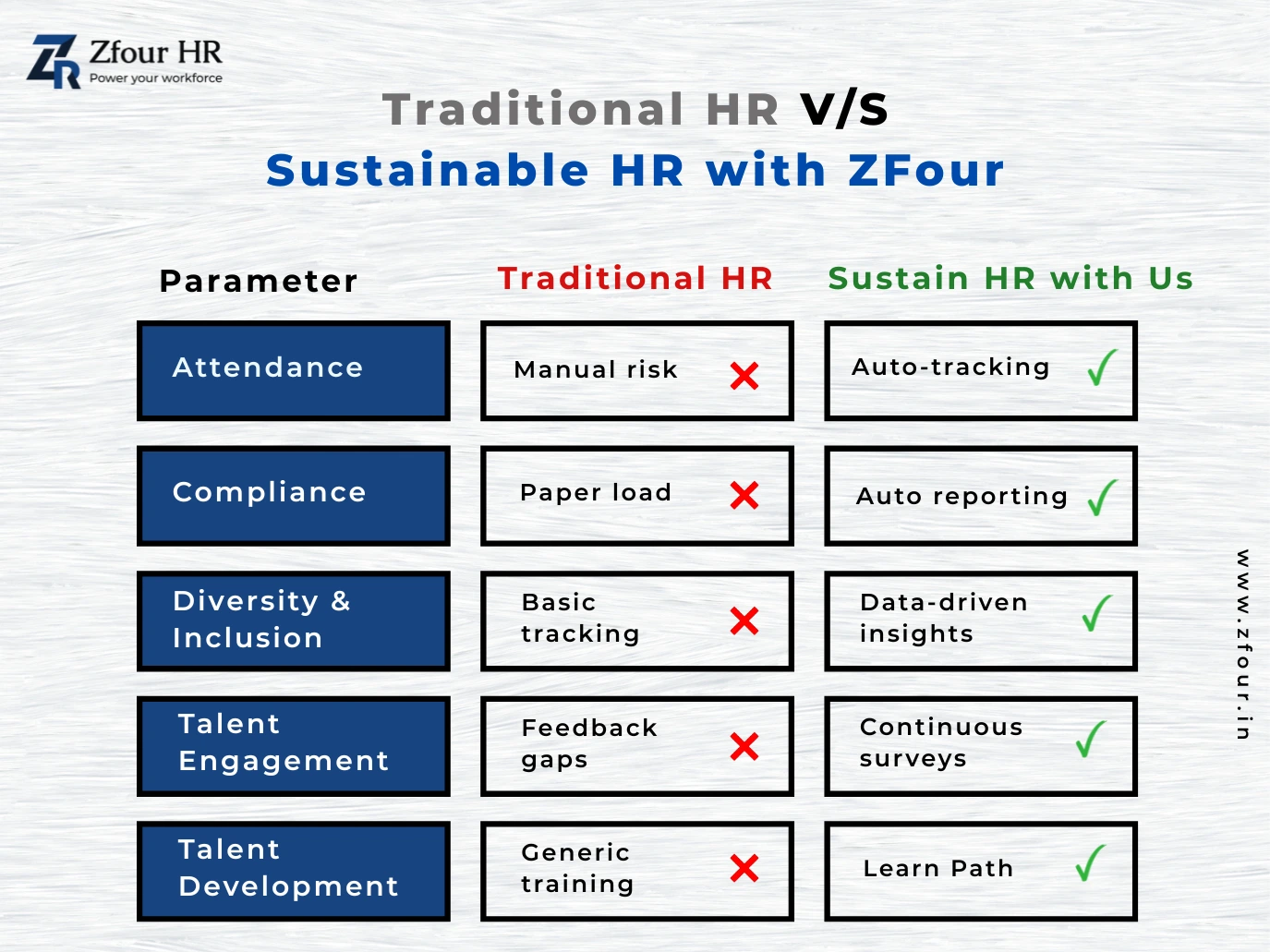
HR can contribute to ESG through policies, workforce practices, employee engagement, and responsible HR operations.
The three ESG dimensions provide a useful framework:
ESG Area | HR Contribution |
|---|---|
Environmental | Digital HR processes, reduced paper use, sustainable workplace practices |
Social | Employee wellbeing, inclusion, development, fair workplace practices |
Governance | HR policies, compliance processes, data governance, accountability |
The specific contribution of HR depends on the organization's industry, workforce, ESG strategy, and reporting requirements.
Environmental Practices in HR
Although environmental management is usually led by sustainability, operations, or facilities teams, HR can support environmental objectives through workplace practices.
Reduce Paper-Based HR Processes
Moving appropriate HR processes from paper to digital workflows can reduce dependence on physical documents.
Examples include:
Digital employee records
Online leave requests
Digital approvals
Electronic HR documents
Digital employee communication
Digitalization does not automatically make an organization sustainable, but it can reduce paper-intensive administrative processes when implemented appropriately.
Support Flexible Work Policies
Where appropriate for the business, remote and hybrid work arrangements may reduce some employee commuting requirements.
However, organizations should evaluate the broader environmental impact of their working model rather than assuming that remote work always results in lower emissions.
Encourage Employee Participation
HR can support sustainability initiatives by communicating environmental policies and encouraging employees to participate in relevant workplace programs.
Social Practices in HR
The social dimension of ESG is closely connected to people management.
HR teams can contribute by creating fair, inclusive, and supportive workplaces.
Employee Wellbeing
Employee wellbeing should be treated as an ongoing organizational responsibility.
HR teams can support wellbeing through:
Clear workplace policies
Reasonable workload practices
Employee feedback mechanisms
Flexible work arrangements where appropriate
Access to relevant wellbeing resources
Supportive manager practices
Wellbeing initiatives should be designed around actual employee needs rather than treated as one-time programs.
HR teams can support employee wellbeing through clear workplace policies, feedback mechanisms, flexible work arrangements, and relevant wellbeing resources.
Diversity, Equity and Inclusion
Organizations can use appropriate workforce information to understand representation and identify potential gaps.
HR teams can review areas such as:
Workforce representation
Recruitment patterns
Career development opportunities
Promotion processes
Employee feedback
Pay-related patterns
Sensitive demographic information should be handled responsibly and only by authorized personnel.
Learning and Development
Employee development supports both workforce capability and long-term organizational sustainability.
HR teams can establish:
Training programs
Skills development initiatives
Career development frameworks
Leadership development
Internal learning opportunities
Continuous development can help organizations prepare employees for changing business and technology requirements.
Fair Employment Practices
Responsible HR management includes clear employment policies, fair workplace practices, appropriate grievance mechanisms, and consistent application of organizational policies.
Governance Practices in HR
Governance is another important area where HR can contribute to ESG.
HR teams often manage policies and processes involving employees, workplace conduct, documentation, and sensitive workforce information.
HR Compliance
Organizations need processes for monitoring applicable employment and workplace requirements.
HR technology can help organize relevant employee and payroll information, but software should not be treated as a guarantee of legal or regulatory compliance.
Requirements vary by location, industry, workforce structure, and applicable laws.
Data Privacy and Security
HR departments handle sensitive employee information.
Responsible HR data practices should include:
Role-based access
Appropriate permissions
Secure data handling
Data accuracy
Appropriate retention practices
Regular access reviews
Responsible use of employee information
Organizations should establish policies that explain how employee data is collected, accessed, used, and protected.
Ethical Workplace Policies
HR can support governance by maintaining clear policies covering areas such as:
Workplace conduct
Anti-harassment practices
Grievance handling
Equal opportunity
Conflicts of interest
Employee responsibilities
Clear policies can help establish accountability and consistent workplace expectations.
HR Metrics That Support ESG Goals
Organizations should select HR metrics based on their ESG objectives rather than tracking metrics simply because they are easy to measure.
Potential HR metrics include:
ESG Focus | Example HR Metrics |
|---|---|
Employee wellbeing | Survey participation, wellbeing feedback |
Diversity | Workforce representation |
Development | Training participation, learning hours |
Retention | Employee turnover |
Recruitment | Hiring and workforce composition trends |
Governance | Policy completion, compliance-related records |
Employee experience | Engagement or satisfaction survey results |
Metrics should be interpreted in context. A single number rarely explains the underlying reason for a workforce trend.
How HRMS Can Support Sustainable HR Practices
An HRMS can help organizations structure and centralize many recurring HR processes.
Depending on the platform and configuration, an HRMS may support:
Employee information
Attendance
Leave management
Payroll workflows
Performance management
Employee self-service
HR reporting
Digital HR documentation
Centralizing these processes can reduce fragmented record keeping and make routine HR administration more organized.
For example, digital leave requests can replace some paper-based processes, while centralized employee information can reduce the need to maintain the same information across multiple files.
The sustainability value of an HRMS depends on how the organization implements and uses the system.
Employee Wellbeing and Responsible HR
ESG-focused HR should not focus only on measurable business outcomes.
Organizations should also consider the employee experience.
Responsible practices can include:
Clear Expectations
Employees should understand their responsibilities, policies, and performance expectations.
Accessible HR Processes
Employees should be able to access appropriate HR services and raise concerns through established channels.
Regular Feedback
Employee feedback can help HR teams identify workplace issues and areas that require attention.
Supportive Management
Managers play an important role in creating healthy and respectful working environments.
Work-Life Considerations
Organizations can review workload, working arrangements, and workplace practices to identify opportunities for improvement.
Diversity, Equity and Inclusion as Part of ESG
DEI can form an important part of the social dimension of ESG.
Organizations should move beyond simply measuring workforce representation and examine whether their HR processes provide fair opportunities.
Areas to review may include:
Recruitment
Promotions
Career development
Compensation practices
Leadership representation
Employee experience
Data can help identify patterns, but organizations should investigate those patterns carefully and avoid making assumptions about individuals.
Responsible Use of Employee Data
As organizations collect more workforce information, responsible data governance becomes increasingly important.
HR teams should ask:
Why are we collecting this information?
Data should have a legitimate organizational purpose.
Who needs access to it?
Access should be limited according to job responsibilities.
How accurate is the information?
Incorrect information can lead to poor reporting and inappropriate decisions.
How is it protected?
Employee information should be handled according to applicable privacy and security requirements.
How long should it be retained?
Organizations should establish appropriate retention practices based on legal, operational, and policy requirements.
The Question That Separates Real ESG Effort From a Checkbox Exercise
ESG is one of the areas most prone to a specific gap: the difference between what an organization reports and what its employees actually experience.
A company can accurately state that it "digitalized HR processes" or "launched a wellbeing initiative" while employees privately describe the workplace as unchanged or worse.
The question that actually distinguishes genuine ESG-focused HR from a checkbox exercise is simple: if you removed the ESG label from every initiative on this list, would employees still notice a real difference in how they're treated, managed, or supported?
Digitizing leave requests genuinely reduces paper — but if the underlying leave policy is still applied inconsistently by different managers, the sustainability claim is technically true and practically hollow.
A diversity metric can improve on a dashboard while the actual promotion conversations behind it remain exactly as biased as before.
This doesn't mean the individual practices covered above (governance, wellbeing, DEI, data protection) are wrong — they're the right areas to focus on.
It means the test for whether they're working isn't whether they exist, but whether removing the ESG framing would leave a visible gap in how the organization actually operates.
An initiative that only exists to be reported on, rather than to change something real, is the pattern worth watching for — in your own organization as much as in any vendor's or competitor's ESG claims.
How ZFour HRMS Can Support Sustainable HR Operations
ZFour HRMS provides a centralized environment for digital HR processes such as employee information, attendance, leave, payroll, performance management, and employee self-service.
For organizations working toward more structured HR operations, a centralized HRMS can help reduce fragmented administrative processes and provide a more organized way to manage relevant workforce information.
For example, digital HR workflows can reduce dependence on some paper-based processes, while centralized employee information can support more consistent record management.
The specific workflows and capabilities available depend on the organization's ZFour configuration and the modules being used.
How HR and Leadership Can Work Together on ESG
ESG should not be treated as an HR-only responsibility.
HR teams can collaborate with:
Senior leadership
Finance
Operations
Legal and compliance teams
IT
Sustainability teams
Employees
This cross-functional approach can help ensure that HR initiatives support the organization's wider ESG objectives.
For example, HR may manage workforce-related information while sustainability teams handle environmental reporting and leadership defines broader ESG priorities.
HR initiatives can also be aligned with relevant UN Sustainable Development Goals where they connect with the organization's broader sustainability priorities.
Conclusion
HR best practices for ESG and sustainability help organizations connect people management with broader environmental, social, and governance objectives.
HR's strongest contribution is often found in areas such as employee wellbeing, diversity and inclusion, workforce development, ethical employment practices, compliance processes, and responsible employee-data management.
Technology can support these efforts by making HR processes more structured and accessible. An HRMS can centralize relevant workforce information and digitalize selected administrative workflows, but technology should complement—not replace—clear policies, responsible management, and human judgment.
Organizations that integrate sustainability into everyday HR practices can build more responsible workforce processes while supporting long-term organizational resilience.

Farheen Ahmed
HR Tech Content Strategist at ZFour Technology Private Limited
Research-driven content on HRMS, payroll, attendance management, employee management, and modern HR technology for Indian businesses.