9 min read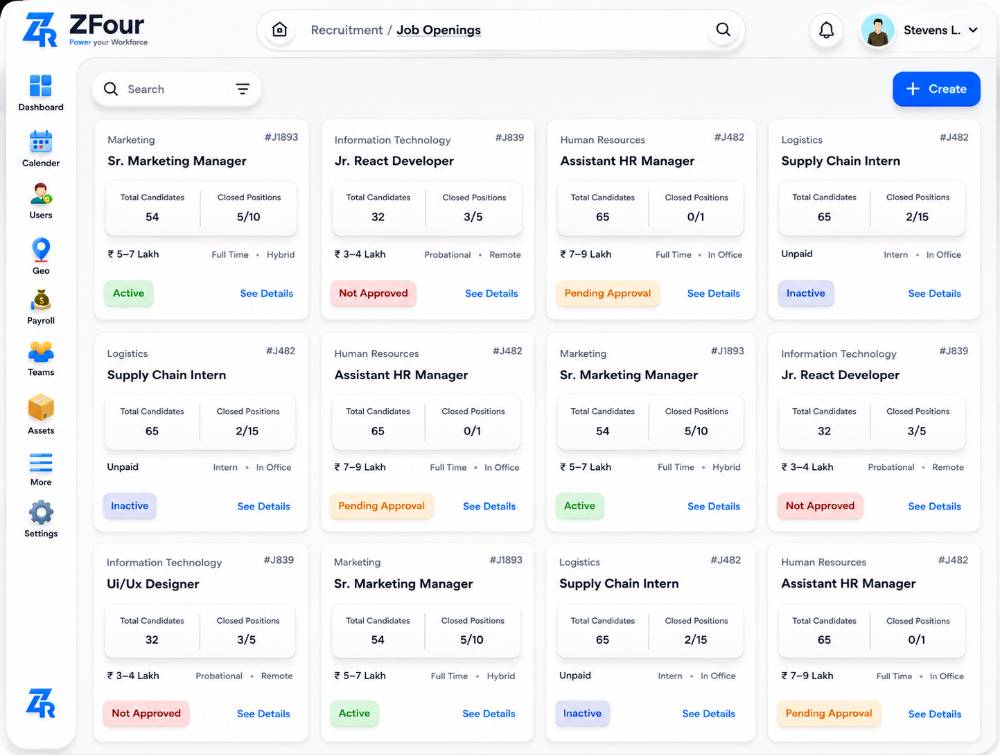
In today’s competitive job market, hiring the right people is not only about attracting candidates. Businesses also need a recruitment process that is organized, responsive, and easy for HR teams and hiring managers to manage.
When recruitment depends on spreadsheets, emails, scattered resumes, and manual follow-ups, even a strong hiring strategy can become difficult to execute. Recruiters may spend too much time on administrative work while candidates wait for updates or move through unclear hiring stages.
A structured recruitment process helps businesses move candidates from application to selection and onboarding more efficiently. ZFour HRMS brings recruitment workflows into a centralized system, helping HR teams manage job openings, candidates, interviews, hiring decisions, and the transition from candidate to employee.
Why Businesses Need a Streamlined Recruitment Process
Recruitment involves several connected stages, including identifying hiring requirements, creating job openings, attracting candidates, screening applications, conducting interviews, selecting candidates, and completing onboarding.
The process becomes difficult when these activities are managed through disconnected tools.
Common recruitment challenges include:
Candidate information spread across emails and spreadsheets
Difficulty tracking applications and hiring stages
Delays in interview coordination
Repeated manual data entry
Limited visibility for hiring managers
Inconsistent candidate communication
Difficulty tracking recruitment performance
Re-entering candidate information after hiring
A structured recruitment workflow gives HR teams a clear view of where every candidate stands and what action is required next.
According to the Society for Human Resource Management (SHRM), a structured recruitment process typically moves through planning, sourcing, selection, offer, and onboarding stages.
This is where a recruitment management system can make the process easier to coordinate.
How ZFour HRMS Streamlines the Recruitment Process
ZFour HRMS helps businesses centralize important recruitment activities instead of managing every stage separately.
1. Centralized Job Opening Management
Recruitment begins with clearly defining the position that needs to be filled.
HR teams need to manage information such as:
Job title
Department
Required skills
Experience
Job description
Hiring requirements
Position status
Hiring stages
ZFour's recruitment workflow provides a centralized way to manage job openings and their associated candidate activity.
Instead of maintaining separate spreadsheets for every vacancy, HR teams can organize recruitment information within a connected workflow.
This becomes particularly useful when organizations are hiring for multiple positions simultaneously.
2. Organized Candidate Management
As applications increase, recruiters need an efficient way to manage candidate information.
A centralized recruitment system can help HR teams organize candidate profiles, application details, hiring stages, and relevant recruitment information.
ZFour's recruitment management solution is designed to centralize applicants and help HR teams track candidates throughout the hiring process.
This reduces the risk of losing candidate information across emails or disconnected spreadsheets.
3. Faster Candidate Screening
Screening is one of the most time-consuming stages of recruitment, particularly when recruiters receive a large number of applications.
A structured screening workflow allows recruiters to evaluate candidates against predefined job requirements and move suitable applicants to the next stage.
Instead of repeatedly searching through emails or manually updating multiple spreadsheets, recruiters can work from a centralized candidate pipeline.
The objective is not simply to make hiring faster. It is to make the screening process more organized and consistent.
4. Better Interview Coordination
Interview scheduling often requires coordination between candidates, recruiters, hiring managers, and interview panels.
Without a centralized workflow, this can result in:
Repeated emails
Scheduling conflicts
Missed updates
Delayed interviews
Poor visibility into interview status
ZFour HRMS helps organize recruitment stages so hiring teams can manage interview-related activities more efficiently.
A structured process also makes it easier for recruiters to identify which candidates are waiting for interviews, which interviews have been completed, and which candidates need further action.
5. Improved Candidate Experience
Recruitment technology should not make hiring feel less human.
Candidates expect clear communication, reasonable timelines, and transparency about where they are in the hiring process.
A recruitment workflow can help HR teams reduce unnecessary delays and maintain better visibility over candidate progress.
This matters because candidate experience can influence how applicants perceive an organization. SHRM notes that communication, responsiveness, and a well-designed hiring journey are important parts of candidate experience.
With ZFour HRMS, businesses can structure their recruitment activities so candidates are less likely to become stuck in an unclear or unmanaged stage.
6. Collaborative Hiring
Recruitment is rarely handled by one person alone.
A typical hiring process may involve:
HR recruiters
Hiring managers
Department heads
Interviewers
Management
Candidates
When information is scattered across different channels, collaboration becomes difficult.
A centralized recruitment workflow gives relevant stakeholders better visibility into candidate progress and hiring stages.
This can help hiring teams coordinate decisions more effectively while reducing unnecessary communication between departments.
7. Streamlined Recruitment Workflows
Every organization has different recruitment requirements.
For example, a company hiring for a technical position may have several interview and assessment stages, while another organization may have a simpler process.
A recruitment system should therefore support structured workflows rather than forcing every organization into exactly the same process.
ZFour HRMS allows businesses to manage recruitment through connected stages, helping HR teams organize their hiring process according to their requirements.
This can make recruitment more consistent as the organization grows.
8. Recruitment Reporting and Visibility
Recruitment performance should be measured rather than managed entirely through assumptions.
HR teams can monitor recruitment information such as:
Number of open positions
Candidate volume
Candidate stage
Interview progress
Hiring status
Recruitment bottlenecks
Time spent at different stages
These insights can help recruiters identify where the hiring process slows down.
For example, if candidates frequently remain in the interview stage for extended periods, HR can investigate whether scheduling, interviewer availability, or decision-making is causing the delay.
The goal of recruitment analytics is therefore not simply to generate reports. It is to identify opportunities to improve the hiring process.
ZFour Recruitment Process: From Job Opening to Employee
A streamlined recruitment process should connect the major stages of hiring instead of treating them as isolated activities.
Step 1: Define the Hiring Requirement
Start by identifying why the position is required and what skills, experience, and responsibilities the role involves.
A clear job requirement helps recruiters attract candidates who are more closely aligned with the position.
Step 2: Create the Job Opening
Create the vacancy with the relevant job information and hiring requirements.
Keeping job-opening information centralized makes it easier for HR teams to monitor active and inactive positions.
Step 3: Collect Candidate Applications
Once applications begin arriving, recruiters need a consistent method of organizing candidate information.
A centralized candidate database can make it easier to review and manage applicants.
Step 4: Screen and Shortlist Candidates
Review candidates against the requirements defined for the position.
Recruiters can move suitable candidates forward while maintaining visibility into candidates who are still under consideration.
Step 5: Conduct Interviews
Coordinate interviews and evaluations with the appropriate hiring stakeholders.
A structured workflow makes it easier to track which stage each candidate has reached.
Step 6: Make the Hiring Decision
After interviews and assessments, the hiring team can evaluate candidates and select the most suitable applicant.
Keeping candidate information within the same recruitment workflow helps reduce unnecessary duplication during decision-making.
Step 7: Move from Candidate to Employee
Recruitment should not end when a candidate accepts an offer.
The next step is onboarding, where employee information, documents, tasks, and joining requirements need to be organized.
ZFour's recruitment solution specifically supports the transition from candidate to employee, connecting recruitment with onboarding and employee management.
For organizations looking at this transition in more detail, see our guide on how to streamline employee onboarding with an HRMS.
Recruitment Automation vs. Manual Recruitment
Manual recruitment can work for organizations with very small hiring volumes, but it becomes increasingly difficult to manage as the number of vacancies and candidates grows.
A streamlined recruitment workflow can help reduce repetitive administrative work while giving HR teams better visibility.
For example:
Manual approach:
Job opening → Spreadsheet → Email applications → Manual screening → Separate interview calendar → Email follow-ups → Spreadsheet update → Manual onboarding
Connected approach:
Job opening → Candidate management → Screening → Interview workflow → Hiring decision → Candidate-to-employee transition
The purpose of recruitment technology is not to remove HR professionals from the hiring process. Instead, it allows HR teams to spend less time managing repetitive administrative tasks and more time evaluating candidates, communicating with stakeholders, and improving hiring decisions.
How to Improve Your Recruitment Strategy with ZFour HRMS
Implementing recruitment software should begin with the organization's actual hiring challenges.
1. Map Your Existing Recruitment Process
Before implementing a new system, identify where delays occur.
Look at:
Application management
Candidate screening
Interview scheduling
Hiring approvals
Candidate communication
Offer management
Onboarding handoff
2. Standardize Hiring Stages
Define the stages that every candidate should move through.
Standardization can help recruiters and hiring managers understand responsibilities and reduce process confusion.
3. Centralize Candidate Information
Keep candidate information organized within the recruitment system instead of relying on multiple spreadsheets and email threads.
4. Connect Recruitment and Onboarding
Avoid treating recruitment and onboarding as completely separate processes.
Once a candidate is selected, the information required for onboarding should move into the next stage as efficiently as possible.
ZFour's recruitment and onboarding capabilities are designed around this connected employee lifecycle.
5. Review Recruitment Metrics Regularly
Monitor recruitment activity and identify recurring bottlenecks.
If candidates are consistently delayed at one stage, investigate the reason and improve the workflow rather than simply increasing hiring pressure.
Recruitment Metrics HR Teams Should Monitor
A streamlined recruitment process should produce useful operational information.
HR teams can consider tracking:
Time-to-hire: How long it takes to move from recruitment initiation to hiring.
Time spent at each stage: Identifies where candidates are experiencing delays.
Candidate volume: Shows how many applications are being generated for each opening.
Interview completion: Helps identify scheduling or coordination problems.
Candidate conversion: Shows how candidates progress from application to later hiring stages.
Open-position status: Helps HR teams understand which vacancies require immediate attention.
These metrics can help businesses improve recruitment decisions over time.
Why Candidate Experience Should Remain a Priority
Recruitment efficiency should never come at the expense of candidate experience.
Automation can make processes faster, but candidates still need meaningful communication and human interaction.
A streamlined recruitment process should therefore combine technology with:
Clear job descriptions
Transparent hiring stages
Timely communication
Structured interviews
Consistent evaluation criteria
Respectful candidate interactions
Technology should remove unnecessary friction while allowing recruiters to focus on the human side of hiring.
For an authoritative overview of how a structured recruitment process works, HR teams can refer to SHRM's recruitment process guide.
Why ZFour HRMS for Recruitment Management?
ZFour HRMS brings recruitment activities into a connected HR environment.
Its recruitment management solution is designed to help businesses manage:
Job openings
Candidate applications
Candidate information
Interview processes
Hiring decisions
Document collection
Candidate-to-employee transition
Onboarding workflows
This connected approach can be especially useful for growing organizations that want recruitment to work as part of their wider HR process rather than as a standalone activity.
You can explore the ZFour Recruitment Management System to see how the platform supports recruitment from job opening through onboarding.
Conclusion
Streamlining recruitment is not simply about hiring faster. It is about creating a recruitment process that is structured, visible, consistent, and easier for both HR teams and candidates to navigate.
ZFour HRMS helps businesses centralize recruitment activities, organize candidate information, manage hiring stages, coordinate interviews, monitor recruitment progress, and connect successful candidates with onboarding.
By reducing unnecessary manual work and creating connected recruitment workflows, businesses can build a more organized approach to talent acquisition while giving HR teams more time to focus on people and hiring decisions.
Ready to streamline your recruitment process? Explore ZFour Recruitment Management and build a more connected hiring workflow.

Farheen Ahmed
HR Tech Content Strategist at ZFour Technology Private Limited
Research-driven content on HRMS, payroll, attendance management, employee management, and modern HR technology for Indian businesses.