4 min read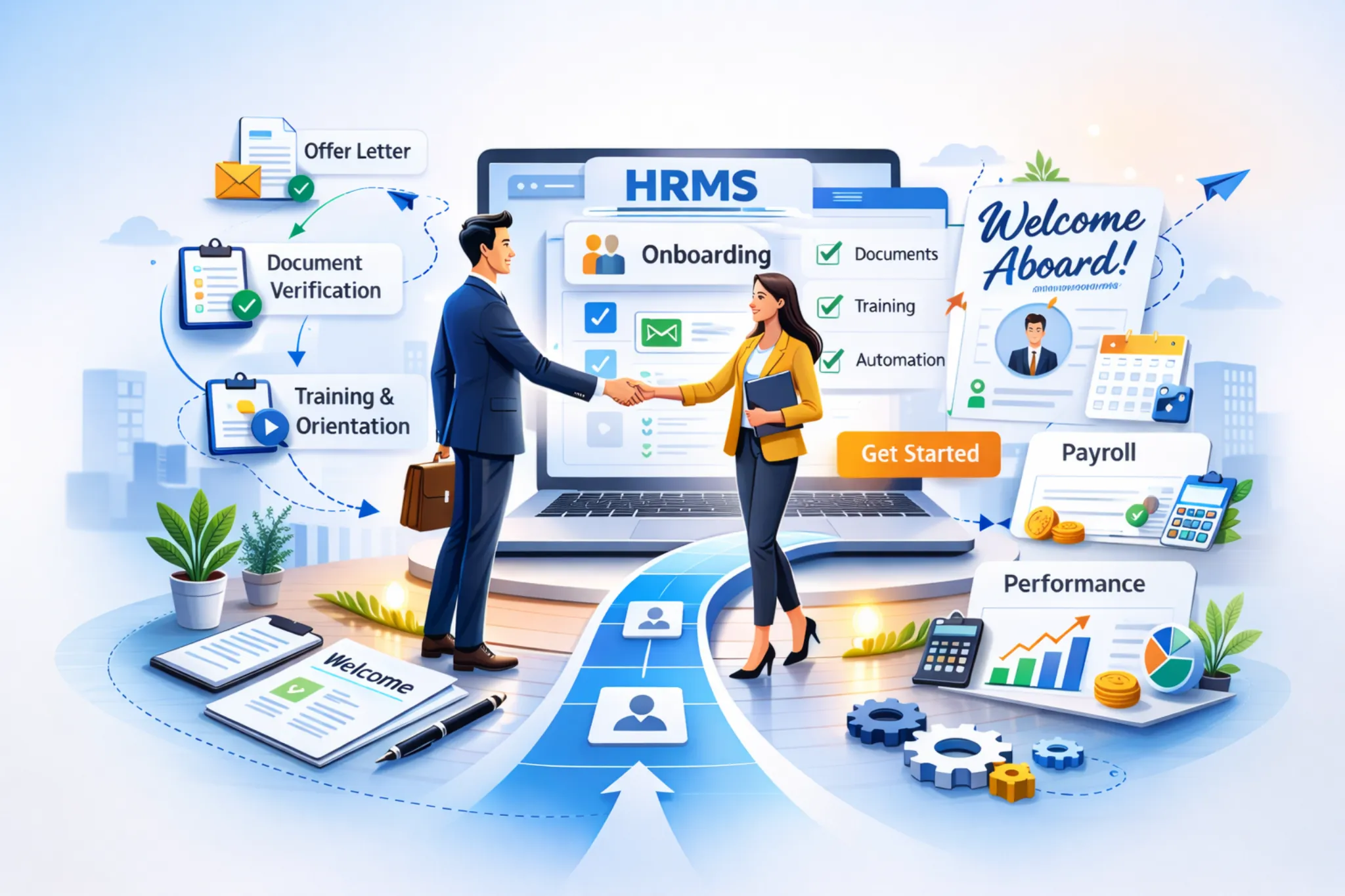
A New Hire's First Week Tells Them Whether You Actually Have Your Act Together
A new employee's first Monday is data. If their laptop isn't set up, their documents got lost in an email thread, and nobody told them where to sit — that tells them something about the company, regardless of what the offer letter said. Onboarding isn't paperwork. It's the first real evidence a new hire gets about what working here is actually like.
Quick answer: An HRMS streamlines onboarding by digitizing document collection, assigning role-specific tasks automatically, tracking what's done vs. pending in real time, and feeding new-hire data directly into payroll and attendance — so onboarding quality doesn't depend on which HR person happens to be handling it that week.
What manual onboarding actually costs you
Inconsistency compounds. If onboarding quality depends on who's running it, growth makes the gap worse, not better — a 5th hire in a month gets a different experience than the 1st, purely by chance of who was free that day.
Slow access delays productivity. A new hire who doesn't have system logins, a clear task list, or knows who to ask for what by day 3 isn't ramping — they're waiting. That's lost productive time you're already paying for.
Lost documents become compliance gaps. Employment documents scattered across email threads aren't just disorganized — they're a real risk if you need to produce something specific during an audit or dispute and can't quickly find it.
First impressions predict early attrition. A confusing, disorganized first two weeks is a measurable predictor of employees who disengage early — not because the job is wrong for them, but because the company looked disorganized before they'd even started real work.
The 8 stages, and what breaks at each one manually
Stage | What breaks without a system | What a connected HRMS does instead |
|---|---|---|
Pre-boarding | Nothing prepared before day one | Documents, accounts, and tasks queued before the start date |
Document collection | Chasing forms over email | Digital submission through self-service |
Record creation | Re-typing the same info into 3 systems | One profile, created once |
Role & team setup | New hire unsure who to ask what | Role-specific info assigned automatically |
Training | Ad hoc, depends on who remembers | Assigned training tied to the role |
Payroll/attendance activation | Manual re-entry into payroll separately | New-hire data flows directly into payroll and attendance |
Progress monitoring | HR checking spreadsheets and emails | Real-time task status, visible pending items |
Follow-up | Nobody checks if training actually happened | Structured check-in tied to onboarding completion |
The pattern across all 8: manual onboarding fails at handoffs — the moment information has to move from one person or system to another is where things get lost. A connected system removes most of those handoff points.
What this doesn't fix
An HRMS won't fix a manager who doesn't show up for a new hire's first week, no matter how well the paperwork is automated. It won't create a good team culture — it just removes the administrative noise that can obscure whether the culture is actually good. And a fast, digital onboarding process with a manager who's absent for the first month is still a bad onboarding experience — the software handles logistics, not relationships.
What this actually costs
Onboarding workflows are typically bundled into core HRMS plans rather than priced separately — for Indian SMEs, this usually falls within the ₹50-70 per employee per month range that also covers attendance and payroll, since onboarding data needs to connect to those anyway.
Ask specifically whether role-based task assignment and digital document collection are included at your plan tier, since some vendors gate these behind higher tiers.
Where to go next depending on what's actually broken
If document collection specifically is the bottleneck, employee self-service is the direct fix — that's what lets new hires submit information themselves instead of emailing HR. If it's the connection between onboarding and payroll that's manual, see payroll compliance in India for what needs to flow correctly. If attendance setup for new hires is the specific gap, our attendance software guide covers what to configure.
For India-specific employment documentation requirements, the Ministry of Labour and Employment is the direct source — worth checking against your onboarding checklist rather than assuming your HRMS's default templates cover everything applicable to your business.
If you're evaluating options right now
Most HRMS demos start with a feature tour. Skip that part and ask instead: "Walk me through what happens from the moment I add a new hire to the moment their first payslip is correct." If the answer involves someone manually re-entering information at any point in that chain, you've found the gap that matters. We're happy to walk through that specific chain with you — no generic feature list required.

Farheen Ahmed
HR Tech Content Strategist at ZFour Technology Private Limited
Research-driven content on HRMS, payroll, attendance management, employee management, and modern HR technology for Indian businesses.