17 min read
Quick answer
A travel allowance policy for field staff sets out how employees who travel for work are paid back for it: the per-kilometre rate for their own two-wheeler or car, daily allowance (DA) for meals and outstation stays, what counts as official travel, how distance is measured, what proof is needed and when claims are paid.
The fairest and most auditable approach for most Indian field teams is a per-km reimbursement based on a published rate per vehicle type, with distance measured by GPS during working hours rather than self-declared kilometres, a daily allowance only for outstation days, and a fixed monthly cut-off so claims flow into payroll on time.
Tax treatment depends on whether the payment is a genuine reimbursement of official travel or a fixed allowance paid regardless of travel, so design the payment around recorded official travel.
Key takeaways
Decide the model first: fixed monthly allowance, per-km reimbursement, actual fuel bills, or company vehicle. Each has different cost, effort and tax results.
Build the per-km rate from fuel cost per km plus running costs, set it per vehicle type, and review it when fuel prices move.
Measure distance from GPS between punch-in and punch-out. It is more accurate and far less disputed than odometer photos or self-declared kilometres.
Decide in writing whether home-to-first-visit and last-visit-to-home travel counts. Most disputes start here.
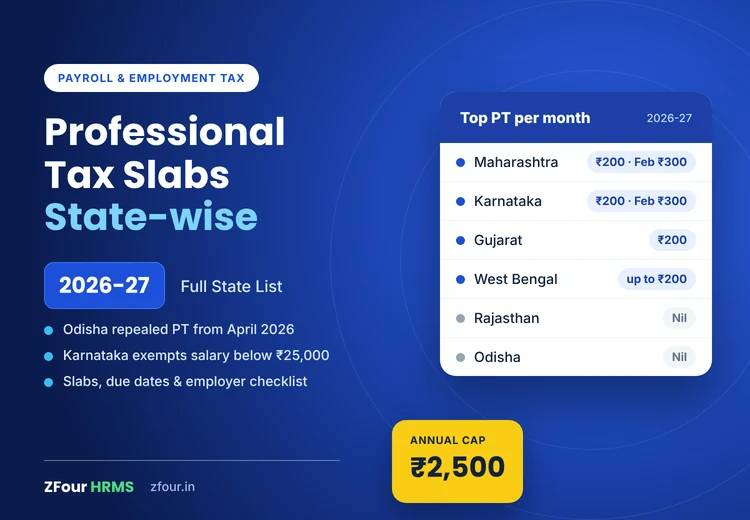
Allowances for official duties can be tax-exempt to the extent actually spent; fixed allowances paid whether or not the employee travels are generally taxable under the Income-tax Act, 2025.
Under the Code on Wages, conveyance allowance is excluded from “wages” but counts towards the 50% cap on exclusions, so it can affect PF and gratuity calculations.
Who this guide is for
This guide is for HR managers, finance teams and business owners in India who employ people who travel locally for work: field sales and distribution teams, medical representatives, service engineers, collection agents, surveyors, merchandisers and area managers. It assumes most of your field staff use their own two-wheeler or car, which is the norm for Indian field teams, and that you want a policy that is fair to honest employees, hard to inflate and simple to run every month.
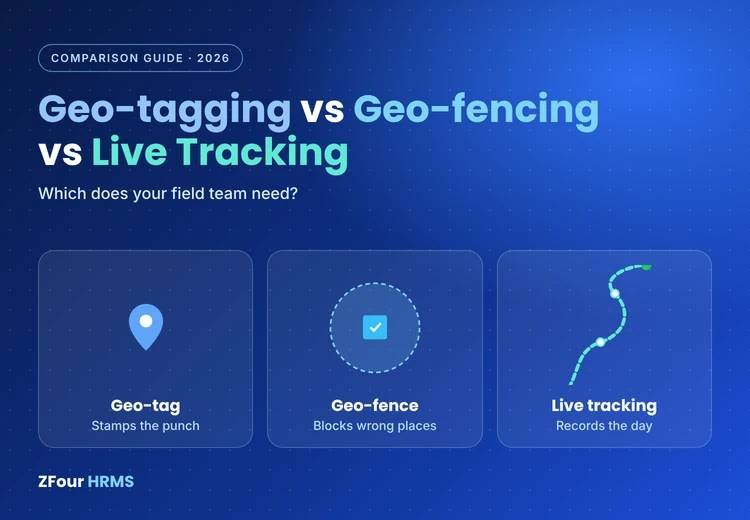
It doesn’t explain how GPS tracking works or whether tracking is allowed. For those, read geo-tagging vs geo-fencing vs live tracking and is GPS tracking of employees legal in India?
TA, DA, conveyance and fuel: getting the terms right
Indian companies use these words loosely, and that causes confusion in payroll and tax. Agree the definitions in your policy.
Term | What it usually covers | Typical use for field staff |
|---|---|---|
Travel allowance (TA) | Cost of travel for official work, including tours away from the base location | Per-km for local travel; tickets or fares for outstation travel |
Daily allowance (DA) | Meals, local transport and incidental costs while away from the normal place of work | Paid for outstation days or long field days, as a fixed per-day amount or actuals |
Conveyance allowance | Cost of local travel to perform official duties | Often a fixed monthly amount for staff who travel locally |
Fuel reimbursement | Actual fuel cost, usually against bills | Used where employees use their own vehicle and keep fuel bills |
Lodging | Hotel or stay costs for outstation nights | Capped per night by city tier |
DA here is not “dearness allowance”. In payslips, DA often means dearness allowance, which is part of wages. In travel policies, DA means daily allowance. Name it “daily allowance (travel)” in your policy and payroll to avoid mistakes.
Allowance or reimbursement? Choose the model first
Before setting any rate, choose how you will pay. The choice affects cost control, admin effort and how the payment is treated for tax and wages.
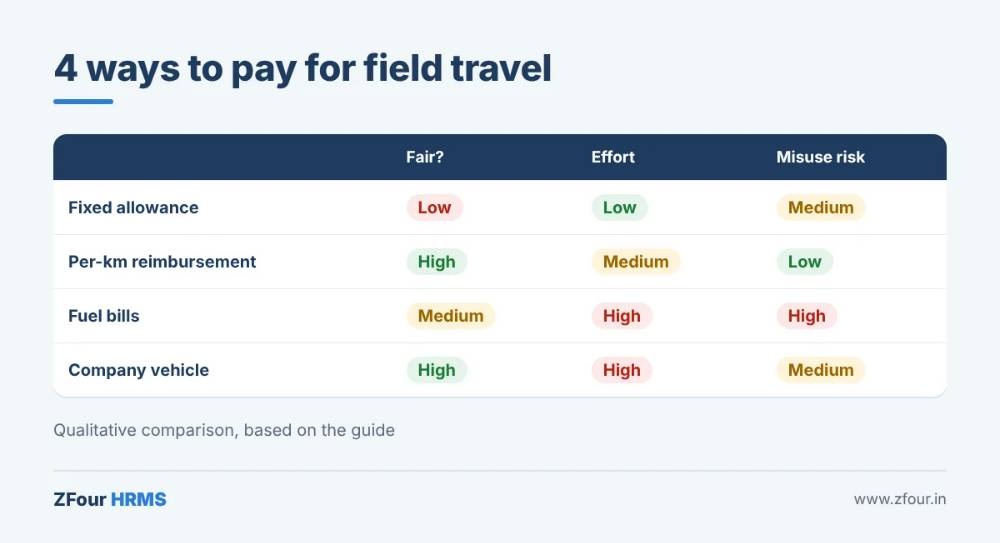
Fixed monthly allowance
Every eligible employee gets the same amount each month — for example a conveyance allowance — whatever they travel.
For: simple, predictable, no claims to process.
Against: unfair to staff who travel a lot, generous to those who don’t, and no link to actual work. A fixed amount paid regardless of official travel is generally treated as taxable salary.
Per-km reimbursement
Employees are paid a set rate for every official kilometre travelled on their own vehicle.
For: fair, scales with real work, easy to audit when distance is measured reliably.
Against: needs a dependable distance record and a rate that is reviewed when fuel prices change.
Actual fuel reimbursement against bills
Employees submit fuel bills and are reimbursed up to a cap.
For: backed by documents.
Against: a fuel bill proves fuel was bought, not that it was used for work. Bills for personal use are easy to submit, and processing them is slow.
Company vehicle or fuel card
The company provides the vehicle or pays for fuel directly.
For: full control over cost and vehicle condition.
Against: capital cost, insurance, maintenance and perquisite tax rules for personal use. Practical mainly for delivery fleets and senior staff.
Which model suits which team
Team | Recommended model | Why |
|---|---|---|
Field sales and FMCG reps on beats | Per-km (GPS distance) + DA for outstation days | Distance varies daily; GPS distance is reliable |
Medical representatives | Per-km + DA, with headquarters and ex-HQ rules | Pharma uses HQ / ex-HQ / outstation categories |
Service engineers | Per-km + job-based travel | Travel follows tickets; distance links to jobs |
Collection agents | Per-km with a monthly cap | Many short trips; cap controls outliers |
Area managers visiting stores | Per-km or fixed allowance | Routes are regular; fixed may be simpler |
Office staff with occasional visits | Per-km on approved trips only | Low volume; no monthly allowance needed |
How to set a per-km rate
There is no statutory per-km rate for private employers in India. Each company sets its own. A defensible rate has three parts: fuel, running costs and a review rule.
Step 1: work out fuel cost per kilometre
Fuel cost per km = fuel price per litre ÷ vehicle mileage (km per litre)
Use realistic city mileage, not the manufacturer’s claimed figure, because field travel is stop-start.
Step 2: add running costs
Fuel is only part of the cost of using a personal vehicle for work. Add an allowance for:
servicing and repairs
tyres and wear
the work share of insurance
depreciation
Many companies add a fixed percentage on top of the fuel cost per km, or a fixed paise-per-km amount. Choose one method and write it into the policy.
Step 3: set rates per vehicle type
Two-wheelers
The most common vehicle for Indian field staff. Set one rate for all petrol two-wheelers rather than per model; it is simpler and avoids disputes.
Cars
Use a separate, higher rate, and limit car use to roles or routes that genuinely need it (heavy samples, long rural routes, senior roles).
Electric two-wheelers
Running cost per km is much lower than petrol. Either set a separate, lower EV rate based on charging and running costs, or pay the same rate as petrol vehicles. Paying the petrol rate is optional; some companies do it to encourage staff to switch to EVs. Decide deliberately; don’t leave EVs undefined.
Step 4: worked example (illustrative)
All figures are illustrative. Use your city’s fuel price on the day you set the rate, your own mileage assumptions and your own running-cost factor.
Petrol was ₹102.12 a litre in Delhi on 31 October 2026 (Business Today fuel price tracker).
Vehicle | Assumed city mileage | Fuel cost per km | Running-cost add-on (illustrative 40%) | Illustrative rate per km |
|---|---|---|---|---|
Petrol two-wheeler | 45 km/litre | ₹2.27 | ₹0.91 | ≈ ₹3.20 |
Petrol car (small) | 15 km/litre | ₹6.81 | ₹2.72 | ≈ ₹9.50 |
The rates above are rounded to a clean figure (₹3.18 → ₹3.20, ₹9.53 → ₹9.50). Many companies round this way and set a slightly higher rate in high-cost cities, because fuel prices differ by state.
Step 5: decide how and when the rate is revised
Review on a fixed schedule
Review the rate every six months, or every quarter if fuel prices are volatile.
Link the rate to fuel prices
Alternatively, add an index clause: “If the petrol price in [city] changes by more than 5% from the price used to set the current rate, the rate will be recalculated from the next month.” This keeps the rate fair without a policy rewrite every time prices move.
Set your per-km rate in two minutes
Get the TA/DA Policy Template + Per-km Calculator (Excel). Enter your city's fuel price and mileage; get a per-km rate and a ready policy.
Set your per-km rate the right way
Get the TA/DA policy template (PDF), with the rate table, review rule and a monthly claim form.
Free template for HR teams. Not legal advice. We only use your details to send the file and related HR guides.
Daily allowance (DA) for field and outstation work
Local field days vs outstation days
Most field employees return home every day. For them, a daily allowance is usually not needed, or a small fixed amount is paid for long field days. Outstation days — when the employee is away from the base location overnight or beyond a set distance — need a proper DA.
Headquarters, ex-HQ and outstation
Many sales organisations, especially pharma, classify each working day into three categories:
Category | Typical meaning | Typical payment |
|---|---|---|
HQ | Work within the employee’s headquarters town | Local per-km only |
Ex-HQ | Work outside HQ, returning the same day | Per-km + a small DA |
Outstation | Work requiring an overnight stay | Fare or per-km + full DA + lodging |
Define the distance or boundary for each category in the policy, and let the attendance record decide which category a day falls into, not the employee’s claim.
City tiers for DA and lodging
Set DA and lodging caps by city tier, because costs in metros are far higher than in smaller towns. Three tiers (metro, other large cities, rest of India) are enough for most companies.
Per diem or actuals?
Per diem (fixed amount per day): simple and fast to approve; no bills.
Actuals up to a cap: lower risk of overpayment; more paperwork.
A common middle path: per diem for meals and incidentals, actuals up to a cap for lodging.
Measuring distance: GPS vs odometer vs self-declared
The rate only matters if the distance is right. This is where most travel claims go wrong.
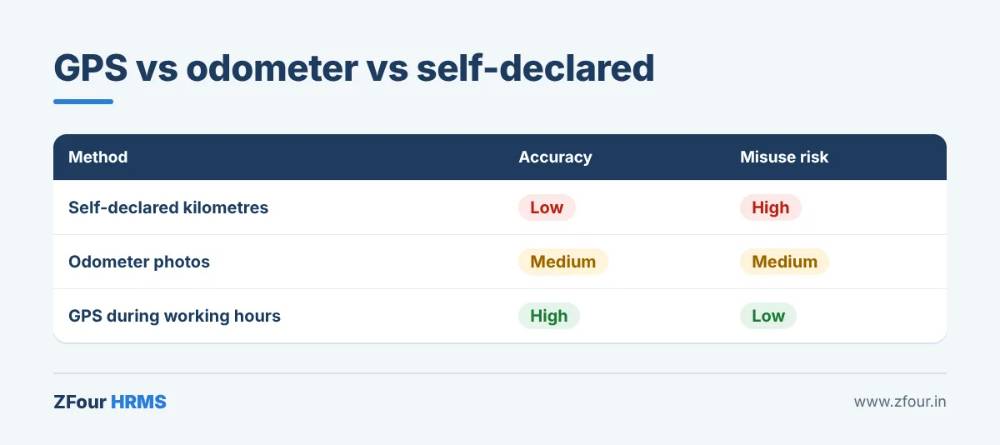
Method | How it works | Accuracy | Effort for employee | Risk of inflated claims |
|---|---|---|---|---|
Self-declared kilometres | Employee writes the distance in a claim form | Low | Low | High |
Odometer photos | Photo at start and end of day | Medium | Medium; easy to forget | Medium: includes personal travel |
Map-based estimate | Distance between visited addresses calculated on a map | Medium | Low | Low, but misses real routes and detours |
GPS distance during working hours | Distance calculated from location points between punch-in and punch-out | High | None | Low |
How GPS distance is calculated
When live tracking is switched on for a role, the app records the employee’s location at intervals between punch-in and punch-out. The distance is the sum of the road distance between those points. Because recording stops at punch-out, evening personal travel isn’t included.
Handling gaps in the GPS record
Phones lose signal, batteries run out and some phones restrict apps in the background. A good system shows gaps clearly rather than hiding them. Your policy should say what happens:
Short gaps between two known locations are bridged with road distance.
Long gaps are flagged for the manager, who can approve a distance based on the visit log.
Repeated gaps for the same employee are reviewed with them: often a phone battery-saver setting, not misconduct.
Home to first visit, and last visit to home
This is the most argued point in any field travel policy, so decide it explicitly.
The three common options
Count everything from punch-in to punch-out. Simple; the employee punches in when leaving home. Generous for staff who live far away.
Deduct a fixed commute. Count everything, but deduct a fixed number of kilometres (for example, the distance from home to the base office) because a normal commute isn’t official travel.
Count from the first visit to the last visit. Only travel between work locations counts. Strict, and can feel unfair to staff whose first visit is far from home.
Option 2 is often the fairest compromise. Whichever you choose, apply it to everyone and show it on the claim.
Applying the rule on outstation days
On outstation days the employee usually starts from a hotel, not home. Most policies don’t apply the commute deduction on those days, and pay the fare or per-km for the journey to and from the outstation location separately.
Stopping inflated claims without punishing honest staff
Most field employees claim honestly. Controls should catch the few who don’t without slowing down everyone else.
Signals worth checking
Claimed distance far above the GPS distance for the same day.
Claims on days with no attendance, or on leave days.
The same high distance every day, regardless of the beat.
Distance growing month after month with no change in territory.
Visits logged far from the customer’s address.
Controls that work
Pay on GPS distance by default, with a simple route for the employee to explain a difference.
Monthly cap per role, with manager approval above it.
Auto-approve within tolerance: if the claim is within, say, 5% of GPS distance, approve automatically; review only the rest.
Sample audits: check a few claims each month in detail rather than every claim superficially.
Fixed claim window: claims for a month must be submitted by a set date, so payroll isn’t held up and old claims don’t pile up.
For a wider look at how unverified travel and attendance add up, see payroll leakage in field teams.
Tax treatment under the Income-tax Act, 2025
This section is general information, not tax advice for any individual case.
What applied until 31 March 2026
Under the Income-tax Act, 1961, section 10(14)(i) read with Rule 2BB(1) exempted certain allowances granted for official duties, to the extent actually spent on those duties.
These included an allowance for travel on tour or transfer, a daily allowance during tours, and a conveyance allowance for official duties where free conveyance wasn’t provided. These remained available under the new (default) tax regime. A fixed allowance paid whether or not the employee travels for work was taxable.
What applies from 1 April 2026
The Income-tax Act, 2025 replaced the 1961 Act from 1 April 2026. Allowances for official duties now sit under section 11 of the Income-tax Act, 2025, read with the relevant Schedule. The principle employers should design around has not changed:
Reimbursement of actual official travel, supported by a reliable record, is generally not taxable salary for the employee.
Allowances for official duties are generally exempt only to the extent actually spent on those duties.
Fixed allowances paid regardless of travel are generally taxable as salary.
What this means for your policy
Link every travel payment to recorded official travel, not to a flat monthly figure.
Keep the evidence: GPS distance, visit logs, approved claims and fare receipts.
Show reimbursements separately from salary in payroll, so they are not taxed as salary by mistake.
Check the treatment of your exact payment design against the current Act and rules before you launch the policy.
Does travel allowance count as “wages” under the Labour Codes?
This matters because “wages” decides PF, gratuity, bonus and other calculations under the Labour Codes, which came into force on 21 November 2025.
The 50% rule
Under section 2(y) of the Code on Wages, 2019, “wages” excludes certain payments, including any conveyance allowance or the value of any travelling concession, and any sum paid to defray special expenses entailed by the nature of the employment.
However, if the excluded payments in clauses (a) to (i) together exceed half of the employee’s total remuneration, the excess is added back to wages.
Conveyance allowance falls inside that 50% test. So a structure with a small basic salary and a large conveyance allowance can push some of the allowance back into wages, increasing PF and gratuity costs.
Reimbursements vs allowances
A genuine reimbursement of expenses incurred for the employer’s work is different from an allowance that forms part of remuneration. This is another reason to run field travel as a per-km reimbursement against recorded official distance, rather than as a fixed monthly allowance built into the salary structure.
For the wider impact of the 50% rule on salary structures, see the 50% basic pay rule under the Labour Codes.
An illustrative example
Illustrative figures only.
A field rep’s monthly remuneration is ₹30,000: basic and dearness allowance ₹13,000, HRA ₹5,000, conveyance allowance ₹8,000 and special allowance ₹4,000. Excluded items (HRA and conveyance) total ₹13,000, well under half of ₹30,000, so nothing is added back.
If the company raised the conveyance allowance to ₹12,000 and cut basic to ₹9,000, the excluded items would total ₹17,000 — over half — and ₹2,000 would be added back to wages. Paying travel as a reimbursement against recorded distance avoids building this risk into the salary structure.
The TA/DA policy template
Copy this structure and adapt the bracketed values. Have it reviewed by your legal adviser before you issue it.
1. Purpose and scope
This policy sets out how [Company] reimburses employees for official travel. It applies to [roles/departments] who travel for work using their own vehicle or public transport. It does not apply to travel between home and the employee’s base office on normal working days.
2. Definitions
Official travel: travel required to perform assigned work between punch-in and punch-out, or approved outstation travel.
Base location: the office or headquarters town assigned to the employee.
HQ / Ex-HQ / Outstation: as defined in section 5.
3. Vehicle and rates
Vehicle | Rate per km | Monthly cap |
|---|---|---|
Petrol two-wheeler | ₹[x] | [x] km |
Electric two-wheeler | ₹[x] | [x] km |
Car (approved roles only) | ₹[x] | [x] km |
Rates are reviewed every [six] months, or when the petrol price in [city] changes by more than [5]% from the price used to set the current rate.
4. How distance is measured
4.1 Source of distance
Distance is calculated from the attendance app’s location record between punch-in and punch-out on working days.
4.2 Commute deduction
[Option chosen: e.g. “A fixed deduction of [x] km per day is made for the normal commute.”]
4.3 Gaps and corrections
Where the location record has gaps, the manager may approve a distance based on the visit log. Employees may raise a correction within [3] working days.
5. Daily allowance and lodging
Category | Definition | DA per day | Lodging cap per night |
|---|---|---|---|
HQ | Within [city/area] | Nil | — |
Ex-HQ | Beyond [x] km from base, same-day return | ₹[x] | — |
Outstation — metro | Overnight stay in a metro city | ₹[x] | ₹[x] |
Outstation — other large city | Overnight stay in a Tier 2 city | ₹[x] | ₹[x] |
Outstation — rest of India | Overnight stay elsewhere | ₹[x] | ₹[x] |
6. Claims and approvals
6.1 Submission
Claims are generated from the attendance and travel record and submitted by the [5th] of the following month.
6.2 Approval
Claims within [5]% of the recorded distance are approved automatically. Others need the reporting manager’s approval within [3] working days.
6.3 Payment
Approved claims are paid with the next salary, shown separately from salary on the payslip.
7. Misuse
Submitting false claims is misconduct under [the standing orders / code of conduct]. Suspected misuse is first discussed with the employee before any action.
8. Data and privacy
Location data is used only for attendance, visit verification and travel reimbursement, recorded only between punch-in and punch-out, and retained for [period]. See the company’s location-tracking policy.
Approval workflow and payroll timing
A travel policy fails if claims arrive late or approvals stall. A simple monthly rhythm keeps it on track:
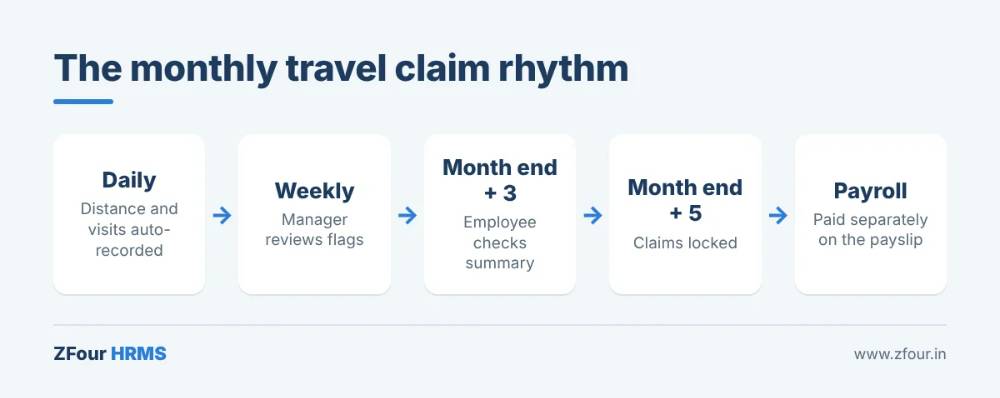
When | What happens | Who |
|---|---|---|
Daily | Distance and visits recorded automatically | System |
Weekly | Manager reviews flagged days (gaps, unusual distance) | Reporting manager |
Month end + 3 days | Employee reviews the monthly travel summary and raises corrections | Employee |
Month end + 5 days | Claims locked; manager approves exceptions | Manager |
Payroll run | Approved claims paid with salary, shown separately | HR / payroll |
Lock the travel cut-off before the payroll cut-off. Late claims roll into the next month rather than delaying everyone’s salary. For the full monthly payroll timeline, see the payroll compliance calendar 2026-27.
Worked example: one month for a field rep (illustrative)
All figures are illustrative.
Ravi is a two-wheeler sales rep in a metro city on an illustrative rate of ₹3.20 per km, with a fixed commute deduction of 10 km per day and an ex-HQ DA of ₹250.
Item | Days / km | Amount |
|---|---|---|
Working days | 24 | — |
GPS distance during working hours | 1,560 km | — |
Commute deduction (10 km × 24 days) | −240 km | — |
Reimbursable distance | 1,320 km | ₹4,224 |
Ex-HQ days | 4 | ₹1,000 |
Outstation nights | 0 | — |
Total travel reimbursement | ₹5,224 |
Before GPS distance, Ravi’s self-declared claims had averaged 1,800 km a month. The difference was not necessarily dishonest — estimates tend to round up, and some personal trips get mixed in — but it was being paid without anyone checking.
Mistakes to avoid
Building travel into salary as a fixed allowance: it is usually taxable, ignores real travel and can affect wages under the 50% rule.
No rule for home-to-first-visit travel: the source of most disputes.
Rates never revised: staff quietly subsidise fuel price rises and morale falls.
Paying on self-declared distance: easy to inflate, hard to challenge.
Approving every claim manually: managers rubber-stamp when they have too many to review. Auto-approve within tolerance instead.
No claim deadline: claims from three months ago arrive with no way to verify them.
Calling it “DA” without saying daily allowance: confusion with dearness allowance in payroll.
How ZFour HRMS handles travel claims
ZFour HRMS connects attendance, location and payroll, so travel claims don’t start from a blank form:
Distance from live tracking: for field roles on the live tracking add-on (₹100 per field user per month, on any plan), distance is calculated between punch-in and punch-out only.
Visit logs: each visit is recorded with time and location, which supports ex-HQ and outstation classification.
Reimbursement requests and approvals in the employee app, with manager approval.
Payroll in the same system: approved claims are paid with salary and shown separately on the payslip.
Hindi and English app for field teams.
See GPS attendance and field tracking, or read the complete guide to GPS attendance for field employees.
See GPS distance turn into travel claims automatically
A 30-minute demo, set up with your own teams and sites.
Sources and further reading

Farheen Ahmed
HR Tech Content Strategist at ZFour Technology Private Limited
Research-driven content on HRMS, payroll, attendance management, employee management, and modern HR technology for Indian businesses.