17 min read

Quick answer
On duty (OD) — also called outdoor duty, out duty or official duty — is an attendance status for an employee who is working for the company, but away from their usual workplace: at a client’s office, a bank, a government office, a training programme, an exhibition or another branch.
An approved OD request marks the day (or part of it) as present, so the employee isn’t shown as absent and no leave or salary is deducted. A good OD process has five parts: clear eligibility, a request raised in advance where possible, quick approval, light proof of where the employee was, and a monthly review so OD isn’t used as unrecorded leave.
Full-time field staff usually shouldn’t need OD at all; their normal location-based attendance already covers work away from the office.
Key takeaways
OD means “working, but not at your usual place of work”. It is a paid working day, not leave.
OD is different from regularization (fixing a missed or wrong punch), work from home and official tours. Keep them separate in your HRMS so reports stay accurate.
Office-based staff who occasionally work outside need OD. Field sales and service staff on location-based attendance usually don’t.
Ask for proportionate proof: a location-stamped punch at the OD location is usually enough; documents only for unusual cases.
Set a deadline for post-facto OD (for example, within 3 working days) so OD can’t be used to cover absences discovered later.
Review OD monthly: frequent OD on Mondays and Fridays, or mostly after-the-fact requests, are the patterns worth a conversation.
What “on duty” means in Indian HR
The term and its variants
Indian organisations use several names for the same idea:
OD — on duty, the most common in HRMS software
Outdoor duty — common in manufacturing and older companies
Out duty — common in some government and PSU settings
Official duty — used in policies and leave rules
They all mean that the employee is doing assigned work away from their normal workplace and should be marked present.
Where OD comes from
OD started in government offices, PSUs and colleges, where staff were tied to a single office and any work elsewhere — a court hearing, a training course, an inspection — had to be recorded so it wasn’t treated as absence. Private companies adopted it as biometric attendance spread: if the only way to mark attendance is a device at the office, any day spent elsewhere needs an OD request.
Typical OD situations
Meeting a client or vendor at their office
Visiting a bank, tax office, labour office or other government department for company work
Attending a training programme, seminar or certification exam sponsored by the company
Working at an exhibition, trade fair or event
Supervising work at a project site or a customer’s premises
Working for a day at another branch or plant
Delivering, collecting or inspecting goods away from the office
OD vs leave, regularization, work from home and tours
OD is often confused with other requests. Mixing them up corrupts attendance reports and can affect pay, so define each one in your policy.
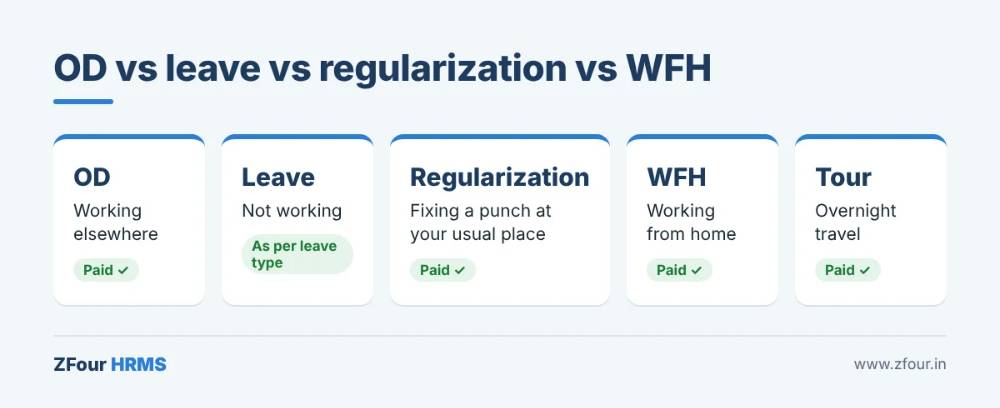
Request | What it means | Paid? | Typical proof | Who raises it |
|---|---|---|---|---|
On duty (OD) | Working for the company away from the usual workplace | Yes, as a working day | Location-stamped punch, visit record or document | Employee, ideally in advance |
Leave | Not working | Depends on leave type | Leave balance | Employee |
Regularization | Correcting a missed, late or wrong punch for a day the employee was at the usual workplace | Yes | Manager confirmation | Employee, after the day |
Work from home (WFH) | Working from home under a WFH arrangement | Yes | Logins, work output | Employee, per WFH policy |
Official tour / outstation travel | Travel away from the base location, often overnight | Yes, plus travel and daily allowance | Travel approval, tickets | Employee, in advance |
Compensatory off (comp-off) | A day off earned by working on a weekly off or holiday | Yes | Record of the extra day worked | Employee, after earning it |
OD vs regularization: the most confused pair
Regularization fixes the attendance record for a day the employee spent at their usual workplace: the punch failed, the device was down, the employee forgot to punch. OD covers a day spent at a different place. Using regularization for OD hides how often staff work outside, and using OD for missed punches inflates outside-work numbers.
OD vs work from home
WFH is an arrangement to work from home; OD is assigned work at another location. Some HRMS products list “work from home” as an OD reason. That’s workable, but keep WFH as its own reason code so you can report on it separately — WFH and outside work have different policies and different managers’ expectations.
OD vs official tour
A tour usually involves overnight travel and triggers travel and daily allowances. A same-day OD normally doesn’t, beyond local travel. Linking OD to travel rules is covered in our travel allowance policy for field staff.
Who needs OD — and who doesn’t
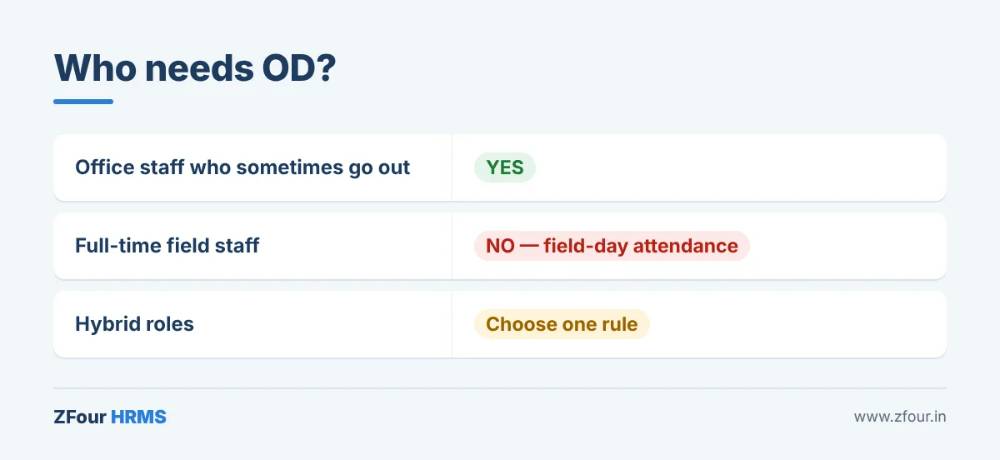
Office-based staff who sometimes work outside
These are the main users of OD: accounts staff visiting the bank, HR attending a labour office hearing, engineers visiting a customer, managers attending a trade fair. Their normal attendance is captured at the office, so outside days need OD.
Full-time field staff
Field sales reps, service engineers and collection agents work away from the office every day. Asking them to raise OD daily creates paperwork with no value and teaches everyone to approve OD without reading it. Instead, their attendance should be captured where they work, with a location-stamped punch at the first visit. The complete guide to GPS attendance for field employees explains how that works.
Hybrid roles
Area managers, supervisors and technical staff who split time between the office and the field are the grey zone. Two approaches work:
Field-day attendance: allow mobile punches from any location on specified days or for specified roles, with no OD needed.
OD for exceptions only: office attendance by default, OD for days outside.
Choose one per role and write it down.
For example, a regional sales manager who spends Monday and Friday at the office and the rest of the week visiting distributors is simpler to manage on field-day attendance for Tuesday to Thursday than with three OD requests a week. A finance executive who visits the bank twice a month is better served by OD.
Types of OD requests
Full-day OD
The employee spends the whole working day away from the usual workplace. The day is marked present.
Half-day or partial OD
The employee spends part of the day outside — for example, a client meeting in the morning and the office in the afternoon. The OD covers the hours outside, and the rest is covered by the normal punch.
Hourly OD
Short outside tasks such as a two-hour bank visit. Hourly OD is useful where late-arrival or early-departure rules would otherwise mark the employee late.
Multi-day OD
A training course or an exhibition lasting several days. Raise one request for the full period rather than one per day.
Advance and post-facto requests
Advance OD is raised before the work happens. It’s the normal case for planned meetings, training and events.
Post-facto OD is raised after the day, when something came up unexpectedly. Allow it, but within a short deadline.
How OD affects attendance, salary and leave
Attendance status
An approved OD marks the day, or the hours covered, as present, usually with an “OD” code so reports can separate it from office attendance.
Salary
OD days are paid working days. No loss of pay applies, and no leave is deducted.
Late marks and early departures
If an employee goes straight to a client meeting and reaches the office at noon, an approved OD for the morning should stop the late mark. Make sure your late-mark rule checks for OD before applying a penalty.
Overtime
OD does not automatically create overtime. If OD work runs beyond normal hours, overtime should follow your normal pre-approval rules. For how field and outside work hours are counted, see our guide to working hours for field employees.
Leave balances
OD never reduces leave balances. If an employee raises OD for a day they were actually on leave, that is a misuse issue, covered below.
Weekly offs and holidays
OD on a weekly off or holiday
If an employee is sent on OD on a weekly off or a holiday — for example, to staff an exhibition on a Sunday — the policy should say what they get: a compensatory off, overtime pay, or both. Many companies grant a comp-off within a set period, such as 30 or 60 days.
Travel days
A day spent travelling to an OD location on the employer’s instruction is generally treated as a working day. State this clearly so employees aren’t asked to use leave for travel.
Travel claims
Local travel during OD is usually reimbursed under the travel policy. The OD record should be the trigger for the claim, not a separate form. See the travel allowance policy for field staff for rates and rules.
Proof of OD: what to ask for
Proof should be proportionate. Asking for a signed letter for every bank visit wastes everyone’s time; accepting no proof at all invites misuse.
OD situation | Light proof (enough for most cases) | Stronger proof (for long or repeated OD) |
|---|---|---|
Client or vendor meeting | Location-stamped punch at the client’s address | Meeting invite or visit note |
Bank or government office | Location-stamped punch | Receipt, token or acknowledgement |
Training or seminar | Registration confirmation | Attendance certificate |
Exhibition or event | Location-stamped punch at the venue | Event pass |
Another branch or plant | Punch at that branch’s device or geo-fence | Branch head confirmation |
Project or customer site | Location-stamped punch at the site | Site visit report |
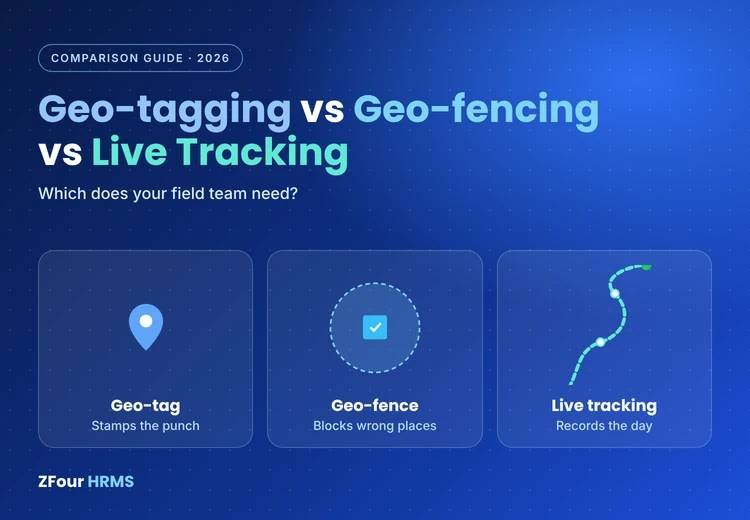
A location-stamped punch is usually the simplest proof: the employee punches in at the OD location on the mobile app, and the record shows where and when. How location-stamped and boundary-based punches differ is explained in geo-tagging vs geo-fencing vs live tracking.
Writing an OD policy
Below is a policy structure you can adapt. Replace the bracketed values and have your HR head approve it.
1. Purpose
This policy explains how employees record time spent on official work away from their usual workplace (on duty, or OD), so that attendance and pay are accurate.
2. Eligibility
2.1 Who can apply
All employees whose attendance is normally recorded at a fixed workplace.
2.2 Who doesn’t need to apply
Employees in [field sales, service, collections] whose attendance is recorded by mobile punch at their work locations do not need OD for normal field work.
3. How to apply
3.1 Advance requests
Raise OD in the HRMS before the work starts, with the reason, location and expected hours.
3.2 Post-facto requests
Where OD couldn’t be raised in advance, raise it within [3] working days.
Deadlines
Requests after [3] working days won’t be accepted, and the day will follow normal attendance rules.
Exceptions for emergencies
The HR head may accept a late request in genuine emergencies, such as a hospital visit with a colleague or a breakdown during travel, with a written reason.
4. Approval
The reporting manager approves or rejects OD within [2] working days. If the manager is away, the request goes to [the next-level manager]. Requests not acted on within [x] days are escalated to HR.
5. Proof
Mark attendance by mobile punch at the OD location where possible. For OD longer than [2] days or repeated OD to the same place, the manager may ask for supporting documents.
6. Limits
OD is not capped, because it reflects work assigned by the company. However, more than [x] days of OD in a month will be reviewed with the employee’s manager.
7. Weekly offs and holidays
OD on a weekly off or holiday earns [one compensatory off, to be used within 60 days / overtime as per policy].
8. Misuse
Raising OD for a day not spent on official work is misconduct under [the code of conduct / standing orders]. Suspected misuse will first be discussed with the employee.
Get the OD policy
Get the OD policy template (PDF)
The full OD policy, plus an OD request form and a 30-second manager checklist.
The OD clause is part of the Field Attendance Policy Kit, an editable set of attendance policy templates for field and office teams.
Free template for HR teams. Not legal advice. We only use your details to send the file and related HR guides.
Approval rules that keep OD fair
Set a response time for managers
A request that sits unapproved until payroll creates salary errors and frustration. Two working days is a reasonable limit, with automatic escalation after that.
Delegate when managers are away
Every approver needs a backup. Otherwise, OD approvals stall during leave and travel season.
Auto-approve pre-scheduled work
Some OD is planned by the company itself: a training programme, an exhibition, a scheduled client audit. Raise and approve these centrally for everyone involved rather than asking each employee to apply.
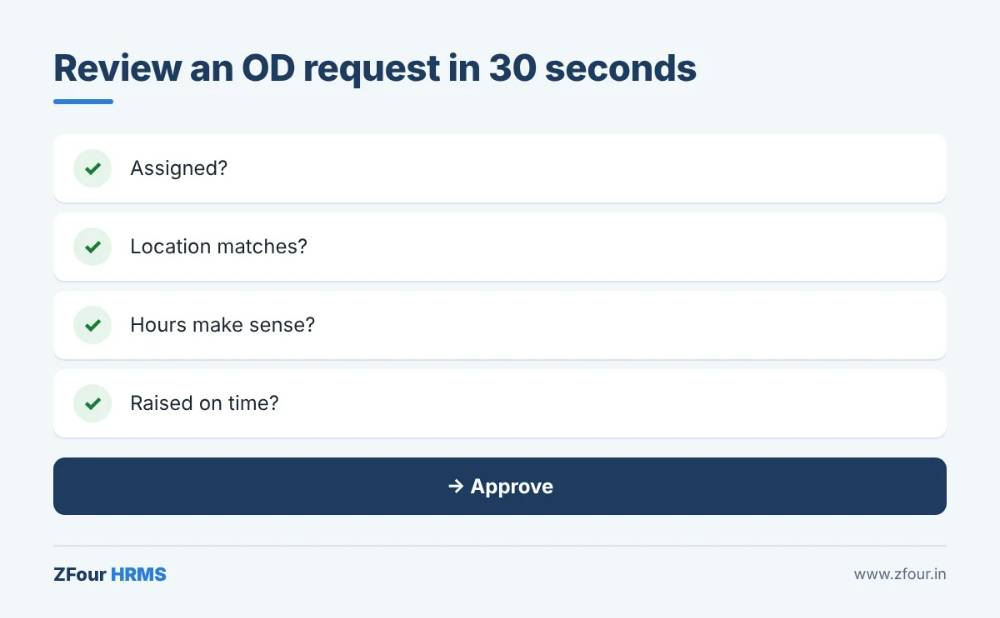
How a manager can review an OD request in 30 seconds
Give managers four questions to ask of every request:
Was this work assigned or expected? A client meeting the manager knew about, a training they nominated the employee for, a bank visit that’s part of the role.
Does the location record match? The punch is at the client’s address, the bank or the venue, not at the employee’s home.
Do the hours make sense? A two-hour bank visit shouldn’t be a full-day OD.
Was it raised on time? Advance, or within the post-facto deadline.
If all four answers are yes, approve. If one is no, ask the employee a single question before rejecting. Most mismatches have a simple explanation, such as a meeting that moved to a café near the client’s office, and a quick question keeps trust intact.
Don’t approve blind
When managers approve dozens of requests at month end without reading them, OD stops meaning anything. Ask managers to approve weekly, not monthly.
OD misuse: patterns and fair responses
Most OD is genuine. A few patterns are worth a closer look.
Pattern | What it might mean | Fair first response |
|---|---|---|
OD clustered on Mondays, Fridays or days next to holidays | Using OD to extend weekends | Check the work done; talk to the employee |
Most OD raised after the day | Covering absences after they’re noticed | Remind of the deadline; require advance requests for planned work |
OD with no location record or output | Day not spent on official work | Ask for the visit details |
Regular OD to the same place with no business reason | Unclear work arrangement | Clarify the role; consider field-day attendance |
OD by one employee for another’s work | Delegation not recorded properly | Correct the record; brief the team |
Respond to patterns with a conversation first. Most turn out to be unclear rules or roles that should be on field-day attendance, not misconduct. Deliberate, repeated misuse is handled under your disciplinary process.
OD in specific situations
Employees attending a court or tribunal for the company
Count it as OD when the employee is attending on the company’s behalf, as a witness or representative. If the employee is attending a personal matter, it is leave.
Training, seminars and exams
Company-sponsored training is OD. Exams for personal qualifications are usually leave, unless the company requires the qualification and has agreed to treat exam days as duty.
Exhibitions and events
Raise OD centrally for the whole team, including setup and teardown days, and decide the weekly-off rule before the event.
Working at another branch
If the other branch has its own attendance device or geo-fence, the employee can simply punch there and no OD is needed. Set this up for employees who move between branches regularly.
Committee work
Time spent on company committees — such as the internal committee under the POSH Act, or safety committees — during working hours is official work. Record it as OD when it takes place away from the usual workplace.
How OD looks in different industries
OD needs differ by industry. Set your reason codes and rules around the outside work your teams actually do.
Industry | Common OD situations | Rule worth adding |
|---|---|---|
Manufacturing | Vendor and supplier visits, quality audits at supplier plants, statutory inspections, dispatch supervision | Separate reason code for supplier audits so quality teams can be reported on |
IT and professional services | Working at a client’s office for days or weeks | Long-term client deployment should be a work-location change, not daily OD |
Banking and financial services | Branch staff visiting customers, document collection, bank-to-bank work | Location-stamped punch at the customer address as default proof |
Education | Exam duty, evaluation centres, conferences, sports events with students | Multi-day OD raised centrally by the administration |
Healthcare | Health camps, outreach programmes, training at other hospitals | Weekly-off OD earns a comp-off; camps are approved centrally |
Construction and real estate | Site visits by office engineers, approvals at municipal offices | Engineers who are mostly on site move to field-day attendance |
Setting up OD in your attendance system
A clean setup prevents most OD problems. Before launch, check each item:
Reason codes: a short list (customer or vendor visit, bank or government office, training, event, another branch, other with a note). Too many codes make reports useless.
Durations allowed: full day, half day and hourly.
Advance and post-facto rules: the deadline for post-facto requests, enforced by the system rather than by memory.
Approval chain: reporting manager first, a backup approver, and automatic escalation after the deadline.
Location rule: a mobile punch at the OD location is allowed even when the employee’s normal attendance is restricted to the office.
Late-mark and early-exit rules: they must check for approved OD before marking anyone late.
Payroll mapping: OD counts as a paid working day, and OD on weekly offs or holidays triggers the comp-off or overtime rule.
Travel link: an approved OD can start a travel claim without a separate form.
Reports: the monthly OD review in the next section is available to HR and department heads.
Telling employees about the OD rules
Rules only work if employees know them. A short announcement is enough. For example:
From 1 December, if you work away from your usual office for company work — a client meeting, a bank visit, training or another branch — please raise an “On duty” request in the ZFour app, ideally before you go. Punch in on the app when you reach the location; that is all the proof most requests need. If you couldn’t raise it in advance, raise it within 3 working days. Your manager will approve it within 2 working days. OD days are full working days; no leave is deducted. Questions: contact HR at [email].
Send it in the language your teams use most, and repeat it in team meetings for the first month.
Common mistakes with OD
Using regularization for outside work, so nobody can tell missed punches from OD.
Daily OD for full-time field staff, which buries real exceptions under routine requests.
No post-facto deadline, so OD is raised weeks later to cover absences.
Bulk approvals at month end, where managers stop reading requests.
Late-mark penalties applied on OD days, which feels unfair and creates disputes.
No rule for OD on weekly offs, so comp-offs are granted inconsistently.
Too many reason codes, making the monthly review impossible to read.
The monthly OD review
A ten-minute monthly review keeps OD honest without burdening anyone.
Report | What to look for |
|---|---|
OD days per employee | Anyone well above their team’s average |
Share of post-facto OD | Teams where most OD is raised after the day |
OD by weekday | Concentration on Mondays and Fridays |
OD without location record | Requests with no supporting punch |
Pending approvals | Managers who haven’t acted within the deadline |
OD on weekly offs and holidays | Comp-offs owed and not yet granted |
Share the summary with department heads. Visibility alone usually corrects most issues.
An illustrative example
This is an illustrative scenario, not a customer case study.
An engineering services company with 140 employees used biometric attendance at its two offices. Engineers often went straight to customer sites, and accounts staff regularly visited banks. All of this was handled by regularization requests at month end, so the HR team couldn’t tell missed punches from outside work, and managers approved everything in bulk.
The company introduced OD as a separate request with three reason codes (customer site, bank or government office, training), a 3-day post-facto deadline and weekly approvals. Engineers who were at customer sites most days moved to mobile field-day attendance instead.
In the first month, regularization requests fell sharply because they were now used only for real punch problems. HR could finally report how many days engineers spent at customer sites, which helped the sales team price service contracts. Two employees with frequent Monday OD were asked about it; one had an unrecorded standing arrangement with a customer, which was formalised.
How ZFour HRMS handles OD
ZFour HRMS records office, field and outside work in one attendance system:
OD requests from the employee app, with reason, location and hours, approved by the reporting manager.
Location-stamped punches at the OD location as proof, so most requests need no documents.
Field-day attendance for roles that work outside every day, so they don’t need daily OD.
Payroll in the same system: approved OD is treated as a working day, and late-mark rules respect it.
Hindi and English app for employees.
Explore the attendance management system.
See OD, field-day attendance and payroll in one app
A 30-minute demo, set up with your own teams and sites.
Sources and further reading

Farheen Ahmed
HR Tech Content Strategist at ZFour Technology Private Limited
Research-driven content on HRMS, payroll, attendance management, employee management, and modern HR technology for Indian businesses.