5 min read
Managing payroll, attendance, leave, recruitment, and employee self-service through separate tools can create unnecessary administrative work for HR teams.
ZFour HRMS brings these core HR functions together in one cloud-based platform, helping startups, SMEs, and growing businesses manage employee information, attendance, leave, payroll, recruitment, and employee requests from a centralized system.
Instead of switching between spreadsheets and disconnected HR tools, HR teams can manage everyday employee processes through one platform while employees can access routine HR services through self-service tools.
Quick Answer: What Does ZFour HRMS Offer?
ZFour HRMS brings core HR processes such as employee management, attendance, leave, payroll, employee self-service, recruitment, reporting, and workforce management together in one centralized platform.
The right HR technology setup depends on the company's size, workforce structure, locations, HR requirements, integrations, security needs, and budget.
For Indian businesses looking to manage payroll, attendance, leave, employee self-service, recruitment, and HR reporting through connected workflows, ZFour HRMS provides a centralized cloud-based HR platform.
Why Choose ZFour HRMS?
1. Payroll Management
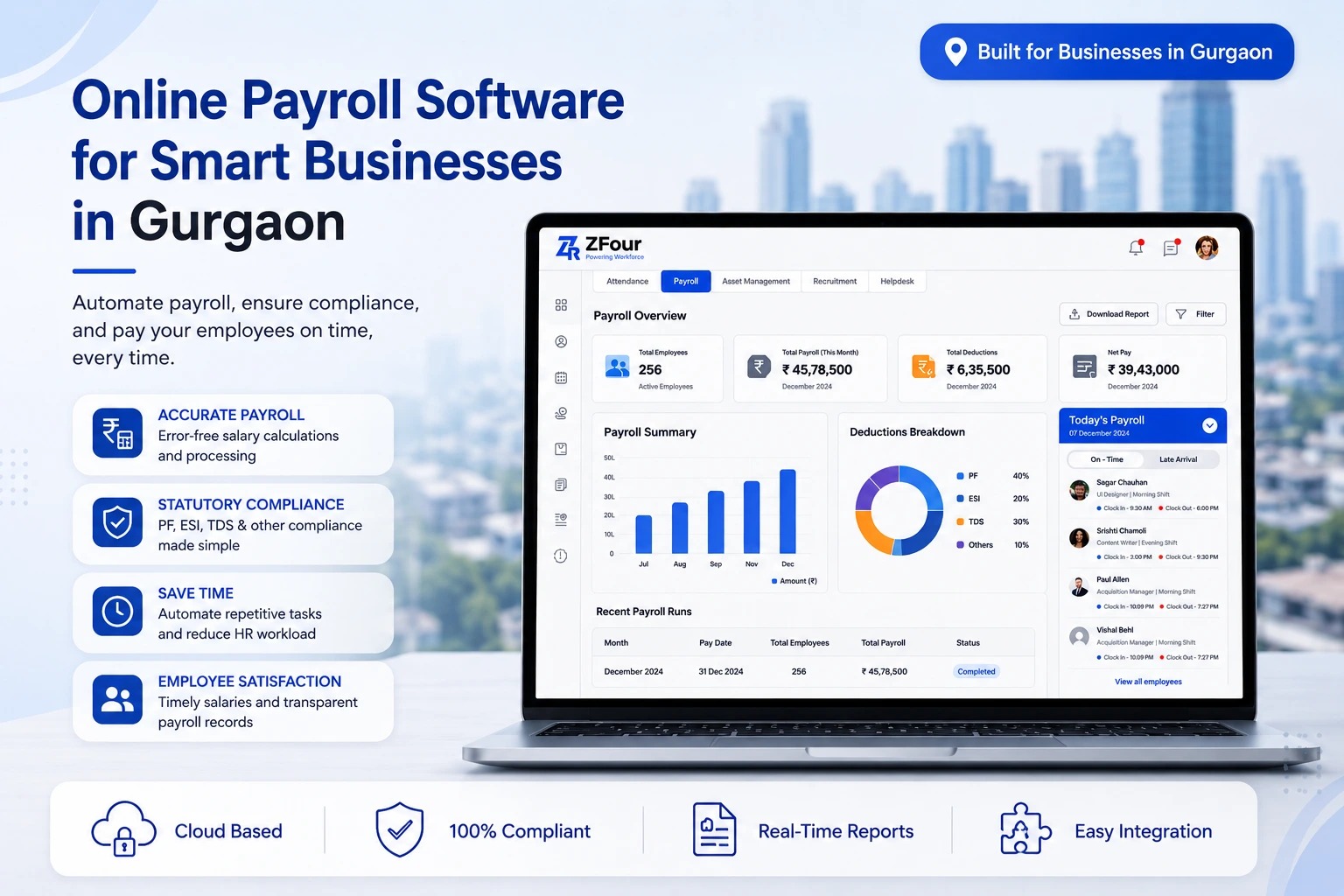
ZFour HRMS helps HR teams manage salary processing, PF-related payroll data, reimbursements, arrears, payslips, and Full & Final settlements from a centralized payroll system.
For a detailed look at reducing repetitive payroll work, see our Payroll Automation in 2026.
2. Attendance and Leave Management
Manage biometric, GPS, and web-based attendance along with shifts, overtime, and employee leave.
HR teams can monitor attendance status, late arrivals, absences, leave balances, and approved leave from a centralized system. Approved attendance and leave information can also flow into relevant payroll workflows.
3. Employee Self-Service (ESS)
Employees can access routine HR services through a mobile-friendly self-service platform.
Depending on the configured features, employees can:
View payslips
Apply for leave
Regularize attendance
Submit expense claims
Access HR information
Manage routine HR requests
This reduces repetitive HR queries and gives employees greater visibility into their own HR information.
4. Recruitment and Onboarding
ZFour HRMS supports recruitment and onboarding workflows from candidate management through employee onboarding.
HR teams can manage:
Job postings
Candidate information
Document collection
Onboarding tasks
Employee records
Connecting recruitment and onboarding with employee management helps keep information organized from the beginning of the employee lifecycle.
5. HR Analytics and Reporting
HR teams can use centralized dashboards and reports to monitor workforce information such as:
Headcount
Attendance
Leave trends
Attrition
Workforce costs
Employee information
These reports help HR teams make decisions using centralized workforce data rather than relying on multiple spreadsheets.
What Should You Evaluate in ZFour HRMS?
Before adopting ZFour HRMS, businesses should evaluate whether its capabilities match their workforce structure, HR processes, payroll requirements, attendance needs, security requirements, and growth plans.
1. Core HR Management
The system should provide a centralized employee database where HR teams can manage employee information and records.
2. Attendance and Leave
Look for attendance methods that match your workforce, including biometric, GPS, web, shift, and leave-management requirements.
3. Payroll Integration
Payroll should be connected with relevant employee and attendance information so HR teams don't have to repeatedly enter the same data.
4. Employee Self-Service
Employees should be able to complete routine HR tasks without depending on HR for every request.
5. Recruitment and Onboarding
A complete HRMS should support the employee lifecycle beyond payroll and attendance.
6. Reporting and Analytics
HR dashboards should make workforce information easier to monitor and analyze.
7. Scalability
Choose an HRMS that can support increasing employee numbers, additional locations, departments, and evolving HR processes as the business grows.
8. Access and Security Controls
Businesses should evaluate role-based access, permissions, authentication, data protection, backups, and other security controls before selecting an HRMS.
How ZFour HRMS Supports the Employee Lifecycle
One of the advantages of an integrated HRMS is that employee information can move through connected HR workflows instead of being recreated in different systems.
A typical employee lifecycle can include:
Recruitment → Onboarding → Employee Management → Attendance & Leave → Payroll → Employee Self-Service → Reporting
ZFour HRMS brings these workflows together so HR teams can manage employee information from a centralized platform.
This is particularly useful for businesses that currently use separate tools for recruitment, attendance, payroll, leave, and employee requests.
Key Benefits of ZFour HRMS for Indian Businesses
Centralized employee information
Keep employee, attendance, leave, and payroll-related information organized in one platform.
Reduced spreadsheet dependency
Replace repetitive spreadsheet-based HR processes with centralized workflows.
Connected HR processes
Connect employee information with attendance, leave, payroll, recruitment, and self-service workflows.
Employee self-service
Allow employees to handle routine HR requests without depending entirely on HR teams.
Better workforce visibility
Use dashboards and reports to monitor employee and workforce information.
Cloud accessibility
Access the platform from locations where your HR team and employees operate, subject to system access and permissions.
Support for growing businesses
Centralized HR workflows can make it easier to manage HR operations as employee numbers and locations increase.
HRMS vs Payroll Software: What's the Difference?
Feature | Payroll Software | ZFour HRMS |
|---|---|---|
Primary purpose | Payroll processing | Complete HR and employee management |
Payroll | Core payroll function | Integrated payroll management |
Attendance | Depends on the platform | Biometric, GPS and web-based attendance |
Leave | May be separate or limited | Integrated leave management |
Employee Self-Service | Depends on the platform | Mobile-friendly ESS |
Recruitment | Usually not the primary function | Recruitment and onboarding workflows |
Employee records | Payroll-related information | Centralized employee records |
HR analytics | Payroll-focused reporting | Workforce dashboards and HR reports |
Scalability | Depends on the platform | Designed for growing businesses |
Who Is ZFour HRMS For?
ZFour HRMS is suitable for Indian businesses that want to manage multiple HR processes through one platform.
Startups and SMEs
Useful for businesses moving away from spreadsheets and disconnected HR tools.
Multi-location businesses
Suitable for organizations managing employees, shifts, and attendance across multiple locations.
Service businesses
Helps manage HR processes for office-based and distributed teams.
Retail and frontline businesses
Supports attendance and employee-management workflows for employees working across locations.
Growing companies
Useful for organizations that need centralized HR processes as their workforce expands.
HR teams replacing legacy systems
Suitable for businesses looking to move from fragmented HR processes to a centralized HRMS.
Is ZFour HRMS Right for Your Business?
Before purchasing an HRMS, HR teams should ask:
Does it cover our core HR requirements?
Can it handle our attendance and leave structure?
Can payroll connect with relevant employee data?
Does it provide employee self-service?
Can it support recruitment and onboarding?
Can we generate the reports we need?
Can it support multiple locations and growing headcount?
Does it provide appropriate access and security controls?
Is implementation practical for our HR team?
Does the pricing fit our business requirements?
The right HRMS should match the organization's workforce, processes, budget, security requirements, and growth plans. Businesses should evaluate the workflows they actually need before selecting a platform.
Ready to Simplify Your HR Management?
Manage payroll, attendance, leave, employee self-service, recruitment, and HR reporting from one centralized HRMS.

Farheen Ahmed
HR Tech Content Strategist at ZFour Technology Private Limited
Research-driven content on HRMS, payroll, attendance management, employee management, and modern HR technology for Indian businesses.