Payroll is one of those processes that has to be right every single month. One mistake in salary, tax, or compliance can damage employee trust, create legal risk, and overload your HR team.
Traditionally, payroll meant manual Excel sheets, endless data entry, cross-checking attendance and leave, recalculating deductions, and late nights before payday. As businesses grow in 2026, that approach becomes harder to sustain.
More businesses are adopting HRMS-based payroll systems to reduce repetitive manual work, improve consistency, and streamline salary processing. This guide explains how payroll automation works, where it can save time and money, what features to look for, and how to evaluate whether your business is ready to move away from manual payroll.
Quick Answer: What Is Payroll Automation?
Payroll automation means using payroll software or an HRMS to handle recurring payroll tasks with minimal manual work. A payroll automation system can:
Pull attendance and leave data
Calculate salaries and configured deductions
Process overtime and variable pay
Generate payslips
Prepare payroll reports
Support applicable statutory payroll workflows
Maintain centralized payroll records
Instead of repeatedly collecting and re-entering the same information, HR teams work from a connected workflow to prepare, review, and approve payroll.
Why Payroll Automation Matters More Than Ever in 2026
Payroll gets harder to manage manually as a business grows. More employees, multiple salary structures, attendance inputs, leave adjustments, overtime, deductions, approvals, and reporting requirements all add repetitive work for HR and finance teams.
Payroll automation helps manage these recurring tasks through a connected system instead of scattered spreadsheets. The main benefits include:
Less repetitive data entry
Faster payroll processing
Better consistency in salary calculations
Easier attendance and leave reconciliation
Centralized payroll records
Simplified payroll reporting
Easier scaling as employee numbers grow
How Payroll Automation Works: 6-Step Process
1. Collect employee data — Attendance, leave, shifts, overtime, new joiners, exits, and salary changes are pulled from connected HR systems.
2. Calculate payroll — The system calculates salary, configured deductions, overtime, variable pay, and other applicable components.
3. Review payroll exceptions — HR and finance review missing information, unusual changes, and flagged exceptions before approval.
4. Approve the payroll run — Authorized users review the payroll summary and approve the final run.
5. Generate payslips and payment files — Payslips and applicable salary-payment files are generated.
6. Generate payroll reports — Payroll records and applicable statutory reports are prepared for HR, finance, and compliance.
This workflow reduces the need to repeatedly move payroll information between spreadsheets, emails, and separate systems.
How Payroll Automation Saves Time
One of the main benefits of payroll automation is reducing repetitive administrative work for HR and finance teams. Instead of manually collecting attendance, checking leave, reconciling overtime, and preparing payslips, an HRMS connects these workflows into one payroll process.
The amount of time saved depends on:
Number of employees
Payroll complexity
Number of salary components
Attendance and leave integrations
Approval workflows
Number of business locations
For SMEs, the biggest time savings usually come from reducing repetitive data entry, reconciliation, and payroll report preparation.
Manual vs Automated Payroll: Process, Accuracy, and Cost Impact
Payroll Area | Manual Payroll | Automated Payroll |
|---|---|---|
Employee data | Manual entry, scattered files | Centralized employee data |
Attendance & leave | Manual reconciliation | Connected attendance and leave data |
Salary calculation | Spreadsheet-based, formula-dependent | Configured payroll calculations |
Overtime | Manual calculation | Attendance-linked calculation |
Payroll corrections | Full manual re-check | Exception-based review |
Payslips | Manually prepared | System-generated |
Payroll reports | Manually compiled | System-generated |
Records | Multiple files, version issues | Centralized, auditable records |
Scaling with headcount | More manual work per new hire | Easier to manage at scale |
The actual benefit depends on how payroll is configured and how much of the existing process is automated — this table is a directional comparison, not a guaranteed outcome for every business.
How Payroll Automation Can Improve Accuracy
Payroll errors affect employee trust, create correction work, and increase compliance risk. Common sources of manual payroll errors include:
Incorrect employee data
Attendance or leave mismatches
Incorrect salary inputs
Formula errors in spreadsheets
Missed overtime
Incorrect deductions
Duplicate or outdated records
Payroll automation can reduce these risks by using centralized employee data, configured salary structures, and repeatable workflows. However, automation does not eliminate the need for human review — HR and finance teams should still review payroll exceptions and confirm applicable rules and configurations are correct.
How Payroll Automation Supports Compliance
Payroll in India involves multiple statutory processes, including PF, ESI, TDS, Professional Tax (where applicable), gratuity, and other statutory benefits.
The four Labour Codes came into effect on 21 November 2025, and the Ministry of Labour & Employment publishes the relevant Codes, Central Rules, notifications, and FAQs. Central and state rules are still being finalized in phases, so businesses should track official updates rather than assume full implementation is complete.
A payroll system can help manage these workflows through configured calculations, employee data, payroll records, and statutory reports. However, payroll software does not replace employer responsibility businesses should verify that payroll configuration, employee eligibility, and applicable statutory requirements stay current. For PF-specific eligibility thresholds, refer to EPFO; for ESI coverage thresholds, refer to ESIC.
For a full breakdown of the 2026 compliance landscape, see our Payroll Compliance India 2026 guide. For exit-related payroll timelines, see our 48-Hour Payroll Automation Software India guide. For statutory calculation specifics, see our How to Calculate PF and ESI on CTC in India 2026 guide.
How Payroll Automation Can Save Money
Payroll automation can reduce costs by lowering the amount of repetitive administrative work required to process payroll. Potential cost benefits include:
Less manual data entry
Fewer payroll corrections
Reduced spreadsheet dependency
Lower administrative workload
Easier payroll scaling
Faster access to payroll reports
Better visibility into workforce costs
The financial impact varies by business and depends on employee count, payroll complexity, existing HR workload, software costs, and how much automation is already in place. Rather than a fixed savings figure, evaluate this against your total administrative workload, not software cost alone.
Why Cloud-Based Payroll Matters in 2026
Modern payroll systems are increasingly delivered through cloud-based platforms, letting authorized users access payroll information without depending on a single office computer. Depending on the provider and configuration, cloud payroll can support:
Remote access for authorized users
Employee self-service
Mobile access to payslips
Centralized payroll records
Role-based permissions
Data backups
Integration with attendance and HR systems
Before selecting a cloud payroll platform, evaluate the provider's security controls, access management, data protection practices, and backup processes.
How AI Can Complement Payroll Automation
AI can complement payroll automation by helping HR and finance teams identify unusual payroll patterns and analyze payroll information. Potential use cases include:
Payroll anomaly detection
Payroll variance analysis
Workforce cost analysis
Employee payroll queries
Payroll trend analysis
Forecasting workforce costs
For example, an AI-enabled system may flag an unusually high salary change or an unexpected payroll variance for human review. AI should support payroll teams — not replace payroll controls, statutory verification, or human approval.
Is Payroll Automation Worth It for SMEs?
Payroll automation is particularly useful for SMEs when HR teams spend significant time on attendance collection, leave checks, salary calculations, or payslip prep. It becomes more valuable as a business adds more employees, multiple locations, different salary structures, variable pay, overtime, frequent employee changes, or more approval workflows.
The right time to automate isn't determined by employee count alone it depends on how much manual payroll work the business performs each month. For most SMEs, the goal isn't removing human oversight; it's reducing repetitive work so HR and finance can focus on review, exceptions, and higher-value tasks.
Key Features to Look for in Payroll Automation Software
Feature | Why It Matters |
|---|---|
Attendance integration | Reduces manual attendance reconciliation |
Leave integration | Brings leave data directly into payroll |
Configurable salary structures | Supports varied employee salary components |
Payroll calculations | Reduces repetitive manual calculations |
Payslip generation | Simplifies employee payroll communication |
Employee self-service | Gives employees direct access to payroll info |
Statutory workflows | Supports applicable compliance processes |
Payroll reports | Helps HR and finance review payroll data |
Role-based access | Limits access to sensitive payroll information |
Cloud access | Allows authorized remote access |
Audit records | Maintains organized, traceable payroll history |
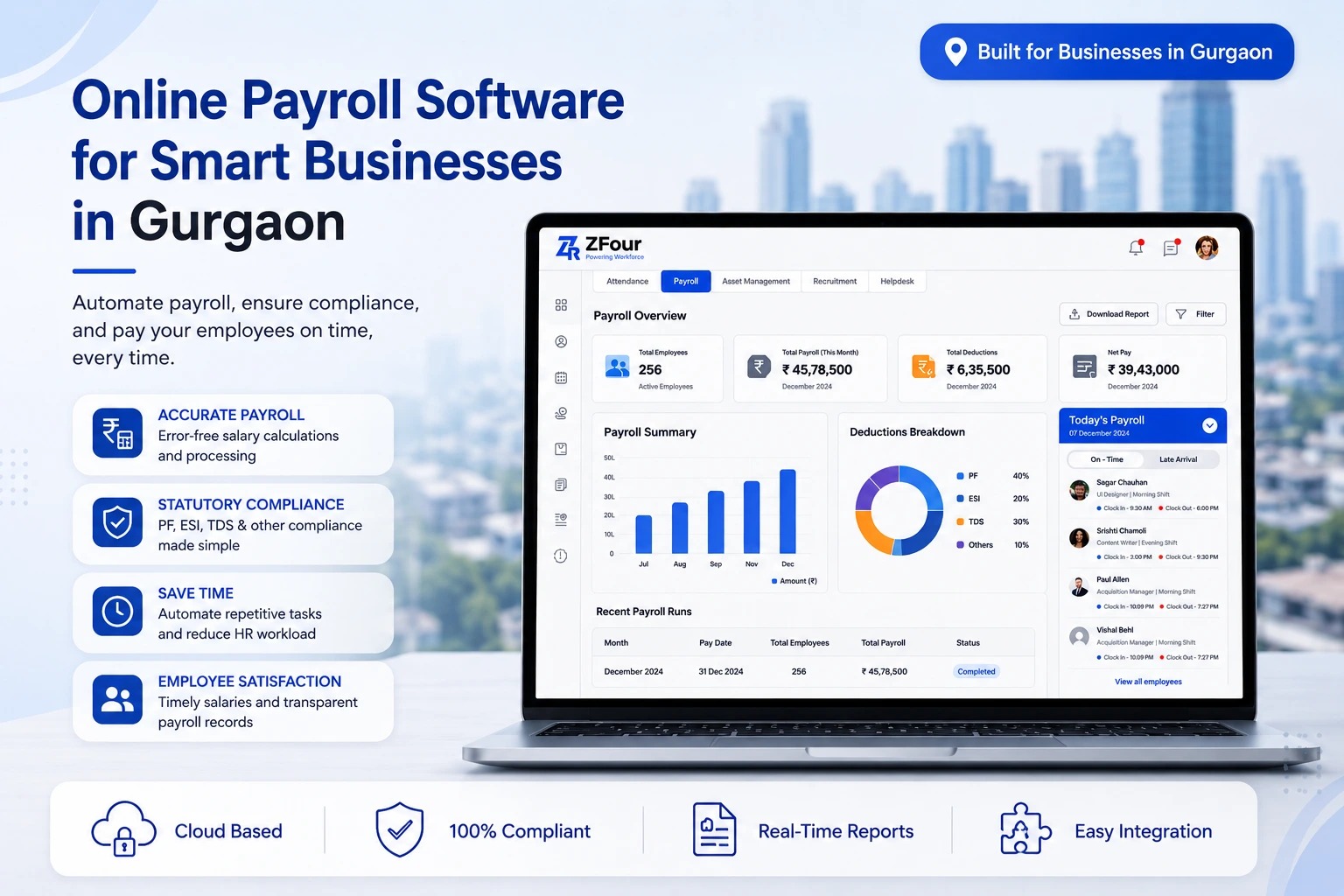
For Indian businesses, ZFour HRMS combines payroll with employee and attendance workflows to support a centralized payroll process.
What Businesses Should Check Before Automating Payroll
Payroll automation isn't a simple software switch. Before implementation, review:
Current payroll process — Identify repetitive manual tasks and error-prone steps.
Employee data — Check employee records, salary structures, and attendance data.
Payroll rules — Verify applicable statutory and company-specific configurations.
Integrations — Confirm attendance, leave, and employee systems can connect with payroll.
Approval workflow — Define who reviews and approves payroll.
Data security — Review access controls, permissions, backups, and data protection.
Reporting requirements — Confirm HR, finance, and statutory reports can be generated.
Testing — Run test payroll calculations before moving to production.
A successful payroll automation project depends on both the software and the quality of the underlying employee and payroll data.
The Future of Payroll Automation
Payroll automation is moving beyond basic salary calculation toward connected HR workflows, employee self-service, analytics, and intelligent payroll review. Key developments include greater integration between HR and payroll, automated data collection, payroll analytics, AI-assisted anomaly detection, mobile payroll access, and more centralized workforce data. Payroll is becoming a connected business process rather than a standalone monthly spreadsheet exercise.
Conclusion
Payroll automation helps businesses reduce repetitive payroll work, improve consistency, and centralize employee and payroll information. The biggest gains come from connecting attendance, leave, employee data, calculations, payslips, and reporting into one structured workflow. For SMEs, automation also makes payroll easier to manage as headcount and complexity grow.
Payroll software should support, not replace, human review and employer responsibility for accurate payroll and statutory compliance. If your payroll still depends heavily on Excel sheets, repeated data entry, and manual reconciliation, it may be time to evaluate a modern HRMS-based payroll system.
Ready to Automate Your Payroll?
Reduce repetitive payroll work, connect employee data with payroll, and give your HR team more time for higher-value work.
Farheen Ahmed
Senior HR & Payroll Subject Matter Expert
Certified HR Specialist & Payroll Compliance Expert with 10+ years in enterprise workforce management.