8 min read
HR teams handle a large number of recurring employee questions and administrative requests every day. Employees may need information about leave policies, attendance, payroll, onboarding, HR documents, or workplace procedures.
HR chatbots can help organizations provide faster digital assistance for routine HR queries while reducing repetitive work for HR teams. Depending on the technology and configuration, an HR chatbot can interpret employee questions, provide relevant information, guide users through HR workflows, or direct them to the appropriate HR resource.
This guide explains what HR chatbots are, how they work, their common HR use cases, benefits, limitations, security considerations, and how they can fit into an HRMS.
What Is an HR Chatbot?
An HR chatbot is a software-based conversational interface designed to assist employees, candidates, or HR teams with routine HR-related questions and workflows.
Depending on the platform, an HR chatbot may help users:
Find HR policies and information
Ask routine questions about leave and attendance
Access payroll-related information
Navigate onboarding processes
Locate HR documents
Submit or start certain HR requests
Receive reminders and notifications
Find answers to frequently asked questions
The exact capabilities vary by platform. An HR chatbot should therefore be evaluated based on the organization's actual requirements and the workflows it supports.
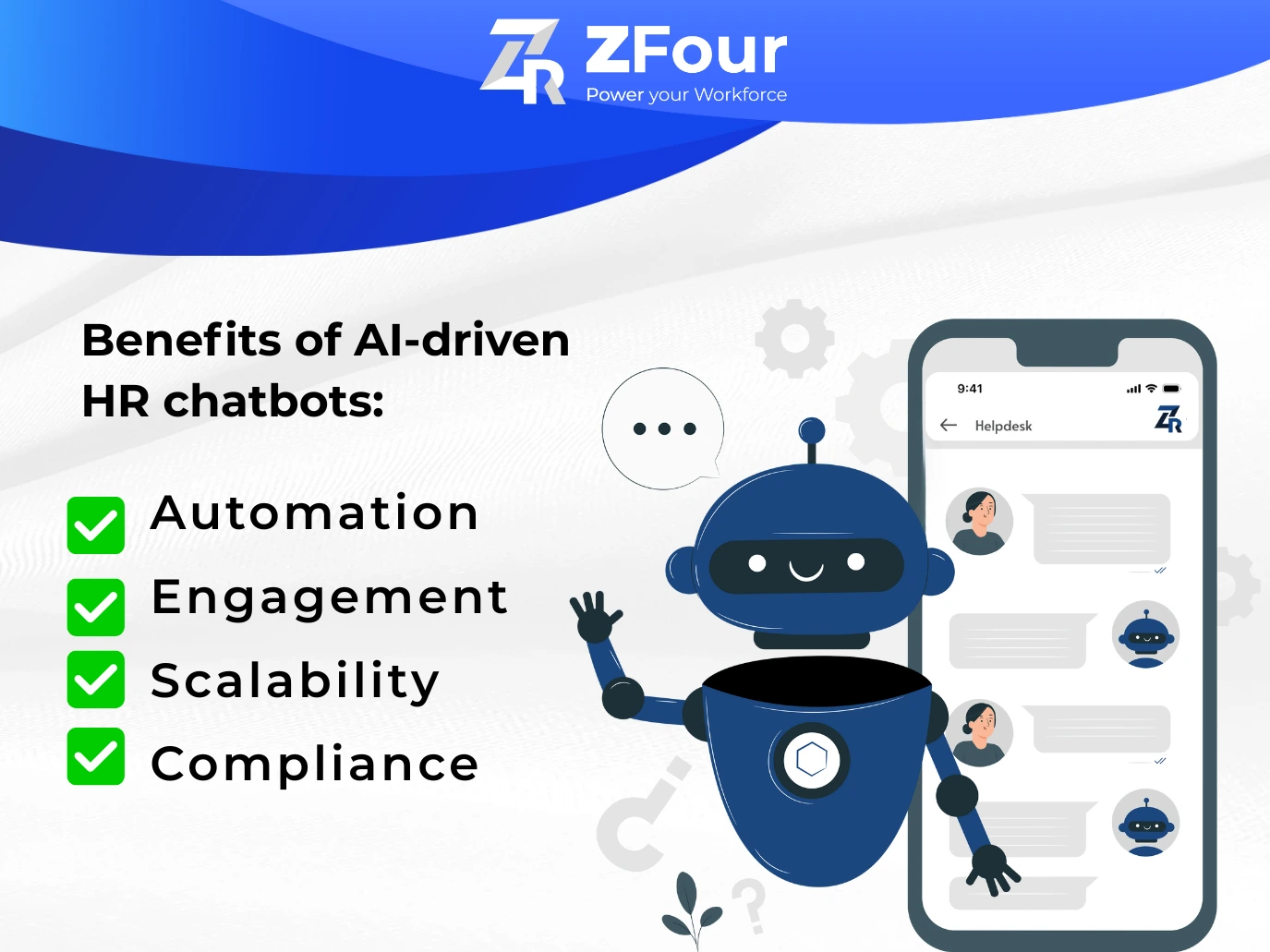
How Do HR Chatbots Work?
Most HR chatbots follow a simple conversational workflow:
Employee asks a question → chatbot interprets the request → relevant information or workflow is identified → response or next step is provided
For example:
Employee: How many leave days do I have?
HR chatbot: The chatbot identifies the request and, where the system is connected to employee leave data and the user is authorized, can provide the relevant information or direct the employee to the appropriate leave section.
For general policy questions, the chatbot may retrieve information from an approved HR knowledge base.
For more complex or sensitive requests, the chatbot should provide an appropriate escalation path to an HR professional.
What Can HR Chatbots Do?
The capabilities of HR chatbots depend on the platform, integrations, data access, and organizational configuration.
1. Answer Routine HR Questions
HR chatbots can help employees find answers to frequently asked questions about:
Leave policies
Working hours
Attendance procedures
Payroll processes
Company policies
Employee benefits
HR documents
Onboarding procedures
This can reduce the number of repetitive questions HR teams need to answer manually.
2. Support Employee Self-Service
An HR chatbot can act as an additional interface for employee self-service.
Instead of searching through multiple HR pages or systems, an employee may be able to ask a question conversationally and receive guidance about the appropriate process.
For example:
“How do I apply for leave?”
The chatbot can explain the process or direct the employee to the relevant HR workflow.
3. Assist With Leave and Attendance Queries
Employees frequently need quick access to attendance and leave information.
Depending on system integration, an HR chatbot may help employees:
Understand leave procedures
Find attendance-related information
Navigate leave requests
Locate attendance policies
Identify the correct HR workflow
The chatbot should only provide employee-specific information when appropriate authentication and access controls are in place.
4. Support Payroll Queries
Payroll generates many recurring employee questions.
An HR chatbot may help employees understand:
Payslip access
Payroll timelines
Salary-related processes
Deduction terminology
Payroll procedures
For account-specific payroll information, the chatbot should operate within the organization's authentication and access-control framework.
5. Help With Employee Onboarding
New employees often have questions during their first few weeks.
An HR chatbot can potentially guide employees toward information about:
Company policies
Required documents
Onboarding steps
HR contacts
Workplace procedures
Benefits information
This can provide employees with another convenient way to access onboarding information.
6. Assist Recruitment Workflows
HR chatbots can also support parts of the recruitment process.
Depending on the platform, they may assist with:
Answering candidate FAQs
Sharing job-related information
Interview scheduling
Application-status guidance
Collecting basic information
Directing candidates to relevant recruitment resources
Chatbots should not automatically make important hiring decisions without appropriate human review and governance.
Benefits of HR Chatbots
Faster Responses to Routine Questions
Employees can receive information without waiting for an HR team member to respond to every basic question.
Reduced Repetitive HR Work
By handling common queries and directing employees toward self-service workflows, chatbots can reduce some repetitive administrative work.
Better Employee Self-Service
Employees can access HR information through a conversational interface rather than relying entirely on manual HR support.
Consistent Information
When a chatbot uses an approved HR knowledge base, it can help provide more consistent answers to frequently asked questions.
Organizations should still review and update the underlying information to prevent outdated responses.
Support Beyond Office Hours
A chatbot can potentially provide access to approved HR information outside normal HR working hours, depending on the platform and deployment.
This does not mean that human HR support is available 24/7.
Scalable HR Support
As organizations grow, the volume of routine employee questions can also increase. An HR chatbot may help handle a larger number of repetitive requests without requiring every interaction to be handled manually.
HR Chatbots vs Traditional HR Support
HR Activity | Traditional Approach | HR Chatbot-Assisted Approach |
|---|---|---|
Employee FAQs | HR answers repeated questions | Chatbot can handle routine information requests |
Leave information | Employee contacts HR or checks portal | Chatbot can guide the employee |
Attendance queries | Manual HR assistance | Chatbot can provide guidance or direct to the relevant workflow |
Payroll FAQs | HR handles recurring questions | Chatbot can explain routine payroll information |
Onboarding questions | HR manually responds | Chatbot can guide employees through approved information |
Recruitment FAQs | Recruiter responds individually | Chatbot can assist with common candidate questions |
Complex cases | HR handles manually | Chatbot can escalate to HR |
The goal is not to replace HR professionals. HR chatbots are better viewed as a support layer for routine information and workflows.
HR Chatbots and Employee Self-Service
HR chatbots can complement traditional employee self-service systems. For a deeper look at how self-service portals work on their own, see our guide on the employee self-service portal.
A chatbot can provide a conversational alternative.
For example:
Employee: “I want to apply for leave.”
Chatbot: “Here is the leave request process.”
Employee: “Where can I see my remaining leave?”
Chatbot: “If your account is connected and you have the required access, you can view your leave information here.”
This type of interaction can make HR systems easier to navigate, particularly for frequently used processes.
Security and Privacy Considerations for HR Chatbots
HR chatbots may interact with sensitive employee or candidate information. Security and privacy should therefore be considered before implementation.
Organizations should evaluate:
Access Control
Employees should only be able to access information they are authorized to view.
Authentication
Employee-specific information should require appropriate authentication.
Data Protection
Organizations should understand what data the chatbot processes, where it is stored, and how it is used.
Knowledge-Base Accuracy
HR policies and information should be reviewed regularly so that the chatbot does not provide outdated guidance.
Human Escalation
Sensitive, complex, or exceptional matters should have a clear route to an HR professional.
Data Retention
Organizations should understand how conversational data is retained and whether retention settings align with their internal requirements and applicable obligations.
Organizations evaluating AI-enabled HR tools can also consider established frameworks such as the NIST AI Risk Management Framework when assessing AI-related risks and governance.
Limitations of HR Chatbots
HR chatbots can improve access to routine information, but they are not suitable for every HR situation.
A chatbot may struggle when:
The employee's situation is highly specific
The request requires judgment
The information is incomplete
A policy has multiple exceptions
The issue involves a sensitive employee matter
The question requires interpretation beyond the available information
For these situations, human HR support remains important.
The best approach is usually to combine automated assistance with clear escalation paths rather than attempting to automate every HR interaction.
How to Choose an HR Chatbot
Before implementing an HR chatbot, HR teams should evaluate:
Use Cases
Start by identifying the specific problems the chatbot should solve.
For example:
Employee FAQs
Leave queries
Attendance guidance
Payroll FAQs
Onboarding support
Integration
Check whether the chatbot can connect with the HRMS, employee portal, knowledge base, or other relevant systems.
Access Controls
Make sure employee-specific information can be restricted to authorized users.
Knowledge Management
The system should allow HR teams to maintain accurate and updated information.
Escalation
There should be a clear process for transferring complex requests to human HR support.
Analytics
Where available, chatbot analytics can help HR teams understand frequently asked questions and identify areas where employees need better information.
User Experience
The chatbot should be easy for employees and HR teams to use without creating unnecessary complexity.
How HR Chatbots Fit Into an HRMS
An HR chatbot can become more useful when it is connected to an organization's wider HR ecosystem.
A typical structure may look like:
Employee → HR chatbot → HRMS / knowledge base → relevant information or workflow → HR escalation when required
For example, an employee could use the chatbot to find a leave policy, navigate an attendance process, or locate a payroll resource.
The exact level of integration depends on the HRMS, chatbot technology, available APIs, authentication setup, and configured workflows.
How ZFour HRMS Supports Digital HR Workflows
ZFour HRMS provides a centralized environment for managing digital HR processes such as employee information, attendance, leave, payroll, and employee self-service.
For organizations considering chatbot technology, the important consideration is how conversational support fits into existing HR processes.
A chatbot can be useful for accessing information and guiding employees, while the underlying HRMS can remain the system where relevant employee records and workflows are managed.
Organizations should evaluate the specific chatbot capabilities, integrations, security controls, and workflows available in their selected ZFour configuration before implementation.
Best Practices for Implementing an HR Chatbot
Start With High-Volume Questions
Begin with repetitive questions that have clear answers.
Use Approved Information
Build the chatbot's responses around current HR policies and verified organizational information.
Keep Humans in the Loop
Provide employees with a clear way to contact HR when the chatbot cannot appropriately handle a request.
Review Responses Regularly
Monitor chatbot interactions and update outdated or incomplete information.
Protect Employee Data
Use appropriate authentication, permissions, and data-protection controls.
Measure Performance
Track useful indicators such as:
Frequently asked questions
Resolution or deflection rates, where measurable
Escalation volume
Employee feedback
Unanswered questions
Response accuracy
These measurements can help HR teams determine whether the chatbot is actually improving employee support.
Conclusion
HR chatbots can help organizations improve digital HR support by making routine information easier to access and reducing some repetitive work for HR teams.
They can support areas such as employee FAQs, leave and attendance guidance, payroll information, onboarding, recruitment queries, and employee self-service. However, their effectiveness depends on accurate information, appropriate integrations, access controls, and clear human escalation processes.
The most practical approach is not to use a chatbot for every HR interaction. Instead, organizations can use chatbots for routine, clearly defined requests while keeping HR professionals responsible for complex, sensitive, and judgment-based matters.
When combined with an HRMS, employee self-service, reliable HR data, and appropriate governance, HR chatbots can become a useful part of a modern digital HR workflow.

Farheen Ahmed
HR Tech Content Strategist at ZFour Technology Private Limited
Research-driven content on HRMS, payroll, attendance management, employee management, and modern HR technology for Indian businesses.