8 min read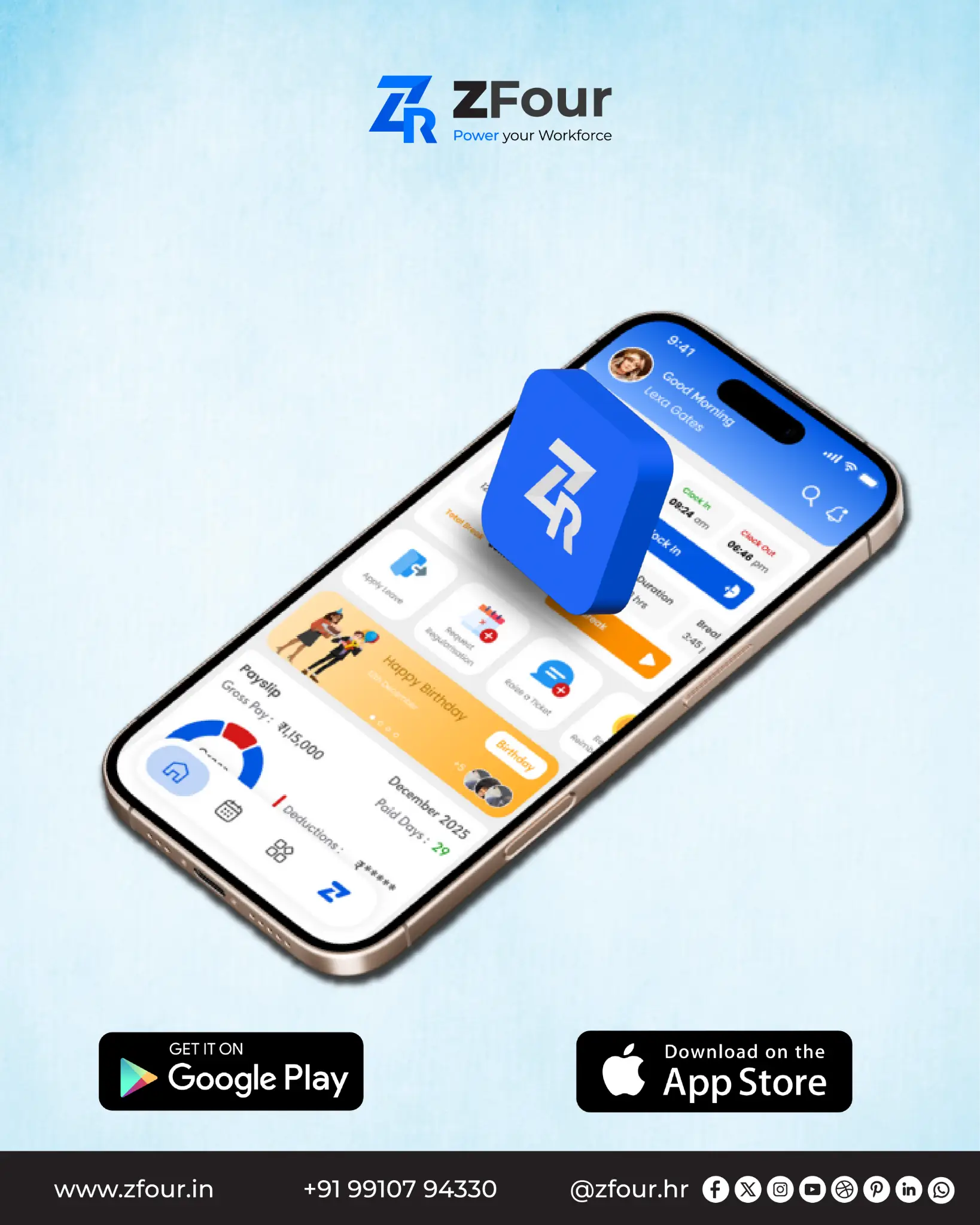
An HRMS app gives employees, managers, and HR teams mobile access to essential HR workflows such as attendance, leave, employee self-service, payslips, notifications, and other workforce activities.
For businesses with office-based, hybrid, field, shift-based, or multi-location employees, a mobile HRMS can make routine HR processes accessible without requiring employees to depend on a desktop system.
ZFour HRMS provides mobile access to supported HR workflows, helping employees and managers handle relevant HR activities from their smartphones.
This guide explains what an HRMS app does, which features businesses should evaluate, who benefits from mobile HR software, and what to consider when choosing an HRMS app for Android or iOS.
What Is an HRMS App?
An HRMS app is a mobile application connected to a Human Resource Management System that allows employees, managers, and HR teams to access supported HR functions from a mobile device.
Depending on the platform and organisation configuration, an HRMS app can support:
Mobile attendance
Leave management
Employee self-service
Payslip access
HR notifications
Employee information
Manager approvals
Location-based attendance where supported
A mobile HRMS does not necessarily replace a complete HRMS platform. Instead, it extends relevant employee and manager workflows beyond the desktop.
Why Businesses Use a Mobile HRMS App
As businesses grow, employees and managers increasingly need HR access while working away from a desktop.
A mobile HRMS can help move routine HR activities directly to employees and managers.
Business Challenge | Mobile HRMS Solution |
|---|---|
Employees depend on HR for routine requests | Employee self-service |
Manual attendance processes | Mobile attendance |
Delayed leave approvals | Mobile leave workflows |
Difficult access to payslips | Mobile payslip access |
Managers work away from desktops | Mobile approval workflows |
Field employees need attendance access | Mobile/location-based workflows |
HR updates are easily missed | Mobile notifications |
Employee information is fragmented | Centralised HR access |
The value of a mobile HRMS is not simply having an app. The app should make frequently used HR workflows accessible, reliable, secure, and easy to use.
Key Features of an HRMS Mobile App
1. Mobile Attendance
Mobile attendance allows employees to record attendance through supported mobile workflows.
Depending on the HRMS and configuration, this may include:
Check-in and check-out
Attendance history
GPS-based attendance
Geofencing
Selfie-based attendance
Location-based verification
Mobile attendance can be particularly useful for field employees, hybrid teams, distributed workforces, and multi-location businesses.
For organisations that need broader workforce operations beyond attendance, see the Workforce Management Software guide.
2. Leave Management
A mobile HRMS can allow employees to manage leave without depending on HR for every request.
Employees may be able to:
View leave balances
Apply for leave
Track requests
Check approval status
View leave history
Managers can use supported mobile workflows to review and approve employee leave requests.
3. Employee Self-Service
Employee self-service allows employees to access relevant HR information directly.
Depending on the platform, employees may be able to access:
Employee profile
Attendance records
Leave information
Payslips
HR notifications
HR requests
Other available employee information
This can reduce repetitive HR queries and give employees faster access to routine HR services.
4. Mobile Payslip Access
Employees often need access to salary information outside the workplace.
A mobile HRMS can provide access to supported payroll information such as:
Payslips
Salary information
Payroll history
Tax-related documents where supported
For businesses looking for a broader payroll solution, explore ZFour Payroll Management Software.
5. Manager Approvals
A mobile HRMS can also support managers who need to complete HR activities while away from their desks.
Depending on the enabled workflows, managers may be able to:
Approve leave
Review attendance
Handle employee requests
Receive HR notifications
Access relevant team information
This can reduce delays in routine HR approvals.
6. HR Notifications
Mobile notifications can help employees and managers stay informed about supported HR activities.
Examples may include:
Leave approval updates
Attendance notifications
HR announcements
Payroll-related information
Employee requests
Manager actions
The exact notification functionality depends on the HRMS platform and organisation configuration.
7. GPS and Geofenced Attendance
For field and distributed employees, office-based attendance may not always be practical.
Where supported, mobile location functionality can help organisations manage:
Field attendance
Location-based check-ins
Geofenced attendance
Multiple work locations
Mobile workforce attendance
Location-based functionality should be implemented according to the organisation's policies, employee notice requirements, and applicable requirements.
For organisations that need broader workforce operations beyond attendance, see the Workforce Management Software guide.
HRMS App for Field Employees
A mobile HRMS can be particularly useful for employees who do not work from a fixed office.
Common use cases include:
Sales teams
Field service teams
Delivery operations
Healthcare workers
Construction teams
Logistics employees
Multi-location employees
Instead of relying on office-based HR processes, employees can access relevant HR workflows through their mobile devices.
HRMS Mobile App vs Desktop HRMS
A mobile HRMS and a desktop HRMS generally serve complementary purposes.
Capability | Mobile HRMS | Desktop/Web HRMS |
|---|---|---|
Mobile attendance | Strong fit | Depends on mobile support |
Leave requests | On-the-go | Yes |
Payslip access | On-the-go | Yes |
Manager approvals | Convenient | Yes |
Field workforce | Strong fit | Requires mobile capability |
Employee self-service | Strong fit | Yes |
Detailed HR administration | More limited | Better suited |
Payroll administration | Usually complementary | Better suited |
Does a mobile HRMS replace a complete HRMS?
Not necessarily.
A mobile app generally extends the wider HRMS to employees and managers. Detailed HR administration, configuration, reporting, and other complex activities may continue through the web platform.
HRMS App for Android and iOS
Businesses using different mobile operating systems should evaluate whether the HRMS supports their workforce's devices.
The current Zfour HR: Attendance & Payroll app is available on both Android and iOS.
HRMS App for Android
Android users can download Zfour HR: Attendance & Payroll on Google Play.
The current Google Play listing includes supported workflows such as attendance, leave management, payslip access, notifications, attendance regularisation, support requests, and other employee-related functions.
Before deployment, businesses should confirm that the current app features match their enabled ZFour HRMS modules and workforce requirements.
HRMS App for iOS
iPhone users can download Zfour HR: Attendance & Payroll from the Apple App Store.
The current App Store listing identifies PANTHEON DIGITAL PRIVATE LIMITED as the developer and provides the official iOS app listing.
Businesses should verify the current app version, supported features, and device requirements before deployment.
Download ZFour HRMS App
Android: Download Zfour HR: Attendance & Payroll on Google Play
iOS: Download Zfour HR: Attendance & Payroll on the Apple App Store
Important: Downloading the application does not necessarily provide access to an organisation's HRMS data. Employees generally need an organisation-provided or registered ZFour account to access the relevant HRMS functionality.
Who Can Benefit From an HRMS Mobile App?
A mobile HRMS can be particularly relevant for:
Small Businesses
Businesses replacing spreadsheets and manual HR requests can provide employees with direct access to supported HR workflows.
Growing Companies
As headcount increases, mobile access can make attendance, leave, and employee information easier to manage.
Field Teams
Employees working away from a fixed office can use supported mobile attendance and HR workflows.
Hybrid Teams
Employees working from different locations can access relevant HR services without depending entirely on a desktop.
Shift-Based Organisations
Mobile access can support attendance, leave, and relevant manager workflows for shift-based teams.
Multi-Location Businesses
Businesses with employees distributed across branches and work sites can provide a consistent mobile HR experience.
How to Choose the Best HRMS App
Don't select an HRMS app simply because it has an Android or iOS application.
Evaluate the complete HR workflow.
Evaluation Area | What to Check |
|---|---|
Attendance | Mobile check-in/out and attendance history |
Location | GPS/geofencing where required |
Leave | Applications, approvals, and balances |
Employee self-service | Profile and HR information |
Payslips | Mobile payroll-document access |
Notifications | HR and workflow updates |
Manager workflows | Approvals and team visibility |
Payroll integration | Connection with payroll workflows |
Security | Access controls and data protection |
Usability | Ease of employee adoption |
Device support | Android and iOS compatibility |
Scalability | Ability to support growing teams |
Support | Vendor assistance and issue resolution |
What Makes a Good HRMS Mobile App?
Easy to Use
Employees should be able to find common actions such as attendance, leave, and payslips without extensive training.
Reliable
Core workflows should work consistently because attendance and leave information can affect payroll and employee records.
Secure
An HRMS app may contain sensitive employee and payroll information, making appropriate access controls and security practices important.
Integrated
The mobile app should connect with the wider HRMS rather than becoming another isolated HR tool.
Scalable
The system should remain practical as employee numbers, locations, and HR requirements increase.
Benefits of a Mobile HRMS
Benefit | Potential Business Impact |
|---|---|
Employee self-service | Reduces routine HR queries |
Mobile attendance | Supports distributed teams |
Faster approvals | Reduces waiting time |
Payslip access | Improves employee convenience |
Mobile notifications | Improves HR communication |
Field attendance | Supports workforce visibility |
Centralised HR workflows | Reduces fragmented information |
Manager mobility | Enables HR actions away from desktops |
Mobile HRMS vs Employee App
The terms employee app and mobile HRMS are sometimes used interchangeably, but they can describe different product scopes.
An employee app may focus primarily on:
Attendance
Leave
Payslips
Employee self-service
A mobile HRMS can provide a broader mobile interface connecting employees and managers with multiple HR workflows.
When comparing products, evaluate the actual functionality rather than relying only on the product name.
Security Considerations for HRMS Apps
HRMS applications handle sensitive employee information, so security should be part of the buying decision.
Before selecting an app, ask the provider about:
Authentication
Role-based access
Data encryption
Session management
Access permissions
Audit logging
Data storage
Backup and recovery
Privacy policies
Relevant security certifications
Verify specific security certifications, encryption standards, and compliance claims against the vendor's current official documentation before making a purchase decision.
Common Mistakes When Choosing an HRMS App
Avoid selecting an HRMS app based only on:
App-store ratings
Number of downloads
Interface design
Lowest subscription price
Number of advertised features
Instead, evaluate whether the app supports your actual workforce, HR, attendance, leave, payroll, security, and employee self-service requirements.
Why Choose ZFour HRMS?
ZFour HRMS combines employee-facing workflows with a broader HRMS environment.
Depending on the organisation's enabled features, businesses can connect mobile employee access with areas such as:
Attendance
Payroll
Leave management
Performance management
Recruitment
Employee management
HR reporting
This can help businesses avoid creating separate tools for every HR activity.
ZFour HRMS Mobile App: Is It Right for Your Business?
ZFour HRMS can be considered by Indian businesses looking for mobile access to supported employee and workforce workflows within a broader HRMS environment.
It can be particularly relevant to:
Growing Indian businesses
SMEs
Field teams
Hybrid teams
Shift-based organisations
Multi-location businesses
The right configuration depends on the organisation's workforce structure, requirements, and enabled ZFour HRMS features.
Final HRMS App Checklist
Before choosing a mobile HRMS, confirm:
Android app available
iOS app available
Mobile attendance
GPS/geofencing where required
Leave management
Employee self-service
Payslip access
Manager approvals
Notifications
Payroll integration
Security controls
Role-based access
Easy employee adoption
Customer support
Scalable pricing
Integration with the wider HRMS
Final Recommendation
A mobile HRMS should do more than place an HR portal on a smartphone. It should make important employee and manager workflows accessible, simple, secure, and practical from anywhere.
When evaluating an HRMS app, compare attendance, leave, employee self-service, payslip access, manager workflows, field workforce support, payroll integration, security, usability, and Android/iOS availability.
ZFour HRMS can be considered by Indian businesses looking for an integrated HRMS environment with mobile access to supported employee and workforce workflows.
For businesses evaluating the complete HRMS rather than only its mobile experience, explore the ZFour HRMS platform.

Farheen Ahmed
HR Tech Content Strategist at ZFour Technology Private Limited
Research-driven content on HRMS, payroll, attendance management, employee management, and modern HR technology for Indian businesses.