12 min read
The Delhi Minimum Wages are the legally prescribed minimum salary rates that employers must pay eligible employees based on their skill category and employment classification. These rates are notified by the Delhi Labour Department and are revised periodically to reflect changes in the cost of living through the Variable Dearness Allowance (VDA).
Whether you're an HR professional, payroll administrator, business owner, finance manager, or employee, understanding the latest Delhi minimum wage rules is essential for ensuring statutory compliance, accurate payroll processing, and fair employee compensation.
In this guide, you'll learn the latest minimum wage rates, eligibility criteria, skill classifications, salary calculations, PF and ESI implications, the relationship between minimum wages and the Code on Wages, common compliance mistakes, and best practices for employers operating in Delhi.
Quick Answer
Delhi Minimum Wages are the minimum salary rates that employers are legally required to pay eligible employees based on their skill category. These rates are notified by the Delhi Labour Department and are revised periodically. Employers should always verify the latest official notification before processing payroll, as wage rates may change with new revisions.
What is the Minimum Wage in Delhi 2026
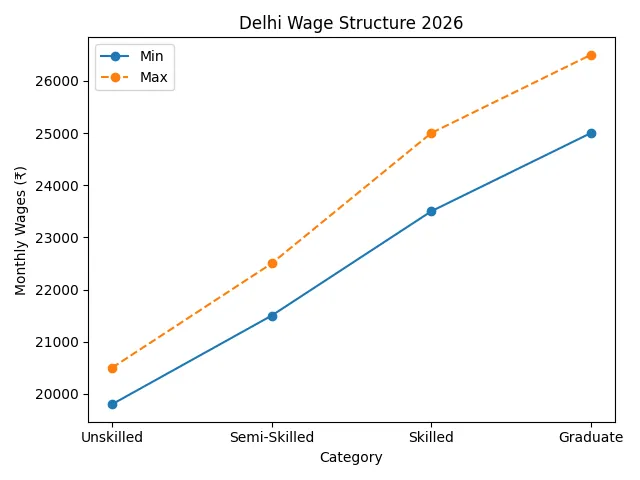
Minimum wage in Delhi ranges from ₹19,800 to ₹26,500 per month depending on skill level. These wages are revised twice a year based on inflation and government regulations.
Understanding the latest wage structure is the first step toward clarity. Delhi continues to offer one of the highest minimum wage standards in India due to its urban cost of living and policy framework.
Updated Wage Rates
Category | Monthly Wages (Approx) | Daily Wages |
Unskilled | ₹19,800 – ₹20,500 | ₹760 – ₹790 |
Semi-Skilled | ₹21,500 – ₹22,500 | ₹820 – ₹860 |
Skilled | ₹23,500 – ₹25,000 | ₹900 – ₹960 |
Graduate / Clerical | ₹25,000 – ₹26,500 | ₹960 – ₹1020 |
These figures are revised periodically and may vary slightly depending on inflation adjustments.
Key Points to Understand
Wages are categorized based on skill level and education
Graduate employees fall into higher wage brackets
Revisions are done twice a year
Employers are legally required to comply
Why Understanding Wage Rules in Delhi is Important
Helps avoid underpayment
Ensures legal compliance
Improves financial planning
Supports better career decisions
How Do Delhi Minimum Wages Compare with Other Major Indian Cities?
Minimum wage policies vary across India because each state and union territory notifies wage rates independently. Revision frequency, skill classifications, scheduled employments, and cost-of-living adjustments differ from one jurisdiction to another.
Location | Wage Policy Overview | ||
|---|---|---|---|
Delhi | Revised periodically with Variable Dearness Allowance (VDA) adjustments. | ||
Maharashtra | Wage rates vary by employment category and geographical zone. | ||
Karnataka | Minimum wages differ based on occupation and regional classifications. | ||
West Bengal | Wage notifications are issued for different scheduled employments. |
Rather than comparing only salary figures, employers operating in multiple states should always review the latest notification issued by the respective state labour department before processing payroll.
Who Is Eligible for Wage Rates in Delhi
Covered Employees:
Private company employees
Contract workers
Daily wage workers
Office staff (clerical, admin)
Field employees
Not Fully Covered:
Freelancers
Business owners
Self-employed professionals
Documents Required for Wage Compliance in Delhi
Employees Should Have:
Offer letter
Salary slip
Bank statement
PF account details
Employers Must Maintain:
Payroll records
Attendance register
Wage register
Challenges Employees Face with Salary Structure Delhi
Even with clear wage laws, employees often face practical issues.
Common Challenges
Lack of awareness about minimum wage category
Incorrect salary structure by employers
No proper salary slips or documentation
PF not deducted correctly
Misclassification of skill level
Example
An employee working in an office role may be categorized as “semi-skilled” instead of “skilled,” leading to lower salary eligibility.
Role of VDA in Wage Rates in Delhi
VDA (Variable Dearness Allowance) plays a major role in wage calculation.
What is VDA
Adjustment based on inflation
Revised twice a year
Added to basic wages
Why It Matters
Protects employees from rising costs
Ensures wages remain relevant
Keeps salary aligned with inflation
Minimum Wages & VDA Orders (Government of India)
Difference Between Minimum Salary in Delhi and Living Wage
Many people assume that minimum wage is enough to live comfortably, but there is a significant difference between minimum salary and a living wage.
Understanding this gap helps employees set realistic financial expectations and plan their careers better.
What is the minimum salary in Delhi
Minimum salary refers to the legal minimum amount that employers must pay employees based on their skill level and job category.
Key Points
Fixed by the government
Varies based on skill level (unskilled, semi-skilled, skilled)
Revised periodically based on inflation
Ensures basic survival needs
It is designed to protect workers from exploitation, not to provide a comfortable lifestyle.
What is a Living Wage
A living wage is the amount required to maintain a decent standard of living, beyond just basic survival.
Key Points
Covers rent, food, transport, healthcare
Includes savings and emergency funds
Allows a better quality of life
Not legally fixed in most cases
Comparison Table
Factor | Minimum Salary in Delhi | Living Wage |
Purpose | Legal protection | Comfortable living |
Coverage | Basic needs only | Full lifestyle needs |
Defined By | Government | Economic conditions |
Flexibility | Fixed rates | Varies by lifestyle |
Savings | Limited | Possible |
Practical Example: Understanding Delhi Minimum Wage Compliance
Scenario
A manufacturing company in Delhi hires a skilled machine operator. Before processing payroll, the HR and payroll teams verify the latest Delhi minimum wage notification to ensure that the employee's gross salary meets or exceeds the applicable statutory wage for the relevant skill category.
While calculating payroll, the organization also considers attendance, overtime, statutory deductions such as PF and ESI (where applicable), and the company's approved salary structure. By following the latest notified wage rates and maintaining proper payroll documentation, the employer helps reduce compliance risks and ensures employees receive their legally applicable wages.
Key takeaway: Employers should review each revised notification and update payroll settings whenever new wage rates become effective.
What is In-Hand Salary After PF and ESI?
In-hand salary is the amount an employee receives after deducting PF and ESI from the gross salary.
PF (Provident Fund) is calculated at 12% of basic salary, while ESI is deducted at 0.75% for eligible employees. These deductions reduce take-home salary but provide long-term financial and medical benefits.
Example:
If gross salary is ₹25,200:
PF: ₹2,160
ESI: ₹189
👉 Final in-hand salary: ₹22,851
This simple PF ESI calculation example Delhi helps understand actual earnings.
Why This Difference Matters
Understanding this gap helps in:
Setting realistic salary expectations
Planning career growth
Negotiating better compensation
Managing expenses wisely
Key Insight
Minimum salary ensures survival, while a living wage supports stability and growth.
Employees should aim to move beyond minimum wage levels to achieve long-term financial security.
Tips to Increase Salary Beyond Minimum Wages
If you are earning close to minimum wage, here are ways to grow.
Practical Tips
Upgrade your skills (digital, technical, communication)
Switch to higher-paying industries
Gain certifications
Improve negotiation skills
Build experience
Example
A semi-skilled worker earning ₹22,000 can move to ₹30,000+ by upgrading skills and switching roles.
How Minimum Wages Are Decided

Minimum wages are not randomly set. They are calculated using multiple economic and social factors.
Major Factors
Cost of living in urban areas
Inflation rate (VDA adjustments)
Industry standards
Skill level requirements
Government labour policies
Delhi’s higher wage rates reflect its higher living costs compared to many other states.
Who Should Read This Guide?
This guide is designed for:
HR Managers and HR Executives
Payroll Professionals
Finance Teams
Business Owners and Employers
Compliance Officers
Startups and SMEs operating in Delhi
Employees who want to understand their minimum wage entitlements
Whether you're hiring new employees, processing monthly payroll, or reviewing statutory compliance, this guide explains the key aspects of Delhi minimum wages in a practical and easy-to-understand format.
Salary Structure Changes and 50% Wage Rule Explained
The biggest change in recent labour reforms is not just about increasing wages but redefining how salaries are structured.
Instead of allowing companies to distribute salary heavily in allowances, the new rule ensures a more balanced and transparent structure.
What the 50% Rule Means
Basic salary must be at least 50% of total CTC
Allowances cannot exceed 50%
Any excess allowance is added back to basic wages
This rule ensures that employees receive fair long-term benefits rather than just higher short-term take-home pay.
Example for Better Understanding
Let’s take a practical example:
If your monthly salary is ₹30,000
Component | Old Structure | New Structure |
Basic Salary | ₹12,000 | ₹15,000 |
Allowances | ₹18,000 | ₹15,000 |
PF Contribution | Lower | Higher |
Take-home Salary | Higher | Slightly Lower |
Long-term Benefits | Lower | Higher |
How to Calculate Salary in Delhi (Step-by-Step)
Calculating salary under Delhi minimum wages 2026 is simple when you follow a structured approach. This process ensures accurate salary calculation in Delhi and full compliance with wage laws.
Step 1: Identify Employee Category
First, determine whether the employee is unskilled, semi-skilled, skilled, or highly skilled. Minimum wages depend entirely on this classification.
Step 2: Set Basic Salary
The basic salary must be equal to or higher than the minimum wage defined for the category under Delhi wage rules 2026.
Step 3: Add HRA and Allowances
Add House Rent Allowance (HRA), usually 40–50% of basic salary, along with other allowances like travel or medical.
Step 4: Calculate Gross Salary
Gross salary = Basic + HRA + Allowances
Step 5: Deduct PF and ESI
PF: 12% of basic salary
ESI: 0.75% (if applicable)
Step 6: Final In-Hand Salary
After deductions, you get the final in-hand salary after PF and ESI.
👉 This step-by-step minimum wages Delhi calculation ensures your salary structure is accurate and compliant.
Real Impact on Employees
This structural change affects employees in both short-term and long-term ways:
Short-Term Impact
Slight reduction in in-hand salary
Increased PF deductions
Long-Term Benefits
Higher retirement savings
Increased gratuity amount
Better financial security
Why This Change Matters
Earlier, many companies kept basic salaries low to reduce PF and gratuity contributions. This resulted in lower long-term benefits for employees.
The new rule corrects this by:
Standardizing salary structures
Improving transparency
Strengthening employee protection
Key Takeaway
The change is not about reducing salary but about redistributing it in a way that benefits employees in the long run.
Wage Structure by Industry in Delhi
Minimum wages are not only based on skill level but also vary slightly depending on the industry. Different sectors have different compliance needs and salary structures.
Industry-Wise Insight
IT & Service Sector Salaries are usually above minimum wage Focus on structured CTC and benefits
Salaries are usually above minimum wage
Focus on structured CTC and benefits
Manufacturing & Factory Jobs Strict compliance with wage laws Overtime and shift-based wages common
Strict compliance with wage laws
Overtime and shift-based wages common
Retail & Hospitality Many employees fall under minimum wage bracket High dependency on skill classification
Many employees fall under minimum wage bracket
High dependency on skill classification
Logistics & Delivery Increasing focus on tracking and wage transparency Shift-based and performance-based pay
Increasing focus on tracking and wage transparency
Shift-based and performance-based pay
Key Takeaway
Even within Delhi, wages may vary slightly depending on industry practices, but legal minimum standards remain mandatory
Quick Summary of Delhi Minimum Wages 2026
Minimum wage starts around ₹19,800
Skilled workers earn up to ₹25,000+
Salary structure must follow 50% rule
PF and gratuity benefits have increased
Wages are revised twice a year
Real-Life Scenario in Delhi
Let’s understand how this works in real situations.
Case: Employee earning ₹28,000
Falls above minimum wage
Must still follow salary structure rules
Basic salary must meet the 50% requirement
Outcome
Higher PF deductions
Better retirement savings
Slight reduction in take-home pay
Impact on Different Job Roles
Entry-Level Workers
Salary range: ₹18,000 to ₹25,000
Benefit from improved wage enforcement
Better legal protection
Corporate Employees
Salary range: ₹25,000 to ₹50,000
Notice changes in salary structure
Gain long-term financial benefits
Field and Contract Workers
Stronger compliance
Reduced exploitation risk
Improved wage transparency
How to Check Your Salary Against Salary Structure in Delhi
Steps:
Identify your job category (unskilled, semi-skilled, skilled)
Check your monthly salary
Compare with current wage table
Verify salary structure (basic ≥ 50%)
Ensure PF deductions are applied correctly
Pro Tip:
If your salary is below minimum wage, you can legally raise a complaint.
Why These Changes Were Introduced
The government aimed to fix long-standing issues in salary structuring.
Problems Earlier
Low basic salary
High allowances
Reduced PF and gratuity benefits
Solution Now
Standardized salary structure
Improved employee security
Better compliance enforcement
Common Mistakes to Avoid
Assuming Higher Salary Means Compliance
Even high salaries must follow wage rules.
Ignoring Salary Breakdown
Understanding components is essential, not just total salary.
Not Checking Skill Category
Your wage eligibility depends on your job classification.
For official updates and policies, refer to the Ministry of Labour and Employment.
Learn more about the 50% salary rule
Explore HR payroll software solutions
Check time tracking software guide
Future Trends in Wages
The wage system in India is expected to evolve further.
Expected Changes
Movement toward living wages
Increased digital compliance
Better transparency in payroll systems
Delhi will likely continue to lead in wage standards due to its economic environment.
How Businesses Should Adapt
Update Payroll Systems
Use automated HR tools
Ensure compliance with new rules
Restructure Salary
Maintain proper salary ratio
Avoid legal complications
Improve Documentation
Clear salary breakdown
Proper employee records
Why HR Software Is Important for Wage Compliance
Managing wages manually can lead to errors and legal risks.
Benefits of Using HR Software:
Automated salary calculation
Compliance with wage laws
Real-time employee tracking
Error-free payroll processing
This is where tools like ZFour help businesses manage payroll efficiently while ensuring compliance.
Latest Trends in Delhi Salary Structure 2026
Key Trends:
Shift toward structured salaries
Increase in PF contributions
More focus on employee benefits
Digital payroll systems adoption
What Happens If an Employer Pays Below Minimum Wage
Consequences:
Legal penalty
Fines and compensation
Business compliance issues
Employee Rights:
File complaint with labour department
Claim unpaid wages
Legal protection under labour laws
Latest Delhi Minimum Wage Notification Explained
Minimum wages in Delhi are revised periodically based on inflation and Dearness Allowance (DA).
These updates ensure that employee salaries remain aligned with the cost of living.
Employers must regularly update salary structures according to the latest notification.
Failure to do so can lead to non-compliance and penalties.
👉 Staying updated with Delhi wage rules 2026 is essential for accurate payroll management.
Final Thoughts
Understanding wage changes is no longer optional, it is essential. The latest wage structure in Delhi reflects a broader shift toward fairness, transparency, and long-term financial security.
While employees may notice slight changes in their take-home salary, the benefits in terms of savings and security outweigh the short-term impact.
For employers, adapting to these changes ensures compliance and builds trust with employees.
If you want to simplify payroll, track employee performance, and stay compliant with wage laws, consider using a smart HR solution.
ZFour helps businesses manage:
Start optimizing your workforce management today with smarter tools and better insights.
Need a Better Way to Manage Payroll Compliance?
Keeping payroll compliant with changing minimum wage notifications, statutory deductions, attendance records, and labour regulations can become increasingly complex as businesses grow.
Before selecting any payroll or HRMS solution, evaluate how effectively it supports minimum wage compliance, payroll automation, attendance management, statutory reporting, employee self-service, and workforce management.
If you're exploring payroll and HR software for your organization, schedule a personalized demonstration of ZFour HRMS to understand how an integrated payroll and HR management platform can help streamline HR operations while supporting statutory compliance.
Are You Underpaid in Delhi? (Quick Salary Check)
Many employees in Delhi are unknowingly underpaid due to incorrect classification or salary structure.
Use this quick checklist to verify your salary:
Is your salary below minimum wage for your category?
Are you classified correctly (skilled vs semi-skilled)?
Is PF deducted at 12% of basic salary?
Is ESI applied correctly (if eligible)?
Is your salary updated as per Delhi minimum wages 2026?
👉 If any answer is “No”, your salary may not be compliant.
Understanding this helps employees ensure fair pay and helps employers avoid compliance risks.
Official Resources
For the latest notifications and compliance guidance, refer to the following official resources:
Employers should always verify the latest government notifications before implementing wage revisions, as statutory requirements may change over time.
Best Practices for Employers
Organizations can improve payroll compliance by following these practices:
Verify every new minimum wage notification before payroll processing.
Classify employees according to the appropriate skill category.
Maintain accurate attendance and overtime records.
Review payroll calculations after every wage revision.
Keep statutory records and payroll documentation updated.
Inform employees whenever salary structures change due to revised wage notifications.
Periodically audit payroll processes to identify and correct compliance issues.

Farheen Ahmed
HR Tech Content Strategist at ZFour Technology Private Limited
Research-driven content on HRMS, payroll, attendance management, employee management, and modern HR technology for Indian businesses.