Payroll is one of the most important recurring processes in HR because it combines employee information, salary structures, attendance, leave, deductions, statutory requirements, approvals, and salary disbursement.
Managing these activities manually across spreadsheets and disconnected systems can make payroll processing more difficult to review and maintain.
HRMS payroll software brings payroll workflows into a centralized HR environment. Depending on the system and configuration, it can connect employee records with salary structures, attendance, leave, deductions, payroll calculations, payslips, reports, and employee self-service.
This guide explains what HRMS payroll is, how the process works, which features matter, the benefits and limitations of payroll automation, compliance considerations in India, and what businesses should evaluate before choosing a system.
Quick Answer: What Is HRMS Payroll Software?
HRMS payroll software is a system that manages payroll processing as part of a broader human resource management platform.
Depending on the software, it can help businesses manage employee salary information, payroll inputs, earnings, deductions, attendance and leave inputs, statutory deductions, payslips, payroll reports, approvals, and employee self-service.
The main difference from a standalone payroll process is that HRMS payroll can use employee information already maintained within the wider HR system.
A typical workflow is:
Employee Records → Salary Structure → Attendance & Leave Inputs → Payroll Calculation → Review & Approval → Payslip → Salary Disbursement → Payroll Reports
The exact workflow varies by organization, payroll policy, integrations, and software configuration.
How Does HRMS Payroll Work?
An HRMS payroll workflow generally begins with employee information and approved salary structures.
The system may then use relevant payroll inputs such as attendance, leave, overtime, deductions, and applicable statutory information to prepare payroll.
A simplified monthly process looks like this:
Step 1: Maintain Employee Information
The HRMS stores employee information required for HR and payroll processes.
This may include:
Employee name
Employee ID
Joining date
Department
Designation
Work location
Employment status
Bank information
Salary structure
Applicable payroll information
Step 2: Configure Salary Components
The organization defines the employee's approved salary structure.
Depending on the payroll setup, this can include:
Basic salary
House Rent Allowance
Other allowances
Incentives
Reimbursements
Deductions
Employer contributions
Other applicable components
Salary structures vary between organizations, so payroll software should support the company's actual policies rather than forcing every employee into one standard structure.
Step 3: Collect Payroll Inputs
Payroll may depend on information generated during the month.
Common inputs include:
Attendance
Working days
Leave
Loss of pay
Overtime
Incentives
Reimbursements
New joiners
Employee exits
Salary revisions
Other approved adjustments
Step 4: Calculate Payroll
The HRMS processes the configured salary structure and approved payroll inputs.
Depending on the system, calculations may include:
Gross earnings
Deductions
Statutory deductions
Net salary
Employer contributions
Other payroll adjustments
Step 5: Review and Approve
Payroll automation does not remove the need for human review.
Payroll teams should verify important inputs and exceptions before finalizing payroll.
Review may include:
New employees
Exiting employees
Salary changes
Unusual deductions
Overtime
Loss of pay
Attendance exceptions
Statutory deductions
Reimbursements
Step 6: Generate Payslips and Reports
After payroll is finalized, the system may generate:
Employee payslips
Payroll summaries
Department reports
Deduction reports
Statutory reports
Bank or salary-disbursement files
Payroll registers
The exact outputs depend on the HRMS and the organization's payroll requirements.
What Are the Key Features of HRMS Payroll Software?
The features available in HRMS payroll systems vary, but the following capabilities are commonly important when evaluating a platform.
1. Salary Structure Management
Payroll software should allow businesses to define and maintain salary structures according to their compensation policies.
This can include different earnings, deductions, allowances, reimbursements, incentives, and employer contributions.
2. Automated Payroll Calculation
The system can process configured salary rules and approved payroll inputs to calculate payroll.
Automation can reduce repetitive manual calculations, but payroll teams should still review exceptions and outputs before final approval.
3. Attendance and Leave Integration
Attendance and leave information can affect payroll inputs.
For example:
Attendance → Working Days → Leave / LOP → Payroll Inputs
An HRMS that connects attendance and payroll can reduce the need to manually transfer this information between systems.
For a deeper look at the broader attendance workflow, businesses can refer to HRMS attendance management.
4. Statutory Payroll Support
Indian payroll may involve statutory requirements such as:
Provident Fund
Employee State Insurance
Tax Deducted at Source
Professional Tax where applicable
Other applicable payroll obligations
Businesses should verify the current requirements applicable to their employees and locations rather than assuming that every statutory rule applies to every organization.
For official PF information, businesses can refer to the Employees' Provident Fund Organisation.
5. Payslip Generation
An HRMS can generate digital payslips containing relevant salary and deduction information.
Depending on employee permissions, payslips may be made available through employee self-service.
6. Payroll Reports
Payroll reporting can help HR and finance teams review payroll information.
Useful reports may include:
Payroll summary
Employee salary report
Earnings and deductions
Department-wise payroll
Overtime
Loss of pay
Statutory deductions
Payroll registers
Salary disbursement information
7. Employee Self-Service
An HRMS may allow employees to access permitted payroll information without contacting HR for every routine request.
Depending on the platform, employees may be able to:
Download payslips
View salary information
Check leave balances
View attendance
Submit requests
Track approvals
Access HR documents
8. Payroll Approval Workflows
Payroll often requires review by HR, finance, or management.
An approval workflow can help define who reviews payroll before final processing.
9. Employee Changes and Payroll Adjustments
Payroll systems should be able to accommodate changes such as:
New joiners
Promotions
Salary revisions
Department transfers
Bonuses
Incentives
Reimbursements
Employee exits
10. Access Controls
Payroll data is sensitive.
A payroll system should provide appropriate controls over who can view, edit, approve, and export payroll information.
How Does Attendance Integration Improve Payroll Processing?
Attendance and payroll are often connected because employee working patterns can affect payroll inputs.
For example, an organization may use:
Attendance → Working Hours → Leave → Loss of Pay / Overtime → Payroll
This can be particularly relevant for businesses with:
Shift-based employees
Overtime
Multiple locations
Field employees
Attendance-linked salary rules
Large workforces
However, attendance data should not automatically be treated as final payroll data.
HR and payroll teams should establish appropriate rules for:
Attendance corrections
Leave approval
Overtime approval
Loss of pay
Shift changes
Regularization
Payroll cut-off dates
This creates a more controlled payroll process.
How Does Leave Affect Payroll?
Leave can become a payroll input depending on the organization's policies.
For example, approved paid leave may have no direct salary impact, while unpaid leave may result in loss-of-pay calculations.
A connected HRMS can help maintain the relationship between:
Leave Policy → Leave Application → Approval → Payroll Input
Businesses should configure these rules according to their employment policies and applicable requirements.
For related workflows, see the leave management system guide.
HRMS Payroll and Compliance in India
Payroll compliance is an important part of payroll processing in India.
Depending on the organization and employee circumstances, payroll may involve requirements related to PF, ESI, income-tax withholding, professional tax, wages, and other applicable regulations.
Because regulations and implementation requirements can change, payroll software should not be treated as a substitute for compliance review.
For example, the Income Tax Department's current guidance states that salary TDS obligations changed with the transition to the Income Tax Act, 2025 from April 2026. Payroll teams should therefore verify the current tax rules and system configuration for the relevant tax year. Income Tax Department TDS compliance guidance.
Similarly, the Ministry of Labour & Employment maintains current information and documents relating to India's Labour Codes and associated rules. Ministry of Labour & Employment — Labour Codes.
What Should Payroll Teams Check?
Before finalizing payroll, businesses should review:
Employee eligibility
Salary components
Applicable deductions
Attendance and leave inputs
Statutory calculations
New joiners
Exits
Salary revisions
Applicable state-level requirements
Payroll reports and filings
An HRMS can support these workflows, but the business remains responsible for ensuring that its payroll process is configured and reviewed appropriately.
Benefits of Using HRMS Payroll Software
1. Reduces Repetitive Administrative Work
Automating recurring payroll tasks can reduce the amount of manual data handling required each month.
2. Connects Payroll With HR Data
When employee information, attendance, leave, and payroll exist within a connected environment, teams may spend less time moving information between separate systems.
3. Improves Payroll Visibility
Payroll teams can use centralized reports to review salary, deductions, attendance-linked inputs, and other payroll information.
4. Supports Employee Self-Service
Employees can access permitted payroll information themselves instead of depending on HR for every payslip or routine payroll request.
5. Creates a More Structured Payroll Process
A defined workflow can help organizations establish consistent stages for payroll preparation, review, approval, and finalization.
6. Supports Workforce Growth
As employee numbers increase, spreadsheets and manual processes can become harder to maintain.
A centralized payroll system can provide a more structured way to manage larger employee populations, provided the software supports the organization's requirements.
What Are the Limitations of Payroll Automation?
Payroll automation is useful, but it does not mean every payroll activity becomes automatic or error-free.
Businesses should understand several limitations.
Incorrect Data Can Produce Incorrect Results
If employee salary, attendance, leave, or deduction information is incorrect, automation can process incorrect inputs efficiently.
Payroll Rules Require Configuration
Every business may have different salary structures, approval workflows, policies, and employee categories.
Compliance Still Requires Review
Payroll software can support compliance workflows, but businesses should verify applicable regulations and system configurations.
Integrations Can Create Dependencies
If payroll depends on attendance, accounting, banking, or other systems, integration failures can affect the workflow.
Human Approval Remains Important
Payroll is financially sensitive. Review and approval should remain part of the process.
The goal of payroll automation should therefore be controlled efficiency, not the assumption that no human oversight is required.
HRMS Payroll vs Manual Payroll
Area | Manual Payroll | HRMS Payroll |
|---|---|---|
Employee information | Often maintained across spreadsheets or files | Centralized within the HRMS |
Salary calculations | Manual or spreadsheet-based | System-based calculations |
Attendance inputs | May require manual transfer | Can be connected to payroll |
Leave inputs | May require separate verification | Can be linked to payroll workflows |
Payslips | Often created or distributed manually | Can be generated digitally |
Reports | Manual preparation may be required | System-generated reports |
Employee access | Employees may depend on HR | Self-service may be available |
Approvals | Email, spreadsheets, or manual process | Configurable workflow where supported |
Scalability | More difficult as workforce grows | Can support larger workflows depending on system |
Audit trail | May be distributed across files | Can be centralized depending on system |
The right choice depends on the organization's workforce, payroll complexity, compliance requirements, budget, existing systems, and implementation capacity.
How to Choose the Right HRMS Payroll Software
Choosing payroll software should involve more than comparing feature lists.
1. Understand Your Payroll Process
Document how your organization currently handles:
Employee setup
Salary structures
Attendance
Leave
Overtime
Deductions
Payroll approval
Payslips
Salary disbursement
Statutory reporting
This helps identify which workflows actually need automation.
2. Check Attendance and Leave Integration
If attendance or leave affects payroll, determine whether the HRMS can connect those inputs with payroll.
Ask:
Can attendance data flow into payroll?
Can approved leave be reflected in payroll?
Can overtime be incorporated?
Can loss-of-pay inputs be reviewed?
3. Evaluate Payroll Configuration
Check whether the system can accommodate your salary structures, earnings, deductions, incentives, reimbursements, and other payroll rules.
4. Review Compliance Support
For Indian businesses, verify support for applicable statutory payroll requirements.
Do not rely only on a vendor's claim that software is “100% compliant.” Ask how compliance updates are handled, what reports are generated, and how changes are communicated.
5. Check Security and Permissions
Review:
Role-based access
Authentication
Payroll approval permissions
Data export controls
Audit logs
Backup procedures
Data protection practices
6. Evaluate Employee Self-Service
Consider whether employees need access to:
Payslips
Attendance
Leave
Tax information
HR documents
Payroll requests
7. Review Reporting
Ensure the system can provide the payroll reports required by HR, finance, management, and applicable compliance processes.
8. Check Integrations
If your organization already uses attendance devices, accounting software, banking systems, or other HR tools, verify whether the HRMS supports the required integrations.
9. Consider Scalability
Evaluate whether the system can accommodate:
More employees
More locations
Different salary structures
Multiple departments
New approval workflows
Changing payroll requirements
10. Calculate Total Cost
Do not compare only subscription prices.
Consider:
Implementation
Data migration
Integrations
Training
Support
Customization
Additional modules
Ongoing administration
The best-value system is not necessarily the cheapest system. It is the one that fits the organization's actual payroll requirements without introducing unnecessary complexity.
HRMS Payroll Implementation Checklist
Before going live, businesses should prepare the following:
Employee Data
Verify employee records
Confirm joining and exit dates
Review bank information
Validate salary structures
Payroll Rules
Configure earnings
Configure deductions
Define payroll periods
Configure applicable statutory rules
Establish approval workflows
Attendance and Leave
Confirm attendance sources
Review shift configurations
Validate leave policies
Define overtime rules
Establish payroll cut-off dates
Testing
Run test payroll before the first live payroll cycle.
Compare:
Gross salary
Deductions
Net salary
Attendance inputs
Leave inputs
Overtime
Statutory deductions
Payslips
Access and Security
Confirm that:
HR users have appropriate access
Payroll approvers have required permissions
Employees can access only permitted information
Sensitive payroll exports are restricted
Common HRMS Payroll Mistakes to Avoid
Choosing Software Based Only on Feature Count
More features do not necessarily mean better payroll management.
Assuming Automation Means Zero Errors
Automation improves consistency but cannot correct incorrect employee data or poorly configured payroll rules.
Ignoring Integration Requirements
If attendance and payroll are disconnected, the organization may still have manual reconciliation work.
Not Testing Before Go-Live
Payroll should be tested using realistic employee scenarios before the first production run.
Ignoring Compliance Updates
Payroll rules can change. Businesses should have a process for reviewing applicable regulatory changes.
Giving Too Many Users Payroll Access
Payroll data should be restricted according to job responsibilities.
Skipping Employee Communication
Employees should know how and where to access payslips, payroll information, and HR requests after implementation.
How ZFour HRMS Supports Payroll Management
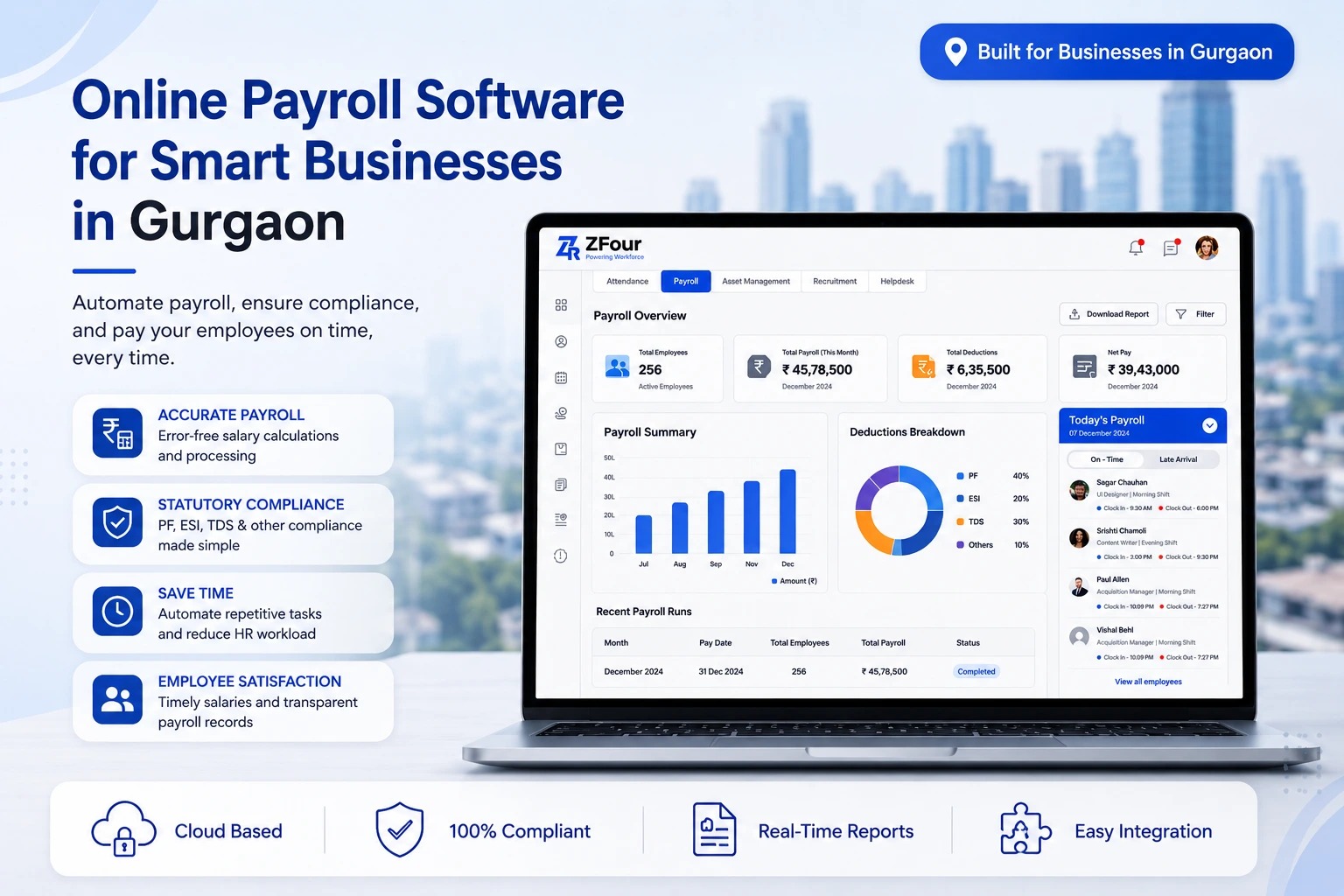
ZFour HRMS provides payroll capabilities within a broader HR environment that also includes employee management, attendance, leave, compliance workflows, reporting, and employee self-service.
Depending on configuration, businesses can use ZFour to connect payroll with relevant HR information and processes.
Relevant capabilities include:
Payroll processing
Salary management
Attendance tracking
Leave management
Employee records
Payroll compliance workflows
Payslips
Employee self-service
Payroll reports
Approval workflows
HR analytics
For businesses researching the broader functionality available in an HRMS, the HRMS software features guide provides additional context.
The appropriate configuration depends on the organization's employee structure, salary policies, attendance requirements, payroll process, and applicable statutory obligations.
Practical Example: A Monthly HRMS Payroll Workflow
Consider a company preparing payroll for 200 employees.
At the beginning of the payroll cycle, employee records and salary structures are already maintained in the HRMS.
During the month:
Attendance → Leave → Overtime → Payroll Inputs
At the payroll cut-off date, HR reviews attendance and approved leave information.
The payroll team then checks:
New joiners
Exits
Salary revisions
Overtime
Loss of pay
Deductions
Statutory inputs
The HRMS then processes the configured payroll rules.
Before finalization, the payroll team reviews the output and resolves exceptions.
After approval, payslips and required reports can be generated.
Employees can then access their permitted payroll information through self-service.
This illustrates an important principle: HRMS payroll is not simply salary calculation. It is a connected workflow for collecting, processing, reviewing, approving, and communicating payroll information.
Conclusion
HRMS payroll software can help businesses move from fragmented payroll administration toward a more structured and connected payroll workflow.
The most useful HRMS payroll systems do more than calculate salaries. They can connect:
Employee Records → Salary Structures → Attendance & Leave → Payroll Inputs → Calculation → Review → Approval → Payslips → Reporting
However, payroll automation should not be treated as a replacement for payroll oversight.
Businesses should evaluate the accuracy of their employee data, configuration of salary rules, applicable statutory requirements, security controls, integrations, reporting needs, and review processes before implementation.
For organizations evaluating HRMS payroll, the right solution is the one that fits their actual payroll process and connects the HR information required to run that process efficiently.
ZFour HRMS provides payroll capabilities alongside employee management, attendance, leave, compliance workflows, employee self-service, and reporting, allowing businesses to evaluate payroll within a broader HR workflow.
Ready to streamline payroll processing? Explore ZFour HRMS to see how its payroll and HR workflows can fit your organization's requirements.
Farheen Ahmed
Senior HR & Payroll Subject Matter Expert
Certified HR Specialist & Payroll Compliance Expert with 10+ years in enterprise workforce management.