7 min read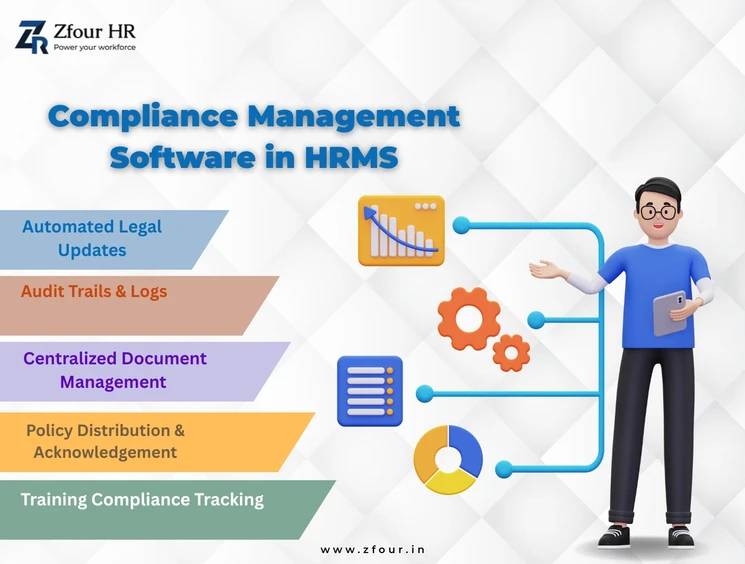
Managing HR compliance can become increasingly complex as organizations deal with employment requirements, payroll processes, employee records, workplace policies, and changing regulatory obligations.
Compliance management software in HR helps organizations organize, monitor, document, and manage compliance-related activities through a centralized digital system. Depending on the platform and configuration, it can support activities such as maintaining employee records, tracking required documents, managing approvals, creating audit trails, and sending reminders for important compliance tasks.
For Indian businesses, compliance requirements can vary according to factors such as workforce structure, location, industry, employment arrangements, and applicable laws. Software can support compliance workflows, but it does not replace the organization's responsibility to determine and meet the requirements that apply to it.
This guide focuses specifically on the concept of compliance management software — what it means, how it differs from compliance automation, and how to evaluate one. For the detailed feature-by-feature breakdown of what a compliance system actually does day to day (records, approvals, access controls, and more), see our HRMS Software for HR Law Compliance guide. For the specific statutory areas a compliance system typically covers in India (EPF, ESIC, TDS, POSH, and more), see our HR Compliance Software in India buying guide.
Quick Answer: What Is Compliance Management Software in HR?
Compliance management software in HR is a digital system that helps organizations organize, monitor, document, and manage HR compliance activities. It can centralize employee records, compliance documents, approvals, reminders, policy acknowledgments, and audit-related information.
The exact capabilities depend on the software provider, enabled modules, configuration, and the organization's compliance processes. HR teams should also verify applicable legal and regulatory requirements independently rather than assuming that software automatically guarantees compliance.
What Is Compliance Management in HR?
HR compliance management refers to the processes an organization uses to identify, implement, monitor, and document requirements related to employment and workforce management.
These requirements may involve areas such as:
Employee records
Payroll-related requirements
Working conditions
Leave and attendance policies
Employee documentation
Workplace policies
Required registrations or records
Training and acknowledgments
Internal HR policies
Applicable labour and employment requirements
The specific requirements differ between organizations. For businesses operating in India, HR teams should refer to authoritative sources and verify which requirements apply to their workforce, state, industry, and employment structure. The Ministry of Labour & Employment provides official information relating to labour and employment matters in India.
What Does Compliance Management Software Do?
Compliance management software provides a centralized environment for managing compliance-related information and workflows.
At a high level, a typical system helps HR teams identify compliance-related activities, maintain relevant records, store supporting documents, assign responsibilities, track completion status, send configured reminders, maintain records of actions and approvals, and prepare information for internal reviews or audits.
For the full breakdown of these capabilities — what each feature actually looks like in practice, from centralized records to role-based access — see our HRMS Software for HR Law Compliance guide. This guide focuses instead on the broader concept and how to evaluate it.
How Does Compliance Management Software Work?
A typical compliance-management workflow follows a general pattern:
Stage | What Happens |
|---|---|
Identify | HR identifies applicable compliance activities and requirements |
Configure | Relevant workflows, responsibilities, records, and reminders are configured |
Collect | Employee and organizational information is added to the system |
Track | HR teams monitor pending and completed activities |
Review | Authorized users review records, documents, and workflow status |
Document | Relevant actions, approvals, and records are maintained |
Report | Available reports help HR review compliance-related information |
The actual workflow varies according to the software, organization, and applicable requirements.
Compliance Management Software vs Compliance Automation
These two concepts are related but should not be treated as identical.
Compliance Management Software | Compliance Automation |
|---|---|
Provides a system for organizing and managing compliance information | Focuses on reducing manual work within specific compliance processes |
Can centralize records and documents | Can automate selected tasks and workflows |
May provide reporting and audit trails | May trigger reminders, approvals, or other configured actions |
Supports broader compliance administration | Concentrates on process automation |
Can include manual review and approval workflows | Attempts to reduce repetitive human intervention |
In simple terms: compliance management software is the broader management environment, while compliance automation is a capability that can be implemented within selected workflows.
For a dedicated explanation of automation within HRMS, see compliance automation in HRMS.
Benefits of Compliance Management Software in HR
When appropriately configured, compliance management software can support HR teams in several ways:
Centralized information. HR teams can manage relevant compliance records and documentation in a centralized environment rather than depending entirely on separate files and spreadsheets.
Better visibility. Task tracking and reporting can give authorized users a clearer view of pending, completed, or outstanding compliance activities.
Reduced administrative work. Digital workflows can reduce repetitive activities such as manually searching for records, sending routine reminders, or consolidating information from multiple sources.
Easier record management. Centralized documentation can make relevant records easier to locate when HR teams need to review them.
More consistent processes. Standardized workflows can help organizations handle recurring compliance activities more consistently.
Improved audit preparation. Organized records, approvals, and audit trails can make it easier to gather relevant information for internal reviews or other authorized assessments.
Important: These benefits depend on accurate data, appropriate configuration, employee adoption, and the organization's own compliance processes.
Why Is HR Compliance Software Important for Indian Businesses?
Indian organizations may need to manage different employment and workforce requirements depending on their location, industry, workforce structure, and applicable regulations.
Manual compliance management can become difficult when HR teams are responsible for multiple employee records, documents, payroll-related processes, approvals, and recurring activities. A compliance management system can provide a centralized way to organize this information and monitor configured workflows.
However, HR software does not automatically make an organization legally compliant. Businesses should verify current requirements with authoritative sources and, where appropriate, qualified legal or compliance professionals. For official labour and employment information, refer to the Ministry of Labour & Employment.
What Should You Look for in Compliance Management Software?
Before selecting a compliance-management solution, HR teams should evaluate the system against their actual requirements:
1. Compliance tracking. Check whether the software can track the specific activities your organization needs to monitor.
2. Document management. Evaluate how documents are stored, accessed, updated, and organized.
3. Reporting. Check whether available reports provide the information required by HR and management teams.
4. Workflow configuration. Review whether approval processes, responsibilities, notifications, and recurring tasks can be configured appropriately.
5. Access controls. Understand how users, roles, permissions, and administrative access are managed.
6. Integrations. Consider whether the software can connect with other systems used by your organization, such as payroll, attendance, accounting, or business applications.
7. Scalability. Consider whether the system can support changes in employee numbers, departments, locations, and HR processes.
8. Support and implementation. Evaluate implementation assistance, training, documentation, and ongoing support before adopting the platform.
For the specific Indian statutory areas (EPF, ESIC, TDS, Professional Tax, POSH, and more) this evaluation should also account for, see our HR Compliance Software in India buying guide.
Compliance Management Software and HRMS
Compliance management is often connected with broader HRMS functionality.
An integrated HRMS may connect compliance-related activities with employee records, attendance, leave, payroll, documents, and other HR workflows — for example, Employee information → Attendance → Leave → Payroll → Documentation → Reporting.
Connecting relevant information can reduce duplicate data entry and give authorized HR teams a more centralized view of workforce processes. However, organizations should verify which compliance capabilities are actually included in a particular HRMS rather than assuming that every platform offers the same functionality.
Compliance Management in ZFour HRMS
ZFour HRMS provides centralized HR technology for workforce processes such as employee management, attendance, leave, payroll, and related HR workflows.
Organizations evaluating ZFour can review its HRMS solutions to understand the available modules and determine whether they align with their HR and compliance-management requirements. The exact capabilities available to an organization depend on its selected modules, configuration, user roles, and implementation.
Conclusion
Compliance management software in HR provides a centralized way to organize and monitor compliance-related information, documentation, workflows, approvals, and reporting. It can help HR teams reduce administrative effort, improve visibility, maintain records, and manage recurring compliance activities more systematically. However, software should be treated as a supporting system rather than a substitute for legal review or organizational responsibility.
For Indian businesses, the right solution depends on the applicable requirements, workforce structure, HR processes, system configuration, security controls, and reporting needs. For the specific feature set, see our HRMS Software for HR Law Compliance guide, and for the statutory areas involved, see our HR Compliance Software in India buying guide.
Organizations evaluating digital HR technology can explore ZFour HRMS solutions to understand how centralized HR workflows can support employee and workforce management.

Farheen Ahmed
HR Tech Content Strategist at ZFour Technology Private Limited
Research-driven content on HRMS, payroll, attendance management, employee management, and modern HR technology for Indian businesses.