7 min read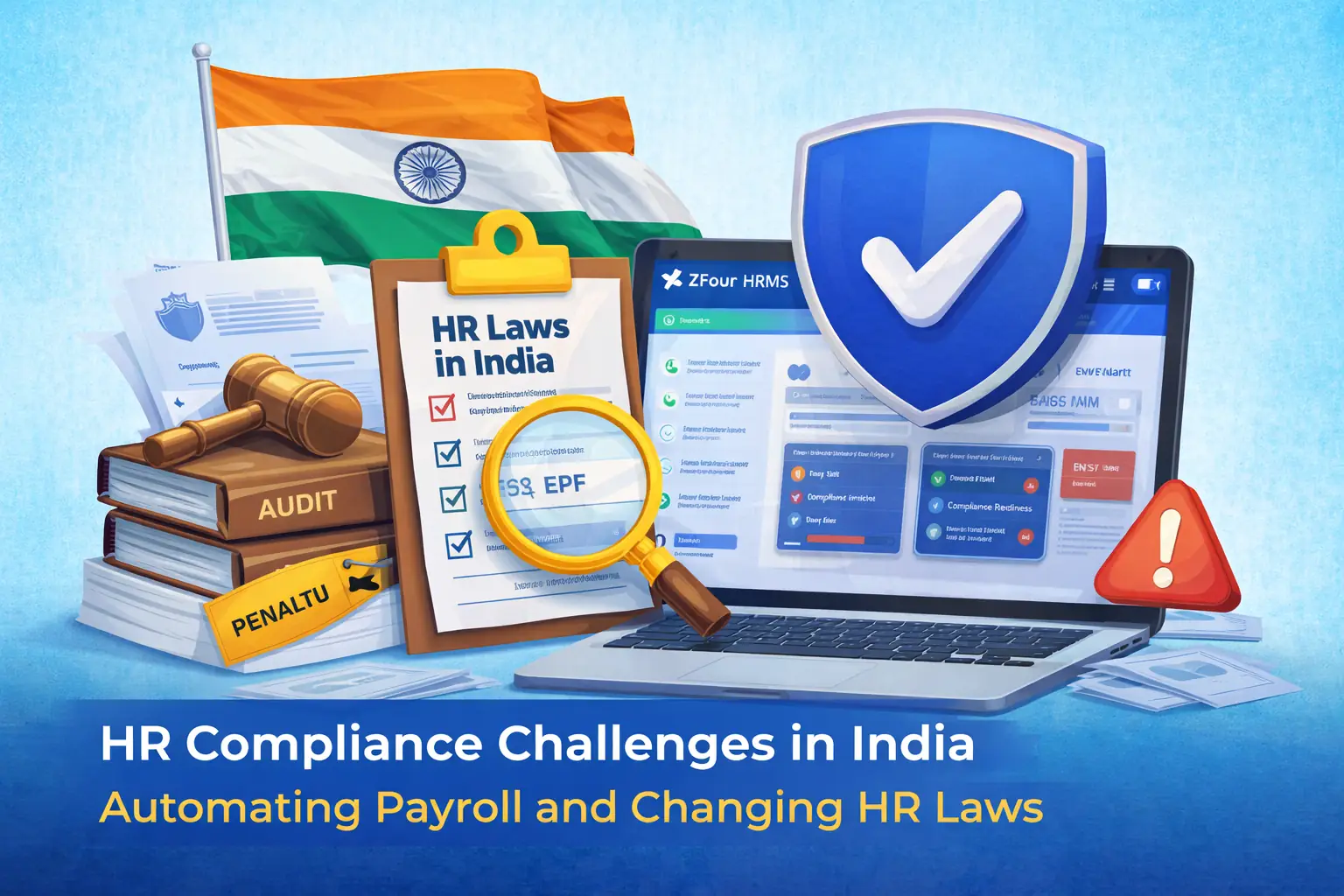
HR compliance becomes harder to manage when employee information, approvals, documents, payroll inputs, and HR records are maintained across disconnected systems.
HRMS software for HR law compliance can help businesses organize these HR processes within a structured digital environment. Instead of treating compliance as a separate administrative activity, organizations can connect relevant employee data, workflows, approvals, records, and reporting processes.
The purpose of an HRMS is not to interpret labour law or guarantee compliance. Its role is to help HR teams maintain consistent information, documented workflows, controlled access, and organized records that support compliance-related processes.
This guide explains how HRMS software can support HR compliance workflows in India and what businesses should evaluate before implementing one.
Important: HR and labour requirements can vary based on the establishment, employee category, location, industry, and applicable law. This article is an HR technology guide, not legal advice. Verify current requirements with the relevant government authority or a qualified professional where necessary.
What Does HR Compliance Mean for HR Teams?
HR compliance involves managing HR processes according to the employment, wage, workplace, social-security, documentation, and data requirements applicable to an organization.
The specific requirements can depend on factors such as:
Employee strength
Industry
Establishment type
State or location
Employee category
Wage structure
Working arrangements
Applicable legislation
For HR teams, compliance administration means maintaining accurate information, following appropriate processes, documenting relevant activities, and reviewing requirements that apply to the organization.
For current labour-law resources, employers can refer to the Ministry of Labour & Employment's Labour Codes resources.
How Does HRMS Software Support HR Compliance?
HRMS software does not replace legal or HR responsibility.
Instead, it provides a structured environment for managing information and workflows that may support compliance-related activities.
A typical HR workflow can be represented as:
Employee Data → HR Workflow → Approval → Record → Report
When these activities are managed separately, HR teams may need to repeatedly reconcile information.
An HRMS can help connect relevant processes and reduce unnecessary manual handling.
It can support:
Centralized employee records
HR workflows
Attendance records
Leave records
Payroll workflows
Employee documentation
Approval processes
Reports
Access controls
Audit trails
1. Centralized Employee Records
Employee information is the foundation of many HR processes.
An HRMS can maintain information such as:
Employee profile
Joining date
Department
Designation
Employment status
Salary information
Bank details
Documents
Reporting structure
Work location
Why It Matters
When employee information is maintained across multiple spreadsheets and systems, inconsistencies can occur.
A centralized employee record provides authorized HR users with a consistent source of information and can reduce duplicate data entry.
2. HR Records and Working-Time Data
Attendance and working-time information can become important inputs for payroll and other HR workflows.
Depending on the platform, HRMS software may help maintain:
Attendance records
Shift information
Working-time records
Overtime records
Attendance approvals
Attendance reports
Why It Matters
Consistent working-time records can help HR teams review relevant employee information and use it as an input for connected HR processes.
For a practical attendance workflow, see How to Mark Attendance in ZFour HRMS
3. Payroll Workflow and Statutory Inputs
Payroll is one of the HR workflows that can benefit from centralized employee data and structured approvals.
Depending on the platform, HRMS software may support:
Salary calculations
Earnings and deductions
Payroll records
Payslips
Payroll reports
Statutory-related workflows
This article focuses on how HRMS supports compliance processes, rather than explaining individual payroll laws or statutory calculations.
For detailed PF, ESI, wages, overtime, and payroll requirements, see Payroll Compliance in India 2026
Why It Matters
Centralized payroll workflows can help HR teams maintain consistent payroll information and reduce unnecessary manual handling.
4. Leave Records and Approval Workflows
An HRMS can centralize:
Leave balances
Leave requests
Approval status
Leave history
Configured leave policies
Why It Matters
Centralized leave records make employee information easier to review and reduce reliance on email chains and spreadsheets.
Businesses should configure leave policies according to the requirements applicable to their workforce.
5. Employee Documentation
HR teams may need to maintain different types of employee records and documents.
An HRMS can help organize:
Employment documents
Employee records
Payslips
Policy acknowledgements
HR forms
Attendance records
Leave records
Why It Matters
A structured document-management process makes relevant information easier for authorized users to locate and review.
The exact documents and retention requirements applicable to a business should be verified according to the relevant requirements.
6. Compliance-Related Reports
HRMS platforms can generate reports using information stored within the system.
Depending on the platform, these may include:
Employee reports
Payroll reports
Attendance reports
Leave reports
Salary reports
Statutory-related reports
Why It Matters
Structured reporting can help HR teams identify missing or inconsistent information before completing an administrative or compliance-related process.
7. Approval Workflows and Audit Trails
Many HR processes involve multiple approvals.
For example:
Employee Request → Manager Approval → HR Review → Final Action
An HRMS can provide digital workflows for activities such as:
Leave approvals
Attendance regularization
Employee requests
Payroll changes
HR approvals
Where supported, audit trails can record relevant administrative actions and changes.
Why It Matters
A structured approval process can make HR operations more traceable than informal email or paper-based processes.
8. Role-Based Access to HR Data
HRMS platforms contain sensitive employee information.
Access should therefore be based on the user's responsibilities.
For example:
Employees → their own information
Managers → relevant team information
HR → broader employee records
Payroll administrators → relevant payroll information
Useful controls may include:
Role-based permissions
Authentication
Access restrictions
Audit logs
Approval controls
Why It Matters
Appropriate access controls can reduce unnecessary exposure of employee information and make administrative responsibilities clearer.
9. Employee Self-Service
Employee self-service allows employees to access relevant HR information and complete routine requests themselves.
Depending on the platform, employees may be able to:
View payslips
Check attendance
Apply for leave
Submit HR requests
Update permitted information
Access documents
For more information, see Employee Self-Service Portal in Noida: HRMS Guide 2026.
Why It Matters
Self-service can reduce routine HR queries and give employees greater visibility into their own information.
10. Multi-Location Employee Data
Businesses operating across multiple locations need accurate employee work-location information when managing location-specific HR processes.
An HRMS can help maintain:
Employee location
Department
Worksite
Branch
Payroll information
Location-specific configurations where supported
For detailed state-level payroll considerations, see Multi-State Payroll Compliance in India: The 2026 Reality.
This article does not reproduce state-wise payroll rules because those requirements are a separate topic.
11. Compliance Reminders and Workflow Notifications
Some HRMS platforms provide reminders and notifications for administrative activities.
These may relate to:
Pending approvals
Missing information
Employee requests
Document expiry
Payroll activities
Workflow deadlines
Why It Matters
Reminders can help HR teams manage recurring processes more consistently.
However, a software reminder is not proof of legal compliance. HR teams still need to verify the underlying requirement and information.
12. Data Protection and HRMS Security
Employee records contain personal and employment information.
When evaluating HRMS software, businesses should ask about:
Access controls
Authentication
Encryption
Backups
Data storage
Audit logs
Data retention
Data deletion
Vendor security practices
Businesses should also consider applicable data-protection requirements and review the relevant official framework.
For India-specific context, businesses can review the Digital Personal Data Protection Act, 2023.
Why It Matters
Compliance is not only about payroll or HR processes. Organizations also need appropriate controls around employee information.
HRMS Software vs Manual HR Compliance Processes
Area | Manual Process | HRMS-Based Process |
|---|---|---|
Employee records | Multiple files | Centralized records |
Attendance | Spreadsheets/devices | Centralized attendance data |
Leave | Email/spreadsheets | Digital workflows |
Payroll inputs | Manual consolidation | Connected workflows |
Documents | Distributed folders | Centralized digital records |
Approvals | Email/paper | Configured workflows |
Reports | Manual preparation | System-generated reports |
Access | Shared files | Role-based access |
Audit trail | Difficult to track | Available where supported |
The objective is not to automate every legal decision.
It is to create more structured, consistent, and traceable HR processes.
What Should Businesses Check Before Choosing HRMS Software for Compliance?
Don't select an HRMS simply because its website says “compliance.”
Ask the provider specific questions.
1. What Compliance Workflows Are Supported?
Ask the provider to demonstrate the actual workflow rather than relying only on a feature list.
2. Which Calculations and Reports Are Automated?
Confirm exactly which processes, calculations, and reports are supported.
3. How Are Regulatory Updates Handled?
Ask how the provider communicates and implements relevant system or configuration updates.
4. Can the System Handle Multiple Locations?
This is particularly important for organizations operating across different locations or states.
5. Can Records Be Exported?
Check whether relevant employee, payroll, attendance, and reporting information can be exported when required.
6. Is There an Audit Trail?
Determine which changes, approvals, and administrative activities are recorded.
7. How Is Employee Data Protected?
Review access controls, security measures, storage, backups, and vendor practices.
8. What Does Implementation Involve?
Ask about:
Data migration
Configuration
Testing
Employee setup
Training
Support
ZFour HRMS for Compliance-Oriented HR Workflows
ZFour HRMS provides HR and payroll capabilities that can support structured HR workflows, including:
Employee management
Payroll
Attendance
Leave management
Employee self-service
Payroll-related reporting
Access controls
Workforce management
The platform should be evaluated against the organization's specific workforce, processes, locations, security requirements, and compliance needs.
Explore ZFour HRMS Solutions to review the platform's current capabilities.
Final Thoughts
HRMS software can make HR compliance administration more structured, but software should support compliance—not be treated as a substitute for compliance responsibility.
Businesses should first identify the HR processes that create the most manual work or operational risk. They can then evaluate HRMS platforms based on the workflows, reports, controls, integrations, and support they require.
Before implementing an HRMS, verify applicable requirements using official government sources and ensure the system is configured appropriately for the organization.
For current labour-law information, employers should refer to the relevant resources published by the Ministry of Labour & Employment and other applicable government authorities. The Ministry's current Labour Codes resource includes the Codes, Central Rules, notifications and FAQs.
Explore ZFour HRMS
If you're evaluating HRMS software to organize employee records, payroll, attendance, leave, documentation, reporting, and related HR workflows, explore ZFour HRMS.
You can also review ZFour HRMS Solutions or Book a ZFour HRMS Demo to discuss your organization's requirements.
ZFour's current solutions page lists modules including payroll, attendance, leave management, performance, recruitment, HR analytics and other HR workflows.

Farheen Ahmed
HR Tech Content Strategist at ZFour Technology Private Limited
Research-driven content on HRMS, payroll, attendance management, employee management, and modern HR technology for Indian businesses.