16 min read
Quick answer
Security guard attendance management means recording, for every client site, which guard covered which post, on which shift, for how long, and proving it to both your payroll and your client. For a security agency the unit that matters is the post, not the guard: a post must be covered every shift, even when the rostered guard is absent.
A workable system has five parts: a post master for every client site, a roster with a relief pool for weekly offs and absences, attendance marked at the site by the guard (or by the supervisor where guards don’t have smartphones), a record of reliefs and double duties, and a monthly reconciliation that turns covered shifts into the client invoice and the guards’ wages. Under PSARA and the Labour Codes, agencies must also keep duty rosters, guard records and wage records that can be inspected.
Key takeaways
Track post coverage, not just guard attendance. A client pays for a covered post, and an empty post is a breach of contract.
Build a post master for every site: client, location, post, shift, required strength and billing rate.
Plan a relief pool. A post covered round the clock on 8-hour shifts needs about 3.5 guards once weekly offs are covered.
Record who actually covered each shift: reliefs and double duties drive both overtime pay and billing.
Reconcile attendance to the invoice every month, with the client’s sign-off, before raising the bill.
Keep PSARA duty rosters and guard records electronically, and be ready to show clients wage and statutory payment proof as the principal employer.
Why guard attendance is harder than it looks
A security agency’s workforce is spread across dozens or hundreds of client sites, most of them not the agency’s own premises. Guards work round the clock, in rotating shifts, with weekly offs that must be covered by someone else. Several things make attendance difficult:
No device at the post. Client sites rarely let an agency install its own biometric machine, and the client’s machine belongs to the client.
Reliefs and double duty. When a guard is absent, someone else covers the post, often by staying on from the previous shift.
Night shifts. A shift that starts at 10 pm and ends at 6 am crosses two calendar dates.
Billing depends on attendance. The client is invoiced for covered shifts or deployed guards; errors in attendance become disputes over money.
Regulation. The Private Security Agencies (Regulation) Act, 2005 (PSARA) and the rules under it require rosters and records, and clients increasingly ask for proof of wages and statutory payments.
Paper registers at the gate and phone calls from supervisors can’t keep up once an agency passes a few hundred guards.
The attendance unit is the post, not the guard
What a post is
A post is a defined duty position at a client site for a defined shift: “Main gate, Shift A (6 am–2 pm)”, “Basement parking, night shift”, “Reception, general shift”. A site may have one post or twenty.
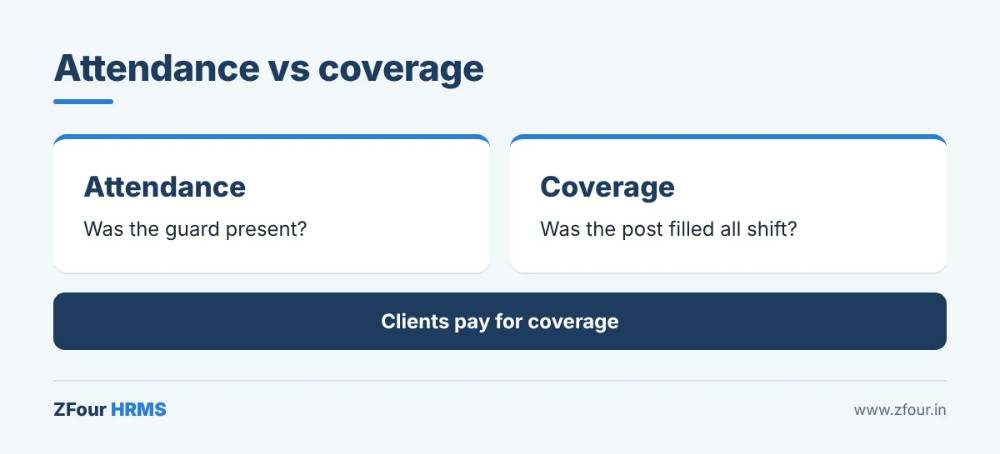
Coverage vs attendance
Attendance answers: was this guard present?
Coverage answers: was this post filled for the whole shift?
A guard can be present and the post still uncovered (the guard was moved to another post), and a post can be covered while the rostered guard is absent (a reliever stepped in). Clients care about coverage; payroll cares about attendance. Your system has to record both.
Building the post master
Before rosters or attendance, list every post. One row per post per shift:
Field | Example |
|---|---|
Client | ABC Logistics Pvt Ltd |
Site | Bhiwandi warehouse 3 |
Post | Main gate |
Shift | A: 6:00 am–2:00 pm |
Required strength | 2 guards |
Grade | Security guard (unarmed) |
Billing basis | Per guard per month |
Site geo-fence / QR checkpoint | Yes / Yes |
Contract start and end | 1 Apr 2026 – 31 Mar 2027 |
Every other part of the system — rosters, attendance, reliefs, billing — hangs off this table. Keep it current when contracts start, change or end.
Rosters for posts that never close
Common shift patterns
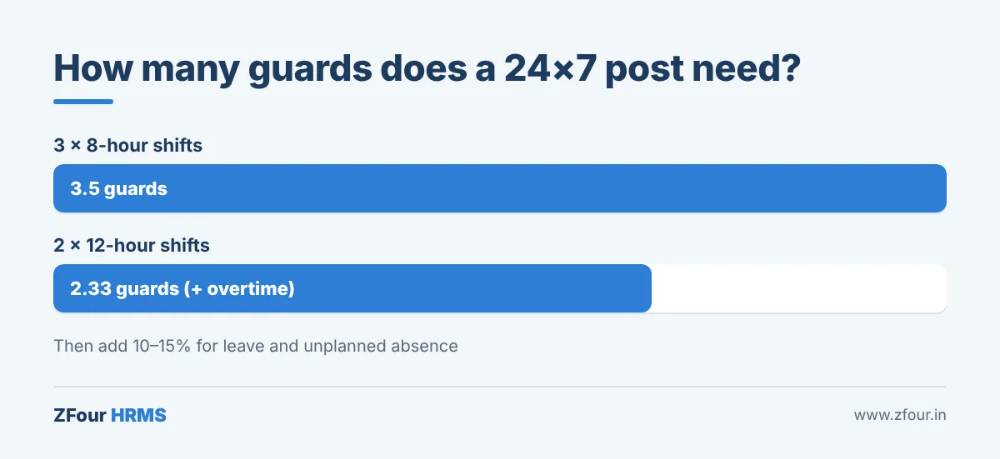
Three 8-hour shifts
Shift A (6 am–2 pm), Shift B (2 pm–10 pm), Shift C (10 pm–6 am). This fits the 8-hour daily limit under the Labour Codes and needs more guards.
Two 12-hour shifts
Day (8 am–8 pm) and night (8 pm–8 am). Common in the industry because it needs fewer guards, but every hour beyond the daily limit is overtime, which needs the guard’s consent and is paid at twice the ordinary rate of wages.
12-hour shifts and the law
Under the OSH Code, no worker should work more than 8 hours a day without overtime, and no more than 6 days a week. States set their own rules on spread-over and overtime limits. If your agency runs 12-hour shifts, price the overtime into your client rates and get your legal adviser to confirm your state’s rules. For the general rules on field and shift hours, see working hours for field employees.
Pricing the overtime into client rates
Illustrative. On a 12-hour shift, 4 hours a day are beyond the 8-hour limit. Over 26 duty days that is 104 overtime hours a month per guard, paid at twice the ordinary hourly rate. If a guard’s ordinary hourly rate is ₹80, the overtime alone is about ₹16,640 a month. A client rate quoted as if 12-hour duties were ordinary hours under-recovers that cost on every guard, every month.
Weekly offs and the relief pool
Every guard is entitled to a weekly off, but the post doesn’t close. You need relievers.
Working out how many guards a post needs
Illustrative calculation. Your numbers will depend on leave, absenteeism and your state’s rules.
A post covered 24 hours a day, 7 days a week:
Shift pattern | Shifts per week | Shifts one guard works per week | Guards needed per post |
|---|---|---|---|
3 × 8-hour shifts | 21 | 6 | 3.5 |
2 × 12-hour shifts | 14 | 6 | 2.33 |
Add a margin for leave and unplanned absence (10% to 15% is a reasonable starting point; adjust it once you have a few months of your own absence data) and you have the size of your relief pool. Agencies that skip this step end up covering absences with double duties, which drives overtime, fatigue and complaints.
Organising relievers
Site-based relievers for large sites with many posts.
Cluster relievers who cover several nearby small sites.
A reliever roster published a week ahead, so weekly offs are covered before the week starts.
Night shifts that cross midnight
Decide which date a night shift belongs to: most agencies attach it to the date the shift starts. Your attendance system must treat a punch-out at 6 am on Tuesday as the end of Monday’s night shift, not as a new day. If it doesn’t, night guards appear as absent on one day and present on another, and both payroll and billing go wrong.
How many guards does your site need?
How many guards does your site need?
Enter your posts and shift pattern. The relief calculator shows how many guards each 24×7 post needs, including weekly offs and a leave margin.
Free template for security agencies. Not legal advice. We only use your details to send the file and related HR guides.
Marking attendance at client sites
The options
Method | How it works | Best for | Watch out for |
|---|---|---|---|
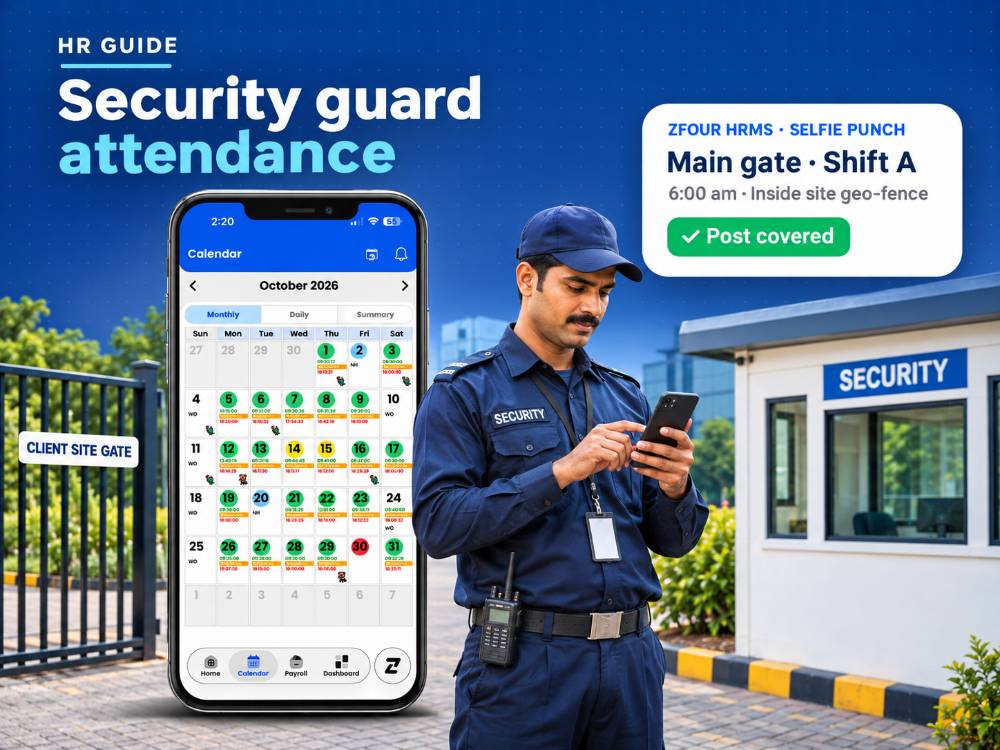
Mobile punch with selfie at the site | Guard punches in on the app inside the site’s geo-fence | Guards with smartphones | Indoor GPS at basements; size the fence well |
Supervisor marks team attendance | Supervisor marks each guard present with a photo at the post | Guards without smartphones | Supervisor must visit every post at shift change |
Shared site device | One phone or tablet at the site, each guard punches with a selfie | Large sites with many guards | Device custody and charging |
QR code at the post | Guard scans the post’s QR code at start and during the shift | Proving presence at a specific post | QR codes must be fixed and replaced if copied |
Client’s biometric machine | Data shared by the client | Sites where the client insists | You depend on the client to share data on time |
Most agencies use two or three of these together: mobile punch for guards with phones, supervisor marking for those without, and QR checkpoints at critical posts. How location-based punches work, and how to size a geo-fence for a site, is covered in geo-tagging vs geo-fencing vs live tracking.
When the client restricts phones on site
Data centres, pharmaceutical plants, defence suppliers and some banks don’t allow phones beyond the gate. Mobile punches still work if you plan for it:
Punch at the entry point: place the geo-fence and QR code at the security cabin or gate, before the phone is deposited.
Use the client’s access-control data: some clients will share entry and exit logs from their own system each day; agree the format and timing in the contract.
Supervisor confirmation for posts deep inside the premises, recorded at shift change.
Write the method into the site’s post instructions so every new guard and reliever follows the same process. Review it with the client’s security or administration head at the start of the contract, and again whenever the client changes its site rules, so the agency is never surprised by a new restriction on day one of a shift.
When the client wants its own biometric records
Some clients require guards to punch on the client’s biometric machine. Accept it, but agree three things in the contract: the client shares the data daily or weekly, in a fixed format; the agency’s own records are used where the client’s data is missing; and disputes are settled on both sets of records. Keep your own punch as well, so billing never depends entirely on someone else’s system.
Guards without smartphones
Many guards still use basic phones. Don’t build a system that excludes them:
Let the supervisor mark attendance with a photo of the guard at the post at the start of each shift.
Or keep a site device for guards to punch on.
Record which method was used for each punch, so you can see where to improve.
Proving the post stayed covered
Attendance at the start of a shift doesn’t prove the guard stayed. For posts where it matters, add:
Patrol checkpoints: QR codes at points the guard must scan on each round.
Random presence checks: a selfie requested at an unannounced time during the shift.
Supervisor rounds: night supervisors recording visits to each post.
These checks are about evidence of coverage for the client. For controls against buddy punching and fake attendance generally, see how to stop proxy attendance.
Reliefs, double duty and absenteeism
When a guard doesn’t turn up
Set a clear escalation with times, so a missing guard is noticed before the post is empty for hours:
Shift start + 15 minutes: no punch from the rostered guard → alert to the site supervisor.
+30 minutes: supervisor calls the guard and the reliever on standby.
+60 minutes: the outgoing guard is asked to stay (with consent, as overtime) until the reliever arrives.
Same day: the absence is recorded, and the client is informed if the post was uncovered at any point.
Double duty
A double duty is when a guard works two consecutive shifts. It is sometimes unavoidable, but:
it is overtime, which needs the guard’s consent and is paid at twice the ordinary rate
it causes fatigue, which is a real security risk on the second shift
it should be capped (for example, no more than two double duties in a week for any guard) and reported weekly
Recording who actually covered each shift
For every shift, record the rostered guard, the guard who actually covered it, and the hours. This one record drives three things:
Record | Used for |
|---|---|
Rostered guard absent | Leave or loss of pay in payroll |
Reliever present | Reliever’s wages and overtime |
Post covered (by anyone) | Client billing |
From attendance to the client invoice
How guard billing usually works
Security contracts are commonly billed in one of three ways:
Per guard per month: a monthly rate per deployed guard, based on 26 or 30 duty days.
Per shift or per duty: a rate for each 8- or 12-hour duty performed.
Per post per month: a fixed rate to keep a post covered round the clock, with the agency managing reliefs.
The rate usually includes wages, statutory contributions (PF, ESI, bonus), uniforms, relief cost, supervision and the agency’s margin.
The monthly reconciliation
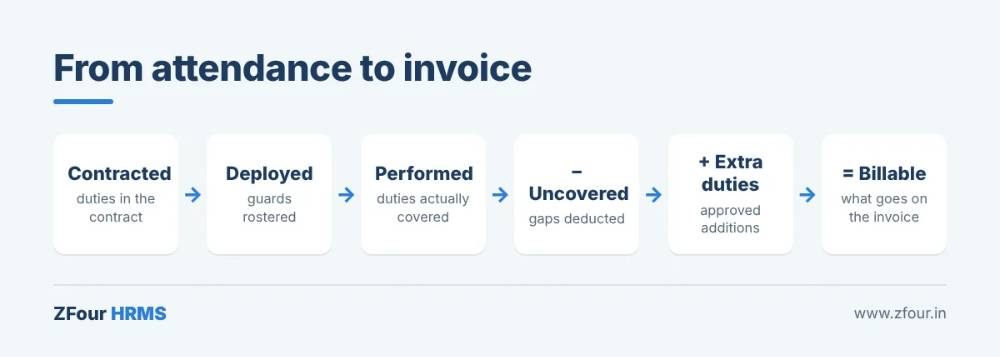
Before raising the invoice, reconcile three numbers for each site:
Contracted: the duties or guards the client ordered.
Deployed: the duties rostered.
Performed: the duties actually covered, from attendance.
An illustrative reconciliation
Illustrative figures only.
Site | Contracted duties | Performed duties | Uncovered duties | Extra duties requested by client | Billable duties |
|---|---|---|---|---|---|
Warehouse 3, main gate | 186 | 184 | 2 | 0 | 184 |
Warehouse 3, parking | 93 | 93 | 0 | 6 (stock audit) | 99 |
Office tower, reception | 62 | 62 | 0 | 0 | 62 |
Uncovered duties are usually deducted, and extra duties requested in writing by the client are billed separately.
What to attach to the invoice
Clients approve invoices faster when the evidence comes with them. Attach a one-page coverage summary for each site (posts, shifts, performed and uncovered duties), the list of extra duties with the client’s written requests, and, for clients who ask, the wage register and PF and ESI challan references for the month. Send the same pack every month in the same format, so the client’s accounts team learns where to look and stops raising queries.
Avoiding billing disputes
Share a monthly coverage report with the client before the invoice: post by post, shift by shift.
Get written requests for extra duties.
Ask for sign-off on the coverage report within a fixed number of days.
Keep the evidence: punches, photos and supervisor records for every duty billed.
PSARA records and attendance
Summary for general information.
Under PSARA and the Private Security Agencies Central Model Rules, 2020, agencies must keep records that overlap heavily with attendance:
Registers of management, guards, supervisors and clients (section 15 of PSARA). The Model Rules require an electronic register covering guards and supervisors, customers, service locations and duty rosters, including salary, ESI and EPF details.
Duty rosters recording the guard’s name, place of duty, whether arms were issued, and start and end times.
Supervision: generally one supervisor for no more than fifteen guards, or one for every six where guards are at separate premises (rule 10 of the Model Rules).
Photo identity cards displayed on duty, training before deployment, and an annual medical examination.
States have their own private security agency rules, so check your state’s version. When your attendance system already holds rosters, posts, supervisors and duty times, producing these records is a report, not a separate register.
Contract labour: what your clients need from you
To your client, your guards are contract labour, and the client is the principal employer. Under the OSH Code and the Central Rules, 2026:
A contractor engaging 50 or more contract workers generally needs a licence.
Wages must be paid within the time limit, electronically where practicable.
If the contractor doesn’t pay wages on time, the principal employer must pay and recover the amount from the contractor (rule 98(8) of the OSH Central Rules).
Principal employers file an annual return covering contractors, wage bills and statutory contributions.
This is why large clients ask agencies for monthly attendance, wage registers and PF and ESI challans. An agency that can send these with the invoice wins renewals more easily than one that sends them only after reminders. For monthly statutory due dates, see the payroll compliance calendar 2026-27.
Wages, overtime and deductions for guards
Minimum wages for security guards differ by state, by zone (city category) and by grade (unarmed guard, armed guard, supervisor). Rates are revised periodically, so check the current notification for every state you operate in. See minimum wages state-wise.
Overtime for 12-hour shifts and double duties is paid at twice the ordinary rate of wages.
PF and ESI apply to guards’ wages under the usual thresholds.
Weekly offs worked need a compensatory off or overtime.
Paying guards accurately depends entirely on the attendance record: which duties were worked, which were double duties and which were weekly offs.
Starting a new client site: a checklist
Most attendance problems at a site start in its first week. Before the first guard reports:
Create the posts in the post master, with shifts, required strength and billing basis from the contract.
Set the site geo-fence (or fences, for large campuses) and fix QR codes at critical posts.
Assign the roster for the first four weeks, including weekly offs and named relievers.
Name the site supervisor and their backup, and give them supervisor access in the app.
Brief the guards: how to punch, what to do if a punch fails, who to call if the reliever doesn’t arrive.
Agree the reporting rhythm with the client: the monthly coverage report, the sign-off deadline and how extra duties are requested.
Test on day one: check that every guard’s punch appears against the right post and shift.
Guard records that feed attendance
Attendance is only as reliable as the guard master behind it. For every guard, keep:
Identity and verification
Name, photograph, identity documents, address, police or antecedent verification status and date, and employee number. A guard whose verification is pending shouldn’t be rostered.
Training and medical
Date of PSARA training completion and the annual medical examination. Set reminders for medical renewals so guards don’t lapse while deployed.
Deployment history
Every site and post the guard has worked at, with dates. This answers client questions (“who was on our night shift on the 14th?”) and supports PSARA records.
Pay details
Grade, wage rate by state and zone, PF and ESI numbers, and bank account for electronic salary payment.
Keeping guards informed
Guard attrition is high across the industry, and pay confusion is a common reason guards leave. Clear attendance helps keep them:
Show guards their own attendance in the app, duty by duty, so they can spot errors before payroll.
Show overtime and double duties separately, so guards can see they were paid for them.
Send payslips in the guard’s language: Hindi and English at minimum.
Pay on time, every month. It is the single biggest retention factor, and it depends on attendance being closed quickly.
The monthly report for agency owners
Report | What it tells you |
|---|---|
Post coverage % by client | Whether you’re delivering what the client pays for |
Uncovered duties | Revenue lost and contract risk |
Reliever usage | Whether the relief pool is big enough |
Double duties per guard | Fatigue risk and overtime cost |
Overtime hours and cost by site | Sites priced too low for their shift pattern |
Billing variance (contracted vs performed) | Disputes to resolve before invoicing |
Verification, training and medical due dates | PSARA compliance gaps |
Attendance method by site | Where supervisor marking is still used and could move to mobile punches |
Mistakes to avoid
Tracking guards but not posts: you can’t tell the client whether their gate was covered.
No relief pool: absences become double duties, overtime and fatigue.
Night shifts split across two dates: wrong attendance, wrong pay, wrong bills.
Billing from the roster instead of attendance: the client pays for duties that weren’t performed, until they find out.
Ignoring guards without smartphones: supervisors end up writing attendance from memory.
No proof of wages for the principal employer: renewals stall while the client chases documents.
12-hour shifts priced as if there were no overtime: margins disappear.
An illustrative example
This is an illustrative scenario, not a customer case study.
A security agency in the NCR with 420 guards across 63 client sites ran attendance on paper registers kept at each site. Supervisors collected the registers at month end, and the back office typed them into spreadsheets for payroll and billing. Invoices went out on the 12th of the following month, and three large clients disputed bills every month.
The agency built a post master of 148 posts, moved guards with smartphones to mobile punches with a selfie inside each site’s geo-fence, and had supervisors mark attendance with photos for the rest. Reliefs and double duties were recorded against each shift, and a coverage report was shared with each client on the 2nd of the month.
Within two months, invoices went out by the 4th, disputes dropped to occasional queries, and the reports showed that four sites were running permanent double duties because the relief pool was too small. The agency hired five relievers and renegotiated rates for two sites priced on 8-hour shifts but run on 12-hour shifts.
How ZFour HRMS supports security agencies
Mobile punch with selfie inside each client site’s geo-fence, included in every plan.
Supervisor-marked attendance for guards without smartphones.
Rosters and shifts, including night shifts that cross midnight.
Payroll with PF, ESI and PT, and overtime for double duties.
Hindi and English app for guards and supervisors.
See HRMS for security services.
See post-wise attendance and billing reports for your sites
A 30-minute demo, set up with your own teams and sites.
Sources and further reading

Farheen Ahmed
HR Tech Content Strategist at ZFour Technology Private Limited
Research-driven content on HRMS, payroll, attendance management, employee management, and modern HR technology for Indian businesses.