16 min read
Quick answer
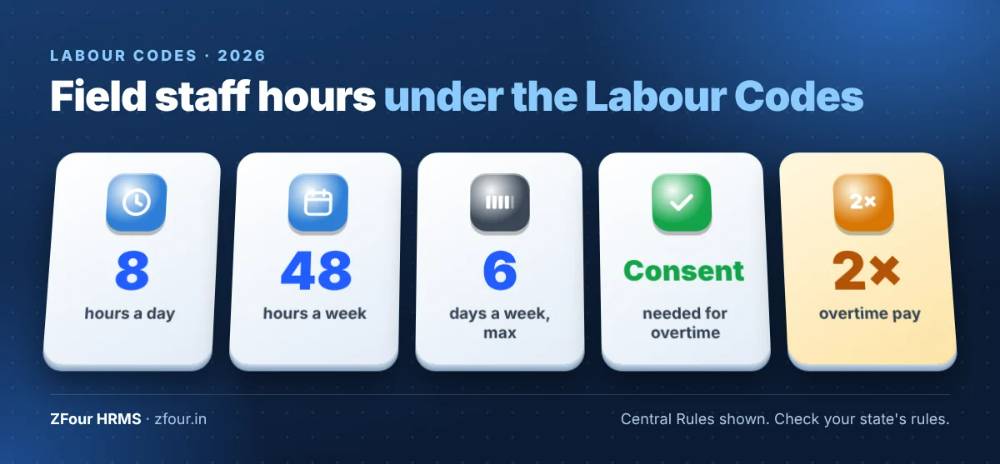
Field employees in India are covered by the same working-hours limits as other workers. Under the Labour Codes, in force since 21 November 2025, a worker can’t be required to work more than eight hours a day or more than six days a week. The Central Rules set a 48-hour weekly limit, and overtime needs the worker’s consent and is paid at twice the ordinary rate of wages. Sales promotion employees, who used to have their own Act, are now covered as workers under the Occupational Safety, Health and Working Conditions Code. The harder question for field teams is what counts as working time: when the day starts, whether travel between customers counts (it should), and how home-to-first-visit travel is treated. Indian law doesn’t spell this out for field staff, so write a clear policy, use punch and visit records as the hours record, and get your legal adviser to confirm the rules for your state.
Key takeaways
The Sales Promotion Employees Act, 1976 has been repealed. Field sales staff are now covered as workers under the Labour Codes, except supervisors above the wage threshold and managerial or administrative staff.
Hours limits: 8 hours a day under the OSH Code, 48 hours a week under the Central Rules, no more than 6 days a week. State rules apply to most private employers, so check yours.
Overtime needs consent and is paid at twice the ordinary rate.
Travel between work locations during the day is working time. Home-to-first-visit and last-visit-to-home travel is the grey zone, so decide it in writing.
Punch-in, punch-out and visit records are your best evidence of hours worked. Keep them for at least the period your registers require.
Why field hours are hard to count
Office hours are easy to see: the employee arrives, works and leaves. A field employee’s day is spread across the road, customers’ premises, distributors’ godowns and waiting rooms. Several questions don’t have obvious answers:
Does the day start when the rep leaves home, or at the first customer?
Is the hour spent waiting for a doctor or a purchase manager working time?
Is the drive back from the last visit part of the day?
What about a day spent travelling to another city for tomorrow’s meetings?
If the rep takes a long lunch between visits, who decides what counts?
Getting this wrong has two costs. Undercounting hours risks unpaid overtime claims and disputes under the Labour Codes. Overcounting, or not recording hours at all, means paying for time that wasn’t worked and having no evidence when questions are asked.
What the law says in 2026
For the general rules on the 48-hour week and 12-hour shifts, see our guide to the new labour law: 48 hours a week and 12-hour shifts. This section covers only what matters for field employees.
This section is general information reviewed by our legal adviser. It is not legal advice for any specific establishment.
Field sales staff under the Labour Codes
Until November 2025, many field sales staff were covered by the Sales Promotion Employees (Conditions of Service) Act, 1976, which applied mainly to pharmaceutical companies and a handful of notified industries. That Act has been repealed. Sales promotion employees are now covered as “workers” under the Occupational Safety, Health and Working Conditions Code, 2020 (the OSH Code), across all establishments the Code covers, and the OSH (Central) Rules, 2026 replaced the old Sales Promotion Employees Rules.
Two groups are generally outside the “worker” definition: people employed mainly in a managerial or administrative capacity, and supervisors earning above the wage threshold (₹18,000 a month). Area managers and regional heads may fall outside; most reps, merchandisers, service technicians and collection agents fall inside.
The hours limits
Rule | Limit | Source |
|---|---|---|
Daily hours | No worker to be required or allowed to work more than 8 hours a day | OSH Code, section 25(1)(a) |
Weekly hours | 48 hours a week | OSH (Central) Rules, 2026, rule 64 |
Days per week | No more than 6 days in any week | OSH Code, section 26 |
Spread-over and rest intervals | Set by the appropriate Government | OSH Code, section 25(1)(b) |
Overtime
Consent: overtime can be required only with the worker’s consent (OSH Code, section 27).
Rate: twice the ordinary rate of wages, for work beyond 8 hours a day or 48 hours a week (OSH (Central) Rules, rule 69(1)).
Rounding: under the Central Rules, a fraction of 15 to 30 minutes counts as half an hour, and more than 30 minutes counts as an hour (rule 69(2)).
Quarterly cap: the Central Rules set a cap of 144 overtime hours in a quarter. Sources differ on whether this applies to all establishments or only to some sectors, such as mines, docks and construction.
Central rules or state rules?
The Central Rules apply only where the Central Government is the “appropriate Government”: for example, banking and insurance, railways, mines, telecom and central public sector undertakings. Most private employers — FMCG distributors, pharma companies, service businesses, NBFCs, security agencies — fall under their State Government’s rules under the Codes, which can differ on spread-over, rest intervals and overtime caps.
Shops and establishments laws still matter
State shops and establishments laws were not among the laws replaced by the Labour Codes. Offices, shops and commercial establishments that employ field staff may still have to follow their state’s rules on opening hours, weekly holidays and registers.
When does a field employee’s day start and end?
This is the question your policy must answer first. There are three common models.
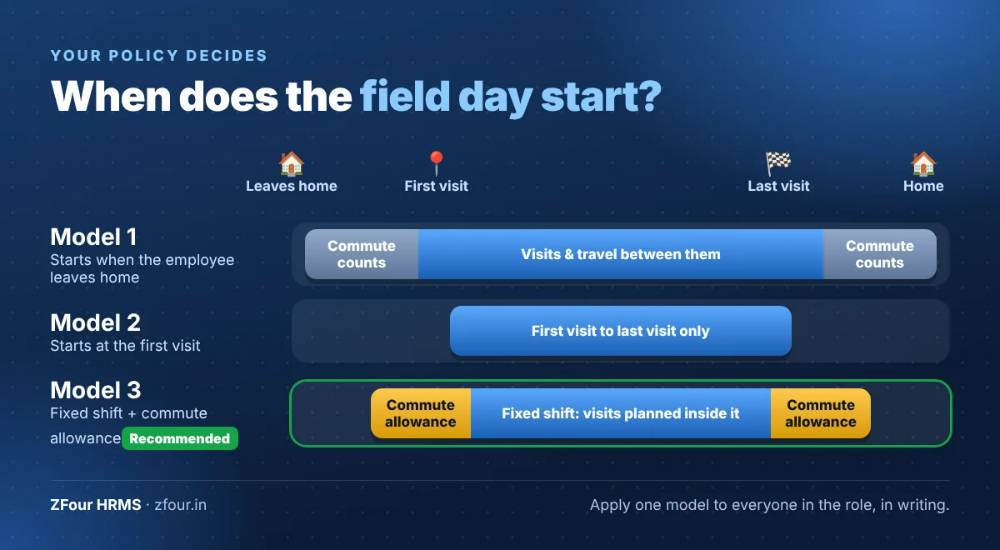
Model 1: the day starts when the employee leaves home
The employee punches in when leaving home and out on returning. Simple and generous; travel at both ends counts as working time.
Suits: roles with long, unpredictable first journeys (rural territories, service engineers called to the first job of the day).
Risk: employees who live far from their territory accumulate long hours that aren’t productive.
Model 2: the day starts at the first work location
The employee punches in at the first customer or work location and out at the last. Commute time doesn’t count.
Suits: urban beats where the first visit is close to home.
Risk: feels unfair when the first visit is far away, and employees may start the first visit later to compensate.
Model 3: a fixed shift with field work inside it
The employee has a fixed shift (for example, 9:30 am to 6:30 pm) and plans visits inside it. Travel within the shift counts; anything outside needs approval.
Suits: most field sales and service teams with planned beats.
Risk: needs a rule for visits that run past the shift end.
What Indian law says about commute time
Indian law doesn’t give a specific rule on whether a field employee’s travel from home to the first customer is working time. The general principle is that working time is time during which the employee is at the employer’s disposal and carrying out duties.
As a reference point from another jurisdiction, the Court of Justice of the European Union held in 2015 (the Tyco case, C-266/14) that, for workers with no fixed or habitual workplace, travel between home and the first and last customers counts as working time. That ruling doesn’t apply in India, but it shows how courts reason about workers whose job is travelling.
A practical recommendation
Many Indian employers use Model 3 with a fixed commute allowance: the shift has fixed start and end times, travel between work locations counts fully, and a reasonable first and last journey counts as part of the shift rather than as extra time. It is predictable for payroll, fair to employees and easy to explain. Whichever model you choose, apply it to everyone in the role and write it down. The same commute decision also affects travel reimbursement; see the travel allowance policy for field staff.
Is travel time working time? Situation by situation
Situation | Usually counted as working time? | Notes |
|---|---|---|
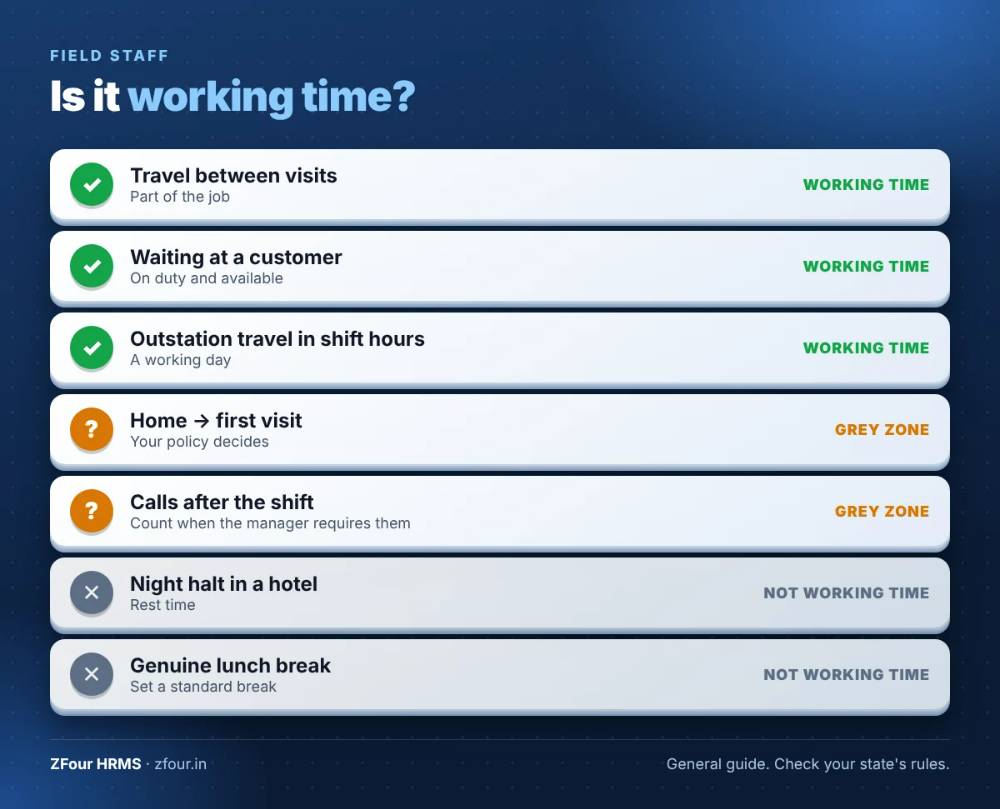
Travel between customers during the day | Yes | It’s part of the job |
Waiting at a customer’s premises for a meeting | Yes | The employee is on duty and available |
Home to first visit | Depends on your model | Decide in writing (see above) |
Last visit to home | Depends on your model | Same rule as the first journey |
Travel to another city for next day’s meetings, during the shift | Yes | Treat as a working day |
Same travel outside shift hours | Grey zone | Many employers count it up to normal shift length or give time off in lieu |
Night halt in a hotel, not working | No | Rest time, not working time |
Lunch break taken between visits | No, if it is a genuine break | Set a standard break in the policy |
Training on a weekly off | Yes | A working day; compensatory off or overtime applies |
Phone calls with customers from home after the shift | Grey zone | Discourage, or count when required by the manager |
Different field roles, different hours
The right hours rule depends on the work. A single policy can cover all field roles, with a short section for each.
Role | Typical day | Hours issue to settle |
|---|---|---|
Field sales and FMCG reps | Fixed beat of outlets, 9 am to 7 pm | Month-end closing days that run late |
Medical representatives | Doctor visits morning and evening, gap in the afternoon | Whether the afternoon gap is a break or working time |
Service engineers | Jobs assigned through the day, sometimes emergencies | Call-outs after shift and on weekly offs |
Collection agents | Visits to borrowers in set hours | Lender rules on contact hours, which also cap the working window |
Merchandisers and promoters | Fixed store hours, often weekends | Weekly off on a weekday, and store hours longer than 8 hours |
Mobile security supervisors | Night rounds across sites | Night work, rest between shifts |
For medical representatives, the classic pattern of morning clinic visits, an afternoon gap and evening visits is the hardest to fit into an 8-hour day. Many pharma companies treat the afternoon as a break in the policy, so the morning and evening sessions together make up the working day. Write it down so the rule is the same across territories.
Women in field roles working late
Field days often end after dark, especially in sales during month end. Under the OSH Code, women can work in all establishments and, with their consent, before 6 am and after 7 pm, subject to the conditions the appropriate Government sets on safety, holidays and working hours.
In practice, for women in field roles:
Get written consent for any regular work after 7 pm, and never make it a condition of the job without it.
Plan beats so the last visit ends well before dark where possible.
Provide safe travel for late finishes, as your state’s conditions require.
Share the live location only with the reporting manager and HR, and only during working hours, as a safety measure the employee has agreed to.
Breaks and rest intervals in the field
Field employees rarely take a formal break at a fixed time, but rest still matters, both legally and for safety on the road.
Set a standard break
Define a standard break (for example, 30 or 60 minutes) that is deducted from field hours automatically, whenever it is taken. This avoids arguing about when lunch happened.
Long gaps between visits
A two-hour gap between a 10 am and a 2 pm visit isn’t automatically a break. If the employee was travelling or waiting, it is working time. If the gap was personal time by choice, the policy can treat it as a break. Ask managers to plan beats that avoid long idle gaps rather than policing them.
Safe driving
Field employees on two-wheelers face real road risks when they rush. Policies that reward visit counts without regard to hours push people to ride fast and late. Set reasonable visit targets for the hours available.
Overtime for field staff
When field work becomes overtime
Field work becomes overtime when the employee works beyond 8 hours in a day or 48 hours in a week (or your state’s limits), with consent. For field staff, the usual triggers are:
visits that run beyond the shift because a customer kept them waiting
extra visits added by the manager late in the day
outstation travel outside shift hours
work on a weekly off, such as an event or a stock audit
Pre-approval and after-the-fact approval
Ask managers to approve overtime in advance where possible, and allow after-the-fact approval within a short window (for example, 2 working days) for genuine delays. Unapproved extra hours should still be recorded; whether they are paid is a matter for the policy and the law, so don’t simply ignore them.
For controls against inflated overtime claims, see how to stop proxy attendance. This guide covers only how genuine overtime is counted and paid.
Calculating overtime: an illustrative example
Illustrative figures only. The method for calculating the ordinary hourly rate is set by the applicable rules, so confirm it with your payroll adviser.
A field rep earns monthly wages of ₹24,000 and works 26 days a month, 8 hours a day.
Step | Calculation | Result |
|---|---|---|
Ordinary daily rate | ₹24,000 ÷ 26 | ₹923 |
Ordinary hourly rate | ₹923 ÷ 8 | ₹115.38 |
Overtime hourly rate | ₹115.38 × 2 | ₹230.77 |
Approved overtime in the month | 6 hours | — |
Overtime pay | 6 × ₹230.77 | ₹1,385 |
How rounding works
Under the Central Rules, if the rep worked 40 minutes beyond the day’s limit, it counts as one hour; 20 minutes counts as half an hour; under 15 minutes is not counted. State rules may differ.
Weekly offs and holidays
Field work on a weekly off or a holiday — an exhibition, a stock audit, a weekend camp — needs a rule: overtime, a compensatory day off, or both. Compensatory holidays should be given within a reasonable period. For work recorded away from the usual workplace, see on duty (OD) attendance.
Using attendance and visit data as your hours record
What records the law expects
Employers must keep registers of employees, attendance and wages. Under the Central Rules, the attendance register-cum-muster roll and the wages register may be kept electronically, for five years (rule 72). State rules have their own formats and periods.
Punches, visits and routes as evidence
For field staff, the strongest hours record is made up of:
the punch-in and punch-out times and locations
the visit log: arrival and departure at each customer
for roles with live tracking, the route between punch-in and punch-out
Together, these show when the day started and ended, where time was spent, and whether extra hours were genuine. They also protect employees: a rep who was kept waiting at a distributor’s godown until 8 pm has a record of it.
Track only working hours
Location should be recorded only between punch-in and punch-out, never after hours. If an employee forgets to punch out, the system should close the day automatically and flag it, rather than tracking through the night. For the rules on tracking, see is GPS tracking of employees legal in India?
Common situations and how to handle them
The customer kept the rep waiting
The waiting time is working time. If it pushed the day past the limit, approve the overtime or give time off in lieu, as the policy says.
The rep forgot to punch out
Close the day at the shift end or the last visit, flag it, and let the employee correct it within the correction window with the manager’s approval. Don’t count the night as working time, and don’t leave tracking running.
Outstation travel on a Sunday for Monday’s meetings
Decide in advance: many employers treat Sunday travel as a working day with a compensatory off, or schedule travel within working hours on Monday.
The rep finishes early
If the beat is completed by 3 pm, is the rest of the day owed? For roles paid for a shift, the policy can require the employee to report for further work, update records or start the next day’s planning. Avoid penalising efficient employees; review whether the beat is too light instead.
Calls after hours
Customer calls after the shift are common in sales. Discourage routine after-hours calls. When the manager requires them, count the time.
A field working-hours policy you can adapt
Replace the bracketed values and have your legal adviser review the policy for your state.
1. Scope
This policy applies to employees in [field sales, service, collections] who work mainly away from a fixed workplace.
2. Working hours
2.1 Normal hours
Normal working hours are [9:30 am to 6:30 pm], [6] days a week, including a [60]-minute break.
2.2 Start and end of the day
The working day starts at [punch-in at the first work location / shift start] and ends at [punch-out at the last work location / shift end].
Commute rule
[Travel from home to the first work location and from the last work location to home is / is not counted as working time. A fixed allowance of [x] minutes is included in the shift for these journeys.]
Outstation travel days
Travel to an outstation location within normal hours is a working day. Travel outside normal hours earns [compensatory time off / overtime] as per section 4.
3. Recording hours
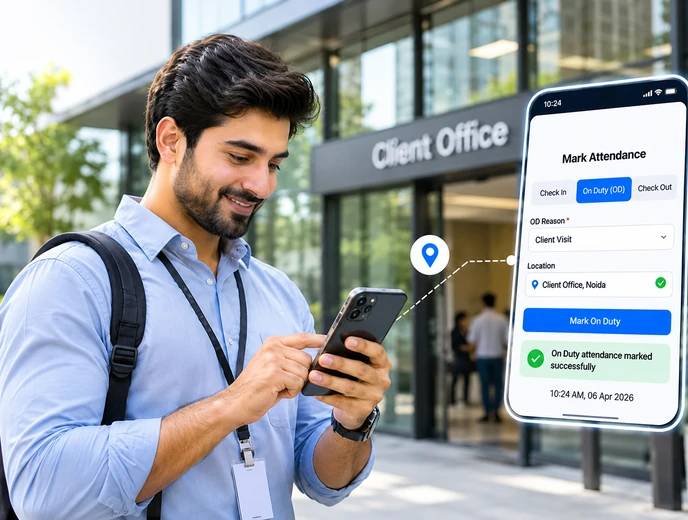
Employees mark attendance through the mobile app at the start and end of the working day and record each visit. Location is recorded only during working hours.
4. Overtime
Overtime requires the worker’s consent and the manager’s approval, in advance where possible and within [2] working days otherwise. Overtime is paid at twice the ordinary rate of wages, as required by law.
5. Weekly offs and holidays
Work on a weekly off or holiday earns [a compensatory day off within 30 days / overtime pay].
6. Corrections
Employees may correct a missing punch within [3] working days, with the manager’s approval.
Get the Field Staff Hours & Overtime Register
Get the Field Staff Hours & Overtime Register
Daily hours, overtime with rounding, consent and approval columns, and a monthly summary. Excel.
An Excel register with daily hours, overtime with rounding, and consent and approval columns.
Free template for HR teams. Not legal advice. We only use your details to send the file and related HR guides.
The monthly hours review
Report | What to look for |
|---|---|
Average daily hours by employee | Anyone regularly far above or below the team |
Days over the daily limit | Patterns by manager, route or customer |
Overtime hours vs approvals | Unapproved extra hours that need a decision |
Missing punch-outs | Employees who need help with the app |
Weekly offs worked | Compensatory offs owed and not yet given |
Long idle gaps between visits | Beats that need re-planning |
Mistakes to avoid
Assuming field staff are exempt from hours rules. Most reps and technicians are workers under the Codes.
No written start-and-end rule. Every dispute starts here.
Ignoring waiting time. It is working time.
Tracking location after hours because the employee forgot to punch out.
Paying overtime without consent or approval records, or not recording it at all.
Using only central rules when your establishment is governed by state rules.
Visit targets that can’t be met in the hours available, which push unsafe riding and unrecorded overtime.
An illustrative example
This is an illustrative scenario, not a customer case study.
A consumer electronics distributor in Maharashtra employed 70 field sales reps on two-wheelers. Hours were never recorded: reps reported visits on WhatsApp, and overtime didn’t exist on paper. After a group of reps raised complaints about routinely working until 9 pm on closing days, the company found it had no records to show what actually happened.
It moved to a fixed-shift model (Model 3) with mobile punch-in at the first visit, visit logs, and a 45-minute commute allowance included in the shift. Month-end closing days were planned as approved overtime with consent.
In the first quarter, the records showed that long days were concentrated in the last four days of each month and on two routes with distant distributors. The company split those routes, paid the remaining month-end overtime, and the complaints stopped.
How ZFour HRMS records field hours
Mobile punch-in and punch-out with location, so the start and end of each field day are recorded.
Visit logs with arrival and departure times.
Live tracking for roles that need it, at ₹100 per field user per month on any plan, recorded only between punch-in and punch-out.
Shift and roster rules, including breaks and automatic day closure when a punch-out is missed.
Overtime approvals and overtime calculation in payroll.
Electronic attendance and wage records for registers.
See overtime management and the complete guide to GPS attendance for field employees.
See field hours, overtime and payroll in one place
A 30-minute demo, set up with your own teams and sites.
Sources and further reading

Farheen Ahmed
HR Tech Content Strategist at ZFour Technology Private Limited
Research-driven content on HRMS, payroll, attendance management, employee management, and modern HR technology for Indian businesses.