17 min read
Quick answer
On 6 August 2026 the Reserve Bank of India issued nine sets of amendment directions on how lenders recover loans and engage recovery agents. They apply from 1 January 2027 to commercial banks, small finance banks, local area banks, regional rural banks, urban and rural co-operative banks, all-India financial institutions, most NBFCs and housing finance companies.
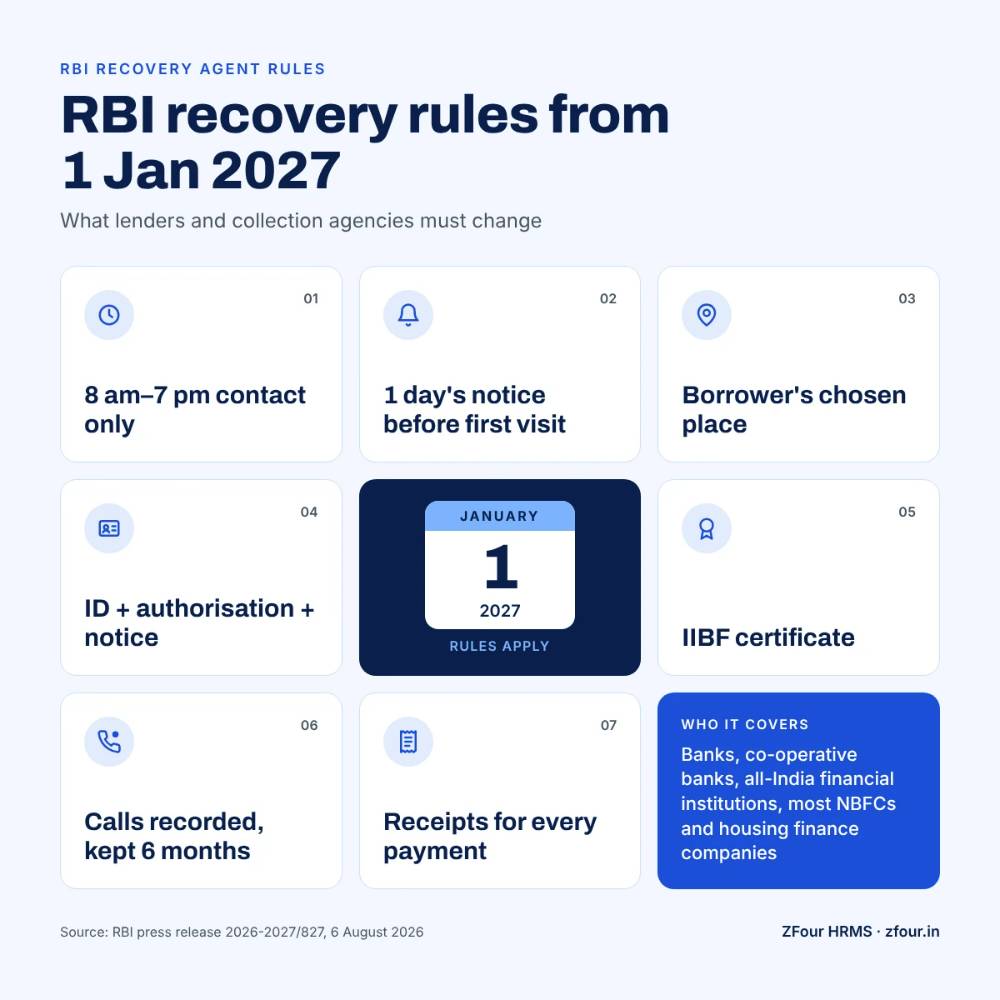
Recovery agents may contact borrowers only between 8 am and 7 pm. The borrower must be told which agency is assigned at least one day before the first in-person visit, and visits should be at the borrower's chosen place. Every agent must carry an identity card, an authorisation letter and a copy of the notice, and must hold an IIBF Debt Recovery Agent certificate. Recovery calls must be logged, recorded and kept for six months.
Key takeaways
Effective date: 1 January 2027. Lenders are accountable for their agencies' compliance, so expect lenders to audit agencies in December.
The 8 am to 7 pm window applies to calls and visits. Earlier or later contact needs the borrower's express request or authorisation.
The first in-person visit needs at least one day's notice of the assigned agency. Residence or workplace visits are a fallback, not the default.
No IIBF certificate, no field work: track certification for every agent.
RBI doesn't require GPS tracking of agents, but time-stamped attendance and visit records are strong evidence that contact happened inside the permitted window.
Redesign incentives that reward volume of contact over fair conduct.
What RBI issued and who it covers
This section summarises the directions. Read the directions that apply to your entity in full before acting.
Nine sets of amendment directions
On 6 August 2026, RBI issued amendment directions under the theme “Conduct of Regulated Entities in Recovery of Loans and Engagement of Recovery Agents” (press release 2026-2027/827). Each amends the responsible business conduct directions (or, for housing finance companies, the fair practices provisions) for one type of lender:
Lender type | Reference |
|---|---|
Commercial banks | RBI/2026-27/223 |
Small finance banks | RBI/2026-27/224 |
Local area banks | RBI/2026-27/225 |
Regional rural banks | RBI/2026-27/226 |
Urban co-operative banks | RBI/2026-27/227 |
Rural co-operative banks | RBI/2026-27/228 |
All-India financial institutions | RBI/2026-27/229 |
NBFCs | RBI/2026-27/230 |
Housing finance companies | RBI/2026-27/231 |
For commercial banks, the instrument is titled the Reserve Bank of India (Commercial Banks – Responsible Business Conduct) Fourth Amendment Directions, 2026.
When it applies
All nine take effect on 1 January 2027.
Who is not covered
For NBFCs, certain categories without a lending relationship with retail borrowers are excluded. These include mortgage guarantee companies, core investment companies, account aggregators, standalone primary dealers, non-operating financial holding companies and NBFCs with no customer interface. Check your own registration category.
The agent-specific rules also don’t apply to a lender’s own employees doing recovery, to agents collecting regular periodic instalments, or to law firms issuing notices or representing the lender in court.
Why collection agencies must act too
The directions apply to lenders, not directly to agencies. But lenders stay accountable for the conduct of the agencies and agents they engage. They will pass every requirement down through their agency contracts and audit compliance. For an agency, losing a lender's mandate is the real penalty.
RBI recovery agent rules 2027 in plain language
Contact only between 8 am and 7 pm
Agents may contact or visit borrowers and guarantors only between 08:00 and 19:00. Contact outside that window needs the borrower's express request or authorisation. Where a borrower asks not to be contacted at certain times, the request should normally be respected.
Notice before the first in-person visit
The lender must tell the borrower which recovery agency is assigned at least one day before the agency's first in-person visit. If the agency changes during the process, the borrower must be told promptly.
Where visits can happen
Agents should meet the borrower at a place the borrower chooses.
When home or workplace visits are allowed
A visit to the borrower's residence or workplace is allowed only where the borrower hasn't chosen a place, or has missed two or more successive appointments. Agents must avoid occasions such as a bereavement, a medical emergency or a family wedding.
Identity, authorisation and notice
On every visit the agent must carry and display three documents:
an identity card issued by the agency
an authorisation letter from the lender
a copy of the lender's notice
These documents must show the agency's contact number and the details of the lender's grievance redressal officer.
IIBF Debt Recovery Agent certificate
Agents must hold a certificate from the Indian Institute of Banking and Finance (IIBF) after completing its Debt Recovery Agent training programme, or one run by an IIBF tie-up institution. New agents must be certified before they are engaged. Agents already engaged who don’t hold the certificate get a transition period, one year from 1 January 2027 in the NBFC, all-India financial institution and rural co-operative bank directions. Check the transition period in the directions for your entity type.
Antecedent verification
The lender or the agency must verify each agent's antecedents before engagement and periodically afterwards, in line with the lender's policy.
Call logging and recording
Lenders must record the time and number of recovery calls, and record the content of calls. This includes calls that borrowers make to numbers the lender has given them. Borrowers must be told the call is being recorded. Records must be kept for six months from the date of the call, or longer if the matter is before a court.
Receipts
Agents must give a proper acknowledgement or receipt for any amount collected.
Prohibited conduct
The following are all barred:
threatening or abusive language
intimidation
repeated unwanted calls
anonymous calls
threats to reputation, property or family
public humiliation
posting borrowers' details on social media
Incentives
Recovery targets and incentive structures must not encourage aggressive or harsh collection practices.
What this means for field collection operations
Most of the rules change how a field collection team's day is planned and recorded. Agencies have the most work to do before 1 January, and so do lenders that apply the same standard to their own staff.
Duty windows and shifts
Agents can start work before 8 am (planning, travel, reaching the area) but can't contact borrowers until 8. Contact must end by 7 pm. Design duty windows around that.
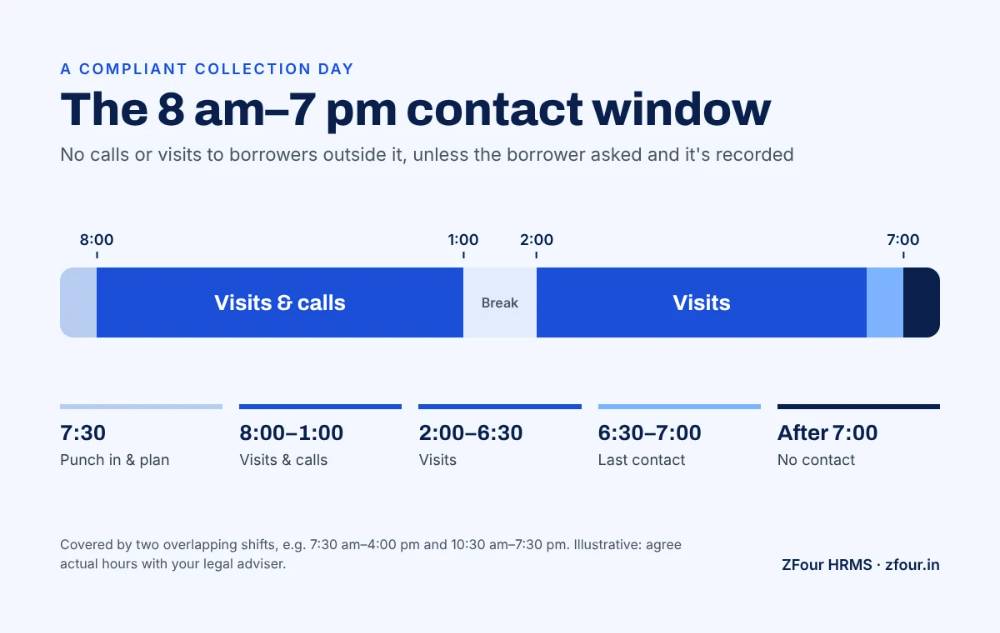
An example duty window
Illustrative. Agree the actual hours with your legal adviser and your agents.
Time | Activity |
|---|---|
7:30 am | Punch in; review the day's cases and confirmed appointments |
8:00 am – 1:00 pm | Visits and calls inside the permitted window |
1:00 pm – 2:00 pm | Break |
2:00 pm – 6:30 pm | Visits and calls |
6:30 pm – 7:00 pm | Last contact; update case notes |
7:00 pm onwards | No borrower contact; punch out after reporting |
This table shows the full contact window, not one agent’s shift. Covering the whole window usually takes two overlapping shifts (for example 7:30 am–4:00 pm and 10:30 am–7:30 pm), because agents are also workers under the Labour Codes, with their own limits on daily hours, breaks and overtime. Check your shift lengths against those limits and your state’s rules. For how field hours are counted, see working hours for field employees.
Visit planning around notice and the borrower's chosen place
Field visits can no longer be "drop in when passing". Each first visit needs a notice sent at least a day earlier. Each visit should be at a place the borrower has chosen, where they've chosen one. In practice:
The lender (or the agency, on its behalf) sends the agency details to the borrower.
The agent calls within the window to agree a time and place.
The visit goes on the agent's plan for that day.
Missed appointments are recorded, because two successive misses change where the next visit can happen.
Visit records as evidence
The directions don't prescribe a field-visit log. But lenders will want to know that every visit happened inside the window, at an allowed place, by a certified agent with the right documents. A time-stamped record of each visit is the simplest way to show that.
What to record for each visit
Field | Why it matters |
|---|---|
Agent name and employee ID | Links the visit to a certified, verified agent |
Case or account reference | Links the visit to the lender's assignment |
Date and time of arrival and departure | Shows contact was inside 8 am – 7 pm |
Place type: borrower's chosen place / residence / workplace | Shows residence and workplace visits followed the rules |
Appointment agreed, or missed-appointment count | Justifies a residence or workplace visit |
Outcome: met, not met, payment collected, promise to pay | Case history |
Receipt number, if payment collected | Matches the receipt rule |
What not to record
Record what the lender needs to show fair conduct, and nothing more. Don't record borrowers' family members, health or personal circumstances beyond what the case requires.
Don't take photographs of borrowers, their homes or their families as "proof of visit". It adds privacy risk and invites misuse, and a time-stamped visit record already proves the visit happened.
The agent onboarding file
Before an agent goes to the field, the agency should hold:
identity and address proof, photograph and employee number
antecedent verification record and date
IIBF Debt Recovery Agent certificate number and date
agency identity card issued, with its validity
authorisation letters for each lender the agent works for
training on the lender's code of conduct, with the date
signed acknowledgement of the conduct rules and prohibited practices
Set reminders for periodic re-verification. Block rostering for any agent whose certificate or verification is missing.
Agency contracts
Expect lenders to revise agency agreements before January. The revised agreements are likely to cover:
the contact window
visit notice handling
document requirements
certification
record-keeping and audit rights
call recording arrangements
penalties or termination for breaches
Agencies should ask lenders early which records they will want each month, and set up their systems to produce them.
In-house teams and outsourced agencies
The amendment directions are written for recovery agents, meaning people engaged through a recovery agency, and the agent-specific rules don’t apply to a lender’s own employees doing recovery. But lenders still owe borrowers fair treatment under their wider conduct and fair practices obligations, and some lenders’ codes of conduct cover their own recovery staff as well as agents. In practice, many lenders will apply the same contact window, documents and records to in-house staff.
Area | Lender's in-house collection team | Outsourced collection agency |
|---|---|---|
Covered by the 2027 amendment directions | Not the agent-specific rules; the lender’s conduct code still applies | Yes, through the lender |
Who sets the rules | The lender's policy directly | The lender's contract with the agency |
Certification and verification | Lender's policy (IIBF certificate not required by these directions) | Agency's HR tracks it; lender audits |
Call recording | Lender's own systems | Agency must use lender-approved, recorded lines |
Visit records | Lender's attendance and case systems | Agency's systems, shared with the lender monthly |
Accountability | Lender | Lender, which then enforces against the agency |
Lenders with both kinds of team gain from holding them to the same standard. Borrowers don't tell the two apart, and their complaints won't either.
Telecalling teams
Much recovery contact happens by phone before anyone visits. The directions cover calls as much as visits.
Use recorded, logged lines only
Calls should go through numbers and systems that log the time and number of every call and record its content. That includes calls borrowers make back to numbers the lender has shared. Agents calling from personal mobiles break this rule even if the conversation itself is polite.
Tell borrowers the call is recorded
Add a short opening line to every script, in the borrower's language.
Respect the window for calls too
The 8 am to 7 pm window applies to calls. Diallers should block calls outside the window automatically, rather than relying on agents to watch the clock.
Record every call's outcome
Use a short list of outcome codes (connected, promise to pay, dispute raised, wrong number, do not call at certain times). Supervisors can then review patterns, such as repeated calls to one borrower in a day.
Borrower requests and special situations
The borrower asks to be contacted outside the window
Contact outside 8 am to 7 pm is allowed only on the borrower's express request or authorisation. Record the request: who made it, when, and the time the borrower asked for. Without a record, an evening call looks like a breach.
The borrower asks not to be contacted at certain times
Such requests should normally be honoured. Add them to the case so every agent and caller sees them.
Guarantors
The same contact window and conduct rules apply to guarantors. Don't use guarantors, family members or neighbours to put pressure on the borrower.
Bereavement, illness and family occasions
Agents must avoid contact during a bereavement, a medical emergency or occasions such as a wedding. When an agent learns of one, they should pause contact on the case and record why, so the next agent doesn't call the following morning.
Disputes
When a borrower disputes the debt or the agent's conduct, stop collection activity on that point. Pass it to the lender's grievance process and record the reference. Agents shouldn't argue the dispute on the doorstep.
What a compliant field day looks like
Before | From 1 January 2027 | |
|---|---|---|
First contact | 7 am visit "to catch them before work" | Call after 8 am to agree a time and place |
Notice | None | Agency details sent at least a day before the first visit |
Visit place | Borrower's home by default | Borrower's chosen place; home or workplace only if no place was chosen or after two missed appointments |
Agent's documents | Visiting card | Agency ID, lender's authorisation letter, copy of notice |
Calls | Agent's personal mobile | Recorded, logged lines |
Payment | Cash with a handwritten note | Numbered receipt |
Last contact | Whenever the borrower is home | Before 7 pm |
Record | WhatsApp message to the supervisor | Time-stamped visit record with outcome |
The supervisor's role
Rules on paper change little unless field supervisors check them every day. Give each supervisor a short routine:
Morning: confirm every agent on the roster is certified and carrying the right documents. Review the day's planned visits and any first visits that still need notice.
During the day: listen to a sample of recorded calls. Accompany one agent on visits each week.
Evening: review any contact outside the window and check the borrower's authorisation is recorded. Close the day's visit records.
Weekly: review complaints and repeat-call patterns with each agent.
Supervisors should be measured on their team's conduct, not only its recoveries.
The agent's daily checklist
Give every agent a short card, in their language, to keep with their ID:
I carry my agency ID, the lender's authorisation letter and a copy of the notice.
I don't contact anyone before 8 am or after 7 pm, unless the borrower asked for that time and it's recorded.
I call only from the approved, recorded number.
I meet the borrower where they choose. I go to a home or workplace only when the rules allow it.
I stay polite. No threats, no pressure on family or neighbours, no social media.
I give a numbered receipt for every payment.
I record every visit and call with the time, place and outcome before I punch out.
A card like this does more for compliance than a long policy most agents will never read.
Microfinance and rural collections
NBFC-microfinance institutions are covered through the NBFC directions, and their field model raises particular questions. Routine centre collections of regular instalments may fall under the exemption for agents collecting periodic instalments, so check how your lenders treat them. The points below are good practice either way.
Centre and group meetings are usually held at a fixed place and time agreed with the group. Keep them inside the permitted window and record the agreed schedule, since that is the borrowers’ chosen place and time.
Give notice and agency details in the local language, and read them out where borrowers prefer.
Agents should never pressure family members, and visits to homes need the same justification as anywhere else.
Cash collections need numbered receipts every time, even for small amounts.
What happens if lenders get it wrong
The directions sit within RBI's conduct framework for regulated entities, and RBI can take supervisory action against lenders that don't follow them. In practice, the first consequence for a collection agency is commercial. A lender that finds breaches during an audit will restrict or end the agency's mandate. Borrower complaints through the lender's grievance process and the RBI Ombudsman also create a record that lenders and RBI can review.
The monthly compliance report to each lender
Lenders will ask agencies to prove compliance. A monthly report in a fixed format avoids repeated document requests.
Section | Contents |
|---|---|
Agents | Agents deployed, with certificate and verification status |
Contact window | Visits and calls outside 8 am – 7 pm, with the borrower's authorisation for each |
First-visit notice | Cases visited for the first time, with the date notice was given |
Visit places | Residence and workplace visits, with the reason (no chosen place / missed appointments) |
Receipts | Collections with receipt numbers |
Complaints | Complaints received, investigated and closed, with outcomes |
Training | Sessions held and attendance |
HR changes for collection agencies
Many of these requirements land on HR rather than operations.
Certification tracking
Keep a certificate register for every agent, with dates. Report expiries and pending certifications monthly. An uncertified agent can't be rostered for field work.
Training
Add the new conduct rules to induction and refresher training. Keep attendance records for every session, because lenders will ask for them.
Incentive redesign
Incentives based purely on recovery amounts or number of contacts push agents towards the conduct the directions prohibit. Balance them with:
quality measures such as complaint-free months and audit scores
adherence measures such as visits inside the window and documented appointments
caps on how much of an agent's pay is variable
Grievances and discipline
Every borrower complaint against an agent needs a documented investigation. Write the prohibited practices into the code of conduct and the disciplinary process, so breaches can be acted on quickly.
Working conditions
A collection agent working under pressure to recover, across a tight window, with long travel, is at risk of both misconduct and burnout. Reasonable caseloads, breaks and travel reimbursement help agents comply. For travel rules, see the travel allowance policy for field staff.
A seven-week readiness plan
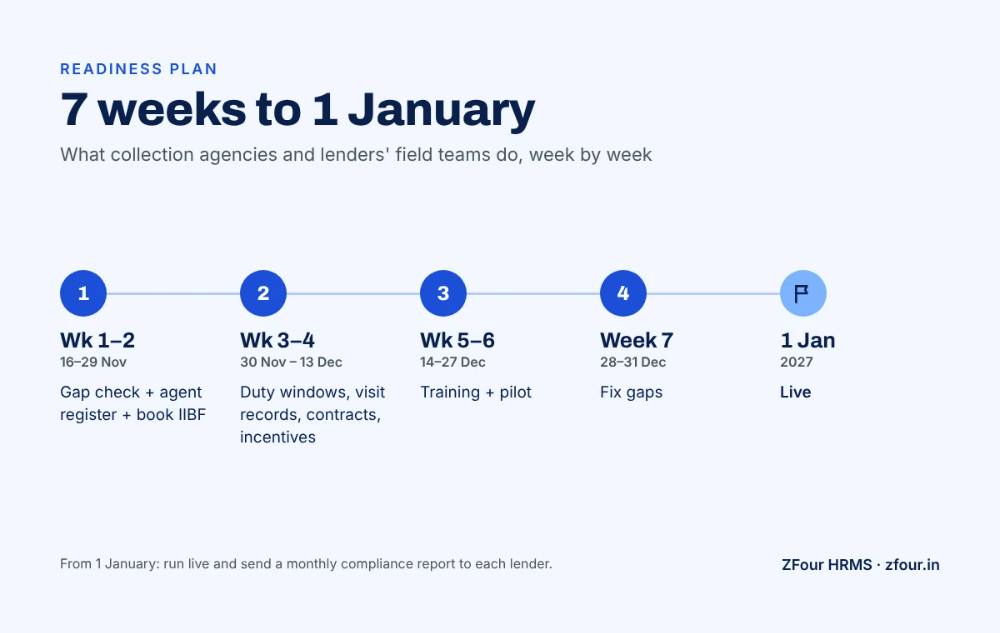
When | What to do | Owner |
|---|---|---|
Weeks 1–2 (16–29 Nov) | Read the directions for each lender you work with; list the gaps against current practice | Compliance / operations head |
Weeks 1–2 | Build the agent certificate and verification register; identify uncertified agents; book IIBF training | HR |
Weeks 3–4 (30 Nov – 13 Dec) | Redesign duty windows and visit planning; set up visit records | Operations |
Weeks 3–4 | Update the code of conduct, incentive plan and agency contracts | HR / legal |
Weeks 5–6 (14–27 Dec) | Train all agents and supervisors; pilot the new process with one lender portfolio | HR / operations |
Week 7 (28–31 Dec) | Fix gaps found in the pilot | Operations |
From 1 Jan 2027 | Run live; monthly compliance report to each lender | Compliance |
Get the RBI 2027 readiness checklist
Agent register, contact-window plan, visit record fields, monthly lender report and a Hindi–English agent card, in one 8-page PDF.
Common gaps to look for
Agents contacting borrowers before 8 am "because they were already in the area".
Calls from agents' personal phones that aren't logged or recorded.
No record of when the borrower was told about the agency.
Residence visits as the default, with no record of the borrower's chosen place or missed appointments.
Agents working for several lenders with only one authorisation letter.
Uncertified agents rostered because the field was short-staffed.
Incentives paid on contact volume.
Receipts issued on plain paper with no numbering.
Location records: helpful, but handle them carefully
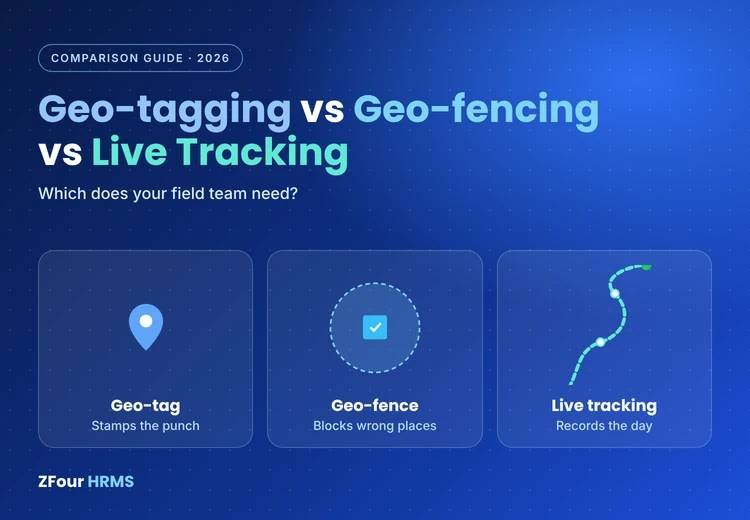
RBI doesn't require lenders or agencies to track agents' locations. But a mobile punch at the start and end of the day, and a time-stamped record at each visit, give lenders and agencies evidence that work happened inside the permitted window and at the recorded place. That evidence also protects agents against false complaints.
If you use location records:
record location only during working hours, never after the punch-out
tell agents in writing what is recorded and why
limit access to supervisors and compliance staff
For the rules on employee location tracking, read is GPS tracking of employees legal in India?
An illustrative example
This is an illustrative scenario, not a customer case study.
Consider a collection agency in Uttar Pradesh working for four NBFCs with 180 field agents. Agents plan their own days, often start visits at 7 am to catch borrowers before work, and log visits in a WhatsApp group. About a third have no IIBF certificate on file.
To be ready by January, the agency would build an agent register with certificate and verification dates, book training for uncertified agents, and move visit logging into its attendance app with time, case reference and place type. It would reset duty windows so contact starts at 8 am, with the first half hour for planning. It would also tie a fifth of variable pay to complaint-free months and complete visit records.
When a lender audit comes, the agency can then show every visit's time and place, every agent's certificate status and the training records. That is what a lender needs to see before renewing a mandate.
How ZFour HRMS supports collection teams
Mobile punch-in and punch-out with location and selfie, so each agent’s working day is recorded.
Visit logs with time and place for every case visit.
Live tracking only between punch-in and punch-out, for teams that choose it, at ₹100 per field user per month on any plan.
Employee records with document and expiry tracking for certificates and verification.
Payroll with incentives, PF, ESI and PT.
Hindi and English app for agents.
See GPS attendance and field tracking.
Sources and further reading

Farheen Ahmed
HR Tech Content Strategist at ZFour Technology Private Limited
Research-driven content on HRMS, payroll, attendance management, employee management, and modern HR technology for Indian businesses.