9 min read
A new employee's first few weeks can shape how quickly they understand their role, connect with their team, and settle into the organization. That makes employee onboarding more than a paperwork exercise.
An effective onboarding process gives new hires the information, tools, relationships, and support they need to start successfully. It can also contribute to a better employee experience and help organizations address early disengagement and turnover risks. The Chartered Institute of Personnel and Development (CIPD) describes induction, also known as onboarding or orientation, as a process that helps employees understand their new role and employer and settle into the organization.
For HR teams, the challenge is creating an onboarding experience that is structured without becoming impersonal.
The CIPD's employee induction guidance explains that effective induction helps new employees settle into the organization and understand the knowledge and support they need to perform their roles.
What Is Employee Onboarding?
Employee onboarding is the structured process of helping a new employee transition from a newly hired candidate into an informed and productive member of the organization.
It can include:
Pre-joining communication
Documentation and administrative tasks
Workplace and policy orientation
Role and responsibility clarification
Team introductions
Training and learning
Manager check-ins
Goal setting
Feedback and development support
Onboarding should not be treated as a single first-day event. A well-designed process continues beyond orientation and gives employees opportunities to understand the organization, their role, their expectations, and how they can contribute.
Why Is Employee Onboarding Important?
A new employee needs more than access to a laptop and a list of policies.
They need clarity about:
What the organization does
What their role involves
Who they work with
What is expected from them
Which tools and processes they need to use
Where to go when they need help
How their work contributes to organizational goals
A structured onboarding process can therefore help organizations:
Improve Role Clarity
Employees can understand their responsibilities, priorities, reporting relationships, and performance expectations earlier.
Strengthen Employee Experience
A coordinated welcome can make the transition into a new workplace easier and more consistent.
Support Faster Integration
Introductions, training, documentation, and access to systems help employees become familiar with their environment.
Build Manager-Employee Relationships
Regular conversations with managers give new hires an opportunity to ask questions, clarify expectations, and discuss progress.
Support Retention
Onboarding does not guarantee retention, but a supportive experience may help employees integrate more effectively and reduce some of the risks associated with a poor start.
How to Create an Effective Employee Onboarding Process
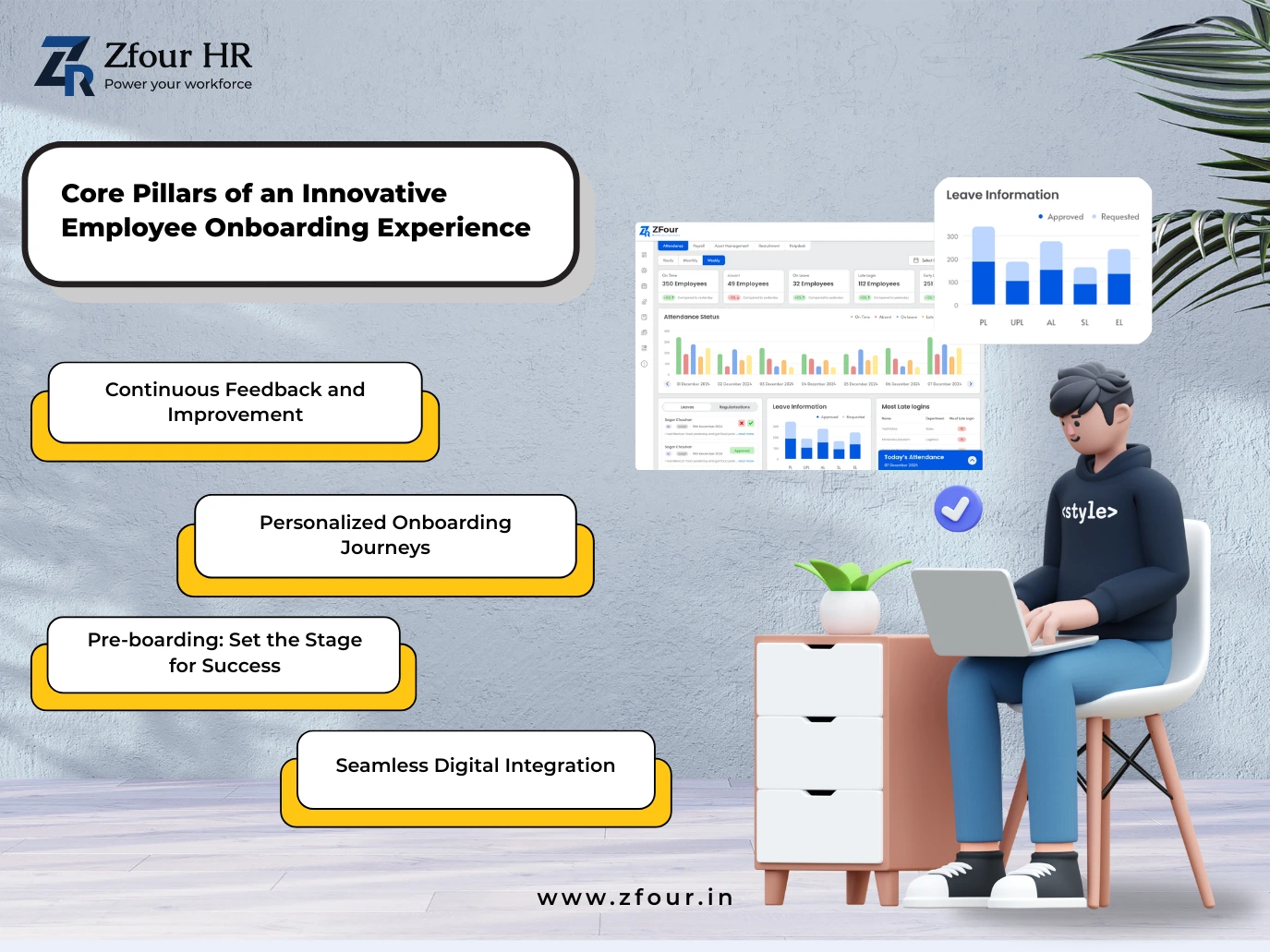
An effective onboarding process should be structured around the employee lifecycle rather than limited to the first day.
A practical framework is:
Pre-boarding → Day 1 → First Week → First 30 Days → 60–90 Days → Ongoing Development
1. Start With Pre-Boarding
Onboarding can begin before the employee's official start date.
The pre-boarding stage can include:
Welcome email
Joining instructions
Required documentation
Employment information
Workplace policies
First-day schedule
Reporting-manager details
IT and system-access preparation
Information about the team
The objective is simple: remove avoidable uncertainty before Day 1.
A new employee should know where to go, whom to contact, what to bring, and what will happen when they arrive.
2. Make Day One Organized and Welcoming
The first day should combine administrative requirements with meaningful human interaction.
A useful Day 1 plan can include:
Welcome and introductions
Organization overview
Team introduction
Role overview
Workplace or remote-working orientation
Required documentation
Access to systems and tools
Initial manager conversation
Time for questions
Avoid filling the entire first day with policies and forms.
Employees also need opportunities to meet people and understand how their team works.
3. Clarify the Employee's Role and Expectations
One of the most important parts of onboarding is role clarity.
The employee should understand:
Their primary responsibilities
Short-term priorities
Reporting structure
Key stakeholders
Expected ways of working
Performance expectations
Initial goals
Available support
Managers should avoid assuming that new employees automatically understand how their role fits into the wider organization.
Clear expectations reduce ambiguity and give employees a practical starting point.
4. Provide Role-Specific Training
Not every employee needs the same onboarding program.
A salesperson, software developer, HR executive, and finance professional may require completely different training.
Create role-specific onboarding paths covering:
Organization-Level Training
Mission and values
Culture
Policies
Workplace practices
Team-Level Training
Team structure
Communication channels
Internal workflows
Collaboration practices
Role-Level Training
Job responsibilities
Tools and systems
Processes
Performance expectations
Role-specific knowledge
This creates a more relevant onboarding experience than giving every employee exactly the same checklist.
5. Introduce the New Employee to the Team
Social integration is an important part of onboarding.
Depending on the organization's working model, this can include:
Team introductions
Buddy or mentor programs
Informal team meetings
Cross-functional introductions
Virtual coffee sessions
Department orientation
For hybrid and remote teams, organizations may need to make these interactions more deliberate because employees cannot rely on spontaneous office conversations.
CIPD research on onboarding for remote and hybrid workers highlights practices such as early meetings and introductions, additional support, social connection, and help with understanding organizational culture.
6. Set Goals for the First 30 Days
New employees need a clear idea of what successful progress looks like.
Instead of giving them a large list of expectations, establish realistic initial objectives.
For example:
Complete required training
Understand core workflows
Meet key stakeholders
Complete initial assignments
Learn relevant tools
Attend manager check-ins
Identify questions or support requirements
The goals should reflect the employee's role and experience level.
7. Continue the Process Through 60–90 Days
Onboarding should not disappear after the first week.
A 30–60–90-day structure can help managers review progress at appropriate intervals.
First 30 Days
Focus on:
Learning
Orientation
Relationships
Basic responsibilities
Days 31–60
Focus on:
Independent work
Skill development
Performance feedback
Greater responsibility
Days 61–90
Focus on:
Performance expectations
Long-term goals
Development needs
Career conversations
Ongoing team integration
The exact timeline should vary by role. A complex position may require a longer onboarding period than a relatively straightforward role.
Employee Onboarding Process Checklist
Use this checklist to make the process easier to implement.
Stage | Key Activities | Owner |
|---|---|---|
Before joining | Documentation, welcome communication, access preparation | HR + Manager |
Day 1 | Orientation, introductions, role overview | HR + Manager |
First week | Training, team integration, workflow explanation | Manager + Team |
First 30 days | Initial goals, check-ins, role-specific learning | Manager |
60 days | Progress review, feedback, development needs | Manager + Employee |
90 days | Performance discussion, long-term goals, development plan | Manager + HR |
Key Components of an Effective Onboarding Process
A strong onboarding framework should cover more than documentation.
Organizational Orientation
Explain the organization's:
Mission
Values
Structure
Products or services
Culture
Key policies
Role Clarity
Explain:
Responsibilities
Expectations
Reporting relationships
Goals
Performance measures
Administrative Readiness
Prepare:
Employment documentation
Payroll information
Required forms
Identification records
Benefits information
System access
Technology Readiness
Ensure employees have the tools required to perform their role.
This may include:
Email
HR systems
Communication tools
Project-management platforms
Role-specific applications
Social Integration
Help employees build relationships with:
Managers
Team members
Cross-functional colleagues
Key stakeholders
Continuous Support
Provide:
Regular manager check-ins
Feedback
Training
Question-and-answer opportunities
Development conversations
How HR Technology Can Support Employee Onboarding
Technology can make onboarding more organized, but it should support rather than replace human interaction.
An HR platform may help HR teams centralize information and automate selected administrative workflows.
Depending on the platform, onboarding-related capabilities may include:
Employee information collection
Document management
Task assignment
Workflow approvals
Employee self-service
Training coordination
Employee records
Reporting
Technology can be particularly useful when an organization is onboarding multiple employees simultaneously or operates across different locations.
Digital HR technology can support parts of the onboarding process, while organizations should continue to consider accessibility and the human side of employee experience.
Organizations that want to understand the broader role of an HRMS can also explore what an HR management system is and how it supports HR operations.
For the specific mechanics of how HRMS software removes manual onboarding handoffs — document collection, payroll setup, system access — see our companion guide on how HRMS streamlines employee onboarding.
This piece covers the onboarding program itself; that one covers the software side in more depth.
How ZFour HRMS Can Support HR Operations During Onboarding
For organizations using an HRMS, onboarding-related employee information can form part of a broader employee-management workflow.
ZFour HRMS provides modules covering areas such as employee management, recruitment, attendance, leave, payroll, performance, and reporting.
Where the relevant functionality is included in an organization's setup, an HRMS can help HR teams keep employee information and related HR processes organized within a centralized system.
However, software should not be viewed as a replacement for manager involvement, team introductions, role-specific training, or regular employee conversations.
The best onboarding experience combines structured HR processes with human support.
Common Employee Onboarding Mistakes to Avoid
Even a well-designed onboarding program can fail if the execution is inconsistent.
1. Treating Onboarding as a One-Day Event
A first-day orientation is only one part of onboarding.
New employees often need continued support as they learn their role.
2. Giving Too Much Information at Once
A new employee cannot absorb every policy, process, and tool immediately.
Prioritize information and provide additional resources as the employee progresses.
3. Ignoring the Manager's Role
HR can coordinate the process, but managers play a critical role in explaining responsibilities, providing feedback, and helping employees integrate into the team.
4. Using the Same Process for Every Role
A standardized framework is useful, but the actual onboarding journey should reflect the employee's role and department.
5. Delaying System Access
Missing access to essential systems can prevent employees from completing their work and create unnecessary frustration.
6. Failing to Collect Feedback
Without asking new employees about their experience, HR teams may not know where the onboarding process is creating friction.
How to Improve Onboarding for Remote and Hybrid Employees
Remote and hybrid employees may need additional structure because they have fewer opportunities for informal interaction.
Consider providing:
A clear virtual Day 1 schedule
Video introductions
Digital documentation
Early manager check-ins
A designated buddy or mentor
Clear communication channels
Remote-work guidelines
Online training resources
Regular team interactions
The objective is to provide remote employees with the same clarity and access to support that office-based employees receive.
How to Measure Employee Onboarding Success
An onboarding program should be measured rather than assumed to be effective.
Useful onboarding KPIs include:
New-Hire Retention
Track how many new employees remain with the organization after defined periods such as 30, 90, 180, or 365 days.
Time to Productivity
Measure how long it takes a new employee to reach an agreed level of role-specific independence.
Onboarding Completion Rate
Track whether required onboarding activities are completed.
Training Completion
Measure completion of required role or organization-specific training.
New-Hire Satisfaction
Use surveys or structured feedback to understand how employees experienced the onboarding process.
Manager Feedback
Ask managers whether new employees had the information, access, and support required to perform their roles.
Early Attrition
Monitor departures during the first several months and look for recurring patterns.
No single metric tells the whole story. Combining quantitative measures with employee and manager feedback provides a more useful picture.
30-60-90 Day Employee Onboarding Framework
A simple framework can make onboarding easier to manage.
Period | Primary Focus | Example Outcomes |
|---|---|---|
First 30 days | Learn and integrate | Understand role, team, tools and processes |
Days 31–60 | Contribute | Handle responsibilities with increasing independence |
Days 61–90 | Perform and develop | Review performance, establish longer-term goals |
This framework should be adapted to the role rather than applied as a rigid formula.
Employee Onboarding in 2026: What Should HR Teams Focus On?
The fundamentals of onboarding remain more important than individual technology trends.
In 2026, HR teams should focus on:
Personalized Onboarding
Different roles require different learning paths and information.
Hybrid-Ready Processes
Onboarding should work consistently for office-based, hybrid, and remote employees.
Human + Digital Experiences
Automation can handle repetitive administration, while managers and colleagues provide context, support, and connection.
Continuous Feedback
Instead of waiting until the end of a probation period, organizations can collect feedback throughout the onboarding journey.
Data-Informed Improvement
HR teams can use onboarding metrics to identify delays, incomplete tasks, recurring employee questions, and early-exit patterns.
Technology should support these objectives rather than become the objective itself.
Final Thoughts
The strongest programs combine administrative readiness with role clarity, meaningful introductions, structured learning, manager support, and regular feedback.
HR technology can make these processes easier to organize, particularly as organizations grow or onboard employees across multiple locations. But technology alone does not create a successful onboarding experience.
The goal is to help every new employee answer three questions:
What does this organization expect from me?
How can I succeed in my role?
Where can I get support when I need it?
When onboarding consistently provides those answers, it creates a stronger foundation for employee integration, engagement, and long-term retention.

Farheen Ahmed
HR Tech Content Strategist at ZFour Technology Private Limited
Research-driven content on HRMS, payroll, attendance management, employee management, and modern HR technology for Indian businesses.