13 min read
Quick Answer
The best HR management software in India automates payroll, attendance, leave, and statutory compliance (PF, ESI, gratuity, and the 2026 labour code changes) in one platform. There is no single "best" platform for every business — the right choice depends on company size, workforce type (office vs. field), and budget. ZFour HRMS, greytHR, Keka, Zoho People, and Darwinbox are among the most-used platforms in India, each suited to a different profile. Use the comparison table and decision framework below to match your business to the right one.
Why This Decision Matters Right Now
India's HR software market isn't a niche category anymore. Third-party market research puts the India HRMS market at roughly USD 0.87–1.1 billion as of 2024–25, growing at a 14–17% CAGR toward USD 2.3–4.3 billion by the early 2030s, depending on the research firm's methodology (IMARC Group; TechSci Research).
Industry body NASSCOM similarly reports the broader HRTech segment growing 15–20% annually, driven largely by compliance complexity (PF, ESI, professional tax, TDS reporting) and the shift to cloud-based, mobile-first HR operations.
(Note: these figures come from different research firms using different scope definitions — HRMS vs. broader HCM/HRTech — which is why the ranges differ. Cite the range transparently rather than picking one number, and update this section if you have a newer report.)
What this means practically: the market is crowded, vendor claims are hard to independently verify, and getting the evaluation criteria right matters more than picking from a "top 10" list.
Two structural shifts are worth understanding before you evaluate any vendor. First, adoption is no longer concentrated in metro IT hubs — cloud-based HRMS pricing has made these tools accessible to SMEs in Tier-2 and Tier-3 cities, and vendors increasingly design for businesses with distributed, non-desk workforces rather than assuming everyone sits in an office in Bengaluru or Gurgaon. Second, compliance has become the primary driver of switching decisions, not a secondary feature. The 2026 labour codes changed how basic pay, PF, and gratuity are calculated for a large share of salaried employees, and businesses running payroll on spreadsheets or older software that hasn't been updated for these changes are the ones most likely to be non-compliant without realizing it.
What HR Management Software Actually Needs to Do in India
Payroll and statutory compliance.
PF, ESI, professional tax, and gratuity calculations vary by state and employee category, and the 2026 labour codes have changed how basic pay, PF, and gratuity are calculated. Software not actively maintained for these changes puts payroll accuracy and legal compliance at risk every time rules shift. For the underlying regulations themselves, the EPFO and ESIC official portals are the authoritative sources, not vendor blog posts.
Attendance that matches how Indian teams work.
An office-based IT team and a field sales or manpower workforce need different tools. Biometric devices suit desk-based teams; GPS and geo-fencing matter for field staff, delivery teams, and multi-site operations.
Data residency and security.
Under the Digital Personal Data Protection Act (DPDPA) 2023 and the IT Act 2000, where and how employee data is stored is a compliance question, not just an IT preference. HRMS platforms hosting data in India and built around these frameworks remove a layer of legal risk and increasingly, enterprise buyers are also checking for ISO 27001 or SOC 2 attestations as baseline trust signals before shortlisting a vendor.
Employee self-service that people actually use.
A payroll and attendance system that only HR can access defeats much of its own purpose. Employees need to be able to check payslips, apply for leave, view their attendance history, and raise reimbursement requests without emailing HR for every routine task. This matters more in India than the feature list suggests, because a large share of the Indian workforce — field staff, retail employees, factory workers — doesn't sit at a desk with a laptop all day, so self-service needs to work reliably on a basic smartphone, not just a browser.
Approval workflows that match how Indian organizations are actually structured.
Multi-level approval hierarchies, branch-wise or department-wise policy variation, and role-based access control matter more as a company grows past the size where the founder can just approve everything personally. A platform that only supports a flat, single-approver structure will need workarounds within a year or two of real growth.
How to Choose HR Software: A 6-Step Framework
1. Map your compliance exposure.
How many states do you operate in? Do you have contract or gig workers subject to the newer aggregator compliance rules? Multi-state payroll compliance is meaningfully harder than single-location payroll — confirm the platform is actively updated for current labour law, not just "compliant" as a marketing claim.
2. Match the tool to your workforce type.
Office-only teams prioritize self-service and performance management. Field, manpower, or shift-based businesses need attendance and payroll built for that reality — GPS tracking and geo-fencing, not just biometric punch-in.
3. Model total cost, not entry price.
Per-user pricing looks simple until headcount doubles. Many vendors add implementation, API access, or biometric hardware as separate line items — ask for a full first-year cost breakdown, not just the advertised per-user rate. See our HRMS pricing guide by employee count for how this typically breaks down.
4. Check data portability before signing.
Confirm you can export your full data set (employee records, payroll history, attendance logs) if you switch vendors later. Vendor lock-in is a real, commonly reported risk in the Indian HRMS market — ask this question during evaluation, not after signing a contract.
5. Test support responsiveness before you need it, not after.
The best feature set is close to useless if support takes 48 hours to respond during a payroll run with a filing deadline the next day. During evaluation, ask what the actual support channel and response-time commitment looks like phone, chat, or ticket-only and if possible, test it with a real question before signing rather than taking a sales deck's word for it.
6. Plan for a realistic rollout, not a same-week switch.
Migrating historical payroll data, employee records, and opening leave balances takes real time to do accurately, and rushing it is how businesses end up with incorrect opening balances or duplicate employee records. Build in a few weeks of parallel-run or verification time before fully cutting over, especially if you're migrating mid-financial-year.
Common Mistakes Businesses Make When Choosing HR Software
Optimizing for the lowest sticker price instead of total cost.
The advertised per-user rate rarely includes implementation, biometric hardware, API access, or add-on modules like payroll (which is a separate module on some platforms).
A plan that looks 30% cheaper on the pricing page can end up costing more once these are added — always ask for a full first-year cost estimate in writing before comparing options.
Choosing based on a feature checklist instead of actual workflow fit.
Two platforms can both claim "leave management" and "payroll automation," but one might handle multi-state compliance and shift-based attendance well while the other is built primarily for single-location office teams. A feature checklist can't tell you this — a demo using your actual org structure and a genuinely difficult edge case (a multi-state employee, a mid-month joiner, a field employee without consistent internet access) can.
Underestimating the compliance maintenance burden.
Indian labour law changes — the 2026 labour codes are a recent example — and software that isn't actively maintained to reflect these changes puts the burden of manual correction back on HR, defeating the point of automating compliance in the first place. Ask any vendor how quickly they update the platform after a regulatory change, and ask for a specific recent example.
Skipping the data migration conversation until after signing.
Migration complexity is one of the most common sources of buyer's remorse in HRMS switches. Ask specifically what data the vendor migrates for you (historical payroll, attendance history, opening leave balances), what you're expected to prepare yourself, and how long a typical migration of your size and complexity actually takes — not the marketing page's generic estimate.
Ignoring how the platform performs for non-desk employees.
Many HR software evaluations are done entirely by office-based HR teams testing the platform on a laptop, which can miss real usability problems for field staff, factory workers, or retail employees who need to mark attendance or apply for leave from a basic smartphone with inconsistent connectivity. If a meaningful share of your workforce is non-desk, test the mobile experience specifically, not just the admin dashboard.
What HRMS Implementation Actually Looks Like
Implementation timelines get glossed over in most comparison content, but they're one of the more predictable sources of frustration if expectations aren't set correctly upfront.
Data collection and cleanup (typically 1–2 weeks). Before any data moves into the new system, it usually needs to be cleaned up — inconsistent formats, missing fields, and duplicate records in the old spreadsheet or legacy system are far more common than most HR teams expect going in.
Migration and configuration (typically 2–4 weeks for an SME). This covers moving employee master data, historical payroll records, attendance history, and opening leave balances, plus configuring approval hierarchies, policies, and any state-specific compliance rules that apply to your business.
Parallel run and verification (typically 1 pay cycle). Running the new system alongside the old process for at least one payroll cycle before fully cutting over is the single most effective way to catch calculation errors before they affect an employee's actual salary. Skipping this step to save a few weeks is a common cause of post-launch payroll errors.
Go-live and employee onboarding. Employees need a short, clear walkthrough of self-service features (checking payslips, applying for leave, marking attendance) — adoption tends to be higher when this is a structured rollout rather than an email announcement with a login link.
Larger, multi-location businesses with more complex approval structures and multi-state compliance requirements should expect this timeline to extend meaningfully beyond the SME range above — ask any vendor for a realistic, company-specific estimate rather than a generic "go live in 2 weeks" claim.
Top HR Management Software in India (2026 Comparison)
Platform | Best for | Attendance method | Compliance/security focus | Typical deployment |
|---|---|---|---|---|
ZFour HRMS | Growing SMEs and multi-branch businesses needing payroll + attendance + compliance together | Biometric + GPS/geo-fencing, mobile app | India-hosted data, DPDPA 2023 / IT Act 2000 aligned | Cloud, SME-focused |
greytHR | SMEs prioritizing payroll and statutory compliance | Biometric, mobile | Strong payroll/compliance track record | Cloud, SME-focused |
Keka | Mid-market companies prioritizing UX and performance management | Biometric, mobile | Standard statutory compliance | Cloud, mid-market |
Zoho People | Businesses already on other Zoho products | Biometric, mobile | Standard statutory compliance; payroll is a separate add-on module | Cloud, ecosystem-dependent |
Darwinbox | Large enterprises needing deep customization at scale | Enterprise-grade, configurable | Enterprise compliance workflows, used by large Indian and Southeast Asian companies | Cloud, enterprise |
Pocket HRMS | SMEs wanting a well-established, India-focused cloud HRMS provider | Biometric, mobile | Payroll and compliance automation for the Indian market | Cloud, SME-focused |
Vendor feature sets and pricing change frequently — confirm current specifics directly with each vendor before deciding. This table reflects general positioning, not a ranked endorsement.
ZFour HRMS
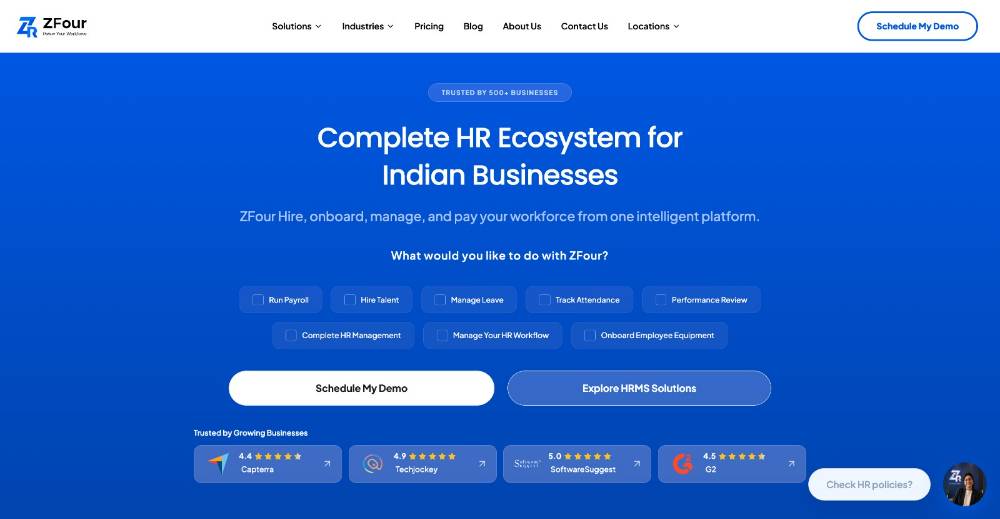
ZFour HRMS is built for Indian startups and SMEs that need payroll, attendance, and employee self-service in one system without enterprise-level complexity or cost. It combines biometric and GPS-based attendance — relevant for businesses with field or multi-location teams — with payroll processing mapped to Indian compliance requirements, and data hosted in India. See the full ZFour HRMS features and pricing breakdown.
greytHR
greytHR has built its reputation primarily around payroll accuracy and statutory compliance, making it a common choice for SMEs whose main pain point is getting payroll and PF/ESI filing right every month.
Keka
Keka is generally chosen by mid-size companies that weigh performance management and user experience heavily alongside core HR and payroll functions.
Zoho People
Zoho People fits naturally for businesses already running on other Zoho products, given tighter ecosystem integration than most standalone HRMS platforms offer. Note that payroll is typically a separate module (Zoho Payroll) rather than bundled by default — confirm current packaging directly with Zoho.
Darwinbox
Darwinbox is typically considered by larger organizations needing deep customization and enterprise-scale HR workflows, and has visible adoption among large Indian enterprises and some Southeast Asian markets.
Pocket HRMS
Pocket HRMS is an established, India-focused cloud HRMS provider positioned similarly to greytHR and ZFour for SMEs — payroll automation are core and compliance are core to its positioning, with mobile-first attendance and self-service features.
Want a deeper, side-by-side breakdown against named competitors? See ZFour vs greytHR vs Pagarbook and ZFour vs Zoho People vs Keka.
Which HRMS Should You Choose?
The answer depends on your priorities.
Consider ZFour HRMS if you prioritize:
- Indian payroll workflows
- Payroll and attendance in one platform
- Biometric attendance
- GPS-based attendance
- Employee management
- Leave management
- Recruitment and onboarding
- Employee self-service
- HR reporting
Consider Keka HR if you prioritize:
- Employee experience
- Payroll
- Performance management
- HR workflows
Consider greytHR if you prioritize:
- Payroll
- Attendance
- HR administration
- Payroll-related workflows
Consider Zoho People if you prioritize:
- Zoho ecosystem integration
- HR workflows
- Attendance
- Employee management
- Integration with Zoho Payroll
Consider Darwinbox if you prioritize:
- Enterprise HR
- Talent management
- Analytics
- Complex workforce requirements
The final decision should be based on your organization's requirements rather than a generic ranking.
HRMS Software by Business Size
Startups may prioritize: Payroll, Attendance, Employee records, Leave, Easy implementation, Employee self-service, Cost
Small Businesses may need: Payroll, Attendance, Leave, Payroll compliance workflows, Basic reporting
Growing SMEs may require: Payroll, Recruitment, Performance, Multi-location support, Integrations, Advanced reporting
Enterprises may require: Complex workforce management, Enterprise integrations, Advanced analytics, Talent management, Multiple business units, Configurable workflows, Governance and access controls
Which HR Software Is Best for Different Business Types
Small businesses evaluating their first HR software — 10 signs your business needs HR software.
Field, manpower, or multi-site businesses — HRMS and payroll for field/manpower workforces.
Businesses in Noida or Gurgaon specifically — Noida HRMS and payroll software guide and Gurgaon HR and payroll software guide.
Choosing HR Software by Industry
IT and professional services.
These businesses are typically office-based or hybrid, with employees who are comfortable with self-service tools. Priorities tend to be performance management, integration with existing tools, and biometric or app-based attendance rather than GPS tracking.
Manufacturing and industrial businesses.
Shift-based attendance, overtime calculation, and compliance with factory-specific labour regulations matter more here than performance management features. Biometric attendance at the plant level combined with reliable shift-pattern configuration is typically the priority.
Field sales, logistics, and manpower-heavy businesses.
GPS-based attendance and geo-fencing aren't optional here — a meaningful share of the workforce isn't at a fixed location during the workday, so attendance and payroll need to work reliably from a mobile device in the field. See the dedicated guide for field and manpower workforce HRMS for more detail on this specific use case.
Retail and multi-branch businesses.
Multi-location policy management, branch-wise reporting, and consistent attendance tracking across locations without a centralized IT presence at each site tend to matter most.
Startups scaling quickly.
The priority here is usually a system that won't need to be replaced again within a year — configurability, ease of adding new approval hierarchies as the org chart changes, and pricing that scales predictably with headcount growth matter more than a long feature list on day one.
Glossary
HRMS (HR Management System): Software that automates core HR processes: payroll, attendance, leave, employee records.
PF (Provident Fund): A mandatory retirement savings scheme for salaried employees in India, administered by the EPFO.
ESI (Employee State Insurance): A statutory health and social security scheme for eligible employees, administered by ESIC.
DPDPA: The Digital Personal Data Protection Act, 2023 — India's data protection law governing how personal data, including employee data, must be handled.
Geo-fencing: A location-based attendance method that verifies an employee is within a defined physical boundary (e.g., a job site) when marking attendance.
Professional Tax (PT): A state-level tax on salaried income, applicable in most but not all Indian states, with rates and slabs that vary by state.
TDS (Tax Deducted at Source): Income tax deducted directly from an employee's salary by the employer and deposited with the government, based on the employee's applicable tax slab.
Gratuity: A statutory lump-sum payment made to an employee on leaving a company after a minimum qualifying period of continuous service, calculated per India's gratuity rules.
Employee Self-Service (ESS): The portion of an HRMS that employees (not just HR admins) can access directly — typically for checking payslips, applying for leave, viewing attendance, and raising requests like reimbursements.
Labour Codes: The consolidated set of Indian labour laws (covering wages, social security, industrial relations, and occupational safety) that replaced a larger number of older, separate labour laws, with phased implementation affecting how salary structures, PF, and gratuity are calculated.
Sources
IMARC Group, India HRMS Market Size, Trends & Forecast
TechSci Research, India HRMS Market Size, Trends, Growth and Forecast 2031
NASSCOM Community, Market Size of HRMS Software in India
Employees' Provident Fund Organisation (EPFO) — epfindia.gov.in
Employees' State Insurance Corporation (ESIC) — esic.gov.in
Ministry of Electronics and IT — Digital Personal Data Protection Act, 2023

Farheen Ahmed
HR Tech Content Strategist at ZFour Technology Private Limited
Research-driven content on HRMS, payroll, attendance management, employee management, and modern HR technology for Indian businesses.