6 min read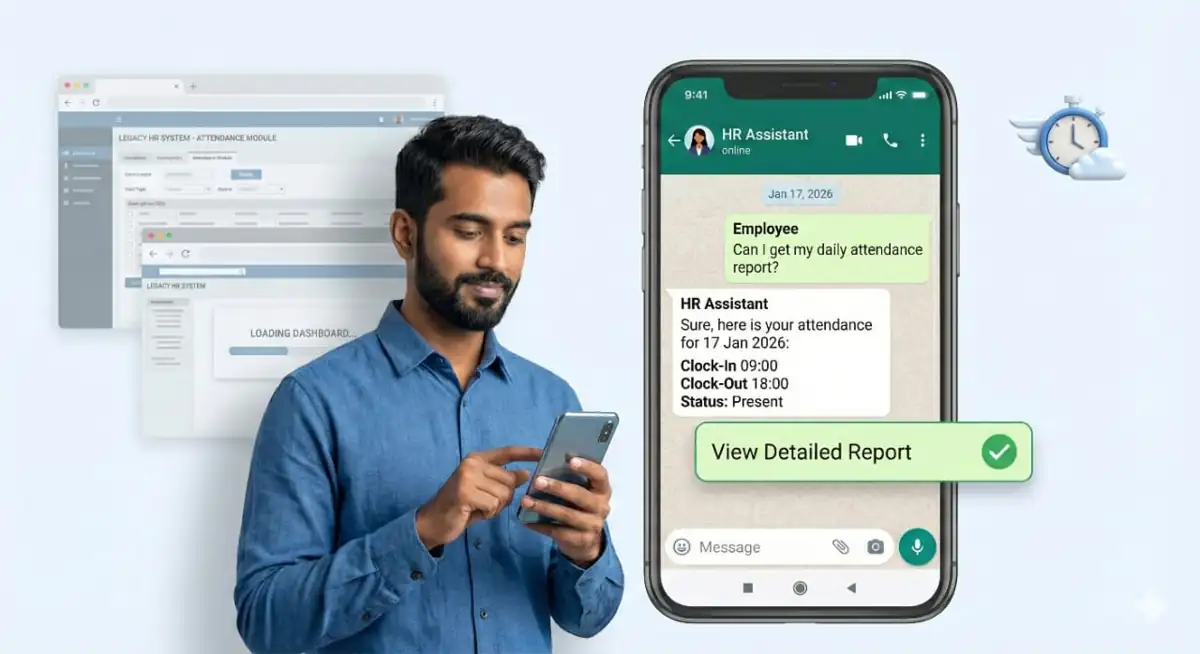
Quick answer: For workforces with a significant share of deskless, field, or shift-based employees, WhatsApp HRMS typically reduces friction and lifts adoption. Traditional portals remain the better fit for document-heavy, desk-based teams — like finance and compliance — where structured workflows and formal system-of-record needs matter more than access speed. The right answer depends on your workforce composition, task complexity, and data-governance requirements, not on which tool has more features.
This isn't a one-size-fits-all answer, and any article claiming otherwise is oversimplifying. Below is a practical framework for deciding — not just a features comparison.
What Is Portal Fatigue in HR?
Portal fatigue is the operational and psychological resistance employees develop toward standalone HR applications — separate logins, unfamiliar navigation, and infrequent-use interfaces — for tasks they perform only occasionally, like downloading a payslip or applying for leave.
It isn't caused by bad software design alone. It's caused by frequency mismatch: employees are asked to master a tool they touch twice a month, while spending eight hours a day inside apps they know by heart — most often WhatsApp.
Why Indian Workforces Are Rethinking the HR Portal
Three structural realities are pushing Indian HR teams to reconsider portal-first design:
Deskless-heavy workforces. Manufacturing floors, retail chains, field sales, logistics, and security services employ large numbers of staff who don't sit at a desk with a company laptop all day.
Device constraints. Budget smartphones with limited storage make employees reluctant to install yet another dedicated HR app alongside WhatsApp, which is already installed and rarely uninstalled.
Communication habits are already set. Supervisors in these sectors already coordinate shifts, attendance, and urgent updates over WhatsApp informally — the shift to a formal WhatsApp HRMS workflow follows existing behavior rather than fighting it.
None of this means portals are obsolete. It means the right channel depends on who is using it and for what.
Portal vs WhatsApp HRMS: Employee Experience Comparison
Experience Factor | Traditional HR Portal / App | WhatsApp HRMS |
|---|---|---|
Learning curve | Requires onboarding/training on a new interface | Near-zero — employees already use the interface daily |
Authentication | Password, 2FA, or SSO login required each session | Can use registered mobile number with configured authentication |
Task frequency fit | Better for daily/weekly power users (HR admins, managers) | Better for infrequent users (payslip once a month, leave occasionally) |
Device requirements | Needs app storage space and stable data/wifi for full features | Works within an app employees already have installed |
Structured, multi-field workflows | Strong — built for forms, approvals with many fields, document uploads | Weaker — better suited to simple, single-intent requests |
Formal audit trail | Strong — native to the system of record | Depends on integration design (see our companion guide on WhatsApp + Email integration) |
Field/deskless adoption | Typically lower without dedicated push | Typically higher, if properly configured |
Language accessibility | Depends on the portal's supported languages | Can be extended to multiple Indian regional languages where configured |
When a Traditional Portal Is Still the Better Choice
This is the part most WhatsApp-HRMS content skips — and it matters for an honest decision.
Keep portal-first workflows for:
Finance and compliance teams who work inside the system all day and need bulk actions, filters, and reporting views that a chat interface can't replicate.
Multi-step approval chains with several sign-offs, conditional routing, or document attachments — these are genuinely harder to manage cleanly inside a conversational interface.
Formal system-of-record needs where a structured database view, not a chat log, is the expected audit format for your auditors or statutory filings.
Desk-based, IT-literate teams where login friction is minimal and portal training is a one-time cost, not a recurring adoption battle.
If your HR function is mostly back-office and administrative, a well-designed portal may already be serving you fine. Portal fatigue is a field and frontline problem far more than a corporate office problem.
When WhatsApp HRMS Wins
Move toward a WhatsApp-first workflow for:
Field sales, delivery, and logistics staff who are rarely at a desk
Manufacturing and warehouse shift workers with shared or basic devices
Multi-location retail and hospitality teams with high frontline headcount
Organizations with genuinely low portal adoption despite repeated training pushes
Workforces spanning multiple regional languages where English-only portals create a real barrier
Real Workflow Comparison: Three Common HR Tasks
Payslip access
Portal flow: Log in → navigate to payroll → select month → re-enter credentials if session expired → download PDF.
WhatsApp flow (where configured): Employee sends a keyword like "Payslip" → receives a password-protected PDF directly in chat.
Attendance marking for field staff
Portal flow: Open a separate attendance app → wait for GPS lock → complete biometric or photo capture → submit.
WhatsApp flow (where configured): Employee shares live location within the chat → the system matches coordinates against approved geo-fenced zones and logs attendance.
Leave requests
Portal flow: Log into the web portal → check leave balance → complete a multi-field form → wait for an email or in-app notification of approval.
WhatsApp flow (where configured): Employee sends a short message like "Leave tomorrow" → the request routes to the configured approver, with status updates returned in-chat.
The pattern across all three: WhatsApp wins on speed for simple, low-frequency requests. Portals still win when a task genuinely needs structured input, multiple fields, or document handling.
A Simple Decision Scorecard
Score each factor 1 (portal favored) to 5 (WhatsApp favored) for your organization, then total the columns.
Decision Factor | Your Score (1–5) |
|---|---|
% of workforce that is deskless or field-based | ___ |
Employee portal adoption rate today | ___ |
Average task complexity (simple requests vs multi-field forms) | ___ |
Number of regional languages your workforce needs | ___ |
IT team's capacity to manage a new integration | ___ |
Total | ___ / 25 |
Under 12: Your portal is likely still the right primary channel — consider WhatsApp only as a notification layer.
12–18: A hybrid model probably fits — portal for structured/admin tasks, WhatsApp for simple, high-frequency requests.
19–25: Your workforce profile strongly favors a WhatsApp-first approach for day-to-day self-service.
Compliance & Data Protection Considerations
Any HR workflow handling employee data — portal or WhatsApp — must be evaluated against India's Digital Personal Data Protection (DPDP) Act, which governs how personal data is collected, processed, and secured. Deploying WhatsApp for HR specifically also means working within the Meta WhatsApp Business Platform's own policy guidelines for business messaging — using unauthorized automation tools or unofficial WhatsApp Web scripts for bulk HR notifications violates Meta's Terms of Service and risks permanent number bans. Always evaluate vendors on whether they operate through the official WhatsApp Business API, not a workaround.
For a deeper look at how the technical integration and compliance audit trail actually work, see our companion guide: Best HRMS Software in India with WhatsApp & Email Integration.
Multilingual Access and Field Adoption
Language is one of the most underrated adoption factors in Indian HR technology. A workforce spanning Hindi, Marathi, Tamil, Telugu, Gujarati, Kannada, and Bengali speakers gains little from an English-only portal, regardless of how many features it has. Where a WhatsApp HRMS workflow supports regional-language interaction — allowing employees to check leave balances or log attendance in their native language — adoption among non-desk and field staff tends to improve meaningfully, because the barrier isn't the task, it's the interface.
Final Perspective: Match the Channel to the Workforce, Not the Trend
The real question isn't "portal or WhatsApp" — it's "which task, for which employee, needs which channel." Getting this match right is what actually reduces HR's administrative burden and improves employee experience. Getting it wrong — forcing either channel onto a workforce it doesn't fit — just relocates the friction instead of removing it.
Related Reading
How to Login to an HRMS Portal: Step-by-Step Guide — for teams keeping a portal-first workflow for structured tasks
Field Employee Attendance Tracking 2026 — geo-fenced attendance in more technical depth than covered here
Best HRMS Software in India with WhatsApp & Email Integration — the technical setup and compliance audit-trail guide, once you've decided WhatsApp is the right fit
Ready to see how this framework applies to your workforce? Schedule a demo to walk through your specific mix of field, office, and hybrid employees.

Farheen Ahmed
HR Tech Content Strategist at ZFour Technology Private Limited
Research-driven content on HRMS, payroll, attendance management, employee management, and modern HR technology for Indian businesses.