15 min read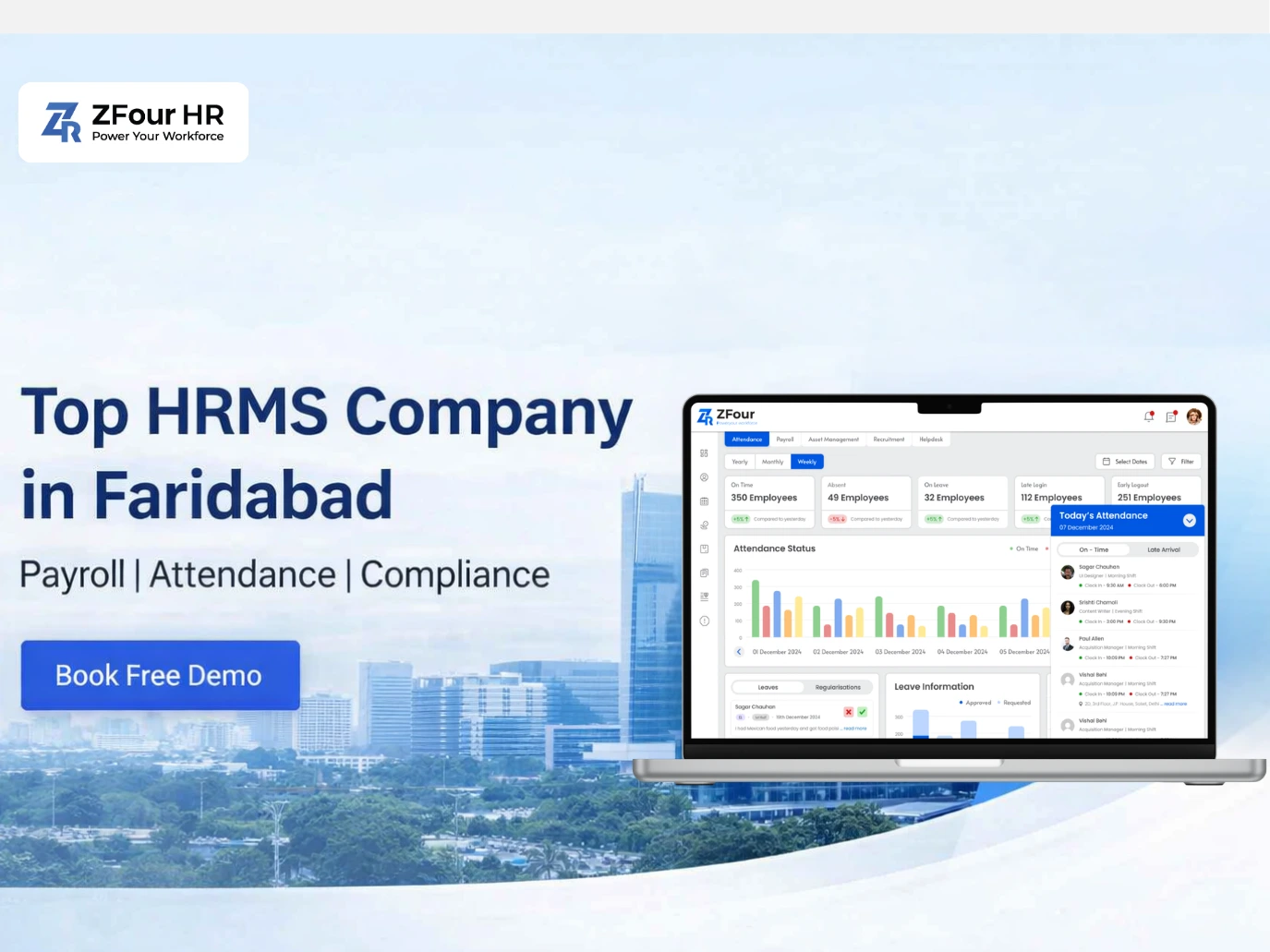
Managing HR operations becomes increasingly challenging as businesses grow. From payroll processing and attendance tracking to leave management, compliance, and employee records, manual HR processes consume valuable time and increase the risk of errors. The right HRMS software helps organizations automate these tasks, improve operational efficiency, and create a better employee experience.
Quick Answer
HRMS (Human Resource Management System) software is a centralized platform that automates payroll, attendance, leave management, employee records, recruitment, and HR workflows. Businesses in Faridabad use cloud-based HRMS solutions to reduce manual work, improve payroll accuracy, maintain compliance, and manage their workforce more efficiently from a single dashboard.
Key Highlights
Category | Details |
|---|---|
Best For | Startups, SMEs, Mid-sized Businesses & Enterprises |
Industries | Manufacturing, IT, Retail, Healthcare, Logistics, Professional Services |
Deployment | Cloud-Based HRMS |
Core Modules | Payroll, Attendance, Leave, Employee Database, Performance Management |
Integrations | Payroll, Attendance, Employee Self-Service, Compliance |
Primary Benefit | Automates HR operations while improving payroll accuracy |
Reading Time | 14–16 Minutes |
Last Updated | August 2026 |
AI Summary
HRMS software centralizes payroll, attendance, leave management, and employee records into one platform.
Businesses in Faridabad use HRMS solutions to reduce manual HR work and improve workforce efficiency.
Cloud-based HRMS software supports growing teams with real-time reporting, employee self-service, and automated compliance.
An integrated HRMS helps organizations improve payroll accuracy, employee productivity, and HR decision-making.
Choosing the right HRMS software supports long-term business growth and operational scalability.
Why Trust This Guide?
This guide is designed to help businesses evaluate HRMS software based on practical business requirements rather than marketing claims. It combines HR technology best practices, payroll management principles, workforce automation strategies, and current HRMS trends to provide balanced, actionable information.
The content is based on industry best practices, publicly available HR resources, and real-world business scenarios. It is reviewed regularly to keep the information relevant and aligned with evolving HR technology.
Whether you are a startup, SME, or enterprise, this guide will help you understand what to look for in an HRMS solution and how to choose software that supports your organization's long-term growth.
Sources referenced include:
Industry best practices for HR technology and workforce management
Introduction
Managing people is one of the most important responsibilities for any growing business. As employee numbers increase, HR teams often spend significant time handling payroll, attendance, leave requests, employee records, statutory compliance, and repetitive administrative tasks. When these processes are managed manually, businesses may experience payroll errors, compliance challenges, delayed approvals, and reduced productivity.
Faridabad is one of North India's leading industrial and commercial hubs, home to manufacturing companies, IT firms, engineering businesses, healthcare providers, educational institutions, logistics companies, and fast-growing startups. As these organizations expand, they need HR processes that are accurate, scalable, and efficient.
HRMS (Human Resource Management System) software addresses these challenges by bringing payroll, attendance, leave management, employee records, recruitment, performance management, and compliance into a single cloud-based platform. Instead of managing multiple spreadsheets and disconnected systems, HR teams can automate routine tasks, access real-time workforce insights, and focus on strategic initiatives that support business growth.
Whether you're running a manufacturing unit in Faridabad, managing an IT company, or leading a growing SME, choosing the right HRMS software can help simplify HR operations, improve employee experience, and support long-term organizational success.
In this guide, you'll learn what HRMS software is, why businesses in Faridabad are increasingly adopting cloud-based HR solutions, the features to look for, common implementation mistakes, and how to choose the best HRMS software for your organization.
What is an HRMS company?
An HRMS (Human Resource Management System) company develops and provides software that helps businesses automate and simplify their human resource operations. Instead of managing employee information through spreadsheets, paper records, or multiple disconnected tools, organizations can use an HRMS platform to centralize payroll, attendance, leave management, employee records, recruitment, performance management, and compliance in one secure system.

For businesses in Faridabad, an HRMS company is more than just a software provider it is a technology partner that helps streamline HR processes, reduce administrative workload, and improve workforce management. Modern cloud-based HRMS solutions also provide real-time reporting, employee self-service, mobile accessibility, and integrations with payroll and attendance systems, making day-to-day HR operations faster and more efficient.
As organizations grow, HR responsibilities become increasingly complex. A reliable HRMS solution enables businesses to automate repetitive tasks, improve payroll accuracy, support compliance requirements, and provide employees with a better workplace experience.
Why Businesses in Faridabad Need HRMS Software
Faridabad is one of India's major industrial and commercial centers, with businesses operating across manufacturing, healthcare, retail, education, logistics, and information technology. As organizations expand their workforce, managing HR processes manually often becomes inefficient and time-consuming.
Many businesses face challenges such as:
Managing employee attendance across multiple departments.
Processing payroll accurately every month.
Tracking employee leave and attendance.
Maintaining employee records securely.
Ensuring compliance with statutory regulations.
Supporting hybrid, remote, or field-based employees.
Generating HR reports for management decisions.
Traditional HR processes frequently rely on spreadsheets, paper documentation, and manual calculations, increasing the risk of payroll errors, delayed approvals, compliance issues, and duplicate work.
Cloud-based HRMS software helps businesses overcome these challenges by centralizing HR operations on a single platform. Payroll, attendance, leave management, employee records, recruitment, and performance management work together seamlessly, enabling HR teams to spend less time on repetitive administrative tasks and more time supporting business growth.
Whether you're a startup, SME, or enterprise, investing in HRMS software helps improve operational efficiency, enhance employee experience, and prepare your organization for long-term growth.
Common HR Challenges Businesses Face
As organizations grow, HR teams manage increasing volumes of employee data, payroll processing, attendance tracking, leave requests, and compliance documentation. Without an integrated HRMS solution, these responsibilities often become fragmented and difficult to manage.
Below are some of the most common HR challenges faced by growing businesses.
Challenge | How HRMS Software Helps |
|---|---|
Manual payroll processing | Automates salary calculations, deductions, and payroll workflows. |
Attendance tracking errors | Captures attendance automatically through integrated attendance systems. |
Leave management delays | Enables online leave requests, approvals, and balance tracking. |
Employee record management | Stores employee information securely in one centralized database. |
Compliance complexity | Supports payroll compliance and maintains digital records for reporting. |
Repetitive HR queries | Employee Self-Service allows employees to access information independently. |
Report generation | Generates real-time HR reports and workforce insights automatically. |
Workforce visibility | Provides centralized dashboards for HR managers and business leaders. |
Without an HRMS platform, businesses often spend significant time managing repetitive HR activities that can otherwise be automated. Modern HRMS software helps organizations improve efficiency, reduce administrative workload, and make better workforce decisions through accurate, real-time information.
Key Features of HRMS Software
An effective HRMS platform should do more than digitize HR records. It should integrate every stage of the employee lifecycle into one centralized system, helping organizations automate routine tasks while improving workforce visibility and operational efficiency.
1. Payroll Management
Payroll is one of the most critical HR functions. HRMS software automates salary calculations, tax deductions, overtime, incentives, reimbursements, and payslip generation while reducing manual effort and improving accuracy.
Business Benefits
Faster payroll processing
Reduced payroll errors
Improved statutory compliance
Secure digital payslips
2. Attendance Management
Integrated attendance management automatically records employee working hours, attendance, overtime, and shift schedules using biometric devices, mobile applications, GPS attendance, or web login.
Business Benefits
Real-time attendance tracking
Reduced manual entry
Improved payroll accuracy
Better workforce visibility
3. Leave Management
Employees can apply for leave online, while managers can review and approve requests through automated workflows.
Business Benefits
Faster approvals
Accurate leave balances
Reduced paperwork
Better employee experience
4. Employee Database
Maintain a centralized repository of employee information, including personal details, employment history, documents, banking information, and organizational records.
Business Benefits
Secure employee records
Easy document access
Improved data accuracy
Faster HR administration
5. Employee Self-Service (ESS)
Employee Self-Service empowers employees to access HR information without contacting HR for routine requests.
Employees can:
View attendance
Download payslips
Apply for leave
Update personal details
Access HR documents
Business Benefits
Reduces routine HR queries
Improves transparency
Enhances employee satisfaction
Saves HR time
6. Performance Management
HRMS software helps organizations monitor employee performance through structured goals, appraisals, feedback, and performance reviews.
Business Benefits
Objective performance evaluations
Better employee development
Improved goal tracking
Increased employee engagement
Benefits of Using HRMS Software
Implementing HRMS software provides measurable advantages for both HR teams and employees by automating repetitive processes and improving workforce management.
Improved Payroll Accuracy
Automated payroll calculations reduce errors while ensuring employees receive accurate salaries on time.
Increased HR Productivity
HR professionals spend less time on administrative work and more time supporting recruitment, employee engagement, and organizational development.
Better Employee Experience
Employees gain instant access to attendance records, payslips, leave balances, and HR documents through Employee Self-Service.
Improved Compliance
Digital records simplify compliance reporting while helping organizations maintain accurate payroll and employee information.
Better Decision-Making
Real-time HR dashboards and workforce reports enable business leaders to make informed decisions using accurate employee data.
How HRMS Software Works
A modern Human Resource Management System (HRMS) connects every major HR function into a single platform, allowing organizations to automate routine processes while maintaining accurate employee records. Instead of managing attendance, payroll, leave, and employee information separately, HRMS software synchronizes these processes to improve efficiency and reduce manual work.
The workflow typically follows these steps:
Employee Joins Organization
        ↓
Employee Information Added
        ↓
Attendance & Leave Tracked
        ↓
Payroll Calculated Automatically
        ↓
Manager Reviews & Approves
        ↓
Salary Processed
        ↓
Employee Receives Payslip
        ↓
Reports & Analytics Generated
This integrated workflow reduces repetitive administrative tasks, improves payroll accuracy, and provides HR teams with real-time visibility into workforce operations.
HRMS Software vs Traditional HR Management
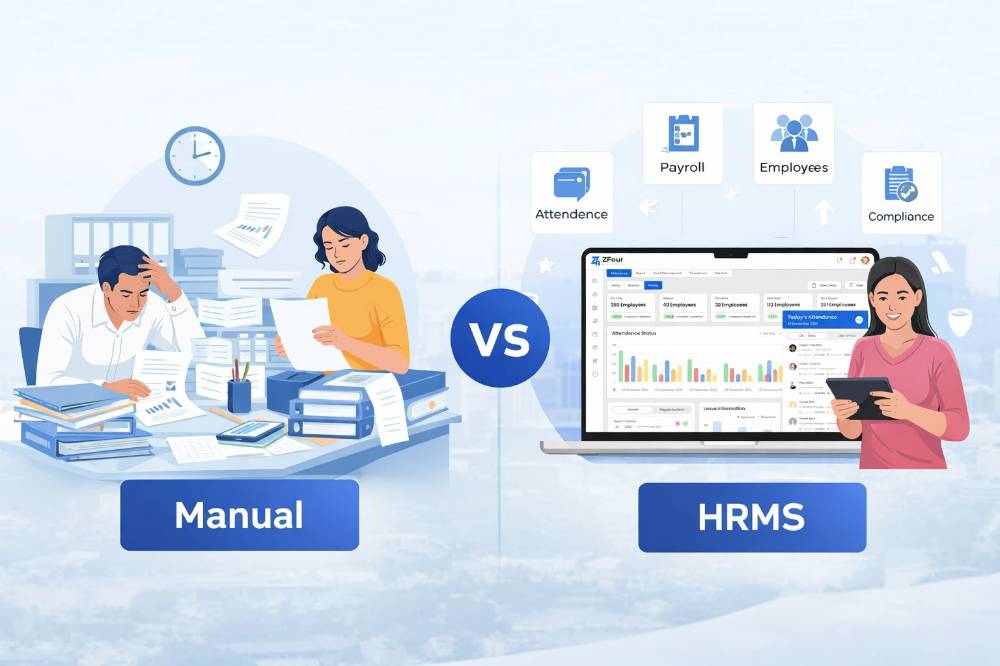
As businesses grow, traditional HR processes often become difficult to manage. HRMS software replaces manual tasks with automated workflows, enabling organizations to improve accuracy, productivity, and employee experience.
Feature | Traditional HR Management | Modern HRMS Software |
|---|---|---|
Employee Records | Paper Files & Spreadsheets | Centralized Digital Database |
Payroll Processing | Manual Calculations | Automated Payroll |
Attendance Tracking | Registers & Excel Sheets | Biometric, GPS & Mobile Attendance |
Leave Management | Paper Forms | Online Leave Requests & Approvals |
Employee Self-Service | HR Dependent | Self-Service Portal |
Compliance Reporting | Manual | Automated Reports |
Workforce Analytics | Limited | Real-Time Dashboards |
Accessibility | Office Only | Cloud-Based Access Anywhere |
Scalability | Difficult | Supports Business Growth |
Modern HRMS software helps organizations reduce administrative effort while improving operational efficiency and workforce transparency.
ROI Metrics (Illustrative Example)
Implementing HRMS software can improve HR efficiency by reducing repetitive manual tasks and centralizing workforce management. The following table shows illustrative operational improvements organizations may experience after adopting an integrated HRMS platform.
Business Metric | Before HRMS | After HRMS* |
|---|---|---|
Payroll Processing | Manual & Time-Consuming | Automated & Faster |
Attendance Management | Spreadsheet-Based | Real-Time Tracking |
Leave Approvals | Manual Workflow | Online Approval Process |
Employee Records | Multiple Files | Centralized Database |
HR Administrative Work | High | Significantly Reduced |
Employee Queries | Frequent | Lower Through Self-Service |
Reporting | Manual Reports | Real-Time Analytics |
Compliance Tracking | Time Intensive | Automated Documentation |
Note: These metrics are illustrative examples. Actual results depend on organization size, HR processes, implementation quality, and employee adoption.
Industry Use Cases
HRMS software is designed to support organizations across multiple industries by automating HR operations and improving workforce management. Different industries have unique HR challenges, and the right HRMS solution helps address them efficiently.
Manufacturing Companies
Manufacturing businesses often manage large workforces, multiple production shifts, overtime, contract employees, and statutory compliance requirements.
HRMS software helps manufacturing companies by:
Automating shift scheduling.
Tracking employee attendance accurately.
Calculating overtime automatically.
Simplifying payroll processing.
Maintaining compliance records.
A centralized HRMS reduces manual paperwork while improving workforce visibility across production units.
Information Technology (IT)
IT companies frequently manage hybrid teams, flexible working hours, remote employees, and project-based workforces.
HRMS software enables IT organizations to:
Monitor attendance remotely.
Manage employee leave digitally.
Automate payroll.
Track employee performance.
Improve workforce reporting.
Cloud-based HRMS platforms also support distributed teams through mobile access and employee self-service capabilities.
Healthcare
Hospitals, clinics, and healthcare organizations require continuous workforce availability with rotating shifts and strict compliance requirements.
HRMS software supports healthcare providers by:
Managing complex shift schedules.
Recording attendance accurately.
Automating payroll.
Maintaining employee records.
Supporting workforce planning.
This helps healthcare administrators focus more on patient care while improving HR efficiency.
Retail Businesses
Retail organizations often operate multiple branches with rotating staff schedules and varying workforce requirements.
HRMS software allows retailers to:
Manage attendance across multiple stores.
Track employee working hours.
Process payroll efficiently.
Monitor leave balances.
Generate workforce reports.
Centralized HR management simplifies operations while improving employee accountability.
Logistics & Field Operations
Organizations managing delivery teams, service engineers, sales representatives, and field employees require flexible attendance tracking.
HRMS software supports these businesses through:
GPS-enabled mobile attendance.
Field workforce monitoring.
Real-time attendance updates.
Automated payroll integration.
Digital employee records.
Managers gain better visibility into employee availability without relying on manual attendance reporting.
Startups & Small Businesses
Growing startups often have limited HR resources but increasing workforce management responsibilities.
HRMS software enables startups to:
Automate repetitive HR tasks.
Improve payroll accuracy.
Manage employee records centrally.
Reduce administrative workload.
Scale HR operations as the business grows.
By implementing HRMS early, startups can establish efficient HR processes that continue supporting business expansion.
Why Businesses in Faridabad Choose Cloud-Based HRMS
Businesses across Faridabad are increasingly adopting cloud-based HRMS software because it provides flexibility, accessibility, and operational efficiency without requiring complex IT infrastructure.
Cloud HRMS solutions allow organizations to:
Access HR information securely from anywhere.
Manage multiple office locations through one platform.
Reduce manual paperwork.
Improve collaboration between HR teams and employees.
Scale HR operations as the workforce grows.
Whether managing a manufacturing unit, IT company, healthcare organization, retail chain, or startup, cloud-based HRMS software helps businesses modernize HR operations while improving productivity and employee experience.
HRMS ROI at a Glance
Area | Business Impact |
|---|---|
Payroll Processing | Faster salary calculations and reduced manual effort |
Attendance Management | Improved accuracy with automated tracking |
Leave Management | Faster approvals and better visibility |
Employee Records | Centralized and secure data management |
HR Productivity | More time for strategic HR initiatives |
Employee Experience | Better transparency through self-service |
Compliance | Easier record management and reporting |
Business Growth | Scalable HR operations for expanding organizations |
Buying Guide: How to Choose the Top HRMS Company in Faridabad
Choosing the right HRMS software is a long-term investment that can significantly improve HR efficiency, employee experience, and business productivity. While many HRMS providers offer similar features, the best solution should align with your organization's current requirements and future growth plans.
Instead of selecting software based only on pricing, businesses should evaluate functionality, scalability, ease of use, security, customer support, and integration capabilities.
Whether you're a startup with 20 employees or a large enterprise managing thousands of employees, choosing the right HRMS platform can simplify HR operations while supporting long-term organizational growth.
Before making a decision, ask yourself:
Does the software automate payroll and attendance?
Can employees access information through a self-service portal?
Is it cloud-based?
Will it support future business growth?
Does it integrate with existing business systems?
Is customer support reliable?
Does it simplify statutory compliance?
Answering these questions helps businesses choose an HRMS platform that delivers long-term value instead of only solving short-term problems.
How to Choose the Best HRMS Software in Faridabad
Every organization has different HR requirements. The right HRMS solution should simplify daily operations while remaining flexible enough to support future expansion.
1. Payroll Automation
Payroll is one of the most critical HR functions. Choose HRMS software that automates:
Salary calculations
Tax deductions
Overtime
Bonuses
Payslips
Reimbursements
Automated payroll minimizes errors while saving HR teams significant processing time.
2. Attendance & Leave Management
Attendance should integrate directly with payroll.
Look for features such as:
Biometric attendance
GPS attendance
Mobile attendance
Shift management
Leave approval workflows
Holiday calendars
Integrated attendance management eliminates duplicate data entry and improves payroll accuracy.
3. Employee Self-Service (ESS)
Employees increasingly expect quick access to HR information.
An effective ESS portal should allow employees to:
Download payslips
Apply for leave
View attendance
Update personal details
Access company documents
Employee self-service reduces routine HR queries while improving transparency.
4. Cloud Accessibility
Cloud-based HRMS software enables businesses to manage HR operations from any location.
Benefits include:
Anywhere access
Automatic backups
Multi-location management
Secure cloud storage
Reduced IT infrastructure
Cloud deployment is particularly beneficial for organizations managing multiple offices or hybrid workforces.
5. Scalability
Choose software that grows with your business.
A scalable HRMS should support:
Additional employees
Multiple departments
Multiple branches
New HR modules
Business expansion
Migrating HR software every few years can be costly, so selecting a scalable solution from the beginning is a better long-term investment.
6. Reporting & Analytics
Real-time HR reporting helps business leaders make informed decisions.
Look for reports covering:
Payroll
Attendance
Leave
Overtime
Employee turnover
Workforce trends
Department performance
Accurate reports support better planning and resource allocation.
7. Security & Compliance
Employee records contain sensitive personal and financial information.
Your HRMS should provide:
Role-based access
Secure authentication
Encrypted data
Audit logs
Regular backups
Strong security measures help protect business and employee information.
According to the Society for Human Resource Management (SHRM), organizations that adopt digital HR technologies can improve workforce efficiency, streamline HR operations, and enhance the overall employee experience. Learn more from SHRM's HR technology.
HRMS Evaluation Checklist
Evaluation Criteria | Recommended |
|---|---|
Payroll Automation | ✓ |
Attendance Management | ✓ |
Leave Management | ✓ |
Employee Self-Service | ✓ |
Mobile App | ✓ |
Cloud-Based Access | ✓ |
Real-Time Reports | ✓ |
Performance Management | ✓ |
Recruitment Module | ✓ |
Employee Database | ✓ |
Multi-Location Support | ✓ |
API Integrations | ✓ |
Compliance Support | ✓ |
Data Security | ✓ |
Customer Support | ✓ |
Common Mistakes Businesses Make When Choosing HRMS Software
Selecting HRMS software without proper evaluation can lead to implementation challenges, increased costs, and operational inefficiencies. Avoid these common mistakes before making your decision.
Choosing Software Only Based on Price
The least expensive software isn't always the most cost-effective.
Instead, evaluate:
Features
Scalability
Security
Customer support
Integration capabilities
Ease of use
A slightly higher investment in a comprehensive HRMS often provides better long-term value.
Ignoring Payroll Integration
Many organizations purchase attendance software separately from payroll.
This often results in:
Duplicate work
Payroll errors
Manual calculations
Increased HR workload
An integrated HRMS eliminates these issues.
Overlooking Employee Experience
Employees interact with HR systems regularly.
A difficult-to-use platform reduces adoption.
Choose software with:
Simple navigation
Mobile accessibility
Employee self-service
Fast response times
Not Planning for Business Growth
Many companies select HRMS software based only on their current workforce size.
As organizations grow, they require:
Additional users
More modules
Advanced reporting
Multi-location support
Selecting scalable software prevents future migration challenges.
Ignoring Customer Support
Implementation doesn't end after software installation.
Reliable customer support is essential for:
Employee onboarding
Technical assistance
Product training
Feature updates
Issue resolution
Evaluate the provider's support services before making your decision.
Expert Insights
Expert Tip 1
Businesses with growing workforces typically achieve better operational efficiency by integrating payroll, attendance, leave management, and employee records into a single HRMS platform rather than managing multiple standalone applications.
Expert Tip 2
Cloud-based HRMS software provides greater flexibility for organizations managing hybrid teams, multiple office locations, or remote employees by enabling secure access from anywhere.
Expert Tip 3
Organizations implementing HRMS software should prioritize employee training and change management. Higher user adoption leads to more accurate data, smoother workflows, and greater return on investment.
Expert Tip 4
When evaluating HRMS providers, focus on long-term business value rather than the number of available features. A platform that is easy to use, scalable, and well-supported often delivers better outcomes than software with unnecessary complexity.
Future Trends in HRMS Software
Human Resource Management Systems continue to evolve as organizations embrace digital transformation and changing workforce expectations.
Key trends shaping the future of HRMS include:
Artificial Intelligence (AI) for HR automation
Predictive workforce analytics
Employee self-service enhancements
Mobile-first HR experiences
Cloud-native HR platforms
Automated compliance management
Real-time workforce dashboards
AI-powered recruitment assistance
Performance analytics
Integrated workforce planning
Businesses that adopt modern HRMS technology today are better positioned to improve operational efficiency, support employee engagement, and scale HR processes as their organizations grow.
Key Takeaways
HRMS software centralizes payroll, attendance, leave management, and employee records in one platform.
Cloud-based HRMS solutions improve operational efficiency while reducing manual HR work.
Integrated payroll and attendance help minimize processing errors and improve accuracy.
Employee Self-Service portals enhance transparency and reduce routine HR queries.
Choosing scalable HRMS software supports long-term business growth.
Evaluate functionality, security, scalability, customer support, and integration before selecting an HRMS provider.
Businesses in Faridabad can benefit from HRMS solutions that simplify workforce management while supporting compliance and employee productivity.
Ready to Simplify Your HR Operations?
Managing payroll, attendance, leave requests, employee records, and compliance manually can become increasingly time-consuming as your business grows. A modern HRMS platform helps centralize these processes, reduce administrative effort, and improve workforce visibility through automation.
Whether you operate a startup, SME, manufacturing unit, healthcare organization, retail business, or enterprise in Faridabad, implementing the right HRMS software can support more efficient HR operations while enhancing the employee experience.
Why Businesses Choose ZFour HRMS
✔ Automated Payroll Management
✔ Smart Attendance Tracking
✔ Leave Management System
✔ Employee Self-Service Portal
✔ Secure Employee Database
✔ Real-Time HR Analytics
✔ Cloud-Based Accessibility
✔ Compliance Support
✔ Mobile-Friendly HRMS
✔ Scalable for Growing Businesses
Book Your Free HRMS Demo
See how ZFour HRMS can help automate payroll, attendance, leave management, employee records, and workforce operations—all from one secure cloud-based platform.
👉 Schedule a personalized demo today and discover how HR automation can support your business growth.
Related Articles

Farheen Ahmed
HR Tech Content Strategist at ZFour Technology Private Limited
Research-driven content on HRMS, payroll, attendance management, employee management, and modern HR technology for Indian businesses.