11 min read
Let's be honest—HR work in India is not simple.
One day it's payroll mismatches, the next day it's PF deadlines, attendance disputes, or onboarding chaos. Most HR teams are still juggling Excel sheets, WhatsApp messages, emails, and multiple tools just to get basic work done.
That's exactly why ZFour HRMS was built—to make everyday HR work easier, cleaner, and far less stressful.
This blog doesn't sell features. It explains how ZFour actually helps HR teams in real life.
Quick Answer: What Does ZFour HRMS Actually Do for Indian HR Teams?
ZFour HRMS centralizes employee data, payroll, attendance, compliance, recruitment, and performance management into one connected platform, replacing the mix of spreadsheets, WhatsApp threads, and disconnected tools most Indian HR teams currently rely on. It's built specifically around Indian statutory requirements—PF, ESI, TDS, and state-wise professional tax—rather than retrofitting a global HR tool for the Indian market.
Who This Guide Is Actually For
This guide is written for the HR person, HR manager, or small HR team who's currently doing the work manually — not for someone comparing feature checklists in the abstract.
If any of this sounds familiar, keep reading:
You're the one who gets pinged on WhatsApp when someone's payslip looks wrong
You've built at least one "master sheet" that three other people also have slightly different copies of
You've had a compliance deadline sneak up on you because it wasn't written down anywhere central
You're spending more time chasing information than actually managing people
This isn't written for a 2,000-person enterprise with a dedicated HRIS team. It's written for the HR function that's still figuring out how to scale itself alongside the business.
Why Indian HR Teams Need One Strong System
Indian businesses operate in a complex environment:
Different state compliance rules
Mixed workforces (office, remote, field)
Frequent payroll changes
Growing employee expectations
Manual processes don't scale—and small mistakes can become big problems.
Here's what that actually looks like in practice. Picture a mid-sized services company with 60 employees across two cities.
HR maintains attendance in one spreadsheet, leave requests come in over email and WhatsApp interchangeably, payroll is calculated by exporting attendance data into a second spreadsheet and manually cross-referencing it against a third sheet with salary structures.
Every month, at least one employee's attendance doesn't match what they remember, someone's leave balance is wrong because a request got approved over WhatsApp but never logged in the "official" tracker, and the person running payroll spends the better part of two days just reconciling numbers before anyone even gets to calculating PF or TDS.
None of this happens because the HR team is bad at their job. It happens because the tools weren't built to talk to each other, so every handoff between attendance, leave, and payroll becomes a manual translation step — and manual translation steps are exactly where errors live.
ZFour HRMS brings everything—people data, payroll, attendance, compliance, and performance—into one place, so HR teams can focus on people instead of paperwork.
What a Typical Week Looks Like, Before and After
It's easier to see the actual impact by comparing a normal week rather than a feature list.
Task | Before (Manual/Spreadsheet-Based) | After (ZFour HRMS) |
|---|---|---|
Monday: Reviewing weekend leave requests | Scattered across WhatsApp, email, and a shared sheet nobody fully trusts | One dashboard showing pending requests with full leave-balance context |
Wednesday: New employee joining | Manual document collection, separate onboarding checklist in a doc file | Digital onboarding workflow with automatic task assignment to HR, IT, and the manager |
Friday: Attendance query from an employee | HR manually checks the attendance register or biometric export | Employee checks their own attendance and leave balance via self-service, no HR involvement needed |
Month-end: Payroll processing | Attendance, leave, and salary data manually reconciled across 3+ files | Payroll pulls directly from synced attendance and leave data |
Ongoing: "Is this employee's information current?" | Depends which of the 4 files someone opens | One source of truth, updated once |
This is really the core value proposition in practice: it's not that any single task becomes dramatically faster in isolation, it's that the handoffs between tasks stop being manual translation work.
Common Concerns HR Teams Raise Before Switching
These come up often enough that they're worth addressing directly, rather than glossing over.
"Won't this be disruptive to switch mid-year?"
Migration typically happens in parallel with your existing process for at least one payroll cycle, so nothing goes live without being checked against what you already know is correct. Most teams don't switch cold.
"We're not big enough to need this."
This is less about company size and more about how many manual handoffs currently exist in your process. A 15-person company with employees across two locations can hit the same reconciliation problems as a 100-person company in one office. Team size is a weaker predictor than operational complexity.
"Our team isn't very technical."
This is a fair concern, and worth testing directly during a demo rather than taking on faith — ask to see the actual day-to-day screens an HR admin would use, not just the sales presentation.
"What happens to our historical data?"
Historical employee records, past payroll runs, and leave balances are part of a standard migration process — this is worth confirming specifically for your data setup before committing, since every organization's existing records are a little different.
"Will employees actually use self-service, or will they still just message HR?"
Adoption depends partly on how it's introduced. Teams that get a short walkthrough and understand why self-service exists (fewer wait times for them, not just less work for HR) tend to adopt it faster than teams where the tool just appears with no explanation.
Core HR & Employee Management
At its core, ZFour works like a single source of truth for employee data.
Instead of updating the same details in five places, HR teams can manage:
Employee profiles
Job roles and departments
Salary and bank details
Documents like PAN, Aadhaar, and offer letters
If an employee's role, location, or salary changes, it updates everywhere automatically. No duplicate entries. No confusion during payroll.
It sounds basic—but this alone saves hours every month.
How ZFour Helps HR Teams (At a Glance)
HR Challenge Faced by Indian Teams | How ZFour Helps |
|---|---|
Managing employee data in multiple files | Centralized employee database with a single source of truth |
Payroll errors and salary mismatches | Fully automated payroll with accurate calculations |
PF, ESI, and TDS compliance stress | Auto-calculation and statutory compliance tracking |
Attendance disputes and manual tracking | Web, mobile, biometric, and geo-fencing attendance |
Complex shift and overtime rules | Automated shift management and overtime handling |
Slow hiring and onboarding process | AI-powered hiring and automated onboarding workflows |
Poor visibility of field staff | Live tracking and geo-fencing for field teams |
Performance reviews feeling biased | Goal-based and structured performance management |
Employees missing HR communications | WhatsApp + email notifications for faster reach |
HR spending time on manual reports | Real-time dashboards and ready HR analytics |
Recruitment & Smooth Onboarding
Hiring can drain a lot of time—especially when resumes pile up.
With ZFour:
AI helps shortlist the most relevant candidates
Interview scheduling happens without endless emails
Feedback stays organized in one place
Once a candidate accepts the offer, onboarding doesn't feel chaotic. HR, IT, Finance, and managers automatically know what they need to do.
The result? New hires feel welcomed, not lost, on their first day.
This matters more than it sounds like on paper. A new hire's first two weeks shape whether they feel like they made the right decision joining your company.
When onboarding is scattered — a laptop request that falls through the cracks, a bank-detail form that gets lost in an inbox, an ID card that takes three weeks because nobody was clearly responsible for ordering it — that friction gets attributed to the company, not to the process.
A structured onboarding workflow removes the ambiguity about who's responsible for what, so those first two weeks go smoothly by default rather than by luck.
Which HR Function Should You Automate First?
Not every HR team needs to switch everything at once, and trying to do so can itself become disruptive. A more realistic approach is identifying where your current process is causing the most actual pain, and starting there.
If your biggest pain point is... | Start with... | Because... |
|---|---|---|
Payroll errors or delays every month | Payroll + attendance integration | This is usually where manual reconciliation causes the most repeated, visible damage |
Constant "what's my leave balance" questions | Employee self-service | Removes the highest-frequency, lowest-value HR interruptions first |
Compliance deadlines feeling unpredictable | Compliance dashboard and tracking | Reduces the risk of a missed statutory deadline, which tends to be the costliest single mistake |
Field staff visibility gaps | Geo-fencing and live tracking | Solves a distinct operational problem that doesn't overlap much with office-based workflows |
Slow, inconsistent onboarding | Digital onboarding workflows | Directly shapes new-hire experience, which is disproportionately visible to leadership |
Most teams end up adopting most modules eventually, but starting with the area causing the most active pain — rather than trying to configure everything simultaneously — tends to produce a smoother rollout and faster, more confident adoption.
Attendance & Daily HR Operations
Attendance is one of the most sensitive HR areas.
ZFour makes it flexible and fair by supporting:
Web and mobile attendance
Biometric machines
Geo-fencing for field teams
Whether your team works from the office, client sites, or multiple locations, attendance data stays accurate—and payroll stays clean.
No more "Sir, my attendance is wrong" messages at month-end.
Payroll That HR Can Trust
Payroll errors damage trust faster than almost anything else.
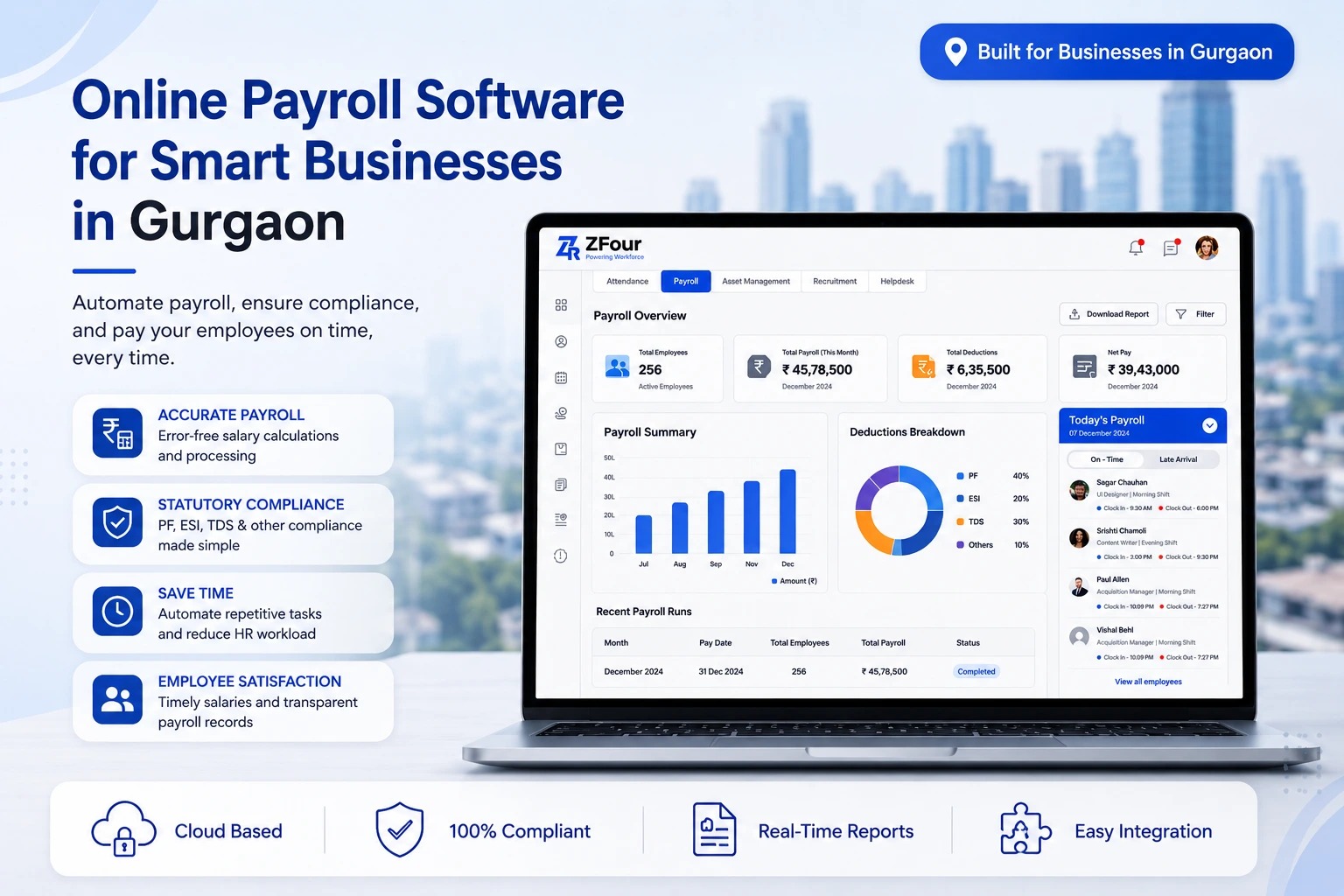
ZFour automates:
Salary calculations
PF, ESI, TDS, and professional tax
Variable pay, bonuses, and incentives
Loans and deductions
Payroll that once took hours (and anxiety) now runs in minutes—with confidence.
Finance teams get clarity. Employees get accurate payslips. HR gets peace of mind.
For a full breakdown of how PF and ESI are actually calculated—on Basic and Gross salary, not full CTC—see our PF and ESI calculation guide.
Compliance Without Panic
Compliance deadlines shouldn't cause panic every month.
ZFour keeps track of:
PF and ESI calculations
TDS and Form 16
State-wise professional tax
Statutory reports and due dates
A simple dashboard shows what's done and what's pending—so nothing slips through the cracks.
This is especially helpful for companies operating across multiple states. For the official contribution rules, see the Employees' Provident Fund Organisation (EPFO) and Employees' State Insurance Corporation (ESIC) — and for the fuller statutory picture, our complete guide to payroll compliance in India covers PF, ESI, wages, and HR rules in depth.
Field Teams & On-Ground Staff
For companies with field employees, ZFour adds real value.
Managers can:
See live team locations
Track attendance using geo-fencing
Optimize routes for deliveries or visits
Track company assets assigned to employees
It reduces unnecessary calls and improves accountability—without micromanaging. See our guide to field employee attendance tracking for how this works in practice.
Performance & Growth Conversations
Performance reviews don't have to feel awkward or biased.
ZFour helps teams:
Set clear goals
Track progress over time
Collect feedback fairly
Managers have data to support discussions, and employees understand how they're growing.
This creates healthier performance conversations—not stressful ones.
Communication Employees Actually Read
ZFour uses WhatsApp along with email—and that's a big win in India.
Employees receive:
Leave approvals
Attendance alerts
Payslip notifications
Important announcements
WhatsApp ensures messages are seen quickly, while email keeps official records intact.
Fast communication + proper documentation = fewer misunderstandings.
Final Thoughts: Is It Worth It?
If your HR team is tired of:
Manual work
Payroll confusion
Compliance stress
Disconnected tools
Then ZFour HRMS is worth serious consideration.
It's practical, India-focused, and designed for real HR challenges—not just feature lists.
Every HR team works differently.
What Getting Started Actually Looks Like
Implementation isn't a single dramatic switch-over — it's typically a short, structured sequence:
Week 1: Data and requirements.
Existing employee records, salary structures, and current attendance/leave policies get mapped out. This is also when your team defines which workflows genuinely need to be configured versus which default settings already work for you.
Week 2: Configuration and migration.
Employee data, historical records, and policy rules get set up in the system. This runs in parallel with your existing process, not instead of it.
Week 3: Parallel run.
Payroll (and other core workflows) run in both the old process and ZFour side by side, so any discrepancies surface and get resolved before anyone relies on the new system alone.
Week 4 onward: Full transition and training.
Once the parallel run confirms accuracy, the old process is retired. Managers and employees get a walkthrough of self-service features specifically — this is usually the step that determines how quickly adoption actually happens.
Timelines vary by company size and data readiness, but this sequence — audit, configure, run in parallel, then fully switch — is the shape implementation takes regardless of company size.
What This Guide Doesn't Cover (And Where to Find It)
What This Guide Doesn't Cover (And Where to Find It)
This guide is deliberately focused on the practical, day-to-day picture of using ZFour — not the detailed mechanics of Indian statutory compliance, which deserve their own dedicated treatment:
* For exactly how PF and ESI are calculated on Basic and Gross salary, see our PF and ESI calculation guide.
* For the full statutory compliance picture — PF, ESI, wages, and HR rules — see our payroll compliance in India guide
* For field and distributed workforce tracking specifically, see our field employee attendance tracking guide.
* If you're comparing ZFour against other HRMS platforms before deciding, see our full comparison of the best HR management software in India.
If you're here because you want to understand what using ZFour actually feels like day to day, this guide should cover that. If you're here for the statutory specifics or a platform comparison, those guides go deeper than this one intentionally does.
Schedule a ZFour HRMS demo and see how it simplifies payroll, attendance, and compliance for your setup.

Farheen Ahmed
HR Tech Content Strategist at ZFour Technology Private Limited
Research-driven content on HRMS, payroll, attendance management, employee management, and modern HR technology for Indian businesses.