7 min read
Choosing HR software in India is confusing partly because vendors use HRIS, HRMS, and HCM inconsistently — some tools call themselves HRIS despite including payroll, some HRMS platforms offer only basic features, and some HCM suites are built for enterprises far larger than most companies evaluating them. This confusion isn't accidental; it reflects genuine overlap in how the industry itself uses these terms.
This guide breaks down what each term actually means, based on feature scope rather than marketing labels, explains why the boundaries are blurrier than most comparison articles admit, and gives you a practical way to evaluate a system regardless of what category it's marketed under.
Quick Answer: What's the Difference Between HRIS, HRMS, and HCM?
HRIS (Human Resource Information System) is the foundational layer — a digital system of record for employee data, attendance, and basic HR processes.
HRMS (Human Resource Management System) builds on HRIS by adding operational automation: payroll, recruitment, performance management, and advanced attendance handling.
HCM (Human Capital Management) extends further into strategic workforce planning: succession, learning and development, compensation strategy, and multi-country operations.
Each system is generally a superset of the one before it — HRMS includes HRIS-level functions, and HCM includes both. There's no universally agreed employee-count threshold for choosing between them; the more reliable approach is evaluating actual feature scope against your organization's operational needs.
Why This Terminology Is Genuinely Confusing
Unlike more standardized technical terms, HRIS, HRMS, and HCM don't have a single authoritative body defining their boundaries. Vendors market products inconsistently — a platform with full payroll and applicant tracking might still call itself "HRIS" for brand-positioning reasons, while another company's "HCM" platform may lack workforce forecasting entirely.
This isn't a minor inconsistency. Multiple HR-technology analysts have noted that even industry experts don't fully agree on precise definitions, and that the practical distinction has more to do with feature depth than the label a vendor chooses. This matters for buyers because comparing platforms by category name alone can be actively misleading — the only reliable comparison is feature-by-feature.
What Is HRIS?
HRIS is the simplest of the three — essentially a digital system of record for employee data and basic HR processes. Think of it as the foundational database layer that other systems build on top of.
What HRIS Typically Includes
Employee data storage (personal details, employment history, documents)
Attendance and leave tracking
Document management
Basic compliance data (statutory information, records for audits)
Simple employee self-service (viewing personal details, basic requests)
What HRIS Typically Doesn't Include
Full payroll processing
Recruitment or applicant tracking
Performance management
Advanced analytics or predictive reporting
Complex shift or attendance rule configuration
Common Limitation
As HR needs grow more complex — more employees, more processes, more compliance requirements across different roles or locations — a basic HRIS often can't keep pace. This typically shows up as increasing manual work: payroll being calculated outside the system, attendance discrepancies requiring manual reconciliation, or hiring being tracked in spreadsheets because the HRIS has no recruitment module.
What Is HRMS?
HRMS builds on HRIS by adding operational automation across core HR functions, moving from pure recordkeeping into active process management.
What HRMS Typically Includes
Payroll processing, including statutory deductions relevant to the Indian context (PF, ESI, TDS, Professional Tax)
Time and attendance, including biometric, GPS, and geo-fencing options for distributed or field teams
Shift and overtime management, for organizations with complex scheduling needs
Automated leave management, connecting leave requests, balances, and approvals
Recruitment and applicant tracking, streamlining hiring workflows
Performance reviews and goal tracking
Employee self-service portal, reducing routine HR queries
Manager dashboards and reporting
Compliance-related automation, reducing manual tracking of statutory requirements
Configurable HR workflows, adapting to an organization's specific approval structures
Why HRMS Is Commonly Used by Growing Indian Companies
HRMS platforms directly address the operational pain points that emerge as headcount grows — attendance discrepancies that require manual investigation, payroll processing that takes days instead of hours, hiring pipelines that outgrow spreadsheet tracking, and compliance requirements specific to Indian labour law (multi-state Professional Tax variation, ESI eligibility thresholds, PF contribution calculations) that become error-prone to track manually.
What Is HCM?
HCM (Human Capital Management) extends beyond operational HR administration into strategic workforce planning, treating employees as assets to be developed rather than purely as administrative records.
What HCM Typically Includes
Succession planning
Leadership development programs
Compensation strategy and benchmarking
Learning and development platforms
Workforce forecasting and predictive analytics
Multi-country payroll and compliance
Enterprise-level, often predictive analytics
Typical Fit
Larger organizations with multiple branches, complex organizational structures, or multi-country operations, where long-term workforce strategy — not just day-to-day administration — becomes a core business function. HCM platforms are generally built assuming a level of organizational complexity that smaller companies haven't yet reached.
General Guide: Which System Fits Your Stage?
As a general guide — not a strict rule:
Smaller or early-stage businesses often start with HRIS-level tools, since basic recordkeeping and simple processes cover most of their immediate needs
Growing companies typically need HRMS-level automation once payroll, attendance, and hiring processes become too complex to manage manually
Larger, more complex organizations often move toward HCM once workforce strategy and multi-country or multi-branch complexity become significant factors
These aren't precise thresholds. Industry analysis of HR technology terminology notes that vendors and even well-known HR-technology experts use these terms inconsistently — a product marketed as 'HRIS' that includes payroll and applicant tracking is functionally an HRMS, regardless of the label.
HRIS vs HRMS vs HCM: Feature Comparison
Feature | HRIS | HRMS | HCM |
|---|---|---|---|
Employee Records | Yes | Yes | Yes |
Payroll Automation | No | Yes | Yes |
Attendance Tracking | Basic | Advanced (biometric, GPS) | Advanced |
Recruitment | No | Yes | Enterprise-level |
Performance Management | No | Yes | Strategic, integrated |
Learning & Development | No | Limited | Comprehensive |
Succession Planning | No | No | Yes |
Multi-Country Support | Rare | Limited | Common |
Analytics | Basic reporting | Strong operational reporting | Predictive, strategic |
Compliance | Minimal, record-based | Full automation for single-country context | Global, multi-jurisdiction |
Note: Feature availability varies significantly between vendors even within the same category. Always verify specific capabilities directly with a provider rather than assuming based on the category label alone — the table above reflects typical positioning, not a guarantee for any specific product.
Signs You Might Need to Upgrade
From HRIS to HRMS, When:
Payroll processing takes increasing amounts of manual time each cycle
Shift scheduling becomes genuinely complex across teams or locations
Employees ask for more transparency into attendance and leave balances
Hiring volume increases beyond what manual or spreadsheet tracking supports
Performance tracking becomes difficult to manage informally across a growing team
Compliance risk starts feeling harder to manage manually, particularly across multiple states
Managers need reporting the current system simply can't produce
From HRMS to HCM, When:
The organization crosses into genuinely enterprise-scale headcount and complexity
Succession planning becomes a real, active business need rather than a future consideration
Strategic workforce analytics matter more than day-to-day operational reporting
Operations span multiple states or countries with meaningfully different compliance requirements
How to Evaluate a System Regardless of Its Label
Given the inconsistent terminology across vendors, the most reliable evaluation approach skips the category label entirely:
List your actual operational pain points — is it payroll speed, attendance accuracy, hiring bottlenecks, or reporting gaps?
Map those pain points to specific features, not category names
Test the platform against your hardest real scenario — a multi-state employee, a complex shift pattern, a mid-cycle joiner — rather than a generic demo walkthrough
Confirm compliance specifics directly — statutory requirements like PF, ESI, and Professional Tax vary by state, so ask how the vendor keeps pace with regulatory changes rather than assuming any platform automatically handles this correctly.
How ZFour HRMS Fits This Landscape
How ZFour HRMS Fits This Landscape
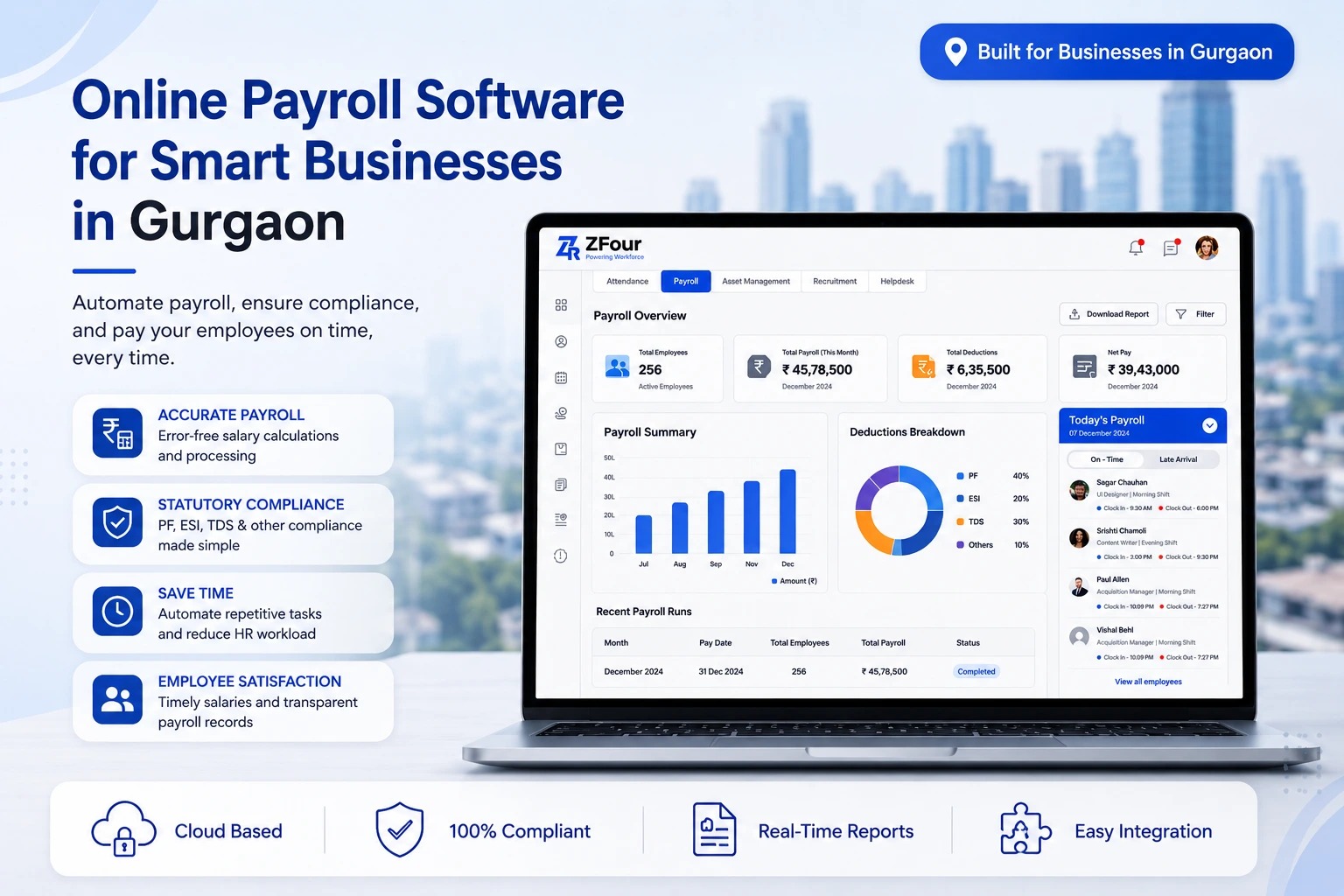
ZFour HRMS is positioned as an HRMS built specifically for Indian companies, with capabilities including payroll automation with statutory compliance (PF, ESI, TDS, Professional Tax), real-time attendance tracking (biometric, GPS, geo-fencing), AI-assisted recruitment support, built-in asset management, and HR analytics — scaled for organizations moving past basic recordkeeping into full HR automation, without the complexity or cost typically associated with enterprise HCM platforms.
For a broader look at how ZFour HRMS compares to other platforms in the Indian market, see ZFour HRMS software in India: a practical guide. If you're comparing ZFour against other vendors specifically, see our full comparison of the best HR management software in India.
Final Thoughts
The distinction between HRIS, HRMS, and HCM is more useful as a framework for understanding feature depth than as a rigid rule based on employee count or vendor marketing. Because the industry itself uses these terms inconsistently, the most reliable way to choose is evaluating what a specific platform actually does — payroll automation, attendance handling, recruitment support, analytics depth — against your organization's actual operational pain points, rather than assuming a category label guarantees a specific feature set.
Want to see whether ZFour HRMS fits your organization's current operational needs?
Book a ZFour HRMS demo.

Farheen Ahmed
HR Tech Content Strategist at ZFour Technology Private Limited
Research-driven content on HRMS, payroll, attendance management, employee management, and modern HR technology for Indian businesses.