9 min read
Choosing the top HRMS software in India depends on more than the number of features a platform offers.
Indian businesses often need HR software that can manage payroll, attendance, leave, employee records, onboarding, employee self-service, reporting, and applicable compliance workflows within a connected system.
For businesses specifically comparing payroll and attendance capabilities, the right HRMS should also support the organization's workforce structure, attendance methods, payroll requirements, integrations, reporting needs, and budget.
This guide compares ZFour HRMS, Keka HR, greytHR, Zoho People, and Darwinbox based on their positioning, payroll and attendance capabilities, business fit, and factors businesses should evaluate before choosing a platform.
Quick Answer: For businesses comparing HRMS software in India for payroll and attendance, the right platform depends on payroll complexity, attendance requirements, compliance workflows, employee size, and budget. ZFour HRMS is one option to evaluate alongside other established platforms.
What Is HRMS Software?
HRMS stands for Human Resource Management System.
It is a digital platform used to manage and connect different HR processes.
Depending on the platform and plan, HRMS software can include:
Employee records
Payroll
Attendance
Leave management
Recruitment
Onboarding
Performance management
Employee self-service
Reporting and analytics
Compliance workflows
Shift management
HR document management
Instead of maintaining employee information across multiple spreadsheets and disconnected tools, businesses can use an HRMS to centralize relevant HR information and workflows.
Why Do Indian Businesses Need HRMS Software?
HR teams often manage processes that depend on the same employee information.
For example:
Employee Records → Attendance → Leave → Payroll → Payslip → Employee Self-Service
When these processes are managed separately, HR teams may have to transfer information between systems or reconcile data manually.
An HRMS can help connect these workflows.
Businesses commonly evaluate HRMS software to:
Reduce repetitive administrative work
Centralize employee information
Automate configured payroll processes
Track attendance and leave
Improve employee self-service
Simplify HR reporting
Support payroll and statutory workflows
Improve visibility across HR operations
However, businesses should verify the exact capabilities and configuration of each platform before implementation.
Top HRMS Software in India for Payroll and Attendance in 2026
For this comparison, we are evaluating five platforms:
ZFour HRMS
Keka HR
greytHR
Zoho People
Darwinbox
These platforms have different strengths, so the right choice depends on the organization's requirements.
HRMS Comparison: Payroll & Attendance
HRMS | Strong fit for | Payroll | Attendance | Other areas to evaluate |
|---|---|---|---|---|
ZFour HRMS | Indian startups, SMEs, and growing businesses | ✓ | ✓ | Employee management, leave, onboarding, ESS |
Keka HR | Growing and mid-sized companies | ✓ | ✓ | Performance, employee experience, ESS |
greytHR | Payroll-focused HR administration | ✓ | ✓ | Leave, HR administration, compliance workflows |
Zoho People | Businesses using Zoho ecosystem | Via Zoho Payroll/integration | ✓ | HR workflows, attendance, integrations |
Darwinbox | Enterprise HR environments | ✓ | ✓ | Talent, analytics, enterprise workflows |
Capabilities can vary by plan, configuration, integration, and product version. Businesses should verify current details with the respective providers before purchasing.
1. ZFour HRMS
ZFour HRMS is designed for businesses looking to manage payroll, attendance, employee information, leave, recruitment, onboarding, employee self-service, and related HR workflows within one platform.
Key capabilities
Depending on configuration, ZFour HRMS supports areas including:
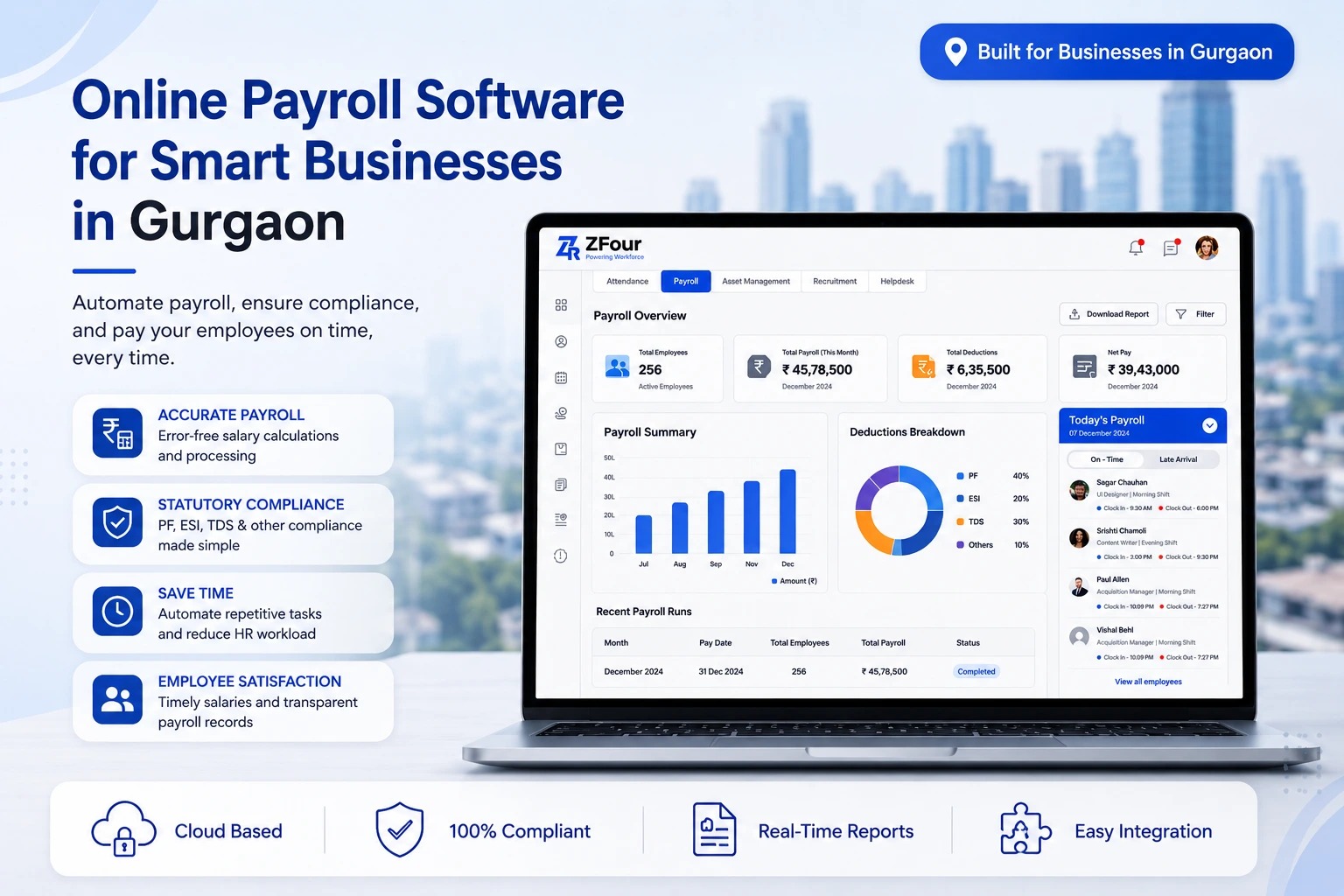
Payroll processing
PF, ESI, and TDS-related payroll workflows
Attendance tracking
Biometric attendance
GPS-based attendance
Leave management
Employee management
Recruitment and onboarding
Employee self-service
Payroll reports
HR analytics
Approval workflows
Payroll and attendance
For businesses where attendance information contributes to payroll inputs, connecting these workflows can reduce the need for repetitive data transfers.
A typical workflow can be:
Attendance → Leave → Payroll Inputs → Payroll Processing → Payslip
Best suited for
ZFour HRMS can be considered by:
Startups
SMEs
Growing Indian businesses
Multi-location organizations
Businesses requiring payroll and attendance in one HR environment
What to evaluate
Before choosing ZFour HRMS, businesses should evaluate:
Payroll requirements
Attendance methods
Employee count
Locations
Integrations
Reporting requirements
Implementation support
Required modules
Businesses that want to understand how payroll processing works in an HRMS can explore this detailed guide.
2. Keka HR
Keka HR is positioned around HR management, payroll, attendance, employee experience, performance management, and employee self-service.
Its payroll workflow documentation shows that leave and attendance can be part of the payroll process, including payroll preparation and attendance-related inputs.
Key areas to evaluate
Payroll
Attendance
Leave
Performance management
Employee self-service
HR workflows
Reporting
Best suited for
Keka can be relevant for:
Growing companies
Mid-sized businesses
Organizations prioritizing employee experience
Businesses looking for payroll and performance workflows together
What to compare
Businesses should evaluate:
Payroll requirements
Attendance workflows
Performance requirements
Integrations
Pricing
Employee self-service
Implementation
3. greytHR
GreytHR is an HR and payroll platform with capabilities around payroll, attendance, employee management, leave, and related HR administration.
Its official resources document attendance-related payroll workflows, including working hours, overtime, clock-in/clock-out information, and attendance finalization.
Key areas to evaluate
Payroll
Attendance
Leave management
Employee self-service
HR administration
Payroll reports
Statutory workflows
Best suited for
GreytHR may be relevant for:
Small businesses
Mid-sized organizations
Payroll-focused HR teams
Businesses looking for established HR administration workflows
What to compare
Before selecting the platform, review:
Payroll complexity
Attendance requirements
Integrations
Reporting
Employee self-service
Support
Pricing
4. Zoho People
Zoho People provides HR management capabilities including employee records, attendance, leave, employee self-service, workflows, and integrations.
For payroll, Zoho offers integration between Zoho People and Zoho Payroll, including employee-data synchronization and loss-of-pay information transfer.
Its attendance platform also supports web and mobile attendance, biometric integrations, IP restrictions, geo-fencing, overtime, and attendance regularization.
Key areas to evaluate
Employee management
Attendance
Leave
HR workflows
Employee self-service
Payroll integration
Reporting
Zoho ecosystem integrations
Best suited for
Zoho People may be particularly relevant for businesses already using other Zoho applications and looking for connected HR workflows.
What to compare
Consider:
Existing Zoho applications
Payroll requirements
Attendance requirements
Integrations
Employee count
Pricing and plan limitations
5. Darwinbox
Darwinbox is positioned as an enterprise HR technology platform covering areas such as core HR, payroll, talent management, performance, analytics, and employee workflows.
Key areas to evaluate
Core HR
Payroll
Attendance
Recruitment
Performance
Talent management
Analytics
Workflow automation
Best suited for
Darwinbox may be more relevant for:
Large organizations
Enterprises
Complex workforce structures
Organizations requiring broader HR transformation
What to compare
Businesses should evaluate:
Implementation requirements
Enterprise integrations
Workforce complexity
Required modules
Total cost
Support requirements
HRMS Comparison by Business Requirement
Different businesses may prioritize different capabilities.
Requirement | Platform to evaluate |
|---|---|
Payroll + attendance for Indian businesses | ZFour HRMS |
Payroll + employee experience | Keka HR |
Payroll + HR administration | greytHR |
HR + Zoho ecosystem | Zoho People |
Enterprise HR transformation | Darwinbox |
This is not an absolute ranking. A platform that fits one business may not fit another.
Key Features to Look for in HRMS Software
1. Payroll Management
Check whether the HRMS supports:
Salary structures
Earnings and deductions
Payroll calculations
Payslips
Payroll reports
Payroll approvals
Applicable statutory workflows
2. Attendance Management
Evaluate whether the platform supports the attendance methods your workforce actually needs.
These may include:
Biometric attendance
Mobile attendance
GPS attendance
IP restrictions
Shift management
Overtime
Attendance regularization
3. Leave Management
Look for:
Leave policies
Leave balances
Applications
Approvals
Holiday calendars
Payroll connectivity
4. Employee Self-Service
Employees may need access to:
Payslips
Attendance
Leave
HR documents
Personal information
HR requests
Approval status
5. Recruitment and Onboarding
If recruitment is part of the requirement, evaluate:
Candidate management
Interview workflows
Offer management
Digital onboarding
Employee profile creation
6. Performance Management
Growing organizations may require:
Goals
Performance reviews
Appraisals
Feedback
Performance reports
7. Reporting and Analytics
Check whether HR, payroll, finance, and management can access the reports they actually need.
8. Integrations
Consider integrations with:
Attendance devices
Accounting software
Payroll systems
Banking workflows
Existing HR tools
Business applications
9. Security and Access Controls
Payroll and employee data are sensitive.
Review:
Role-based access
Authentication
Permissions
Audit logs
Data handling
Backup and recovery
10. Scalability
Consider whether the HRMS can support:
More employees
Multiple locations
Additional departments
Different shifts
More complex approval workflows
The Comparison Questions That Actually Separate These 5 Platforms
Rather than a generic step-by-step evaluation process, here's what actually differentiates ZFour, Keka, greytHR, Zoho People, and Darwinbox in practice — the questions worth asking directly, in the order they typically matter:
Question | Why it separates these 5 specifically |
|---|---|
Do you need payroll and attendance genuinely connected, or are they acceptable as separate tools? | ZFour and greytHR are built payroll-first; Zoho People's payroll runs through a separate integration, which matters if tight coupling is the actual requirement |
Is your team already using other Zoho products? | This single factor makes Zoho People meaningfully cheaper and easier to adopt than it would be for a business starting from zero — for everyone else, it's a neutral factor |
Is your organization under 200 employees or genuinely enterprise-scale? | Darwinbox's strength (enterprise workflow complexity) is often unused overhead for a smaller business, while ZFour, Keka, and greytHR are built closer to that mid-market range |
Does performance management need to be tightly integrated with payroll, or can it stay separate? | Keka is specifically positioned around combining employee experience and performance with payroll — if that combination isn't a priority, it's not a deciding factor |
What does actual implementation and data migration look like, not just the demo? | This is where feature-list comparisons mislead most — ask each vendor to walk through migrating your actual current data, not a clean sample dataset |
What's the realistic total cost including setup, training, and support — not just the per-employee subscription number? | Subscription price differences between these 5 are often smaller than the implementation and support cost differences |
The pattern across all six questions: the meaningful differences between these platforms are rarely in the feature list — they're in fit (Zoho ecosystem, company size, payroll-attendance coupling) and in implementation reality, neither of which shows up in a side-by-side feature comparison.
HRMS Software by Business Size
Startups
Startups may prioritize:
Payroll
Attendance
Employee records
Leave
Easy implementation
Employee self-service
Cost
Small Businesses
Small businesses may need:
Payroll
Attendance
Leave
Payroll compliance workflows
Basic reporting
Growing SMEs
Growing businesses may require:
Payroll
Recruitment
Performance
Multi-location support
Integrations
Advanced reporting
Enterprises
Large organizations may require:
Complex workforce management
Enterprise integrations
Advanced analytics
Talent management
Multiple business units
Configurable workflows
Governance and access controls
HRMS Software vs Manual HR Management
Area | Manual / Spreadsheet-Based | HRMS |
|---|---|---|
Employee records | Multiple files | Centralized system |
Payroll | Manual calculations or spreadsheets | Configured digital workflows |
Attendance | Manual or separate tools | Can be integrated |
Leave | Email/spreadsheets | Digital workflows |
Recruitment | Manual coordination | Recruitment workflows |
Employee access | HR-dependent | Self-service where supported |
Reporting | Manual preparation | System-generated reports |
Approvals | Email/manual | Workflow-based where supported |
Scalability | Becomes harder as the workforce grows | Structured digital workflows |
Common Mistakes When Choosing HRMS Software

Choosing Only by Price
A lower subscription price does not necessarily mean a lower total cost.
Choosing Only by Feature Count
More features do not automatically mean a better fit.
Ignoring Implementation
A good platform can still create problems if employee data migration, training, and adoption are poorly managed.
Not Checking Integrations
If attendance and payroll remain disconnected, manual work may continue.
Ignoring Security
Employee and payroll data should be protected with appropriate access controls.
Not Testing Real Workflows
Always test the actual HR processes your team will use.
Assuming Software Guarantees Compliance
HRMS software can support payroll and statutory workflows, but businesses should verify applicable requirements and system configuration.
For example, EPFO provides employers with online facilities for registration, monthly returns, payments, and related compliance processes.
Which HRMS Should You Choose?
The answer depends on your priorities.
Consider ZFour HRMS if you prioritize:
Indian payroll workflows
Payroll and attendance in one platform
Biometric attendance
GPS-based attendance
Employee management
Leave management
Recruitment and onboarding
Employee self-service
HR reporting
Consider Keka HR if you prioritize:
Employee experience
Payroll
Performance management
HR workflows
Consider greytHR if you prioritize:
Payroll
Attendance
HR administration
Payroll-related workflows
Consider Zoho People if you prioritize:
Zoho ecosystem integration
HR workflows
Attendance
Employee management
Integration with Zoho Payroll
Consider Darwinbox if you prioritize:
Enterprise HR
Talent management
Analytics
Complex workforce requirements
The final decision should be based on your organization's requirements rather than a generic ranking.
Future of HRMS Software in India
HRMS technology is evolving toward more connected HR workflows.
Important areas to watch include:
AI-assisted HR analytics
Payroll automation
Employee self-service
Mobile HR applications
HR and accounting integrations
Workforce analytics
Digital onboarding
Automated approval workflows
The future of HR technology is likely to involve more connected systems rather than isolated HR tools.
Businesses should adopt new technology based on actual operational requirements rather than adding features simply because they are available.
Conclusion
Choosing the top HRMS software in India is ultimately about business fit.
ZFour HRMS, Keka HR, greytHR, Zoho People, and Darwinbox each have different strengths and may be suitable for different organizations.
For businesses comparing HRMS platforms specifically for payroll and attendance, focus on:
Payroll capabilities
Attendance methods
Leave integration
Employee self-service
Reporting
Integrations
Security
Scalability
Implementation
Total cost
Rather than selecting software based only on a ranking, test how each platform handles your actual HR workflows.
Looking for an HRMS for payroll and attendance? Explore ZFour HRMS and evaluate the platform against your business requirements.

Farheen Ahmed
HR Tech Content Strategist at ZFour Technology Private Limited
Research-driven content on HRMS, payroll, attendance management, employee management, and modern HR technology for Indian businesses.